
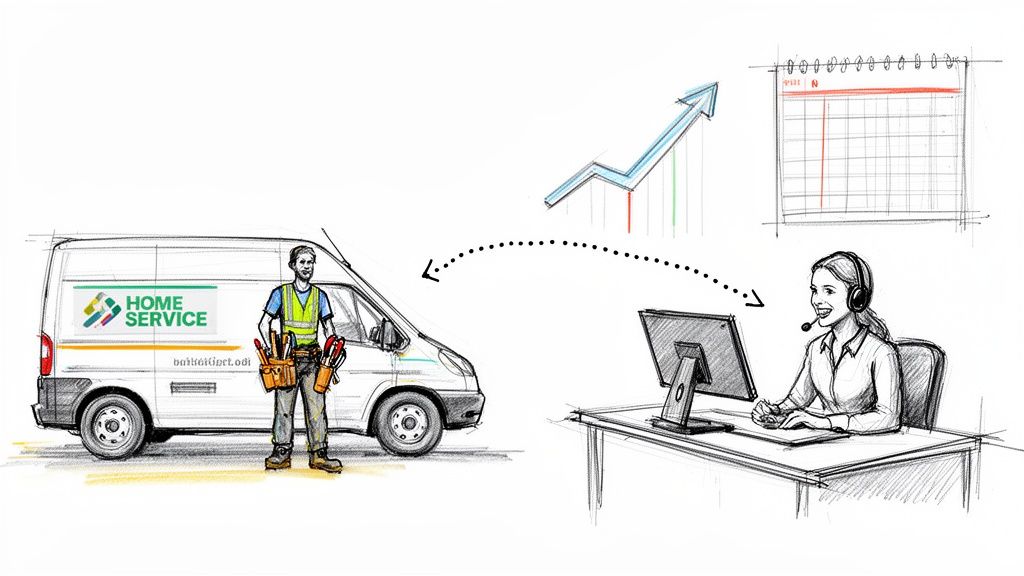
Before you can boost your sales productivity, you have to plug the leaks in your current process. For most home service businesses I’ve worked with, this comes down to three things: answering every single inbound call, following up on web leads instantly, and getting skilled technicians out of the administrative weeds.
If you can nail these fundamentals, you’ll capture and convert way more of the high-value opportunities you’re already getting.
Pinpointing the Real Bottlenecks in Your Sales Process
If you're running a home service business, I can almost guarantee you're leaving money on the table every single day. The problem isn't a lack of demand—the market is on fire. The real issue is the small, often invisible cracks in your process that quietly drain your sales momentum and send eager customers right to your competition.
Sound familiar? For so many owners, the day is a mad dash. You’re bouncing between giving estimates, managing crews, and trying to return a stack of voicemails from the truck. This chaos is exactly where revenue disappears.
Think about it: a potential customer calls with an urgent plumbing issue during your morning rush, but everyone's already out on a job. The call rolls to voicemail. What happens next? That customer immediately dials the next company on their Google search.
Let's be honest, in the home service game, speed is everything. A homeowner with a burst pipe or a dead AC unit in July isn't going to sit around waiting for a callback. The first person who answers the phone and offers a real solution almost always wins the job.
Common Productivity Killers in Home Services
These bottlenecks aren't just minor headaches; they represent serious lost income and are the very things holding your business back from real growth. Simply seeing them for what they are is the first step toward building a sales engine that actually works.
Here are the usual suspects I see time and time again:
- Missed Calls During Peak Hours: It's a simple fact: when your phone isn't answered live, your win rate for that lead is zero. Most urgent service requests flood in during business hours—the exact time you and your team are busiest in the field. Some studies show that sales teams using the right tools can achieve a 49% higher win rate, but that's impossible if you don't even get a chance to talk to the lead.
- Delayed Lead Follow-Up: A lead that comes in from your website form or a third-party service like Angi or Thumbtack has a shelf life measured in minutes, not hours. If you wait even an hour to get back to them, your odds of booking that appointment plummet.
- Technician Administrative Overload: Your best technicians are often your best salespeople. When they’re stuck scheduling their own follow-ups, filling out paperwork, or making confirmation calls, they aren't out in the field closing deals or generating revenue. Every minute they spend on admin tasks is a direct hit to your bottom line.
Tackling these issues is non-negotiable, especially with the skilled labor shortage we're all facing. When good help is hard to find, you have to make every lead and every technician's hour count for something. This guide will walk you through practical, actionable ways to stop these leaks and turn more of your calls into profitable, booked jobs.
Find Out Where Your Sales Process is Leaking Money
Gut feelings don't book jobs. Data does. Before you can seriously boost your sales, you have to stop guessing and start measuring. A clear, data-backed picture is the only way to know for sure where your process is breaking down and—more importantly—where your biggest opportunities are hiding.
I've talked to countless home service owners who feel like they have a decent handle on their business. But when they see the hard numbers, they're often floored. They think the phone is ringing off the hook, but the data might reveal that 30% of calls go to voicemail between 8 AM and 10 AM—prime time for those high-value emergency jobs.
This is where a simple, honest audit comes in. It’s not about getting lost in complex spreadsheets or buying expensive software. It's about consistently tracking a handful of key performance indicators (KPIs) that tell the real story of your sales health.
The Metrics That Actually Matter
First things first, let's focus on the numbers that directly impact a home service business. Forget the generic corporate metrics. We care about the specific actions that turn a potential customer into a paying one.
These are the non-negotiable KPIs every plumber, electrician, and HVAC pro should have on their dashboard:
- Call Answer Rate: What percentage of calls are actually answered live by a person? This is your front door. If this number is low, nothing else matters because you’re not even getting a chance to talk to potential customers.
- Lead Response Time: When a lead comes in from your website, Yelp, or another online source, how many minutes does it take your team to follow up? Speed is everything here. A five-minute response time blows a one-hour response out of the water.
- Booking Conversion Percentage: Of the qualified leads you do speak with, how many actually book an appointment? This number tells you how effective your team is on the phone. It's a direct reflection of their communication and your sales script.
- Average Job Value: What’s the average revenue you make from each job you book? Tracking this helps you see which lead sources or services are most profitable, so you can double down on what works.
Tracking these numbers is the difference between reacting to problems and getting ahead of them. It gives you the clarity to make smart decisions that directly impact your bottom line.
Key Sales Productivity KPIs for Home Service Businesses
To give you a clearer picture, here’s a breakdown of those essential metrics, what they tell you, and what the top-performing teams are hitting.
| KPI (Key Performance Indicator) | What It Measures | Industry Benchmark (Goal) |
|---|---|---|
| Call Answer Rate | The percentage of inbound calls answered live. | 95% or higher |
| Lead Response Time | The average time to first contact a web lead. | Under 5 minutes |
| Booking Conversion Rate | The percentage of qualified leads that book a job. | 70% or higher |
| Average Job Value | The average revenue per completed service call. | Varies by trade; track for growth. |
Getting a handle on these numbers gives you a real, tangible starting point. You can't fix what you can't see.
The goal of an audit isn't to find blame; it's to find opportunities. When you see a low call answer rate, you haven't failed—you've just discovered the fastest way to increase your revenue.
The chart below shows the most common bottlenecks a quick data audit will almost always uncover. These aren't minor hiccups; they are significant profit leaks.
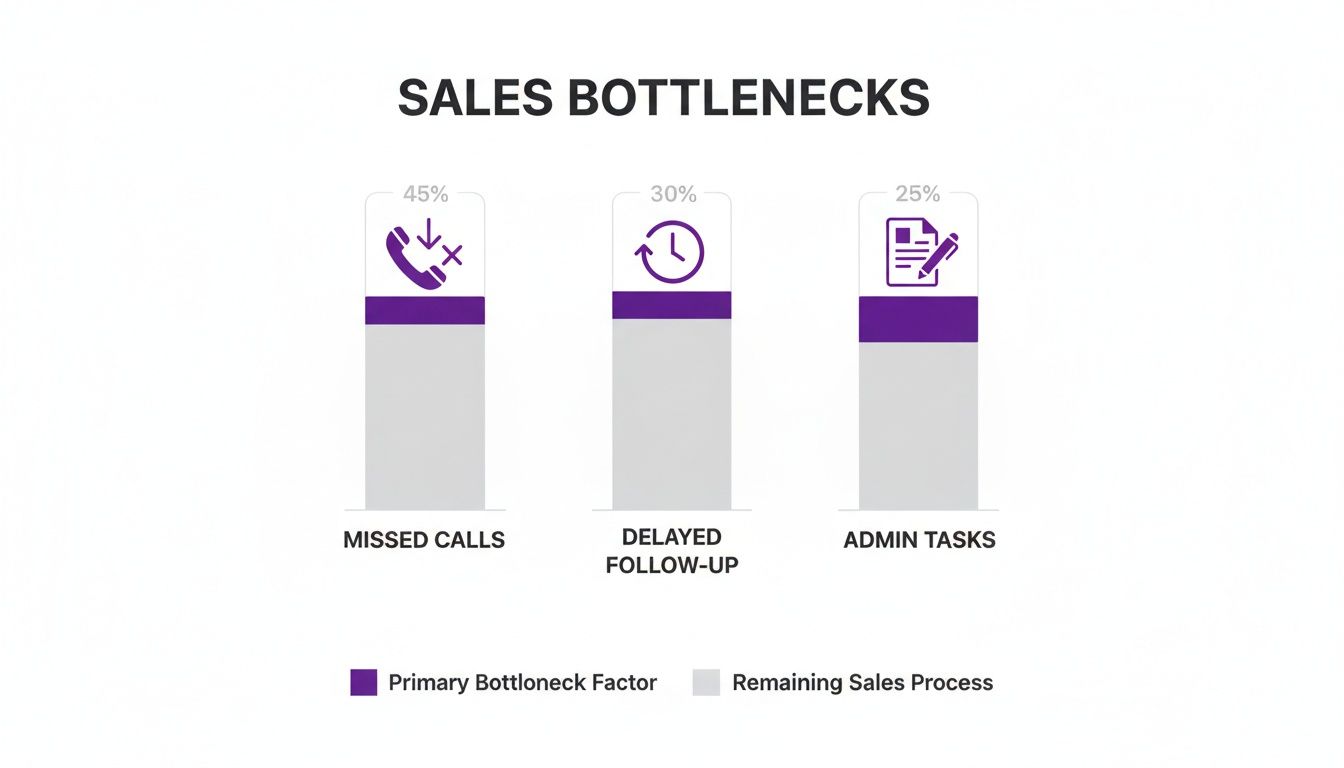
As you can see, things like missed calls and slow follow-up aren't just frustrating—they're costing you serious money. Once you have this baseline data, you have a clear roadmap for what to fix first. This is the foundation for all the other strategies we're about to cover.
Mastering Instant Lead Response and Follow-Up
In the home service business, speed isn't just a nice-to-have; it's the entire game. Think about it: a homeowner with a busted AC unit on a 95-degree day isn't casually shopping around and waiting for callbacks. They're calling the first company that answers the phone and can solve their problem right now.
This sense of urgency is the single biggest factor in turning a new lead into a booked job.
Every minute you let a lead sit, one of your competitors is getting closer to swooping in and taking that customer. We've all been there—trying to return calls from the truck in between jobs, often hours after the homeowner first reached out. Frankly, that approach is a surefire way to lose money.
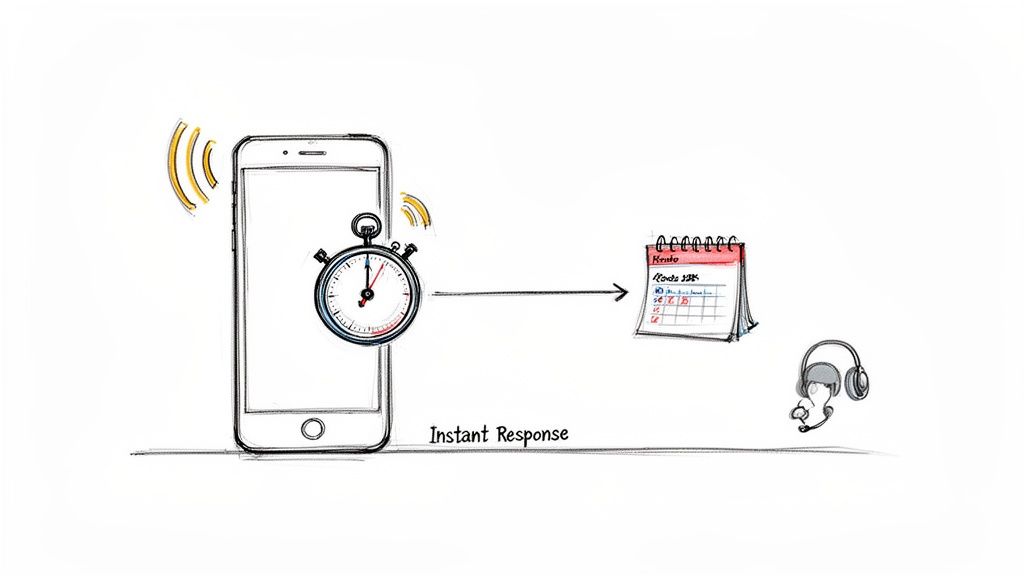
To really boost your sales productivity, you have to ditch the reactive, "I'll call them back later" mindset. It needs to be replaced with a proactive system built for immediate engagement. This is where having someone dedicated to this role—whether they're in-house, remote, or from a service—becomes an absolute game-changer.
The Five-Minute Rule
If there's one golden rule in lead follow-up, it's this: make contact within five minutes. When an online lead comes in, connecting with them in under five minutes dramatically increases your odds of qualifying them and booking the job. Wait any longer, and your chances of even having a conversation drop off a cliff.
Put yourself in the customer's shoes. They fill out your website form for a quote. In their mind, the clock starts ticking immediately. If they don't hear from you almost instantly, they'll assume you're disorganized or too busy and just click on the next company in their Google search.
Today's customers expect this level of service. In fact, a staggering 71% of consumers now expect personalized engagement. With the home remodeling market projected to hit $526 billion by early 2026, the stakes have never been higher. You have to be fast and professional, especially when 78% of mobile searches lead to a sale within 24 hours—if the business responds quickly.
From Chaos to Control: A Real-World Scenario
Let's paint a picture of how this plays out for an HVAC company on a scorching summer morning.
-
Scenario A (The Old Way): Mike, the owner, is in the middle of a tricky repair job. A web lead for a full system replacement—a potential $10,000 ticket—lands in his inbox. It sits there for two hours until he finally breaks for lunch. By the time he calls, the homeowner has already talked to two other contractors and booked an estimate for that same afternoon. Ouch.
-
Scenario B (The Productive Way): The same web lead comes in. This time, a trained, remote Customer Service Representative (CSR) gets an instant notification. Within 90 seconds, the CSR is on the phone with the homeowner, running through a script to answer their basic questions and booking an estimate directly into the company's calendar.
The difference couldn't be clearer. The second approach doesn't just capture a high-value lead; it provides a polished, seamless experience that builds trust from the very first interaction. This is how top-performing companies consistently win in their local markets.
A missed call is not just a missed call; it's a direct transfer of revenue to your closest competitor. Your response system is either your greatest asset or your biggest liability.
Building a System for Instant Response
Putting a system in place for immediate follow-up is one of the most powerful moves you can make to increase sales. It's your insurance policy against leads going cold, whether they come from a phone call or a web form.
Here’s what that system needs:
- Dedicated Phone Coverage: Someone has to be available to answer every single call during business hours. No exceptions. A missed call is a 100% loss. You can learn more about the best way to always answer the phones in our detailed guide.
- Instant Web Lead Alerts: Your process must immediately notify the person responsible for follow-up the second a web form is submitted.
- A Solid Script: Your team needs a consistent, effective script to qualify leads, handle common questions, and confidently schedule appointments.
This structure doesn't require a massive upfront investment. You can find services that provide remote CSRs or handle outbound calling for you. They can manage this entire workflow, ensuring every inquiry is handled professionally and turned into a booked job before a competitor even knows the lead exists.
Building a Remote Team to Overcome the Labor Shortage
Let's be honest: finding skilled, reliable local staff often feels like an impossible task. It’s one of the biggest roadblocks I see holding home service companies back from real, scalable growth. But what if you could sidestep the local hiring headaches altogether? The smartest business owners I know are doing just that by strategically building remote teams.
This isn't about replacing your expert technicians on the ground. It's about building a bulletproof support system around them so they can focus on what they do best—high-value, revenue-generating work. When you bring on remote Customer Service Representatives (CSRs) or Virtual Assistants (VAs), you solve several critical problems all at once.
Suddenly, your phones are always answered by a trained professional. You're freed from the constant weight of administrative overload. And most importantly, your technicians can stay in the field where they actually make you money. It's a fundamental shift in how you operate, moving from a reactive, chaotic model to a proactive one built for efficiency.
The Power of Specialized Remote Support
Not all remote help is created equal, and this is where a lot of people go wrong. The key is to find individuals or services that live and breathe the home service industry. A generic virtual assistant from a massive marketplace platform won't understand the critical difference between a routine maintenance call and a homeowner with a burst pipe.
A specialized remote CSR, however, hits the ground running. They come pre-trained to understand the urgency in a customer's voice, they know the right questions to ask to qualify a lead, and they can speak the language of your trade. This expertise is what turns a simple phone-answering service into a powerful sales and productivity engine.
They become a seamless extension of your local team, providing a polished and professional first impression that builds trust and helps you close more jobs from the very first call.
A Real-World Scenario: HVAC Expansion
Picture a growing HVAC company that’s consistently booked solid in their home city. They see a massive opportunity to expand into the neighboring county but are completely held back by logistics. The thought of opening a new physical office and hiring local admin staff is a huge upfront cost and a management nightmare.
Instead, they hire two remote VAs who specialize in home services.
- VA #1's Role: Manages all inbound calls, qualifies leads based on service type and location, and handles the initial scheduling for the new territory.
- VA #2's Role: Focuses on dispatching, coordinating technician schedules across both territories, managing follow-up confirmations, and handling customer invoicing.
Within three months, the company has successfully launched in the new market. Their technicians are fully booked, and they did it all without the crushing overhead of a second office lease or the months-long process of hiring and training local administrative staff. This is a perfect example of how to increase sales productivity by focusing your resources where they truly matter.
By delegating the administrative and scheduling tasks to a capable remote team, the owner was free to focus on marketing, technician management, and overall growth strategy. The VAs didn't just fill a gap; they created the capacity for expansion.
This approach is especially powerful right now. The home services industry is booming, with growth projected at a robust 9.18% from 2024 to 2028, but it's happening alongside an acute skilled labor shortage. ManpowerGroup reports that a staggering 75% of US employers are struggling to fill service provider positions, with a 70% labor shortage in 2024. By having expert remote callers book appointments directly on your calendar, you bypass these hiring headaches and capitalize on the 150% surge in home service bookings we've seen since the pandemic. You can find more insights about the home services industry boom at FieldServiceLy.com.
Finding and Integrating Your Remote Team
Getting started with a remote team is more straightforward than you might think. The goal isn't just to find a person; it's to find a partner who can handle the heavy lifting of recruiting, vetting, and training. That way, you get a qualified professional who is ready to contribute from day one.
First, get clear on the specific tasks you need to offload. Are you drowning in phone calls and missed leads? A remote CSR is your answer. Bogged down by scheduling, dispatch, and paperwork? A VA is a perfect fit. Once you've identified your biggest pain points, you can begin the integration process. If you want a deeper dive, check out our guide on how to hire a virtual assistant for your business.
Success really hinges on clear communication and solid systems.
- Develop Clear Scripts: Don't leave them guessing. Provide scripts for common inbound calls, lead qualification questions, and appointment setting.
- Grant Calendar Access: Give your remote team direct but controlled access to your scheduling software so they can book jobs in real-time. No more back-and-forth.
- Establish Communication Channels: Use simple tools like Slack or a dedicated phone line to stay connected and answer questions quickly.
By investing a little time upfront to set up these systems, you create a self-sufficient remote team that not only boosts your current productivity but also lays the groundwork for your future growth.
Let Technology Supercharge Your Sales Workflow
Technology should be your biggest ally in boosting sales productivity, not just another complex system to manage. The best tools are the ones that work in the background, automating the grunt work and giving your team the data and speed it needs to really shine. This isn't about replacing people; it's about making your team faster, smarter, and more effective at every single step.
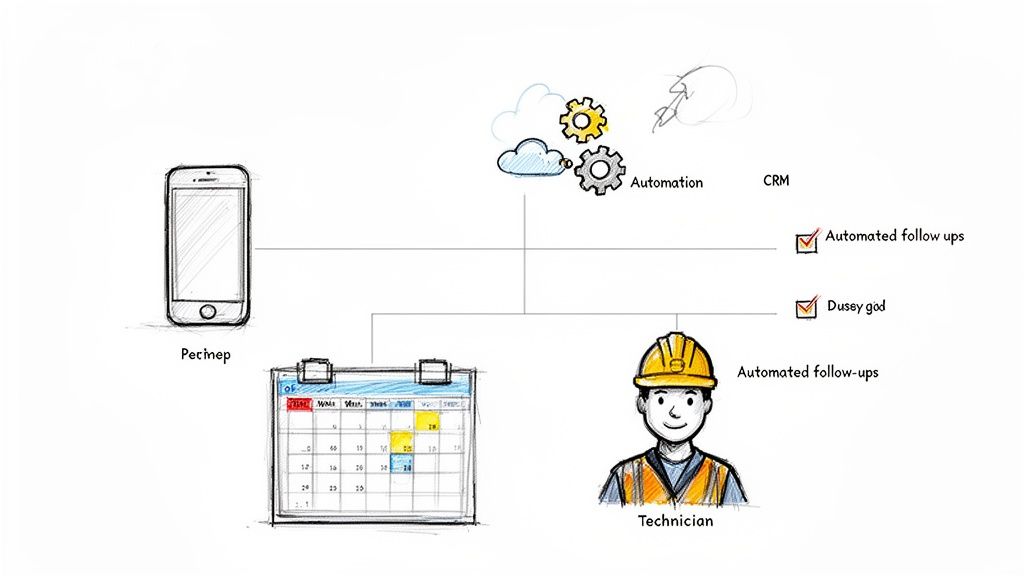
Just imagine a setup where every customer touchpoint is automatically logged, follow-up reminders go out without you lifting a finger, and you have clear insights into your busiest booking times. This isn't some far-off dream—it's what modern tools are making possible for home service businesses right now.
Building Your Core Tech Stack
You don’t need a dozen different apps to see a real difference. In fact, consolidating your tools into a few powerful platforms that work well together is usually far more productive.
Focus on these core pieces:
- A Modern CRM (Customer Relationship Management): This is your command center. A good CRM built for home services keeps track of every lead, customer chat, and job history all in one spot. It’s the safety net that stops leads from falling through the cracks and gives your team the full picture before they even pick up the phone.
- Automated Scheduling Software: Stop the endless phone tag. Tools like Calendly or schedulers built into your CRM let customers—or a remote CSR—see your real-time availability and book a slot instantly. This one tool alone can slash your administrative time.
- A Central Communication Hub: Something like Slack or Microsoft Teams keeps everyone connected, from your techs in the field to your office staff and remote CSRs. It's the perfect way to handle quick updates, dispatch changes, and share job details without getting lost in a messy chain of text messages.
The real magic happens when these pieces work together. It’s how you can seamlessly connect a remote team member to your on-the-ground operations, creating a top-notch customer experience that locks in more sales. For more on how a remote team fits in, check out our guide on the benefits of a virtual receptionist.
Putting It All Together: A Real-World Example
Let's walk through how this actually works for a plumbing company.
A homeowner calls in a panic about a leak. The call is routed to a remote CSR.
Using the CRM, the CSR immediately pulls up the customer’s file and sees they’re a returning client. She then checks the integrated scheduling software and spots that a technician just finished a job nearby and has an opening in 45 minutes.
She books the high-priority job on the spot. The system automatically fires off a confirmation text to the homeowner and an alert with all the job details to the technician through the company’s communication hub.
The whole thing takes less than three minutes. The customer is blown away by the speed, and a high-value emergency job is secured instantly. That's how you boost sales productivity with technology.
The goal of technology is not to replace your people but to amplify their effectiveness. A well-integrated system empowers a single CSR to manage the logistics of an entire field team, turning every inbound call into a perfectly executed service appointment.
The Rise of AI in Home Services
We're starting to see AI-driven tools become a major factor in sales success, and it's not about robots answering your phones. It’s about using smart automation to give your human team superpowers. For home service companies, this is changing the game in lead management and job scheduling.
Recent stats show that 42% of professionals have already used AI in the last year to get more efficient and grow revenue.
When you pair that with the fact that 78% of local mobile searches convert to purchases within 24 hours, you see just how much a missed call can cost you. This is where AI-powered scheduling and remote CSRs become an unstoppable combo, making sure you never waste another opportunity. You can find out more about the growth outlook for home services at HVAC Insider.
Building a System for Continuous Sales Improvement
Boosting your sales productivity isn't about a single magic bullet. It's a commitment to getting a little bit better, every single week. The home service businesses that truly crush it don't just put out fires—they build systems for continuous improvement that turn their sales process into a fine-tuned engine.
This means getting out of the "I think this works" mindset and creating a regular rhythm of reviewing what's happening, coaching your team, and refining your approach. It’s a simple, repeatable loop that ensures you’re always finding and acting on small opportunities for growth.
Review, Coach, and Refine Your Process
One of the most powerful habits you can build is digging into real-world customer interactions. If you have a remote CSR or VA handling your calls, you're sitting on a goldmine of training material.
Set aside time each week to listen to a few call recordings. This isn't about finding fault; it's about spotting coaching moments.
- Listen for clarity: Did your CSR explain your services and value in a way that was easy to understand?
- Find the friction: Where did customers seem to get confused, hesitate, or push back?
- Highlight the wins: What specific phrases or questions did a great job of securing a booking?
Doing this turns training from a stuffy, theoretical exercise into a practical, targeted coaching session. It shows your team exactly what a great call sounds like and gives them the tools to make it happen again and again.
A/B testing isn't just for digital marketers. It's an incredibly powerful tool for any home service owner trying to dial in their sales process. By testing just one thing at a time, you get clean, undeniable data on what actually moves the needle.
Test Everything to Get Better Results
You can't improve what you don't measure, and this is especially true when it comes to your sales scripts and booking process. A great place to start is running simple A/B tests to see what language actually converts better.
For example, for one week, have your CSR end their calls with Script A: "Would you like to book for Thursday or Friday?"
The following week, have them switch to Script B: "I have an opening tomorrow at 10 AM, does that work for you?"
Track the booking rate for each script. You might be shocked at how small changes in wording can have a huge impact on your results. This is how you build a powerful sales program. Research shows that sales teams with mature processes see 15% higher productivity per person. You get there by methodically finding these small wins and building a data-driven process that's proven to work.
Got Questions? We've Got Answers
If you're thinking about bringing on a remote CSR to boost your sales, you probably have a few practical questions. Let's tackle some of the most common ones I hear from home service owners just like you.
"How Fast Will I Actually See Results?"
Honestly, the impact can be immediate. Many businesses see their call answer rate jump and more appointments get on the books within the very first week. Think about it: a professional service can get a trained CSR handling your phones almost overnight, so you start catching all those leads that used to slip through the cracks.
But the real game-changer is the momentum you build over the first few months. As your calendar stays consistently full, your techs can focus on what they do best—revenue-generating work. That’s when you’ll see a serious, lasting improvement to your bottom line.
"Can My Small Business Really Afford to Outsource Sales Tasks?"
Absolutely. In fact, it's often more cost-effective than hiring in-house. Just think about the value of a single missed emergency call—that panicked homeowner with a busted furnace or a major leak. That one job alone could easily cover the cost of a remote CSR service for an entire week.
When you run the numbers, outsourcing almost always comes out on top. Compare it to the true cost of an in-house employee (salary, benefits, training, overhead), and the return on investment is significantly higher. You get a pro converting your leads without all the fixed costs. It's just a smarter financial move.
"Will a Remote CSR Even Understand My Trade?"
This is a great question, and it all comes down to choosing the right partner. The best services specialize in the trades—they live and breathe HVAC, plumbing, and electrical.
Their CSRs are trained on the specific terminology, the most common customer questions, and exactly how to qualify leads for your business.
A quality provider will work with you to build scripts and ensure their team sounds like a seamless extension of your company. The goal is simple: create a professional, knowledgeable first impression that builds trust from the get-go. No, they won't be a master plumber, but they will be an expert at turning a phone call into a booked job.
Ready to stop missing calls and start booking more jobs? The team at Phone Staffer can place a trained, remote CSR into your business to handle your phones, qualify leads, and fill your calendar. Schedule a free consultation today to learn how we can help you grow.