
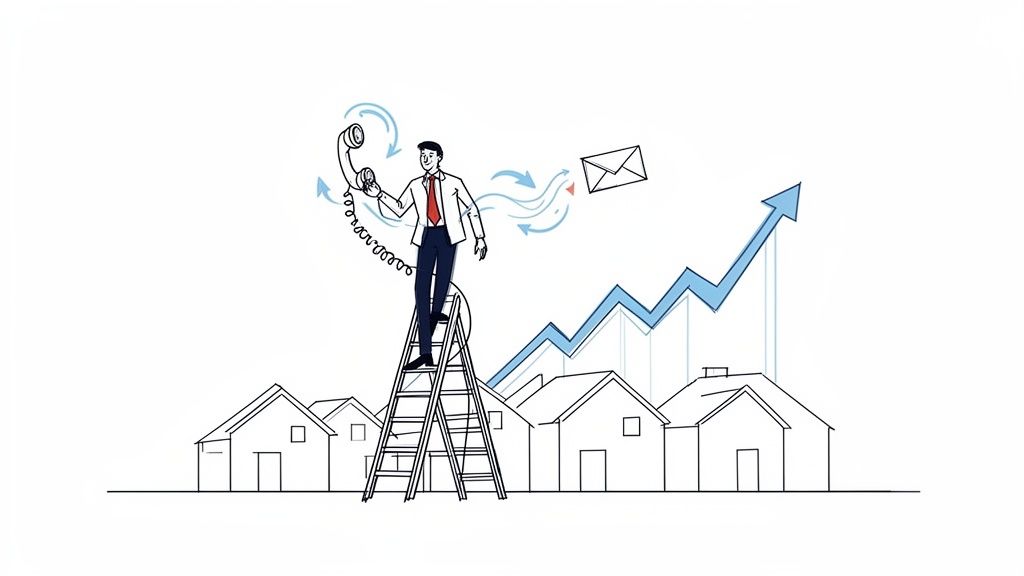
When we talk about outbound sales, we’re talking about taking the initiative. Instead of waiting for potential customers to find you, your team is actively reaching out to people who haven't necessarily shown any prior interest in your services. Think of it as going out and hunting for new business, not just waiting for it to walk through the door. This mindset shift—from reactive to proactive—is what outbound is all about.
What Outbound Sales Looks Like in the Real World
Let's make this concrete. Imagine you run a local roofing franchise and a nasty hailstorm just hammered a neighborhood a few towns over.
The inbound approach? You'd wait for your phone to ring. Homeowners might find you through a Google search or remember seeing one of your trucks around town. You're essentially passive, hoping they find you first.
Now, here’s the outbound play: The very next day, you send a team to that exact neighborhood. They go door-to-door offering free, no-obligation roof inspections to assess the hail damage. You've identified a real, immediate need and you're starting the conversation yourself. You aren't waiting for an opportunity—you're creating one on the spot. That, in a nutshell, is the heart of outbound sales.
The Hunter vs. The Farmer Analogy
One of the best ways to understand the difference is the classic "hunter versus farmer" analogy. It breaks down perfectly for home services.
- Outbound Sales is the Hunter: The hunter goes out into new territory, actively tracks down leads, and brings back business that wouldn't have just stumbled upon you. This is your team cold-calling a list of new homeowners or a remote CSR following up with businesses in a new commercial park.
- Inbound Sales is the Farmer: The farmer is all about cultivation. They plant seeds with things like blog posts, local SEO, and social media content. They nurture the interest that sprouts from their marketing efforts and wait for the harvest when a customer is finally ready to reach out.
For any home service business, whether it's plumbing, HVAC, or pest control, relying only on the farmer (inbound) can lead to some seriously unpredictable slow seasons. Having a hunter (outbound) on your team gives you direct control to fill those gaps in your schedule.
By actively going after new business, you take the wheel of your sales pipeline. Outbound sales lets you generate demand when you need it most, building a more predictable and scalable way to grow instead of just riding the waves of market demand.
This proactive strategy completely changes the game. It allows you to zero in on specific neighborhoods, target commercial properties, or focus on demographics that are a perfect match for your services. Instead of casting a wide net and hoping for the best, outbound is like fishing with a spear—it's direct, precise, and aimed right at your ideal customer. That distinction is the key to keeping your appointment book full, week in and week out.
To make it even clearer, let's break down the core differences side-by-side. While both approaches aim to win new customers, the way they get there couldn't be more different.
Outbound vs Inbound Sales At a Glance
| Attribute | Outbound Sales (Proactive) | Inbound Sales (Reactive) |
|---|---|---|
| Initiation | You contact the prospect first. | The prospect contacts you first. |
| Approach | "Hunting" for new business. | "Farming" by cultivating interest. |
| Targeting | Highly specific and targeted lists. | Broad audience attraction. |
| Control | High control over lead volume. | Less control; depends on market interest. |
| Timeline | Can generate immediate results. | Typically a longer-term strategy. |
| Common Tactics | Cold calling, email outreach, door-knocking. | SEO, content marketing, social media. |
| Cost | Can have higher upfront labor costs. | Often lower initial cost, but builds over time. |
Understanding this table helps you see how a blended strategy—combining the strengths of both the hunter and the farmer—can create a powerful, resilient growth engine for your home service franchise.
The Core Activities of an Outbound Sales Strategy
Knowing what outbound sales is and actually doing it are two different things. This is where the rubber meets the road. A great outbound strategy isn't just about making noise; it's a series of calculated, repeatable actions designed to connect with your ideal customers and turn cold prospects into booked jobs.
For a home service business, this means you stop waiting for the phone to ring and start making it ring yourself. You take control of your lead flow.
These are the core activities that will power your outbound engine.
Strategic Cold Calling
Cold calling is the classic outbound play, and for home service businesses, it’s still a powerhouse. Done right, a simple phone call can turn a name on a list into a booked appointment faster than almost any other method. In fact, a surprising 69% of buyers have accepted a cold call from a new provider in the last year, proving that a well-aimed phone call is far from dead.
But this isn't your grandfather's cold calling. We're not just dialing for dollars from a phone book. Today's approach is surgical.
- Hyper-Targeted Lists: You start with a quality list of people who likely need your services, like new homeowners in a specific subdivision or property managers of local commercial buildings.
- A Solid Script: You use a script that gets straight to the point, identifies a potential problem, and offers a clear, valuable solution—no fluff.
- One Clear Goal: Every call has one objective. Maybe it's booking a free HVAC inspection or scheduling a no-obligation quote for lawn care.
Imagine a remote CSR for a plumbing company calling new residents in the area. The offer? A complimentary plumbing system check-up. It's a low-risk way to get a technician in the door and start building a relationship, not make a hard sell on the first call.
Targeted Email Outreach Sequences
While a phone call is immediate, email gives you scale and persistence. A single email can get lost in a crowded inbox, but a well-designed outreach sequence—a series of pre-written emails sent over several days or weeks—is hard to ignore.
Think of an email sequence as your digital salesperson who never gets tired and never forgets to follow up. It systematically warms up a lead, educates them about your services, and keeps your brand top of mind until they're ready to talk.
This method is fantastic for targeting specific groups with custom messages. For example, an HVAC franchise could set up an automated email sequence for homeowners whose systems are over 10 years old, with each email highlighting the benefits of a modern, energy-efficient unit. You're providing value long before you ask for the appointment.
This flowchart shows the fundamental difference between the proactive outbound "megaphone" and the reactive inbound "magnet."
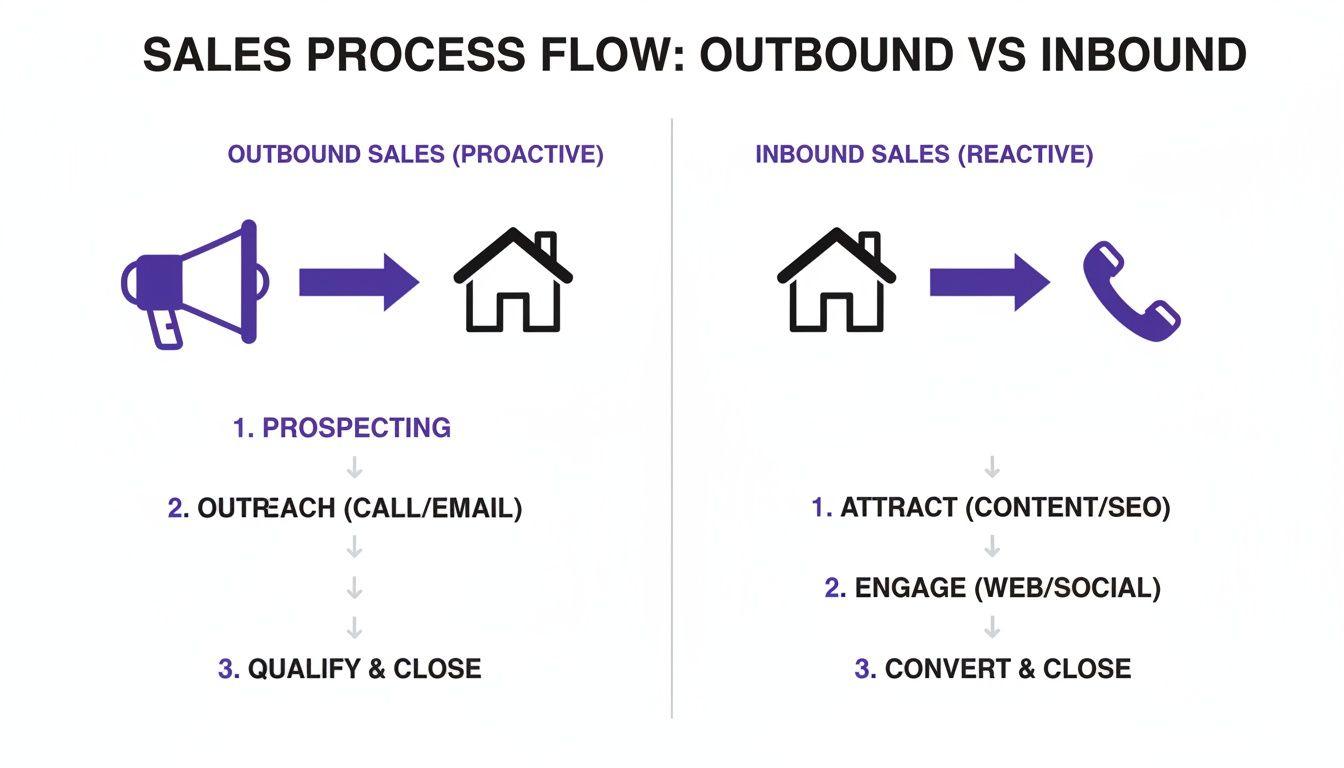
As you can see, outbound is all about initiating the conversation, while inbound waits for the customer to come to you.
Professional Social Media Engagement
Beyond calls and emails, platforms like LinkedIn are a goldmine for B2B outbound sales. If your home service franchise wants to land more commercial contracts—think cleaning services for office parks or landscaping for retail centers—then LinkedIn is non-negotiable.
This is more than just blindly sending connection requests. A smart social media strategy involves a few key steps:
- Find the Decision-Makers: First, you identify the exact people you need to talk to, like facilities managers, property owners, or office administrators at the companies you're targeting.
- Give Before You Ask: You establish yourself as an expert by sharing useful content, adding thoughtful comments to their posts, and becoming a familiar, trusted name.
- Reach Out Personally: When you do send that direct message, you make it personal. Reference a shared connection or a recent company update before you gently introduce what you can do for them.
Whether you have an in-house team or a skilled remote assistant handling these tasks, these activities are the bedrock of any solid outbound campaign. They take the abstract concept of outbound sales and turn it into a concrete set of actions that systematically fills your schedule. For franchise owners looking to grow, learning how to hire a virtual assistant for telemarketing can provide the focused expertise you need to get it done right.
How to Measure What Matters in Outbound Sales
Running an outbound sales campaign without tracking metrics is like flying a plane with no instruments. You’re moving, but you have no idea if you're gaining altitude, burning through fuel too fast, or heading in the wrong direction entirely. To know if your efforts are actually working, you need to watch your Key Performance Indicators (KPIs). Think of them as the vital signs for your entire outbound strategy.
Measuring these numbers isn't just for building fancy reports. It’s about getting real, actionable feedback. Is your connect rate abysmal? Maybe you’re calling at the wrong time of day or your contact list is stale. Are you having lots of conversations but setting zero appointments? That’s a giant red flag that your script isn't resonating. Each metric tells a story and points you toward a fix.
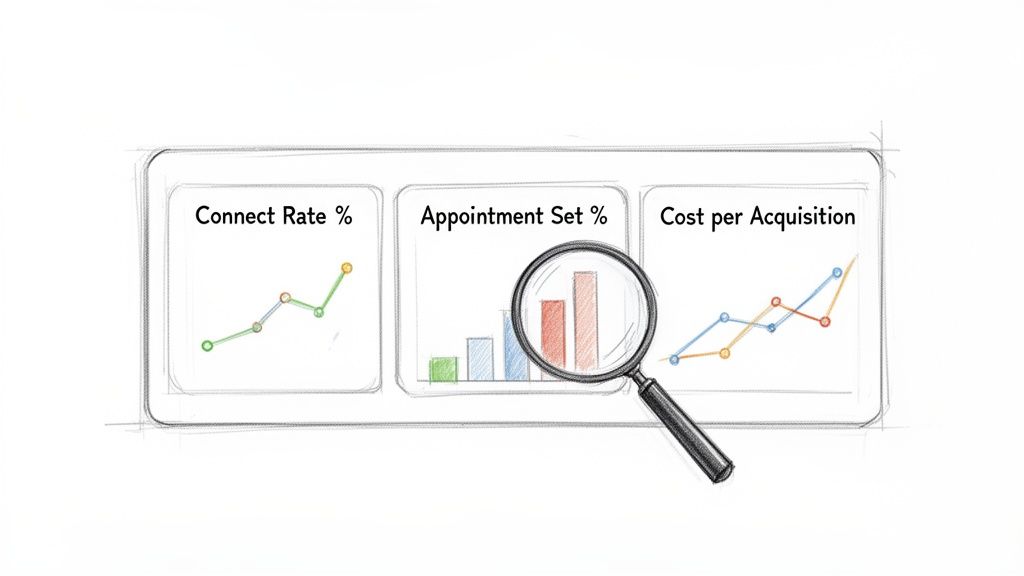
Core Metrics for Your Outbound Dashboard
Good news: you don't need to get lost in a sea of data. For a home service business, a handful of core metrics will give you a crystal-clear picture of what's happening and whether you're getting a solid return on your investment (ROI).
These are the absolute essentials every home service franchise owner should have on their dashboard:
Dials Per Day: This is a pure activity number. It simply tracks the raw outreach volume your team is putting in. While more dials don’t guarantee more sales, it’s the foundational effort that every other result is built upon. No dials, no anything.
Connect Rate: What percentage of those dials actually result in a conversation with a real person? A consistently low connect rate (think under 5-10%) often points to a poor-quality list, widespread call blocking from carriers, or simply calling when nobody is home.
Appointment Set Rate: This is where the rubber meets the road. Of the people you actually speak with, how many agree to book an estimate or service call? This KPI is a direct measure of how well your script, your offer, and your caller’s skills are working together.
Show-Up Rate (or Kept Appointment Rate): It’s one thing for a homeowner to say "yes" on the phone; it's another for them to actually be there when your truck pulls up. This metric tells you about the quality of the appointments being set and how effective your confirmation process is.
Tracking your Show-Up Rate is non-negotiable. A low number here will burn through fuel, waste your technicians' time, and completely torpedo the ROI of your outbound efforts. A simple text or email reminder sequence is often all it takes to fix this.
To make it even clearer, here are the most important KPIs to keep an eye on.
| Key Outbound Sales KPIs for Home Service Businesses |
|---|
| Track these essential metrics to measure the performance and ROI of your outbound sales campaigns. |
| KPI (Key Performance Indicator) |
| Connect Rate |
| Appointment Set Rate |
| Show-Up Rate |
| Cost Per Lead (CPL) |
| Cost Per Acquisition (CPA) |
| Close Rate |
By keeping a close watch on these numbers, you can spot problems before they sink your campaign.
The Financial Metrics That Truly Matter
Activity metrics are great for diagnosing issues, but at the end of the day, this is all about the bottom line. Financial KPIs are what translate all that dialing and talking into actual dollars and cents. These are the numbers that tell you if outbound is a profitable growth engine or just a money pit.
Here are the two most important financial yardsticks:
Cost Per Lead (CPL): This is your all-in cost for the outbound campaign (salaries, outsourced service fees, data lists, etc.) divided by the number of leads it produces. It gives you a clear price tag for every single appointment you generate.
Cost Per Acquisition (CPA): This one takes it a crucial step further. Your CPA is the total campaign cost divided by the number of new paying customers you actually win. This is the ultimate scorecard for your outbound efficiency—it’s the true cost to acquire a new job.
By consistently tracking both activity and financial KPIs, you can move from guessing to knowing. You’ll be able to spot weaknesses, double down on what’s working, and turn your outbound sales program into a predictable, profitable source of new business.
Implementing Outbound Sales in Your Business
Alright, so we've covered what outbound sales is and why it's so important. But theory is one thing—putting it into practice is another. How do you actually get an outbound sales machine running in your home service business without completely overwhelming your daily operations?
This is the point where a lot of owners get stuck. They picture a massive, expensive project that will take months to get off the ground.
Thankfully, it doesn't have to be that complicated. For a home service franchise, you really have two main paths to get started with outbound sales. One is the old-school way, and the other is a much faster, more efficient route to getting qualified appointments on your calendar.
The traditional option, of course, is building an in-house team. This means you're on the hook for everything: finding the right people, training them up, managing them, writing scripts, buying lead lists, and setting up all the tech. While you get total control, it's a huge drain on your time, money, and focus.
The Modern Alternative: Building Your Team Remotely
The second, and frankly smarter, path is to outsource to a specialized partner. This has become the go-to move for thousands of businesses, especially in the home services world. Instead of building the entire engine from scratch, you just plug into a system that's already built and proven to work for companies just like yours.
By outsourcing, you get instant access to a team of trained professionals, field-tested processes, and the right technology from day one. It's less like building a car and more like getting the keys to one that's already gassed up and ready to go.
This is where hiring remote CSRs or using a done-for-you cold calling service can be a total game-changer. It's a low-overhead, high-impact way to launch a powerful outbound program almost overnight.
Leveraging Outsourced Cold Calling and Remote CSRs
Let's get specific about how this actually works. When you partner with a service that gets the home services industry, you can roll out a powerful one-two punch to fill your pipeline and make sure no lead ever gets wasted.
Done-for-You Cold Calling: Think of this as your proactive growth engine. A dedicated team of callers hits targeted lists—maybe new homeowners, businesses in a specific zip code, or property managers—with the sole purpose of booking qualified estimates directly onto your schedule. They do all the heavy lifting at the top of the funnel.
Remote CSRs for Lead Follow-Up: This is your safety net. A remote Customer Service Representative (or Virtual Assistant) makes sure every single lead that comes in gets a fast, professional follow-up. They can handle incoming calls, respond to web forms, and nurture leads that aren't quite ready, ensuring a smooth handoff to you or your techs.
This combination creates a complete system. The cold callers are your "hunters," actively bringing in new opportunities. The remote CSRs are your "farmers," making sure every seed of interest is nurtured so nothing falls through the cracks. In the competitive home services space, this approach is critical. Combining phone calls with other outreach can seriously lift your results—average outbound win rates are around 20%, but top-tier teams can push past 40% with smart qualification. You can review more sales statistics on Martal.ca to see the trends for yourself.
For franchise owners, this outsourced model is a perfect fit. It gives you the power to scale up or down without adding a single person to your payroll or management workload. Need to book more jobs during a slow season? Just turn up the dial. Seeing a spike in web leads? Your remote team can handle it.
Learning how to hire a virtual assistant is often the most direct path to getting this strategy in place, letting you get back to what you do best—delivering fantastic service—while your partner focuses on filling your calendar.
Common Outbound Sales Mistakes to Avoid
Jumping into outbound sales can be a game-changer, but it's easy to get tripped up by a few common hurdles. When you get it wrong, even a brilliant strategy can feel like you're just burning through cash and time. Knowing what these pitfalls are is the first step to building an outbound engine that actually works.
For a home service business, the stakes are even higher. A single bad phone call can do real damage to your local reputation. The goal isn't just to make calls; it's to make the right calls, the right way.
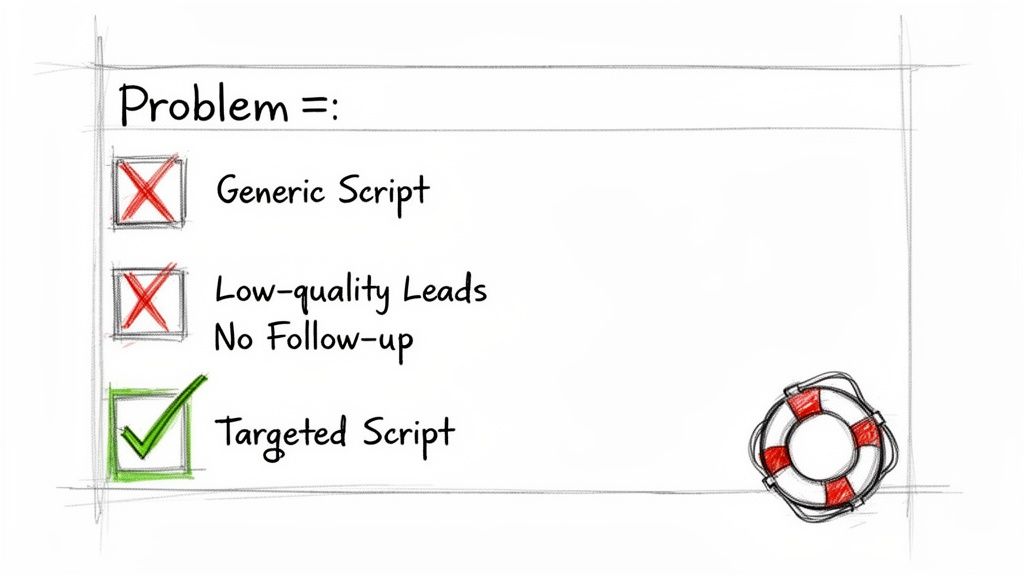
Using Generic, One-Size-Fits-All Scripts
Want to fail fast? Sound like every other telemarketer. A generic script that doesn't connect with a homeowner's real-world problems—like an old HVAC unit in a neighborhood built 20 years ago—is a one-way ticket to getting hung up on. People can smell a canned pitch a mile away.
The fix here is to think of your script as a flexible guide, not a word-for-word monologue. It absolutely has to be customized for the list you're calling. For instance, a script for new homeowners should be all about welcome inspections, whereas one for property managers needs to hit on the value of long-term maintenance contracts.
Working From Low-Quality Lead Lists
You can have the best callers in the world, but if their list is garbage, the results will be too. Using outdated, wrong, or totally irrelevant contact lists is like trying to fish in an empty pond. It’s a massive waste of time dialing disconnected numbers and talking to people who couldn’t possibly need what you’re selling. It’s a tempting shortcut that always costs more in the long run.
So, what's the solution? You have to invest in high-quality, targeted data. A solid list needs to be:
- Accurate: Full of verified phone numbers and correct contact names.
- Relevant: Made up of people who actually fit your ideal customer profile (like homeowners in a specific zip code with houses over 15 years old).
- Fresh: Cleaned up regularly to get rid of old contacts and add new ones.
Think of your lead list as the fuel for your outbound campaign. If you start with cheap, dirty fuel, the whole engine is going to sputter and die before you even leave the driveway.
Lacking a Persistent Follow-Up System
Here's a hard truth: most jobs aren't lost on the first call. They’re lost in the dead air that comes after. A homeowner might be interested but just too busy, asking you to call back next week. If you don't have a bulletproof system to track that, the opportunity just vanishes.
The fix is a disciplined process. Use a CRM or even a well-organized spreadsheet to log every single conversation and schedule the next follow-up. This is where a professional remote CSR or a done-for-you cold calling service really shines—they make sure no lead ever slips through the cracks.
Remember, persistence is what separates the pros from the amateurs. Most deals are closed after the fifth, sixth, or even seventh try.
Why Outbound Sales Is a Growth Engine for Your Business
So far, we've walked through what outbound sales is, how it works, and the common mistakes to sidestep. Now, let’s tie it all together. A smart outbound strategy isn’t just another sales tactic—it's a predictable, scalable growth engine that puts you in the driver's seat of your business.
For any home service business, relying only on inbound leads is a bit like being a farmer waiting for rain. Sure, you'll have good seasons and you'll have dry spells, but you’re ultimately at the mercy of the weather. Outbound sales is how you build your own irrigation system.
Taking Control of Your Growth
The biggest difference outbound makes is the shift from a reactive to a proactive mindset. Instead of waiting for the phone to ring, you decide when to make it ring. In a crowded local market, that proactive approach is a massive competitive advantage.
Think about it. When your competitors are quiet during a seasonal lull, your team is actively filling the calendar. You can laser-focus on specific neighborhoods, go after valuable commercial contracts, or circle back to past customers with new offers. This builds a consistent, reliable stream of appointments, smoothing out the revenue roller coaster that plagues so many service businesses.
Outbound sales turns your lead generation from a game of chance into a predictable system. When you control the inputs—the number of calls made or emails sent—you gain a surprising amount of control over the outputs: qualified appointments and booked jobs.
Building a Scalable Acquisition System
Maybe the most powerful long-term benefit here is scalability. An inbound strategy built on word-of-mouth and local SEO is great, but it’s tough to scale on command. You can’t just decide to double your referrals next month.
With an outbound system, growth becomes a math problem. If you know one caller can book 5 appointments a week, you know exactly what it takes to get to 10. This gives you a clear, repeatable process for finding new customers that can grow right alongside your ambitions.
An outbound engine lets you:
- Fill Seasonal Gaps: Proactively book jobs during your historically slow months.
- Dominate New Territories: Systematically introduce your services to a new part of town.
- Secure High-Value Contracts: Target commercial clients with the persistence it takes to land them.
By embracing this proactive model, you’re not just chasing leads; you’re building a core asset for your business. It's the engine that powers real, sustainable growth, giving you the confidence to add more trucks, expand your team, and actually hit your revenue targets. Of course, a strong outbound effort works best when supported by solid digital marketing, which is why understanding how to hire a virtual assistant for internet marketing can complete your growth strategy.
At the end of the day, a solid outbound sales program is your ticket to breaking free from the whims of the market. It’s how you stop waiting for business to happen and start building it yourself, one conversation at a time.
Frequently Asked Questions About Outbound Sales
Even after you get the basic idea of outbound sales, a few practical questions always pop up. Here are some straight answers to the things home service owners ask most when they start thinking about a more proactive outreach strategy.
Is Cold Calling an Obsolete Tactic?
Not a chance. Look, the days of just grabbing a phone book and smiling-and-dialing are long gone, and good riddance. But strategic, well-timed outreach? That’s more powerful than ever.
Think about it. For a home service business, a quick call to a new homeowner about HVAC maintenance or to a local business about their commercial cleaning needs can be incredibly effective. The whole game is about using good data and having a message that actually solves a problem for them. It’s not the tool that's outdated—it's how people used to use it.
How Much Does Outsourcing Outbound Sales Cost?
The cost really depends on the route you take. If you go for a fully "done-for-you" service, you're likely looking at a monthly retainer or paying a set fee for every qualified appointment they put on your calendar. It's predictable and completely hands-off for you.
On the other hand, hiring a dedicated remote CSR or virtual assistant is almost always more affordable than hiring someone in-house. You don't have to worry about the overhead like benefits, payroll taxes, or finding them a desk. Either way, the goal is the same: get a positive ROI where the money from new jobs easily covers what you spent to get them.
What Is the Difference Between a Remote CSR and a Cold Caller?
This is a great question. While both roles involve picking up the phone, they have very different jobs. It helps to think of them as two specialists on the same team.
- Dedicated Cold Caller: This person is your hunter. Their one and only job is to be proactive, reaching out to cold lists of potential customers to spark initial interest and book that first appointment. They're focused on filling the very top of your sales funnel.
- Remote CSR (Customer Service Representative): This role is more of a hybrid. A remote CSR handles incoming calls, but they also jump on outbound tasks like immediately calling back someone who just filled out your website form or nurturing leads that have already shown some interest.
You really need both for a complete system. The cold caller starts the conversation, and the CSR makes sure every single lead—whether it came in warm or was generated cold—gets the follow-up it needs.
A dedicated cold caller's job is to start the fire. A remote CSR's job is to make sure every spark of interest is fanned into a flame and never goes out. A complete system needs both.
How Long Does It Take to See Results?
You can start seeing appointments get booked within the first few weeks, but let’s be realistic: a truly great outbound campaign is a long game, not a get-rich-quick scheme. It usually takes a solid 60-90 days to really get things humming—to dial in the scripts, clean up the calling lists, and figure out what's working best.
You have to be patient during that initial ramp-up. The feedback you get in those first couple of months is pure gold. It’s what allows you to build a predictable, efficient appointment-setting machine that can fuel your company’s growth for years.
Ready to build a predictable growth engine for your home service business? Phone Staffer provides done-for-you cold calling services that book qualified appointments directly onto your calendar. We also hire, train, and place expert remote CSRs to ensure no lead is ever wasted. Learn how we can fill your schedule at https://phonestaffer.com.