
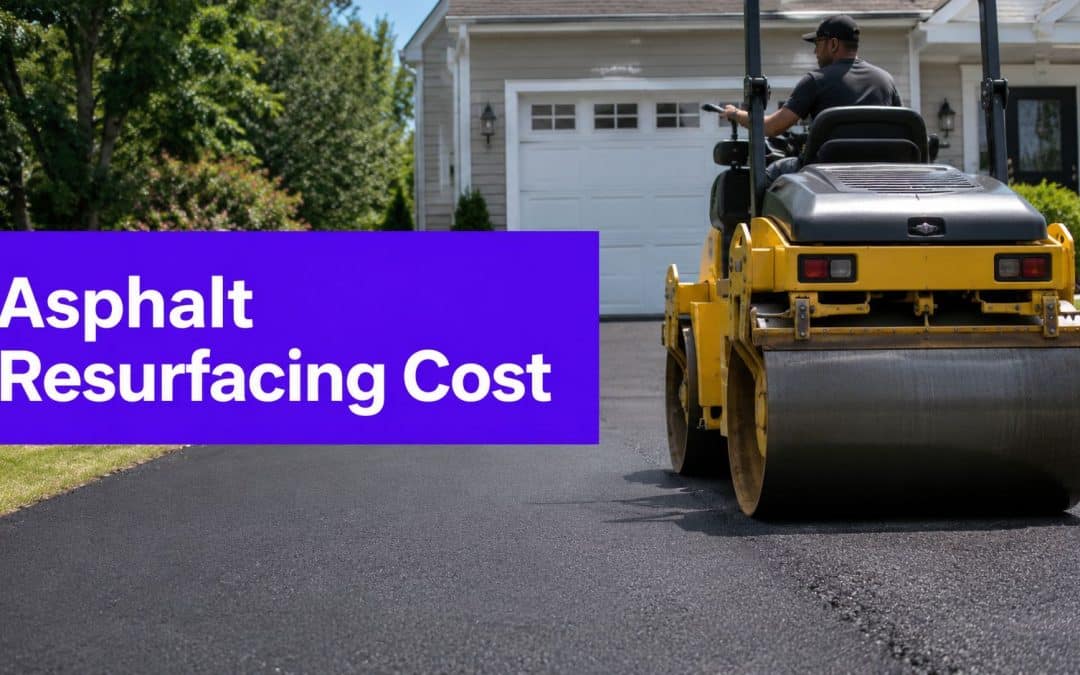
Asphalt driveway resurfacing typically costs $1,277 to $4,001, and many jobs price out around $3 to $10 per square foot depending on condition, labor, and location. At the edges of the market, small straightforward jobs can come in around $566, while difficult or larger projects can reach $8,916.
That range catches a lot of homeowners off guard because the driveway often looks like a simple blacktop fix. It also trips up newer paving contractors who quote too fast, miss the prep, and burn margin before the crew even unloads the roller.
The job itself sits in the middle of the driveway decision tree. Patching is cheaper but limited. Full replacement costs more but solves deeper failures. Resurfacing is the middle ground that makes sense when the base is still sound and the surface is what's worn out. If you're a homeowner, that means you need to know whether you're paying for a cosmetic lift or a real extension of service life. If you're a paving business owner, it means your estimate has to prove you understand the difference.
Your Driveway Is Cracked But Is Resurfacing the Answer
A homeowner usually starts in the same place. They stand at the end of the driveway, look at the cracks, notice weeds pushing through, and ask one question: can this be fixed without tearing everything out?

That's also where many new contractors make their first mistake. They see surface damage and say “resurfacing” before they've checked the edges, drainage, soft spots, or whether the cracking pattern points to deeper movement. A clean overlay over a failing base looks good for a while. Then the callbacks start.
What resurfacing actually solves
Resurfacing works best when the existing structure still has good bones. The top layer has aged, dried out, or cracked beyond what sealcoating can reasonably help, but the driveway isn't collapsing underneath. In that situation, resurfacing can be the practical answer instead of a full reconstruction.
Practical rule: If the driveway has surface wear but still feels stable under traffic, resurfacing is worth serious consideration. If it moves, pumps water, or has broad structural breakup, the conversation changes fast.
I've seen homeowners hope an overlay will fix everything because replacement sounds expensive. I've also seen contractors oversell replacement when resurfacing would have been the honest call. The profitable contractor is the one who can tell the difference and explain it in plain language.
The real decision on site
On a real estimate, the choice usually comes down to three buckets:
- Minor wear and isolated cracking: This may still be repair and maintenance territory, not resurfacing.
- Widespread surface wear on a stable base: Resurfacing is often suitable for these conditions.
- Base failure, drainage problems, or severe breakup: That usually pushes the job toward replacement.
For homeowners, the cost to resurface asphalt driveway surfaces is only part of the question. The bigger question is whether resurfacing is the right fix at all.
For contractors, that distinction is where trust starts. A quote that says “overlay” without explaining the condition of the existing pavement is a weak quote, even if the price is attractive.
The Real Cost to Resurface an Asphalt Driveway in 2026
The market numbers are broad, but they're useful when you frame them correctly. In major U.S. markets, asphalt driveway resurfacing commonly falls in the $1,277 to $4,001 national average range, with low-end projects around $566 and high-end jobs reaching $8,916 depending on size, condition, labor rates, and location, according to Thumbtack's asphalt resurfacing cost guide.

That same cost reference also notes a broader typical homeowner spend of about $3,000, with most jobs landing between $600 and $6,000, which works out to roughly $3 to $10 per square foot for a standard driveway.
What those numbers mean on a real estimate
The mistake is treating square-foot pricing like a final answer. It isn't. It's a starting point.
A smaller, simple driveway with decent access and limited prep may land near the lower end of the total range. A wider driveway with edge damage, multiple crack zones, or awkward equipment access can move up quickly. Two properties can have similar square footage and still produce very different quotes because the crew isn't just buying asphalt. They're buying time, prep, mobilization, cleanup, and risk.
A simple way to look at it:
| Project type | Typical pricing frame |
|---|---|
| Straightforward resurfacing | Often closer to the lower end of the published ranges |
| Average residential job | Often clusters around the broader homeowner spend of about $3,000 |
| Complicated resurfacing with more prep | Can move toward the high end of the published range |
A field example contractors will recognize
A homeowner once sent over photos and asked for a “quick number.” The driveway looked ordinary in pictures. On site, the surface was rough but serviceable, the apron had minor breakup, and the edges needed attention. That's a normal resurfacing conversation. The photos didn't show the detail that would shape the quote. The site visit did.
That's why smart contractors avoid quoting solely from aerial imagery or a street-view snapshot. Homeowners appreciate speed, but they appreciate accuracy more when the invoice doesn't drift halfway through the job.
A fast estimate wins attention. A scoped estimate wins trust.
If a homeowner is still comparing materials, it also helps to understand where asphalt sits against alternatives. A practical comparison is Firm Foundations gravel driveway pricing, especially for customers debating lower upfront cost versus a more finished paved surface.
What Drives Your Final Resurfacing Price Tag
One driveway gets a clean, competitive resurfacing quote. Another starts in the same ballpark and ends up much higher. The difference usually isn't the overlay itself. It's everything wrapped around it.
Independent cost coverage notes that many resurfacing jobs land closer to $3 to $10 per square foot when labor, prep, thickness, and line-item work are included, and a Princeton, New Jersey benchmark converted to about $3.60 to $8.30+ per square foot depending on scope, as outlined in this analysis of asphalt driveway resurfacing labor, materials, and hidden fees.
The line items that move the price
A resurfacing quote rises or falls on scope. These are the items that usually decide whether the job stays simple or turns into a broader rehabilitation project:
- Surface prep: Cleaning, crack prep, and patching weak areas take labor before any new asphalt goes down.
- Milling needs: If grades at the garage, sidewalk, or apron are tight, the contractor may need to mill before overlaying.
- Drainage corrections: Water problems don't disappear under fresh asphalt. If water already sits in a low area, the new surface can inherit the same problem.
- Edge repair: Broken edges often need rebuilding so the new mat has something solid to tie into.
- Access and equipment movement: Long drives, narrow gates, and steep approaches slow the crew and affect production.
A quote can change after the first shovel
One job I remember started as a clean resurfacing candidate. The surface was tired but not destroyed. Once the crew opened up a weak area near the edge, the underlying support was soft and saturated. The original idea of “overlay and go” was off the table. The right call was more repair before resurfacing.
That kind of discovery is exactly why lowball quotes are dangerous. A contractor who leaves out prep can look cheap at the kitchen table and expensive on job day.
The cheapest resurfacing estimate often excludes the very work that makes the resurfacing last.
Sample Resurfacing Quote Breakdown (800 sq. ft. Driveway)
| Line Item | Description | Example Cost |
|---|---|---|
| Surface cleaning and prep | Remove debris, clean surface, prep for bond | Included in overall quote |
| Crack repair | Treat visible cracking before overlay | Included in overall quote |
| Localized patching | Repair weak or failed spots | Included in overall quote |
| Milling at transitions | Reduce height issues near garage or walk | Included in overall quote |
| Asphalt overlay | New resurfacing layer over sound base | Included in overall quote |
| Edge work and finish | Tie-ins, edges, cleanup | Included in overall quote |
That table is intentionally qualitative because the exact distribution of cost depends on conditions. The published market data is useful for the full-job budget. An accurate estimate is built from the site.
What experienced estimators do differently
Good estimators slow down before they price. They walk the driveway. They look at drainage. They check where the asphalt meets the garage slab and public sidewalk. They look for alligator cracking, edge failure, and softness at the wheel paths.
New contractors often ask, “What's your price per square foot?” The better question is, “What kind of driveway lets me use that price without getting burned?”
Resurfacing vs Replacement What Is the Better Investment
The cost gap matters. HomeAdvisor pegs asphalt driveway replacement at $8 to $18 per square foot, while resurfacing runs about $3 to $10 per square foot, making resurfacing roughly 30% to 60% cheaper in many cases according to HomeAdvisor's resurfacing and replacement cost comparison.

That price difference is why so many homeowners ask for resurfacing first. It's also why contractors need to resist using it as the answer to every driveway problem.
When resurfacing is the smarter buy
Resurfacing is the better investment when the structure underneath is still solid and the wear is concentrated in the top layer. It gives the homeowner a visible upgrade without paying for tear-out, disposal, and reconstruction.
A practical example is the family who wants to improve curb appeal and preserve cash for another home project. If their driveway has age, oxidation, and cracking that hasn't turned into widespread structural failure, resurfacing can be the right tool.
Historical maintenance guidance also matters here. Sealing is commonly recommended every 3 to 5 years, while resurfacing fits the stage where sealing alone won't do enough but full rebuild still isn't necessary, based on the same HomeAdvisor reference.
When replacement is the honest answer
Replacement makes more sense when the base has failed, the surface movement is obvious, or the water problems are built into the driveway's structure. In those cases, resurfacing can turn into expensive postponement.
Here's the simplest comparison:
| Decision point | Resurfacing | Replacement |
|---|---|---|
| Upfront cost | Lower published range | Higher published range |
| Existing base condition | Needs to be structurally sound | Can address deeper failure |
| Best use case | Surface wear beyond basic maintenance | Structural distress, poor support, major drainage problems |
Before and after visuals help customers understand the difference in scope. This walkthrough is useful if you want to show the field reality of what gets resurfaced and what gets rebuilt.
If the driveway's bones are good, resurfacing is a cost-control move. If the bones are failing, replacement is the repair.
How to Spot a High-Quality Contractor Estimate
A one-line quote is usually where driveway jobs go sideways.
Homeowners get tempted by a simple number scribbled on the back of a card. Then the crew arrives, points out “extra repairs,” and the final bill starts climbing. Sometimes the work still gets done well. Sometimes the homeowner ends up paying more for less scope than they expected.
What a strong estimate includes
A professional resurfacing estimate should spell out what the contractor is doing. Not every company uses the same format, but a trustworthy quote usually makes these points clear:
- Defined scope: It should say whether the job includes cleaning, crack treatment, patching, milling, overlay, edge work, and cleanup.
- Material description: The homeowner should know they're buying an asphalt overlay, not a vague “blacktop treatment.”
- Site assumptions: If the quote depends on the existing base being sound, that should be stated clearly.
- Exclusions: If drainage repair, deep base repair, or other hidden conditions are not included, that needs to be in writing.
- Payment terms and warranty language: Customers shouldn't have to guess what happens if the surface has an issue after completion.
Questions homeowners should ask
These questions cut through vague bids fast:
- Is milling included if height becomes an issue?
- How are existing cracks and weak areas handled before the overlay?
- What happens if you find base failure after prep starts?
- Are edge repairs included or priced separately?
- Will the final invoice match this scope unless hidden conditions appear?
That last question matters more than people think.
A detailed estimate protects both sides. The homeowner knows what they're buying, and the contractor has fewer pricing fights after work begins.
For contractors, professionalism off the driveway matters too. If you're building a legitimate paving company or expanding into a regulated market, it helps to understand the process behind how to get your contractor license. A proper business footprint supports better estimates because it pushes you toward documentation, consistency, and accountability.
The red flags are usually obvious
Be cautious when a contractor avoids specifics, pushes for cash only, refuses to describe prep, or says they can “see everything from the road.” Good paving crews know the estimate is part of the job. They don't treat it like a nuisance.
For Paving Pros Using Cost Estimates to Win Jobs
Most new paving businesses think pricing is about not being too high. In practice, pricing is about being specific enough to be believable and disciplined enough to stay profitable.
Market references cluster around $1 to $3 per square foot for a basic resurfacing layer, with total project averages around $400 to $1,800 for a standard driveway-sized scope when the work is a straightforward overlay on a sound base, according to HomeGuide's asphalt driveway resurfacing cost overview. That's useful as a baseline, not as a finished selling price for every lead.

Build the estimate in layers
If you're training a new estimator, teach them to separate the job into components instead of blurting out a square-foot number.
Start with the basic overlay economics. Then add realities that eat margin:
- Crew and equipment time: Mobilization, roller time, handwork, and cleanup.
- Prep exposure: Crack treatment, patch areas, transitions, and edge work.
- Overhead: Insurance, admin, fuel, callbacks, and the cost of selling the job.
- Profit: Not what's left over. What you plan for.
A contractor who says yes to every job at the same markup usually ends up underpricing the ugly ones and overpricing the easy ones.
Use options without turning the estimate into a menu board
Homeowners like choices if the choices are clear. A clean way to structure it is a good-better-best frame:
- Basic resurfacing option: For driveways that need a straightforward overlay with limited prep.
- Resurfacing plus corrective prep: For jobs with more crack repair, patching, or transition work.
- Replacement recommendation: For sites where resurfacing would be a short-term fix.
That approach helps you sell transparently without forcing one answer onto every property.
A script that opens the conversation
If your sales team or outbound callers are setting driveway appointments, cost knowledge gives them a credible opening. Keep it simple:
“Hi, this is [Name] with [Paving Company]. We're speaking with homeowners in your area about worn asphalt driveways. Resurfacing often falls in the low thousands when the base is still in good shape. If you'd like, we can give you a no-pressure on-site quote and tell you whether resurfacing even makes sense.”
That works because it sounds like advice, not a trap.
One more point for growth-minded paving companies. Estimates help you close leads, but lead flow still has to exist. If you want a stronger local pipeline, this guide on boosting contractor leads with local SEO is a useful complement to outbound sales.
Making a Smart and Profitable Paving Decision
The cost to resurface asphalt driveway surfaces is only useful when it's tied to the right diagnosis.
For homeowners, the smart move is to ask one question before focusing on price: is the driveway structurally sound enough for resurfacing to last? If the answer is yes, resurfacing can be a sensible middle-ground investment. If the answer is no, the cheapest overlay quote on the table may become the most expensive mistake.
For contractors, accurate pricing is part estimating and part reputation management. The job has to carry labor, prep, equipment, and profit. It also has to match the actual site. That means walking the driveway, writing a real scope, and explaining why one property qualifies for resurfacing while another doesn't.
The best driveway projects usually start the same way. Somebody slows down, looks closely, and prices the work that needs to happen.
If you run a paving company and want more conversations with homeowners before your competitors get there, Phone Staffer helps home service businesses book appointments through outbound cold calling. They handle caller hiring, training, supervision, data scraping, skip tracing, and high-volume outreach so your team can spend more time quoting real jobs and less time chasing cold leads.