

So, you're thinking about hiring a virtual assistant. The whole process really boils down to a few critical steps: figuring out exactly what you need done, writing a job post that attracts the right people, vetting them like a pro, and having a solid plan to get them started. If you approach it with a clear strategy, you’ll find a genuine partner who gives you back your time—not just create another management headache.
Why a Virtual Assistant Is Your Next Best Hire

Does this sound familiar? You wrap up a long day on-site, and your truck is a mess of invoices, sticky notes with new client details, and a mental to-do list of calls you still have to make. Meanwhile, your phone keeps buzzing with new leads, but you can’t give any of them the focus they need.
This is the day-to-day grind for so many home service pros. The very things that mean you're growing—more invoices, more calls, more scheduling—are the same things that bog you down. They pull you away from the work that actually makes you money, like finishing jobs, quoting new ones, and talking to your customers.
Moving from Overwhelmed to Organized
This is exactly where a virtual assistant (VA) can be a game-changer. Think of a VA not as just another expense, but as a smart investment in getting your business—and your sanity—back on track. A good VA can take that administrative chaos and turn it into a well-oiled machine.
Here's what that actually looks like in practice:
- Scheduling and Dispatch: Instead of you trying to juggle calls while on a ladder, your VA can manage the calendar, book appointments, and even help map out the most efficient routes for your crew.
- Customer Communication: They can be the first point of contact for new inquiries, answer frequently asked questions, and send out appointment reminders. No more letting good leads fall through the cracks.
- Invoicing and Follow-Up: Your VA can get invoices out the door the moment a job is done and politely follow up on late payments, which does wonders for your cash flow.
- Lead Management: They can also take on the crucial task of managing sales leads by pre-qualifying callers and scheduling estimates for you or your sales team.
By handing off these vital but time-sucking tasks, you get to reclaim your focus. All of a sudden, you have the breathing room to focus on quality control, train your team, or even just think about the big picture for your business. It’s the classic shift from working in your business to working on it.
The Growing Trend of Virtual Support
This isn't some niche strategy; it’s a massive global trend. The virtual assistant industry is exploding. It's projected to grow from $19.5 billion in 2025 to a whopping $55.4 billion by 2035. That's a 184% jump, and it shows just how many businesses are realizing the power of remote help.
For a home service business, hiring a VA is one of the fastest ways to buy back your time and scale your operations without the hefty overhead of another full-time, in-office employee. Let's walk through how to find the right person who can become a true asset to your team.
Getting Your Ducks in a Row Before You Post a Job
I see it all the time: a business owner gets overwhelmed, decides they need a VA, and immediately throws a job post up online. That’s a recipe for frustration. You end up hiring someone for the wrong tasks, which leads to confusion on their end and disappointment on yours.
So, before you even think about writing that job ad, we need to do some groundwork. This prep work is what separates a strategic hire from a hopeful guess. It ensures you know exactly who you're looking for, can write a killer job description, and set your new team member up to win from day one.
The "Time Audit": Figure Out What to Actually Hand Off
First things first, you need a brutally honest look at where your time is really going. For one full week, I want you to log everything you do. And I mean everything. Don't filter, don't judge—just write it down.
At the end of the week, grab a piece of paper or open a spreadsheet and split your list into two columns. The first is "High-Value Tasks," the stuff only you, the owner, can do. Think closing big jobs, training your lead technicians, or negotiating with suppliers. The second column is "Delegatable Tasks"—all the repetitive, administrative work.
You’ll probably be shocked at how much of your day is spent on things that don't directly make you money. That second column? That's your goldmine. Those are the first tasks for your new VA.
For a home service pro, that delegatable list usually looks something like this:
- Wrangling the Calendar: Scheduling estimates and new jobs in your software, whether it's Jobber or Housecall Pro.
- Answering the Phone & Emails: Responding to website inquiries, handling basic customer questions, and sending out appointment reminders.
- Data Entry: Keeping your client CRM updated with new customer info or job notes.
- Social Media Basics: Posting those awesome before-and-after photos to your company's Facebook or Instagram.
- Sending Invoices: Creating and sending invoices after a job is wrapped up.
The point here isn't just to offload work. It's about strategically buying back your time so you can focus on steering the ship, not just bailing water.
Setting a Realistic Budget
Now that you have a task list, you can figure out what you can afford to spend. This is about more than just an hourly rate; it’s a real investment. The good news is that hiring a VA often saves you a ton of money. Research shows that a full-time virtual assistant can save a U.S. employer more than $11,000 a year compared to a traditional employee. Some businesses have even slashed their operational costs by up to 78%. You can dig into more of these virtual assistant statistics and their impact on businesses if you're curious.
When you're crunching the numbers, you'll generally find two ways to go:
- Go Direct with a Freelancer: You can hire an independent contractor directly from a platform like Upwork. This is often cheaper per hour ($15 to $40+ depending on their skills and where they live), but you're on the hook for all the recruiting, vetting, and day-to-day management.
- Partner with an Agency: You can work with a managed service that provides pre-vetted, trained VAs. This route usually costs a bit more ($25 to $75+ per hour), but it saves you an enormous amount of time. They handle everything and even provide a backup if your main VA gets sick.
Your budget will pretty much decide which path you take and helps you target candidates in the right ballpark from the get-go.
Get Your Tools and Logins Ready
Last but not least, make a list of every single tool, software, and platform your VA will need to use. Nothing says "I'm not ready for you" like scrambling to create logins on their first day. A smooth start depends on having their digital desk set up and waiting for them.
Break it down into a few key areas:
- Communication: How will you talk? Think Slack, email, or maybe a dedicated business phone line.
- Task Management: How will you assign and track work? This could be a tool like Trello or Asana, or even just a simple shared Google Doc.
- Your Core Software: What programs do they absolutely need access to? Your scheduling software (Jobber, Housecall Pro) and accounting software like QuickBooks are probably at the top of the list.
- File Sharing: Where will you keep shared documents? Google Drive or Dropbox are easy wins here.
Figure out what level of access they'll need for each and get ready to create their accounts. Having this checklist done ahead of time doesn't just make onboarding a breeze—it shows your new VA that you’re a professional who's organized and truly ready for them to join the team. Once you've got this foundation laid, you're finally ready to start the search.
Writing a Job Description That Attracts Top Talent

Now that you've done your homework, it’s time to put the word out. But here’s a hard truth: if your job post reads like a generic laundry list of tasks, you’ll get a flood of equally generic applicants. A thoughtfully crafted job description is your single best tool for filtering out the noise and getting the attention of serious professionals.
Think of it as the first real test. A top-tier VA can spot a thoughtful, organized business owner from a mile away just by the clarity of the job post. They’re looking for a genuine partner, not just another gig, and your description sets the entire tone for that relationship.
Start with a Specific and Descriptive Title
Forget generic titles like “Virtual Assistant Needed.” They’re basically invisible, lost in a sea of identical postings. They tell a candidate absolutely nothing about your business or what you actually need.
Your goal is to be so specific that the right person sees it and immediately thinks, "Hey, that's me!"
Try packing more detail right into the title:
- Good: Administrative VA for Plumbing Business
- Better: Customer Service VA for HVAC Company (Eastern Time Zone)
- Best: Scheduling & Invoicing VA for a Growing Electrical Contractor
These titles instantly communicate the industry, the core function, and even the timezone. You'll start attracting applicants who already have relevant experience or are looking for exactly that kind of work. Learning how to create job descriptions that actually get results from the start will save you countless hours of sifting through irrelevant resumes.
A specific title is your first line of defense against unqualified applicants. It acts as a magnet for specialists and a polite deterrent for those who are just mass-applying to every VA job they see.
Detail the Role with Action and Clarity
This is where you connect the dots back to that task audit you did earlier. Don't just list vague responsibilities like "manage schedule" or "handle emails." Use strong action verbs and give enough context so applicants can actually visualize themselves doing the work day-to-day.
Break the core responsibilities down into a clear, scannable list. For a home service business, this might look something like:
- Manage Inbound Leads: Answering incoming calls and responding to website contact forms within one hour during business hours.
- Schedule Appointments: Booking service calls and estimates directly into our Housecall Pro calendar, optimizing routes when possible.
- Handle Customer Communication: Sending appointment reminders via text and email, then following up post-service to request reviews.
- Process Invoices: Generating and sending invoices from QuickBooks Online as soon as a job is marked complete by our techs.
This level of detail shows you have a real plan and respect their time. It also helps candidates self-select—if someone hates being on the phone, they’ll know right away this role isn't for them.
Be Transparent About Skills, Pay, and Time
Ambiguity is the enemy of a good job post. High-quality VAs are running their own businesses, and they need clear information to decide if an opportunity is worth their time. Be upfront about the non-negotiables.
Your post absolutely must clearly state:
- Required Skills: List the true must-haves. Think "excellent verbal communication skills" and "high attention to detail."
- Software Proficiency: Be specific about the tools you use. "Experience with Jobber is a major plus" is far more effective than "experience with CRM software."
- Time Commitment: Is this for 10 hours a week or 40? Specify the expected weekly hours.
- Timezone: Clearly state your operating hours and the timezone they must work in (e.g., "Monday-Friday, 9 AM – 5 PM EST").
- Compensation: Provide a clear hourly rate or a tight range. This is one of the biggest deciding factors for any applicant.
Finally, don't forget to inject a bit of your company's personality. Add a short paragraph about your business values or what it's like to work with your team. This helps you find someone who is a genuine cultural fit, not just a person checking off a task list.
Finding the Right Candidate in a Sea of Applicants
So, the applications are pouring in. It's a double-edged sword, isn't it? On one hand, your job post clearly hit the mark. On the other, you're now facing a mountain of resumes. Sifting through dozens, or even hundreds, of candidates can feel overwhelming, but with the right approach, you can find your needle in the haystack without pulling your hair out.
This part of the process is all about smart filtering. The idea is to quickly narrow a huge applicant pool down to a handful of people you're genuinely excited to talk to. We’ll do this by checking for attention to detail, testing real-world skills, and asking questions that actually matter.
It helps to have a clear map of the process, from choosing where to post your job to how you'll screen the people who apply.
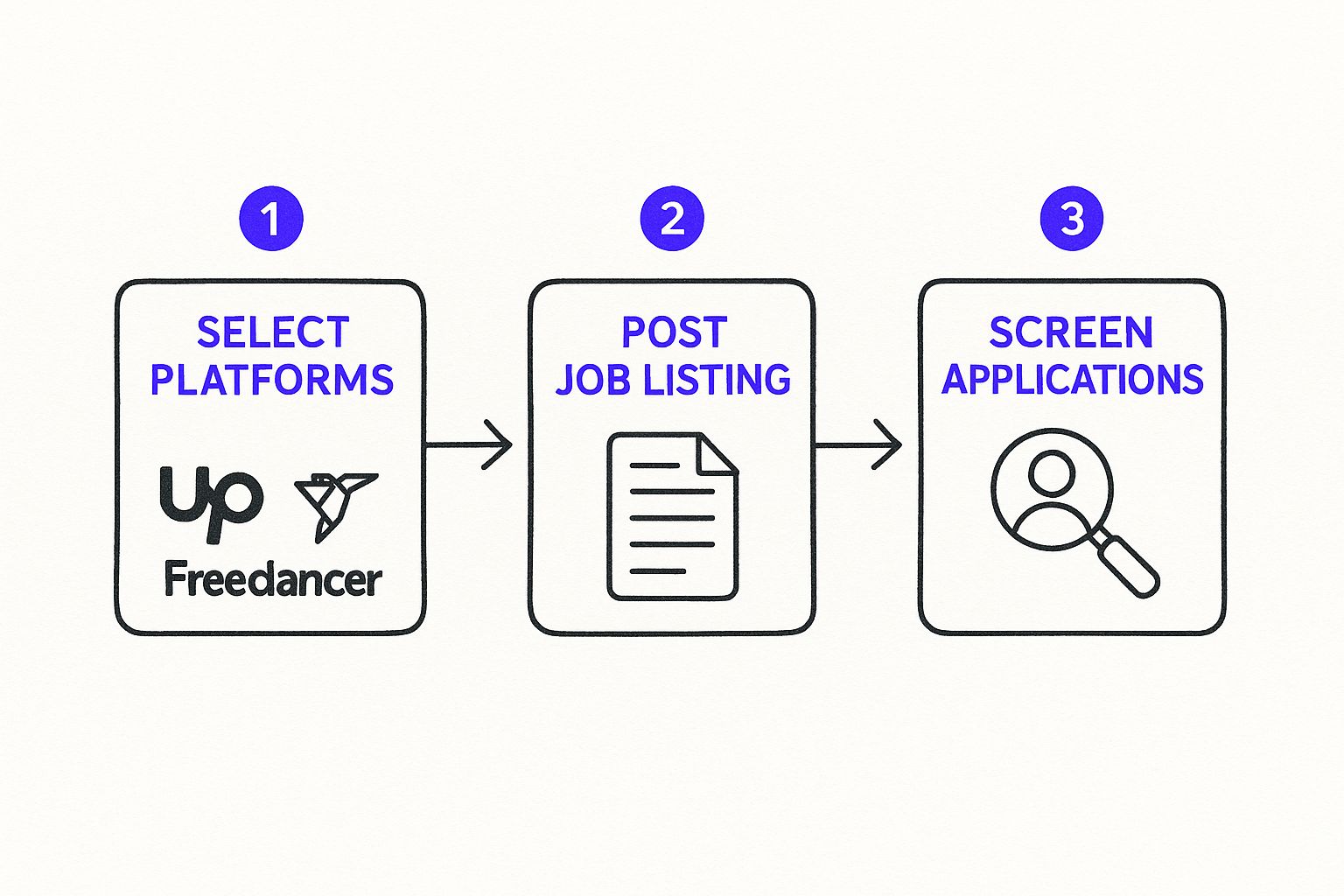
This kind of flowchart keeps you grounded. It’s a simple reminder to be methodical about where you look for help and how you start sorting through the responses.
The First Pass: An Eye for Detail
Your first filter should be ruthless. Did the applicant actually follow the instructions in your job post? You would be absolutely shocked how many people don't. This is a simple, powerful way to weed out those just blasting out resumes or who lack the attention to detail that’s non-negotiable for this kind of role.
Here’s a trick I always use: I bury a specific, slightly unusual instruction in the job description. Something like, "In your application, tell me about your favorite productivity tool and why you love it."
Anyone who skips that question gets moved to the "no" pile. Immediately. If they can’t follow a simple instruction when applying, how can you trust them to handle customer appointment changes or complex invoices? This one tactic alone can cut your applicant pile in half.
The Paid Skills Test: A Window into Their Work
Once you have a shortlist of candidates who passed that first test, it’s time for a small, paid skills test. I consider this mandatory. A resume is what someone claims they can do; a skills test shows you what they actually do.
Keep it brief, make it relevant to your business, and always pay them for their time. A fair rate is usually around $20-$30. This simple gesture shows you respect their skills and helps you stand out to the true professionals.
For a home service business, a great test might include tasks like these:
- A Simulated Customer Email: Give them a fictional, slightly frustrated customer email. Ask them to "Draft a polite and helpful response that calms the customer down and confirms their appointment."
- A Scheduling Challenge: Provide a short list of jobs and a technician's availability. Ask them to "Organize these into a logical route in Google Calendar and flag any potential conflicts."
- A Data Entry Task: Send a blurry photo of a handwritten work order. Ask them to "Enter this customer and job info into the Google Sheet template provided."
The results from a test like this give you cold, hard evidence of their communication style, problem-solving skills, and how meticulous they are. It shifts your hiring decision from a gut feeling to one backed by real data.
Asking the Right Interview Questions
The final filter is the interview itself. This is your chance to see if their personality is a good fit, gauge their reliability, and see how they think on their feet. Ditch the generic questions like, "What are your weaknesses?" They’re a waste of time.
Instead, focus on situational questions that reflect the reality of a remote role in a busy service business.
Try asking things like:
- "Tell me about a time you had to deal with a really difficult customer. What happened, and how did you turn it around?"
- "Imagine an angry client calls, you spot a major scheduling error, and an urgent invoice needs to go out—all at the same time. What do you do first, and why?"
- "When you're working from home without direct supervision, how do you stay organized and on top of your tasks?"
The virtual assistant industry has exploded, with an estimated 40 million VAs working worldwide today. That massive talent pool means your perfect hire is out there, but it also means your vetting process has to be rock-solid. As you're interviewing, keep in mind that you're not just hiring a contractor; you're adding a remote member to your team. For more on this, you might find some useful tips on mastering virtual hiring for remote employees. The answers to these practical questions will tell you far more than any resume ever could.
Setting Your New Virtual Assistant Up for Success

You’ve found the one. The interviews went great, their skills test was on point, and you’re genuinely excited to bring them on board. While it feels like you've crossed the finish line, the next two weeks are actually the most critical part of the entire process.
Even the best hire can sour quickly if they're dropped into a chaotic or confusing environment. Your real mission now is to seamlessly integrate your new VA into your business, arming them with the tools, clarity, and confidence they need to start making a real impact.
Think about it like this: you wouldn't send a new technician out to a customer's home without their tools, a work order, or the right address. Your VA needs the same level of preparation to succeed. A solid onboarding plan is how you give it to them.
Your Day One Onboarding Checklist
The first day sets the entire tone. A messy, disorganized start breeds uncertainty. A prepared, welcoming one builds immediate trust and gets things moving in the right direction. Your only job on day one is to make their transition into your business as smooth as possible.
Before your VA even logs in for the first time, get these essentials sorted:
- Grant All Necessary Access: Send out every single login they'll need. This means your CRM, scheduling software (Jobber, Housecall Pro, etc.), project management tools, and any shared cloud storage.
- Set Up Communication Channels: Get them added to your primary communication hub, like a dedicated Slack channel. This gives them an instant connection to you and the rest of the team.
- Provide a Welcome Packet: Don't underestimate the power of this simple document. It should have a list of key contacts, links to important company files, and a quick rundown of your company's mission and values.
Getting these basics handled before they start shows you’re a pro who respects their time. It lets them dive into meaningful work instead of burning their first few hours just trying to find the keys.
Building a Foundation of Clear Communication
In a remote setup, you can’t just pop your head over a cubicle wall to ask a quick question. That’s why you have to be incredibly intentional about communication from the very beginning. By setting clear expectations and a predictable rhythm, you can head off misunderstandings before they even start.
Don't just leave communication up to chance.
A huge mistake I see owners make is to "set it and forget it," assuming their new VA will magically figure everything out. Your goal in the first few weeks should be to over-communicate. This builds a habit of transparency that will pay off for years.
Here’s a simple but incredibly effective communication framework to get you started:
- Daily Check-in: A quick message at the start of each day. It can be as simple as, "Morning! My top 3 priorities today are: 1) Following up on yesterday's leads, 2) Scheduling the Miller job, and 3) Drafting invoice #1234. Anything urgent from your end?"
- End-of-Day Summary: A brief recap of what got done. This isn't about micromanagement; it's about making sure nothing slipped through the cracks and taking a moment to celebrate progress.
- Weekly Sync Meeting: A 30-minute video call once a week is non-negotiable. Use this time to review the past week, spot potential roadblocks for the week ahead, and just connect face-to-face.
This structure creates a predictable flow that helps your VA feel looped in and confident. It’s absolutely vital for roles that involve virtual assistant customer service, where consistent, clear communication is everything.
Documenting Your Processes with SOPs
You simply cannot expect someone to read your mind. The daily tasks that are second nature to you are a complete mystery to your new VA. This is where Standard Operating Procedures (SOPs) become your secret weapon.
An SOP is nothing more than a simple, step-by-step guide on how to do a specific task right. You don't need fancy software—a Google Doc with screenshots or a quick screen-recorded video (using a tool like Loom) works perfectly.
Start by documenting the tasks you delegated first. For example:
- How to schedule a new estimate in your specific calendar software.
- The exact step-by-step process for creating and sending an invoice.
- The script and steps for responding to a new lead from your website.
Creating SOPs does more than just train your new hire. It actually forces you to refine your own workflows and creates an asset you can use to train every future team member. Ultimately, it empowers your VA to work independently and find answers on their own—which is the whole point.
Building a Long-Term Partnership with Your VA
https://www.youtube.com/embed/rWlEx7LolsM
Hiring a virtual assistant is a huge step, but the real magic happens in the weeks and months after the onboarding is complete. The goal isn't just to hand off tasks; it’s to build a genuine partnership that grows with your business.
This is where you move beyond simple instructions and start fostering a sense of shared purpose. A great VA doesn’t just check off your to-do list. They start to anticipate your needs, suggest improvements, and become truly invested in your success. But that relationship doesn't happen by accident—you have to build it intentionally.
Get on the Same Page with a Project Management Tool
One of the best things you can do for clarity is to get everything out of scattered emails and text messages and into a simple project management tool. It’s an absolute game-changer for working with anyone remotely.
A tool like Trello or Asana creates a central hub where both you and your VA can see exactly what’s on the docket at any given time. This transparency empowers your VA to manage their own workload and gives you a bird's-eye view of progress without having to constantly ask for updates. It builds trust and encourages them to take initiative.
Feedback Is How You Both Get Better
When you're not in the same office, feedback can't be an afterthought—it needs to be a regular, scheduled practice. Don't just wait for a problem to pop up. Consistent, constructive feedback is the fuel for your VA's growth and their ability to better serve your business.
I recommend putting a brief monthly or bi-weekly check-in on the calendar specifically for this.
- Celebrate the Wins: Always start by highlighting what they're doing well. Specific praise is key. "The way you handled that complicated scheduling issue last week was fantastic," is so much more powerful than a generic "good job."
- Offer Constructive Pointers: Frame areas for improvement as opportunities to solve a problem together. Instead of saying, "You're sending invoices too slowly," try, "Let's brainstorm how we can get invoices out within 24 hours of job completion. What would that look like?"
A strong feedback loop turns a good VA into an exceptional one. It shows you're invested in their development, which in turn deepens their commitment to your company's mission.
From Delegation to True Partnership
Once your VA has really mastered their initial responsibilities, start looking for ways to expand their role. This is where you unlock the true value of a long-term VA—when they begin taking on higher-level responsibilities that directly contribute to business growth.
Think about the next bottleneck in your business. Could they take ownership of the social media content calendar? Maybe they could start compiling weekly performance reports for your tech team? As you hand over more ownership, you're not just freeing up more of your own time. You’re making your VA a key player in your success story.
Questions I Hear All the Time About Hiring VAs
When home service pros start thinking about hiring a virtual assistant, the same few questions always pop up. It makes sense—you want to be sure you're making a smart move for your business. Let's walk through the most common ones I hear.
How Much Is This Going to Cost Me?
That's the big one, right? The honest answer is, it varies quite a bit. You could be looking at anywhere from $15 an hour to over $75 an hour.
What causes such a big swing? It really boils down to location, experience, and the specific skills you need. A VA handling general admin work like scheduling or answering emails is going to be on the lower end of that scale. But if you need someone with specialized skills—say, a marketing whiz who can run your social media ads or a bookkeeper—you can expect to pay a premium for that expertise.
Should I Hire a Freelancer or Go Through an Agency?
This is a classic "time vs. money" dilemma. There's no single right answer, just the one that’s right for you.
-
Hiring a Freelancer: Going direct usually saves you some money on the hourly rate. You get to build a one-on-one relationship from the get-go. The catch? You're the hiring manager, the trainer, and the supervisor. It's all on you.
-
Using an Agency: An agency costs more, no doubt. But what you're paying for is convenience and security. They do all the heavy lifting—finding, vetting, and training the VA. The best part for a home service business is that they often provide a backup if your VA is sick or on vacation, so you never miss a call.
Here's how I think about it: A freelancer costs you less money but more of your time. An agency costs you more money but buys back your time and gives you peace of mind.
What Should I Hand Off First?
Don't try to boil the ocean. The key to a successful start is to delegate small, repetitive tasks first. Look for the things that eat up your time but don't necessarily require your specific expertise to get done.
This strategy lets you and your new VA build a rhythm and establish trust without overwhelming anyone.
For a home service business, some great "first tasks" are:
- Tackling your email inbox and handling routine customer questions.
- Getting estimates and appointments booked on your calendar.
- Posting those before-and-after photos to your Facebook or Instagram page.
- Simple data entry, like updating your customer list in your CRM.
At Phone Staffer, we live and breathe this stuff. We specialize in finding top-tier, remote VAs and CSRs who already know the home service industry. We handle the entire hiring and training process, so you get a pro who’s ready to contribute from day one. Let us find the right person to manage your calls, leads, and admin work. You can learn more about how we do it over at https://phonestaffer.com.