
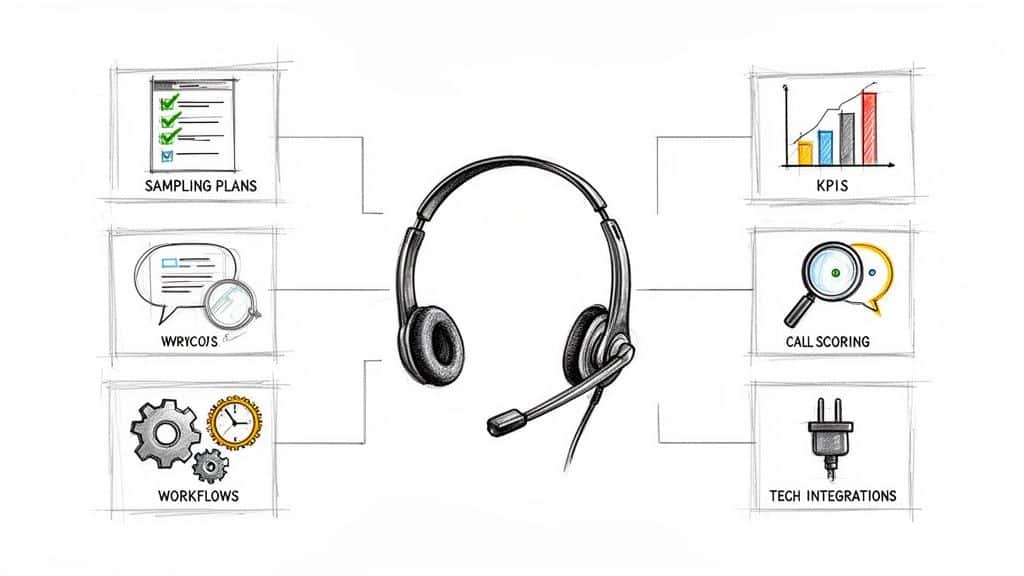
In the high-stakes world of home services, every phone call is a critical opportunity. It's not just about resolving an issue or answering a question; it’s about converting an expensive lead, booking a revenue-generating appointment, and building the essential trust that gets your technicians through a customer's front door. Yet, many home service businesses and franchisees adopt generic call center quality assurance best practices that completely miss the mark for their unique operational needs. Standard advice often prioritizes metrics like average handle time or rigid script adherence, overlooking the nuanced communication skills required to turn a panicked call about a leaking pipe into a scheduled, high-value job.
This guide is different. We have compiled a list of 10 actionable, home-service-specific QA strategies tailored for businesses like yours, from local HVAC and plumbing franchisees to multi-location roofing and electrical contractors. We will move beyond abstract theories and provide a practical framework to refine your customer interactions. Following these steps will help you transform your call handling from a necessary operational cost into a powerful and consistent revenue-generating engine.
You will learn how to implement effective call recording programs, build scorecards that measure what truly matters for appointment setting, and leverage coaching workflows that improve first-call resolution. This comprehensive list covers everything from key performance indicators and technology integration to compliance and agent development, giving you a clear roadmap to elevate your customer service and boost your bottom line.
1. Call Recording and Review Programs
Systematic call recording and review is the bedrock of any effective call center quality assurance best practices program. This involves capturing every customer interaction and then strategically analyzing a sample of those calls to evaluate agent performance, pinpoint training opportunities, and ensure adherence to company protocols. For home service businesses, where a single call determines whether a lead converts into a booked appointment, this practice is non-negotiable.

This foundational practice provides a direct, unfiltered view into the customer experience. It allows managers to assess critical skills such as lead qualification, empathetic communication, effective objection handling, and accurate appointment scheduling. Without it, performance management is based on assumptions rather than concrete data.
How to Implement a Call Review Program
Implementing this practice requires more than just turning on a recording feature. A structured approach ensures you get meaningful, actionable insights from your efforts.
Select a Robust Platform: While many VoIP systems offer basic recording, dedicated QA platforms like NICE or Verint provide advanced analytics and streamlined review workflows. Home service companies using specialized call centers, such as Phone Staffer, leverage integrated call review features to specifically evaluate appointment booking quality and conversion rates.
Define Your Sampling Strategy: It's impractical to review every single call. Instead, a targeted approach yields better results. Aim to review a meaningful sample, such as 10-15% of each agent's monthly calls, to ensure consistent evaluation and a fair performance baseline.
Focus on High-Impact Calls: Prioritize calls with specific, telling outcomes. This includes successfully booked appointments, calls where leads were lost, interactions with upset customers, or long calls that failed to convert. Analyzing these moments provides the most valuable coaching material.
Key Insight: Treat call recordings as coaching assets, not punitive tools. The goal is to facilitate agent growth and improve performance across the team. Frame feedback constructively to build confidence and reinforce positive behaviors. Sharing exemplary calls with the entire team can also serve as powerful, real-world training material, demonstrating exactly what a successful interaction sounds like.
2. First Call Resolution (FCR) Metrics and Tracking
First Call Resolution (FCR) is a critical call center metric that measures the percentage of customer inquiries resolved on the first interaction, eliminating the need for follow-up calls. For a home service business, a high FCR directly translates to successfully booking a qualified appointment on the initial call. This KPI is a powerful indicator of agent efficiency, process effectiveness, and customer satisfaction, making it a cornerstone of call center quality assurance best practices.
Tracking FCR reveals how well agents are equipped to handle customer needs promptly. A low FCR often signals issues in training, access to information, or empowerment to make decisions. When a customer has to call back, it not only creates a poor experience but also doubles the workload and increases the risk of losing the lead to a competitor.
How to Implement FCR Tracking
Effectively tracking FCR requires a clear definition of what "resolved" means for your business and a system to measure it accurately.
Define Clear Resolution Criteria: Establish unambiguous standards for what constitutes a successful first-call resolution. For appointment booking, this means the call ends with a confirmed appointment including the customer’s name, address, phone number, service type, and agreed-upon date and time slot.
Track FCR by Service Type: Resolution complexity can vary significantly between different services like a simple drain cleaning versus a complex HVAC installation quote. Track FCR separately for plumbing, electrical, and HVAC calls to identify specific areas needing process or training improvements.
Set Realistic FCR Targets: While 100% FCR is often unattainable, striving for a high benchmark drives performance. Industry best practices suggest a 70-80% FCR, but for straightforward appointment setting, home service businesses should aim for 85% or higher. Specialized services like Phone Staffer often achieve even higher rates through dedicated training on specific service scripts.
Key Insight: Analyze FCR failures as valuable coaching opportunities, not just negative statistics. Review calls that required follow-up to pinpoint the exact reason for the failure. Was the agent unsure of the service area? Did they lack information on pricing? Use these specific instances to create targeted training modules and refine scripts, turning resolution failures into a roadmap for continuous improvement.
3. Standardized Quality Assurance Scorecards
Standardized Quality Assurance (QA) scorecards are structured evaluation forms used to assess agent interactions against specific, measurable criteria. They transform subjective call reviews into objective, data-driven performance assessments. For home service businesses, where consistent lead qualification and appointment setting are paramount, scorecards ensure every agent is measured by the same high standard.
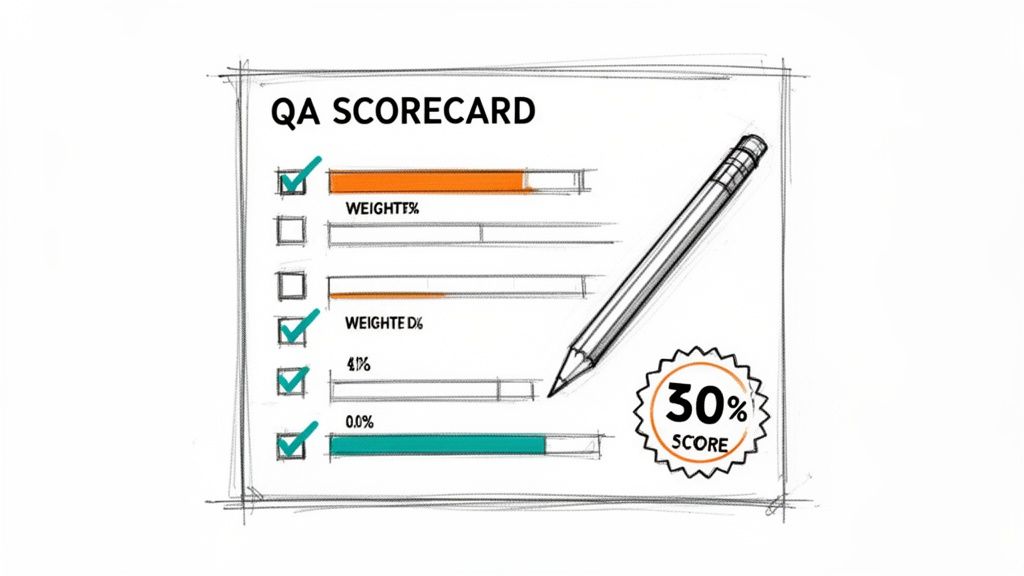
This practice removes guesswork from performance evaluation, providing clear, consistent feedback that agents can act on. By defining what a "good call" looks like, scorecards align agent behaviors with key business objectives like booking rates, customer satisfaction, and first-call resolution. This alignment is crucial for maintaining a high level of service and maximizing every inbound lead.
How to Implement a QA Scorecard
Creating an effective scorecard involves more than just listing desired behaviors; it requires strategic design and clear definitions to ensure fairness and accuracy.
Define Key Evaluation Criteria: Start by identifying the most critical components of a successful call for your business. An effective scorecard typically includes 8-12 key criteria, such as a professional greeting, accurate needs discovery, effective objection handling, a clear closing or booking attempt, information accuracy, and overall tone.
Weight Criteria by Importance: Not all criteria are created equal. For a home service company, appointment booking accuracy and effective lead qualification are more critical than a perfect script adherence. Assign higher point values to these high-impact areas to reflect their importance to your bottom line.
Set Clear Passing Scores: Establish a clear benchmark for success, typically a passing score of 80% or higher. This creates a tangible goal for agents and a clear threshold for identifying when additional coaching is needed. Companies like Phone Staffer use customized scorecards that heavily weigh appointment quality to ensure their remote CSRs meet franchisee-specific standards.
Key Insight: Your QA scorecard is a living document. Review and refine it quarterly to ensure it remains aligned with your business priorities, marketing campaigns, and any changes in customer expectations. As you introduce new services or promotions, your scorecard must evolve to measure how effectively agents are communicating those updates and driving desired outcomes.
4. Real-Time Call Monitoring and Coaching
While call recording offers a look back, real-time monitoring provides an immediate, in-the-moment opportunity to improve performance as it happens. This practice involves supervisors or QA specialists listening to live calls, enabling instant feedback, intervention, and coaching. For home service businesses, where a single mishandled objection can mean a lost appointment, the ability to course-correct in real-time is a powerful tool in your call center quality assurance best practices toolkit.

This proactive approach allows managers to reinforce positive behaviors and address issues before they negatively impact the customer experience or lead to a lost booking. It is particularly effective for training new agents and ensuring consistent script adherence and service quality across the team.
How to Implement Real-Time Monitoring and Coaching
A successful real-time coaching program is about support, not surveillance. It requires a clear framework to be effective and well-received by your team.
Utilize System Capabilities: Modern contact center platforms like Avaya and Genesys have built-in real-time monitoring features, often including "whisper coaching" (speaking to the agent without the customer hearing) and "barge-in" (joining the call). Specialized services, such as Phone Staffer, integrate live monitoring into their initial training and deployment periods for new remote CSRs to ensure they meet performance standards from day one.
Prioritize New and Developing Agents: Focus your real-time monitoring efforts on agents in their first 30-90 days. This is the most critical period for building good habits and correcting mistakes. For tenured agents, use this method more sparingly, perhaps when they are learning a new script or showing a dip in performance.
Establish Clear Protocols: Define when and how a supervisor will intervene. For example, a manager might only whisper a suggestion if an agent misses a key qualifying question or barge in only if a customer becomes highly escalated. This prevents agents from feeling micromanaged and ensures interventions are purposeful.
Key Insight: Frame real-time monitoring as a supportive, skill-building exercise, not a method of catching mistakes. The goal is to act as a safety net, helping agents navigate difficult calls and build confidence. Always follow up a live coaching session with a brief, private debrief to discuss the situation, reinforce the lesson, and answer any questions the agent may have.
5. Customer Satisfaction (CSAT) and Net Promoter Score (NPS) Programs
Integrating customer feedback directly into your call center quality assurance best practices is essential for a holistic view of agent performance. CSAT and NPS programs achieve this by capturing direct, post-interaction feedback, measuring not just if an agent followed a script, but how the customer felt about the experience. For a home service business, this data reveals customer confidence in the booked appointment and their overall perception of your brand.
This direct feedback loop is invaluable. It links agent actions to customer sentiment, helping you understand which behaviors drive loyalty and which create friction. Positive CSAT scores after a booking call often correlate with higher show rates and a greater likelihood of a successful service completion, making it a powerful predictive metric.
How to Implement a CSAT/NPS Program
A successful feedback program is about more than just sending surveys; it requires a strategic approach to gather and act on customer insights.
Choose a Suitable Platform: Implement tools that can automatically trigger post-call surveys via SMS or email. Platforms like Zendesk or Qualtrics offer robust features for enterprise needs, but many CRMs and VoIP systems have built-in survey functionalities suitable for home service businesses.
Keep Surveys Short and Focused: To maximize completion rates, limit surveys to a maximum of three questions. Long, complex surveys are often ignored. Focus on the core aspects of the interaction that matter most to a home service booking.
Ask High-Impact Questions: Design questions that provide actionable data. Consider asking about the agent's professionalism, the clarity of the appointment details provided, and an NPS-style question like, "Based on this call, how likely are you to recommend our company to a friend?"
Key Insight: Treat every piece of negative feedback as a high-priority coaching opportunity. While overall scores are important, individual low-score reviews often highlight specific, recurring issues with an agent's approach or a flaw in your booking process. Review this feedback with the agent promptly to address the root cause, turning a poor customer experience into a valuable lesson that prevents future service failures.
6. Quality Assurance Training and Certification Programs
A quality assurance program is only as effective as the people running it. Formal training and certification for your QA managers and supervisors ensure they have the skills to conduct fair evaluations, provide impactful coaching, and drive meaningful performance improvements. This practice transforms QA from a simple scoring exercise into a strategic development tool, which is critical for home service businesses where consistent agent performance directly impacts revenue.
This best practice establishes a high standard for your evaluators, ensuring they remain objective, understand the nuances of your assessment criteria, and deliver consistent feedback. When supervisors are properly trained, they can more effectively coach CSRs, leading to better booking rates and a higher quality customer experience. Without certified evaluators, feedback can be inconsistent, subjective, and less effective.
How to Implement QA Training and Certification
Building a skilled evaluation team requires a dedicated focus on their professional development. A structured training plan is key to maintaining high standards for your call center quality assurance best practices.
Invest in Industry-Standard Certifications: For a deep understanding of contact center operations, consider gold-standard certifications like COPC for your QA leaders. This provides a comprehensive framework for managing performance and quality at a high level.
Develop Internal Training Programs: Create a certification program specific to your home service business. For instance, a partner like Phone Staffer trains its remote CSRs and supervisors on the specific scripts, software, and lead qualification tactics unique to scheduling home service appointments, ensuring deep domain expertise.
Mandate Training for All Evaluators: Require any manager or team lead who will be scoring calls to complete your formal QA training before they begin evaluating staff. This prevents inconsistencies and ensures every agent receives feedback based on the same standardized criteria.
Key Insight: The most crucial element of QA training is calibration. Implement quarterly calibration sessions where all evaluators score the same set of calls independently and then meet to discuss their results. This process aligns everyone's interpretation of the scorecard, reduces scoring discrepancies, and ensures every agent is evaluated fairly, regardless of who reviews their calls.
7. Performance Coaching and Development Plans
Effective call center quality assurance best practices go beyond merely identifying errors; they must power tangible improvement. Performance coaching and development plans transform QA insights into individualized, agent-centric growth strategies. Rather than taking a punitive approach, this practice uses data from call scoring and reviews to pinpoint specific skill gaps, set clear improvement goals, and deliver targeted training to help agents succeed.
This proactive method is essential for retaining talent and elevating team-wide performance. For home service businesses, where a single agent's ability to build rapport or handle a pricing question can determine thousands in revenue, structured coaching is a direct investment in your bottom line. Successful contact centers report that 60-70% of underperforming agents show significant improvement when placed in a structured coaching program.
How to Implement a Coaching and Development Program
A successful program is built on timely, specific, and supportive feedback. It requires a clear process that turns performance data into actionable steps for every agent.
Act with Urgency: Conduct coaching conversations within 24 hours of a QA observation. This proximity ensures the details of the call are fresh in the agent's mind, making the feedback more relevant and impactful.
Use Concrete Evidence: Leverage call recordings during coaching sessions. Play back specific moments to provide clear, objective examples of both strengths and areas for improvement. This shifts the conversation from subjective critique to a collaborative analysis of the interaction.
Set Clear Timelines and Goals: Establish realistic 30 to 60-day improvement timelines with scheduled interim progress checks. Document specific, measurable goals, such as improving first-call resolution by 10% or increasing the use of empathetic statements.
Key Insight: Frame coaching as a supportive partnership focused on professional development. Celebrate incremental progress publicly and privately to build momentum and reinforce positive behaviors. Saying, "You nailed needs discovery on 8 of 10 calls this week, that's real progress," is far more effective than only highlighting failures. Documenting all conversations also provides a clear record for HR purposes and tracks an agent's growth over time.
8. Compliance and Regulatory Monitoring
Integrating compliance and regulatory monitoring into your quality assurance framework is not just a best practice; it's a critical business safeguard. This process ensures agents adhere to all legal requirements, industry regulations, and internal policies, protecting your home service business from fines, legal action, and reputational damage. For companies making outbound calls or handling sensitive customer data, this is an indispensable part of operations.
This practice moves beyond evaluating soft skills to verifying adherence to strict rules. It covers everything from Do Not Call list compliance and proper lead handling protocols to providing accurate service quotes and disclosing state-specific licensing information. A single compliance failure can have significant financial consequences, making it a high-stakes component of your call center quality assurance best practices.
How to Implement Compliance Monitoring
A proactive and structured approach to compliance is essential. Instead of reacting to issues, build a system that prevents them from occurring in the first place.
Create a Compliance Checklist: Develop a detailed checklist specific to your services and operating jurisdictions. This should include items like adherence to the FTC's Telemarketing Sales Rule (TSR), scrubbing numbers against the National Do Not Call Registry, and verifying local contractor licensing and insurance disclosures.
Integrate into QA Scorecards: Make compliance a non-negotiable, heavily weighted section of your standard QA scorecard. A failure on a critical compliance item, such as failing to provide a required disclosure, should result in an automatic failure for the entire call review.
Conduct Regular Training: Don't assume agents will remember every rule from their initial onboarding. Hold mandatory quarterly or semi-annual training sessions to review key compliance requirements, especially when regulations change. Document attendance and comprehension for every agent.
Key Insight: Maintain meticulous records of all compliance-related activities, including training sessions, call audits, and corrective actions taken. This documentation is your first line of defense if your business ever faces a regulatory inquiry. It demonstrates a clear, good-faith effort to operate within the law and can significantly mitigate potential penalties.
9. Benchmarking and Competitive Analysis
Understanding your internal quality metrics is only half the battle; knowing how they stack up against the competition provides the context needed for true strategic improvement. Benchmarking involves comparing your call center's performance against industry standards and top competitors to identify performance gaps, set realistic goals, and uncover opportunities for a competitive edge. For a home service business, this means understanding if your 35% booking rate is average or lagging behind industry leaders.
This practice moves your quality assurance efforts from an internal exercise to a market-aware strategy. It helps you answer critical questions like, "Are our agents as effective at converting leads as those at major companies like Home Depot?" This external perspective is crucial for setting ambitious yet achievable targets that drive real business growth.
How to Implement Benchmarking and Competitive Analysis
Effectively implementing benchmarking requires a disciplined approach to data collection and analysis, ensuring you compare apples to apples.
Identify Key Metrics: Don't try to benchmark everything. Focus on 4-5 core metrics that directly impact your bottom line, such as First Call Resolution (FCR), appointment booking conversion rate, Customer Satisfaction (CSAT), and average call duration. Consistent tracking is essential.
Gather Industry Data: Look for credible sources for your comparison data. Organizations like COPC publish annual contact center benchmarks, and industry associations often share relevant performance statistics. Observing industry leaders, who often set the pace with appointment conversion rates of 40-50% or higher, provides a high-level target.
Leverage Partner Insights: If you work with a specialized answering service, they can be an invaluable source of benchmark data. For example, Phone Staffer's clients benefit from their ability to benchmark performance against a portfolio of other home service companies, offering a highly relevant and direct comparison that helps determine whether a dedicated phone answerer vs call center model is more effective for their specific needs.
Key Insight: Use benchmarking data to create context for your team's goals, not to create pressure. Share industry performance standards with your agents to help them understand the "why" behind their targets. When agents see how their individual performance contributes to matching or exceeding industry leaders, it fosters a sense of shared purpose and motivates collective improvement. Review these benchmarks quarterly to adjust targets and stay aligned with industry trends.
10. Quality Assurance Technology and Automation Integration
Integrating specialized technology and automation is a critical step in scaling and refining your call center quality assurance best practices. These tools move beyond manual processes, leveraging software to streamline call reviews, analyze interactions at scale, and provide deeper, more immediate insights into agent performance and customer sentiment. For a home service business, this means faster identification of conversion roadblocks and more efficient coaching.
Technology multiplies the effectiveness of your QA team by automating repetitive tasks and uncovering trends that would be impossible to spot manually. Platforms can automatically score calls based on predefined criteria, flag keywords related to customer dissatisfaction (like "cancel" or "unhappy"), and provide analytics dashboards that visualize performance across the entire team, making it easier to manage quality consistently.
How to Implement QA Technology
Adopting new technology requires a strategic approach to ensure it complements your existing workflows and delivers a clear return on investment.
Choose Integrated Systems: Select tools that seamlessly connect with your existing CRM and phone systems. Platforms like Genesys and Avaya often have built-in QA modules, while specialized providers like NICE and Verint offer advanced analytics. For businesses with remote teams, services like Phone Staffer integrate QA monitoring directly with CSR management and appointment scheduling functions.
Start with Core Functionality: Begin with foundational tools such as automated call recording, digital scorecards, and post-call customer survey tools. Once these are established, you can progressively implement more advanced features like AI-powered speech and sentiment analysis.
Pilot and Validate AI Tools: Before a full-scale rollout of AI scoring, pilot the technology on a subset of calls. Manually review the AI-scored interactions to verify its accuracy and fine-tune the criteria. This ensures the automated system aligns with your specific quality standards for booking appointments and handling customer inquiries.
Key Insight: Technology should empower your QA analysts and supervisors, not replace them. Use automation to handle the heavy lifting of data collection and initial analysis, freeing up your team to focus on high-value activities like targeted coaching, trend analysis, and developing strategic improvements. The best tools provide actionable data that fuels more effective human-led performance management.
Call Center QA: 10-Point Best Practices Comparison
| Program | Implementation Complexity 🔄 | Resources Needed ⚡ | Expected Outcomes ⭐📊 | Ideal Use Cases 💡 | Key Advantages ⭐ |
|---|---|---|---|---|---|
| Call Recording and Review Programs | Medium — integrate recording + consent | Moderate — storage, reviewers, compliance | Accurate performance evidence; coaching inputs | Verify bookings; train objection handling | Objective records; real customer insights |
| First Call Resolution (FCR) Metrics and Tracking | Medium — CRM integration & rules | Moderate — CRM, dashboards, analysts | Higher conversion; fewer repeat calls | Improve booking efficiency; reduce callbacks | Clear outcome metric tied to calls |
| Standardized Quality Assurance Scorecards | Low–Medium — design & calibration | Low — templates + evaluator training | Consistent, objective evaluations | Scale QA across teams/locations | Reduces bias; communicates expectations |
| Real-Time Call Monitoring and Coaching | High — live tooling & protocols | High — supervisors, monitoring tech | Immediate correction; faster skill growth | Onboard new agents; difficult calls | Prevents poor experiences; live coaching |
| Customer Satisfaction (CSAT) & NPS Programs | Low — survey tools + CRM links | Low–Moderate — survey platform, analysis | Customer sentiment; predict show rates | Validate booking clarity; feedback loops | Direct customer perspective; trend signals |
| QA Training and Certification Programs | Medium — curriculum & assessments | Moderate — trainers, materials, time | Consistent evaluator competency; better coaching | Build QA capability; multi-evaluator teams | Improves QA credibility; reduces variance |
| Performance Coaching & Development Plans | Low–Medium — plans & tracking | Moderate — supervisor time, follow-ups | Measurable agent improvement; higher retention | Underperforming agents; development-focused | Targets gaps; increases retention |
| Compliance and Regulatory Monitoring | Medium–High — legal alignment & audits | Moderate — legal support, audit tools | Reduced legal risk; compliant interactions | Regulated jurisdictions; DNC adherence | Protects from fines; preserves reputation |
| Benchmarking and Competitive Analysis | Medium — data collection & analysis | Low–Moderate — research subscriptions, analysts | Contextual targets; identify performance gaps | Set realistic KPIs; strategic planning | Data-driven targets; justify investment |
| QA Technology & Automation Integration | High — deployment & integrations | High — software, licenses, training | Scalable QA; broader coverage & insights | High-volume operations; multi-site scaling | Automates scoring; uncovers patterns at scale |
Turn Your QA Program into a Revenue Driver
Implementing a world-class quality assurance program is not just about checking boxes or managing CSRs. It's about fundamentally transforming your call center from a necessary cost center into a powerful revenue-generating engine. The journey from basic call monitoring to a fully integrated QA strategy is where home service businesses and franchises unlock significant competitive advantages. By consistently applying the call center quality assurance best practices detailed in this guide, you directly influence the metrics that matter most: lead conversion rates, customer lifetime value, and the strength of your brand reputation in the communities you serve.
The shift in perspective is critical. Instead of viewing QA as a reactive measure to fix problems, see it as a proactive system for creating exceptional customer experiences. Each practice we've covered, from refining your FCR tracking to leveraging automated QA technology, is a lever you can pull to drive tangible business outcomes. A well-designed QA scorecard isn't just a grading tool; it's a blueprint for the perfect call that books a high-value job. A structured performance coaching plan isn't just a meeting; it's a direct investment in your team's ability to turn a hesitant inquiry into a loyal customer.
From Theory to Tangible Results
Let's distill the core takeaways from this guide into actionable insights. The power of these practices lies not in implementing all of them at once, but in understanding how they interconnect to create a self-improving system.
- Data-Driven Decisions: Move beyond anecdotal evidence. Your QA program, anchored by standardized scorecards, FCR metrics, and CSAT/NPS feedback, provides the hard data needed to make strategic decisions about training, scripting, and operational workflows.
- Consistency is Key: For home service franchises especially, a unified QA framework ensures that every customer receives the same high-quality experience, regardless of which location they call. This consistency builds brand trust and simplifies training across your entire network.
- Coaching Creates Champions: Real-time monitoring and structured performance development plans are the most effective tools for elevating your team. They transform quality assurance from a punitive process into a collaborative effort focused on growth and excellence.
The most important takeaway is that mastering these call center quality assurance best practices is a continuous journey, not a one-time project. It's about fostering a culture where every team member is committed to quality, from the newest CSR to the operations manager. This cultural shift begins when you stop asking, "Was that call handled correctly?" and start asking, "How can we make the next call even better?"
Your Actionable Next Steps
Building a robust QA program can feel like a monumental task, but progress starts with a single step. Don't aim for perfection overnight. Instead, focus on incremental, high-impact improvements.
- Choose Your Starting Point: Select one or two practices from this list to implement first. A great place to start is by creating a standardized QA scorecard and establishing a consistent call review schedule.
- Involve Your Team: Share your goals with your CSRs. Frame the new QA initiatives as a tool for their professional development and a way to help them succeed, not as a method of micromanagement.
- Measure and Iterate: Track your key metrics before and after you implement a new practice. Use this data to demonstrate the value of your efforts and to identify where to focus your attention next.
Ultimately, a strong quality assurance program is your best defense against missed opportunities and your most potent tool for sustainable growth. It ensures every phone call reinforces your reputation for reliability and professionalism, turning first-time callers into lifelong customers who refer their friends and neighbors. The investment you make in quality assurance today will pay dividends in booked jobs, positive reviews, and a stronger bottom line for years to come.
Overwhelmed by the thought of building a QA program from scratch? Phone Staffer provides highly-trained, remote CSRs and VAs who are already experts in these call center quality assurance best practices. We embed quality into our process from day one, so you can benefit from a professional, revenue-focused call handling team without the overhead of in-house implementation. Discover how our dedicated staff can transform your customer service at Phone Staffer.