
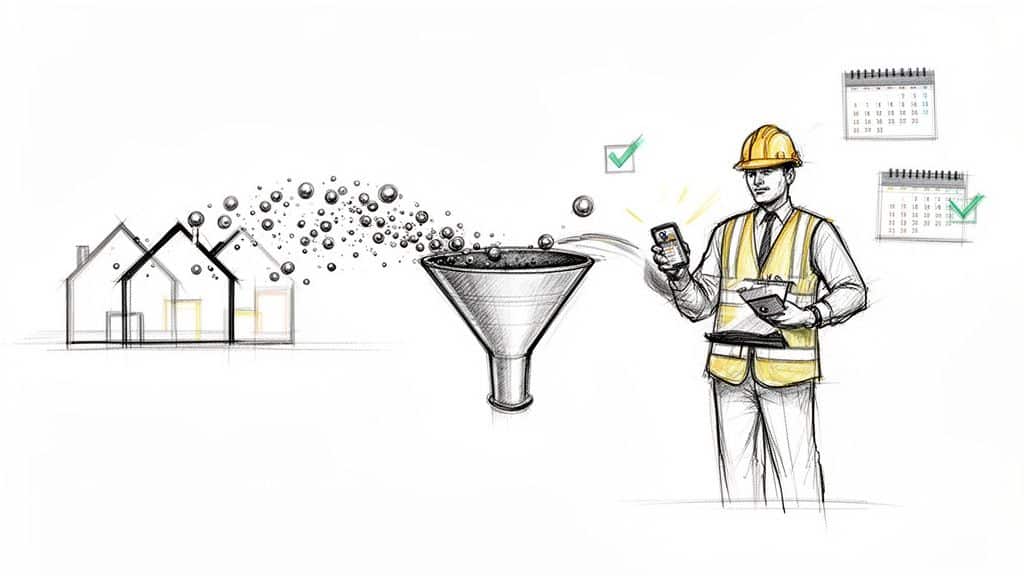
Let's be honest, what's a contractor lead service, really? At its core, it’s a system built to connect you with homeowners and property managers who need your skills right now. Think of it like a fuel delivery service for your business—a predictable way to keep your project pipeline full and put an end to those dreaded slow weeks. These services are the bridge between your expertise and the customers looking for it.
Why a Steady Stream of Leads Is Not a "Nice-to-Have"
Every contractor I know is familiar with the feast-or-famine cycle. One month, you're slammed, turning down work. The next, you're staring at the phone, wondering where the next job is coming from. That kind of rollercoaster workflow isn't just stressful; it kills growth, makes financial planning a nightmare, and puts a hard ceiling on what you can earn. Just waiting for word-of-mouth referrals is a passive game that leaves you exposed to every market dip and seasonal slowdown.
A consistent flow of new opportunities is the engine that drives a contracting business. It’s what lets you be picky about the jobs you take, focus on the high-margin projects you actually want, and build a revenue stream you can actually count on. Without it, you’re always stuck in survival mode, unable to confidently invest in that new truck, hire another crew member, or expand your territory.
Solving Your Biggest Business Headaches
A good lead service isn't just about getting more phone calls; it's about solving the real, day-to-day problems that keep you from growing. It’s a proactive solution to the uncertainty that plagues so many talented tradespeople.
Here are the core problems a solid lead service tackles head-on:
- Killing the Feast-or-Famine Cycle: Instead of waiting for the phone to ring, you get a dependable flow of potential jobs. This smooths out your revenue and makes it a whole lot easier to plan your schedule and cash flow.
- Stopping the Marketing Guesswork: How many contractors throw money at local ads or online listings with no real way to know if it's working? A lead service creates a direct, measurable line between what you spend and the job opportunities you get.
- Giving You Your Time Back: Let's face it, finding and vetting leads is a full-time job in itself. A service does the heavy lifting of finding people who are actually interested, freeing you up to do what you're best at—estimating jobs and getting the work done right.
The real goal here is to turn lead generation from a constant source of anxiety into a reliable business system. It’s about building a predictable pipeline that lets you scale your company with confidence, knowing new work is always coming in.
At the end of the day, putting money into a quality lead service is an investment in your company's stability and future. It's how you shift from just finding work to strategically building a business. When you can keep your team busy with profitable projects, you lay the foundation for lasting success in a tough industry. For any contractor looking to break through to the next level, that shift is everything.
Comparing the Different Types of Lead Services
Trying to figure out contractor lead services can feel like walking into a massive hardware store for the first time. You've got dozens of aisles, each packed with different tools promising to do the job. To cut through the noise, these services really boil down to four main types. Knowing the difference is the key to picking the right tool to grow your business.
Each model offers a unique way to fill your project pipeline. Some hand you the raw materials and expect you to do the processing, while others deliver a finished product, ready to go. Let's break down how each one works.
This map here shows how the right service can smooth out those classic feast-or-famine cycles and pave the way for steady, predictable growth.
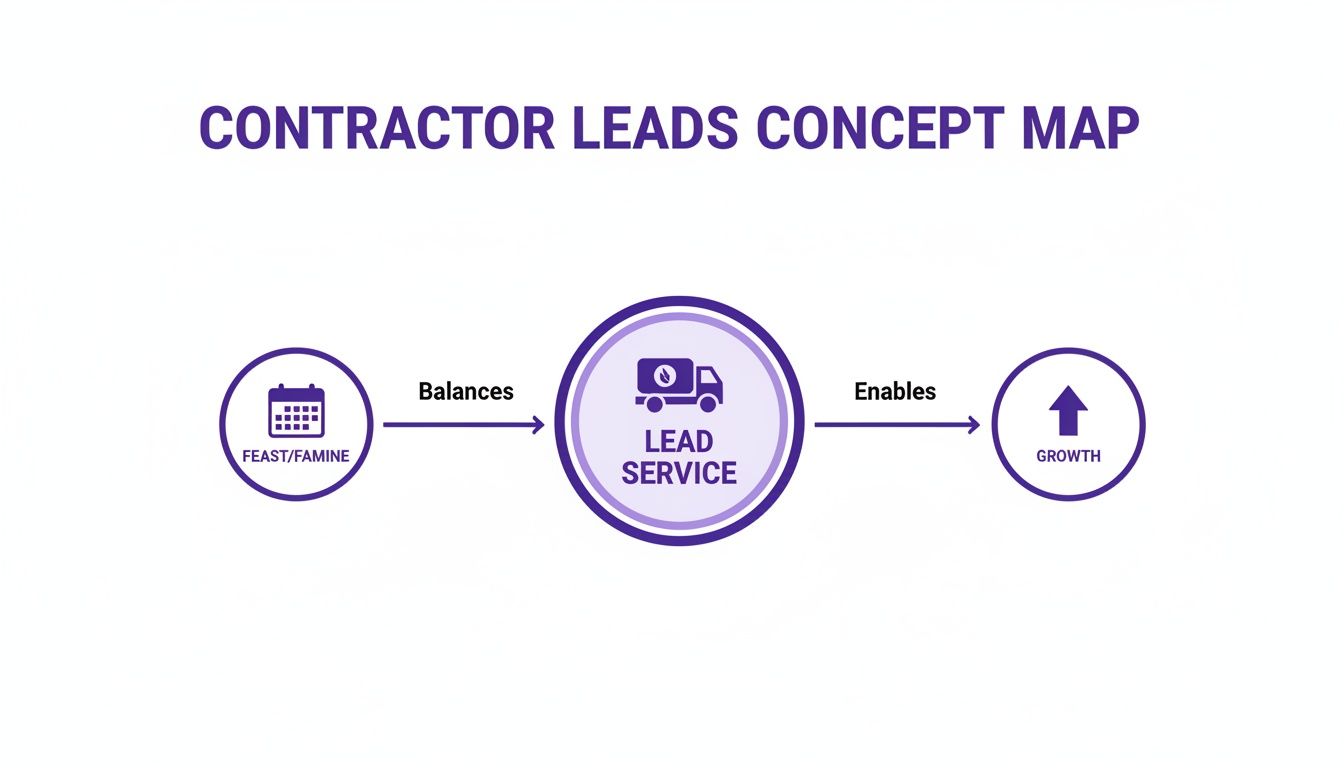
It’s a simple but powerful idea: turning an unpredictable schedule into a reliable fuel source that powers your company’s expansion.
H3: Lead Buying: The Crowded Grocery Store
Buying leads is a lot like grocery shopping at a packed supermarket right before a storm. You get what you need—homeowner contact info—right away, but you’re elbow-to-elbow with a bunch of other contractors all fighting for the same thing.
These services are often called lead aggregators. They’re massive platforms where homeowners submit project details, and the platform then sells that single request to multiple contractors. Simple as that.
This model is popular because you get a high volume of leads, fast. Giants like Angi (formerly Angie's List) and HomeAdvisor process a staggering 30 million service requests annually, making them a common starting point. The catch? Those leads are typically sold to 3-5 different companies. That means you're in a race to the bottom on price, with leads costing anywhere from $20 to over $200. With homeowners getting multiple calls, conversion rates often struggle to get past a tough 6-10%. You can dig into the data on these platforms to see just how competitive it gets.
H3: Full-Service Lead Generation: Your Private Garden
A full-service lead generation agency is more like planting your own garden. It takes a bigger investment upfront and a bit of patience to get things growing—like building up your SEO and running targeted ads—but everything you harvest is 100% yours.
Instead of buying shared leads off a shelf, this model is all about building your brand's own lead-generating machine.
- How It Works: The agency uses digital marketing to pull homeowners directly to your website or a dedicated landing page.
- The Result: When someone fills out a form or calls, that lead is exclusive to you. No competition.
- The Trade-Off: This isn't an overnight fix. It takes time to gain momentum and usually involves a monthly retainer, but the reward is higher-quality leads that are already looking for you.
H3: Appointment-Setting Services: Your Personal Concierge
Appointment-setting services take things one step further. Think of them as your personal concierge—they don’t just find people who might be interested, they actually talk to them, qualify them, and book a confirmed appointment right on your calendar.
This model is built for contractors who are tired of chasing down leads and just want to show up to estimates and close deals.
This is exactly where a service like Phone Staffer's done-for-you cold calling comes in. Instead of just getting a name and a number, our team does the hard work. We handle the outreach, qualify the prospect, and schedule a solid appointment. We turn a cold lead into a hot, quote-ready opportunity.
The biggest win here is pure efficiency. You stop wasting time calling tire-kickers and spend your hours in front of serious customers who are ready to talk business.
H3: Dedicated Remote CSRs: Your Full-Time Restaurant Host
Finally, you have dedicated remote Customer Service Representatives (CSRs). This is like having a full-time host at a busy restaurant. Their job is to greet every guest (every incoming call or web lead), manage the reservations (your schedule), and make sure nobody gets left waiting.
This model gives you a dedicated person who becomes a true part of your team, but without the overhead of an in-house hire.
A remote CSR or Virtual Assistant (VA) placed by a company like Phone Staffer can handle all the front-line communication:
- Answering every single incoming call so you never miss a lead.
- Making outbound calls to follow up on web forms or old quotes.
- Scheduling appointments and managing your calendar chaos.
- Handling admin tasks that eat up your day.
This approach gives you the most control and ensures a professional, immediate response to every inquiry. It turns your lead management from a reactive scramble into a smooth, well-oiled system.
To help you see how these all stack up, here’s a quick comparison.
Comparison of Contractor Lead Service Models
This table breaks down the four main models side-by-side, giving you a clear look at the differences in cost, control, and what kind of contractor each is best suited for.
| Service Model | Typical Cost Structure | Lead Exclusivity | Contractor Effort | Best For |
|---|---|---|---|---|
| Lead Buying | Pay-per-lead ($20 – $200+) | Shared (3-5+ contractors) | High (fast follow-up, competitive quoting) | Contractors needing immediate lead volume and who have a strong sales process to compete on speed and price. |
| Full-Service Lead Gen | Monthly retainer ($1,500 – $5,000+) + ad spend | 100% Exclusive | Medium (reviewing performance, providing feedback) | Established contractors looking to build a long-term, branded asset for high-quality, exclusive leads. |
| Appointment-Setting | Pay-per-appointment or retainer ($100 – $300+ per booked job) | 100% Exclusive Appointment | Low (show up to the estimate) | Contractors who want to skip the chase and spend their time only on pre-vetted, sales-ready appointments. |
| Dedicated Remote CSR | Monthly flat fee or hourly rate ($1,500 – $4,000/month) | N/A (Handles your exclusive leads) | Low (initial training and management) | Contractors who want a fully integrated team member to manage all inbound/outbound calls and scheduling. |
Choosing the right model really depends on your budget, how much time you can commit, and whether you're playing the short game for immediate volume or the long game for sustainable brand growth.
The True Cost of Generating Contractor Leads
When you’re looking at contractor lead services, just glancing at the price tag is like judging a work truck by its shiny paint job—it tells you nothing about what’s under the hood. The real cost of a lead goes way beyond what you pay upfront. It’s a much bigger picture that folds in your time, your team’s payroll, and all the jobs you miss out on along the way.
To figure out if a service is actually worth the money, you have to look past that initial number and calculate your real return on investment. That means getting honest about the numbers and accounting for all the hidden costs that are quietly draining your bank account.
Deconstructing the Price Tag
Contractor lead services usually have a few different ways they charge you, and each one hits your wallet differently. For instance, a pay-per-lead company might bill you $50 to $150 for a single name and number. On the other hand, a full-service agency could ask for a monthly retainer that runs into thousands. Those numbers might seem simple, but they don't tell the whole story.
The two metrics you absolutely need to get your head around are Cost Per Lead (CPL) and Customer Acquisition Cost (CAC). CPL is just what you pay for the contact info. But CAC? That’s the total cost to actually land a paying customer, and it includes the money you spent on all the leads that went nowhere.
Think of it this way: if you buy 10 leads at $100 a pop (that’s a $1,000 investment) but only close one single job from that batch, your CAC is a whopping $1,000. That single number is a much more honest look at your marketing expenses than the initial CPL.
Uncovering the Hidden Financial Drains
Often, the biggest expenses tied to getting new leads are the ones you can't see on an invoice. These "soft costs" can easily add up to more than the price of the leads themselves, silently eating away at your profits and causing a ton of frustration.
Let’s break down the three biggest hidden costs you’re probably facing:
- Wasted Labor on Low-Quality Leads: Every single hour your best salesperson—or you—spends chasing down a shared, unqualified, or just plain bogus lead is an hour you’ll never get back. If you have a team member calling leads that lead to dead ends, their salary is a direct—and major—part of your customer acquisition cost.
- Lost Revenue from Missed Opportunities: A missed call isn't just a missed conversation. It's potentially thousands of dollars in revenue walking right over to your competition. If your team is too swamped to answer the phone right away, every ring that goes to voicemail is a direct hit to your bottom line.
- The High Price of Inflexible Contracts: A lot of lead services lock you into long-term contracts with zero performance guarantees. This means you’re stuck paying a big monthly bill whether you get ten great leads or two terrible ones. That lack of flexibility can become a huge financial anchor, especially during your slow season.
The real cost of a lead isn't the purchase price. It's the total investment of time, money, and resources required to turn that lead into a signed contract. A "cheap" lead that wastes your team's time is far more expensive than a qualified, exclusive appointment that closes quickly.
Understanding these factors is why so many contractors are trying to trim the fat, like figuring out how much a phone answerer can save your business by making sure every valuable call gets answered.
The Shifting Economics of Lead Generation
The market for contractor leads is only getting tougher and more expensive. In 2025, rising costs are the name of the game. We've seen Google Ads cost-per-conversion jump 19% across the board. For certain trades, it’s even worse—HVAC is up 16%, and electrical services have seen a painful 23% spike as of late 2024.
This trend is putting serious pressure on profit margins, especially as more competitors drive up the cost for keywords in the home services space. For you, this means every single marketing dollar has to work harder than ever before. This new reality makes it absolutely critical to invest in services that deliver real efficiency and a high chance of closing the deal, not just a long list of names.
Why Phone Calls Are Your Most Valuable Leads
In the world of home services, a ringing phone is the sound of money. It’s that simple. Sure, web forms and emails have their place, but a live phone call means you’re talking to a customer with a problem right now and a serious intent to hire someone to fix it.
Think about it from your customer’s point of view. When a pipe bursts or the air conditioning gives out in July, they aren't leisurely browsing websites and filling out contact forms. They’re grabbing their phone and calling down a list of contractors until someone—anyone—answers. They need help, and they need it now.

This urgency is what makes a phone lead pure gold. An email can sit in your inbox for hours, but a real conversation lets you connect with the homeowner, understand their issue, and get on their schedule in minutes. Every call you miss is more than a missed opportunity; it’s a job you just handed to your competition.
The Power of an Immediate Connection
There’s a direct line between how fast you answer the phone and whether you win the job. A live conversation accomplishes critical things that a text or email just can’t replicate:
- It builds instant trust. A calm, confident voice on the other end of the line is incredibly reassuring to a stressed-out homeowner. It tells them they’ve found a real pro.
- It lets you qualify them on the spot. You can ask the right questions to figure out the job's scope and see if it's a good fit for your crew, all in a two-minute chat.
- It massively shortens the sales cycle. Forget the endless back-and-forth of emails. You can often book the appointment or even close the sale on that first call.
This is why contractor lead services that focus on generating phone calls or ensuring every ring is answered aren’t just a nice-to-have. They are a fundamental part of a profitable home service business.
The Numbers Don't Lie
The data on phone lead superiority is pretty staggering. Leads from social media or shared lead sites might convert in the low single digits over weeks or months. But a motivated customer calling you directly from a Google search? That's a different beast entirely.
In fact, phone leads that start from a search have been shown to convert at a 40% rate, with the whole process from call to closed deal taking as little as 3-7 days. Even for bigger, planned projects, you’re looking at close rates around 35%, which blows most other channels out of the water.
Think about it this way: A single missed call could easily be a $5,000 job walking out the door. If that happens just once a week, you're looking at $260,000 in lost revenue over a year. That math makes a bulletproof call-handling system a no-brainer.
This is exactly the problem a dedicated service is built to solve. Investing in a professional who answers every call and is trained to turn that inquiry into a booked job is one of the smartest, highest-ROI moves a contractor can make. A professional phone answering service for contractors doesn’t just answer calls; it captures revenue and turns your phone into your most powerful tool for closing deals.
A Checklist for Choosing the Right Lead Service
Picking a partner to help you find more work is a big deal. Get it right, and your business can soar. Get it wrong, and you'll burn through cash with little to show for it. To sidestep the flashy sales pitches and empty promises, you need a solid way to vet potential providers. This checklist gives you the exact questions to ask to cut through the noise and find a partner who’s actually invested in your success.
Think of it like you’re about to buy a new work truck. You wouldn’t just kick the tires and call it a day. You’d look under the hood, check the service history, and definitely take it for a test drive. You need to apply that same level of scrutiny here.
Vet the Leads and Their Origin
The quality of your leads dictates the quality of your results, period. If a company gets cagey about where their leads come from, that's a huge red flag. Your first job is to figure out what you're paying for and, just as importantly, who else is getting the same information.
Start by asking these pointed questions:
- "How many other contractors will receive this exact lead?" This is the single most important question you can ask. Exclusivity is a game-changer.
- "Can you walk me through your lead generation process?" Are they running targeted ads, using SEO, or just scraping data from a list? You have a right to know the source.
- "What specific information do you verify before sending a lead to me?" At an absolute minimum, they should confirm the name, number, service needed, and location.
A reputable service will be an open book about their methods. If they can’t give you a straight answer on lead exclusivity and verification, it’s a clear sign their leads will toss you into a bidding war with five other contractors before you even pick up the phone.
Scrutinize the Contract and Costs
The contract is where a company’s true colors show. Don’t just skim it—read every single line. Pay close attention to the terms, payment schedules, and what happens if you need to bail. Hidden fees and rigid clauses can turn a promising deal into a financial nightmare.
Here’s what to look for and what to ask:
- Term Length and Cancellation Policy: Are you getting locked into a 6- or 12-month contract? Ask them directly, "What are the exact steps and penalties for early termination?" Flexible, month-to-month agreements are a sign that a provider is confident they can deliver.
- Hidden Fees: Beyond the per-lead or monthly cost, are there setup fees, management fees, or any other charges lurking in the fine print? Ask, "Can you provide a complete list of all potential costs not included in the main fee?"
- Performance Guarantees: Does the service offer any kind of guarantee or credit for bad leads, like wrong numbers or jobs way outside your service area? A good partner stands behind their product.
Evaluate Their Support and Onboarding
Even the best lead service is worthless without a system to help you use it. A company that just emails you a list of names and vanishes is a vendor, not a partner. You need a service that actually helps you succeed with the opportunities they send your way.
Gauge their commitment to your success by asking these questions:
- "What does your onboarding process look like?" Will they help you connect their system to your CRM or scheduling software?
- "Who is my dedicated point of contact for support?" Having a consistent person to call is a world away from being stuck with a generic support ticket system.
- "Do you provide any training or resources on how to work these leads?" The best companies offer guidance to help you maximize your ROI.
By using this checklist, you can move past the sales hype and evaluate potential contractor lead services on what really matters: transparency, fairness, and a genuine commitment to helping you fill your pipeline with profitable jobs.
Creating a Winning Lead Management Process
Getting a steady stream of opportunities from contractor lead services is a huge win, but it's only half the battle. A lead is just a potential conversation. Turning that conversation into a signed contract? That takes a disciplined, repeatable process.
Without a solid system, even the best leads will slip through the cracks. It's an easy way to waste your investment and, frankly, hand jobs directly to your competitors.
Think of it like this: a lead is a freshly delivered bundle of lumber. It has all the potential to become a beautiful deck, but it’s useless until you have a blueprint and a team ready to build. Your lead management process is that blueprint. It ensures every opportunity is handled with speed, professionalism, and persistence.
The Blueprint for Initial Contact
In this game, speed is everything. When a homeowner reaches out, their problem is top-of-mind, and their loyalty is completely up for grabs. Your goal is simple: be the first contractor they have a real conversation with. This means having a clear plan for that critical first contact and a follow-up cadence for those who don’t answer right away.
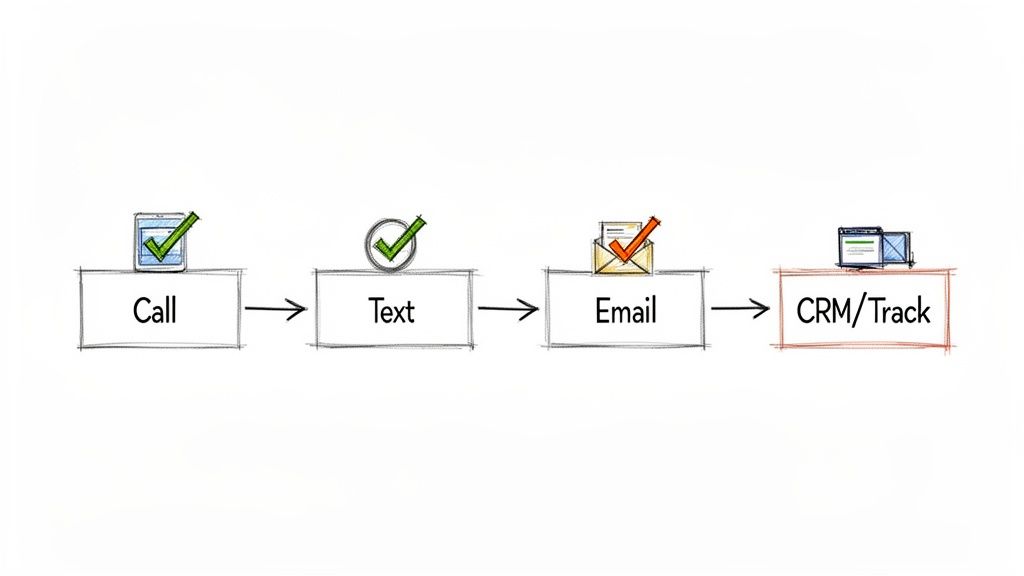
Here’s a simple but incredibly powerful workflow we've seen work time and time again:
- Immediate Call (Within 5 Minutes): The second that lead hits your inbox, call them. This is non-negotiable. If they answer, keep it simple: "Hi [Name], this is [Your Name] from [Your Company]. I saw you were looking for help with [Service]. Is now a good time to chat for a minute about your project?"
- Immediate Text Message (If No Answer): If they don't pick up, immediately send a text. Something friendly and direct works best: "Hi [Name], it's [Your Name] from [Your Company]. Just tried calling about your [Service] request. When is a good time for a quick call back?"
- Immediate Email (Follow-Up): At the same time, send a professional email. This is your chance to introduce your company, drop a link to your website or portfolio, and confirm your interest in their project.
This multi-channel approach maximizes your chances of making contact fast, before they've had a chance to call someone else.
The most expensive lead is the one you never talk to. By systemizing your follow-up, you ensure every dollar spent on lead generation has the best possible chance to produce a return.
Tracking and Measuring What Matters
You can't improve what you don't measure. Honestly, tracking your leads doesn't require a complicated, expensive system. A simple spreadsheet or a basic CRM can work wonders. This is your command center—the place where you log every lead, every contact attempt, and every outcome.
Having a dedicated person, like a remote CSR or virtual assistant, is invaluable for keeping this system running smoothly. If you're considering getting some help, our guide on how to hire a virtual assistant is a great place to start.
To really get a handle on what's working, you only need to focus on a few key performance indicators (KPIs):
- Contact Rate: What percentage of your leads do you actually speak with?
- Appointment Set Rate: Of the people you talk to, how many turn into a scheduled estimate?
- Closing Ratio: What percentage of your estimates become paying jobs?
- Cost Per Booked Job: This is the big one. Your total spend on leads divided by the number of jobs you actually won.
By keeping an eye on these simple metrics, you'll quickly spot weak points in your process. You can then make decisions based on real data, not guesswork, and turn your lead service into a predictable engine for growth.
Answering Your Top Questions
Even after laying out a game plan, a few questions always seem to come up when contractors are weighing their options for lead services. Let's tackle the most common ones head-on so you can decide what's right for your business.
How Many Leads Do I Actually Need?
There’s no magic number here—it all comes down to your own goals. The easiest way to figure this out is to work backward from your revenue target.
Let's say you want to bring in an extra $50,000. If your average job is worth $2,500, you need to land 20 new jobs. Now, if you typically close one out of every four qualified leads you talk to (a 25% closing rate), you'll need 80 solid leads to hit that 20-job goal. This simple math makes it crystal clear: quality beats quantity every single time.
Is It Better to Buy Leads or Pay for a Service?
Buying leads from a big aggregator gets you a list of names fast, but there’s a catch. You're almost always competing with a handful of other contractors for that same customer, which means a race to the bottom on price and much lower closing rates.
On the other hand, paying for a dedicated lead generation or appointment-setting service typically gets you exclusive, high-intent leads that are far easier to turn into paying jobs. For contractors focused on predictable, sustainable growth, a service that puts appointments directly on your calendar almost always provides a better return.
What Is the Biggest Mistake Contractors Make with Leads?
The single most common—and most expensive—mistake is a lack of speed. It doesn't matter if the lead came from a pricey ad campaign or a shared list; if you don't respond within the first 5-10 minutes, your odds of winning the job plummet.
Think about it: a homeowner with a leaking pipe isn't going to wait around. They'll just move on to the next name on their list. This is precisely why having a system or a dedicated person for immediate follow-up isn't just a nice-to-have; it's a complete game-changer for your bottom line.
Stop letting perfectly good opportunities go to your competitors. Phone Staffer can place a trained, remote CSR in your business to answer every call and follow up on every lead the moment it comes in.
Book a discovery call today to build your unstoppable lead management system