

For any home service business, every ringing phone represents a critical moment: a direct line to new revenue, a chance to build lasting loyalty, or a completely missed opportunity. While every customer conversation is unique, success shouldn't be left to chance. A structured framework is essential for delivering a consistent, high-quality experience every single time. Many home service companies struggle with inconsistent lead follow-up, untrained staff handling complex calls, and the high cost of missed opportunities, which directly impacts their bottom line.
This guide provides the solution. It's a comprehensive resource filled with powerful customer service call scripts designed specifically for the home service industry. We will break down seven distinct script templates, moving far beyond simple word-for-word instructions. You’ll find strategic frameworks for handling everything from initial lead qualification and appointment booking to complex issue resolution and tactical upselling. These aren't just scripts; they are replicable systems for turning every customer interaction into a positive outcome. Consider these the blueprints for empowering your team to perform at their peak, ensuring no lead is ever left behind and every customer feels valued.
1. Problem-Solving Script
A Problem-Solving Script is a structured guide designed to help customer service representatives methodically diagnose and resolve customer issues. Unlike a rigid, word-for-word mandate, this script acts as a framework, guiding the agent through a logical sequence of questions and actions. Its primary goal is to ensure consistency, accuracy, and efficiency when tackling complex problems, transforming a potentially chaotic conversation into a systematic troubleshooting process.
This approach, popularized by frameworks like ITIL and platforms such as Zendesk, is essential for maintaining high service standards. For a home service business, this could mean diagnosing a malfunctioning HVAC unit, identifying the source of a plumbing leak, or troubleshooting a faulty security system sensor over the phone before dispatching a technician. The script ensures no critical detail is missed, leading to faster, more effective resolutions.

Strategic Breakdown
The power of a Problem-Solving Script lies in its structured yet flexible nature. Leading companies like Apple use similar systematic protocols at their Genius Bar to ensure every customer issue is diagnosed with the same level of care and precision. The script breaks down the call into distinct phases: information gathering, diagnosis, solution proposal, and confirmation.
This methodical approach prevents agents from jumping to conclusions and empowers them to handle issues confidently, even if they are new to the role. It standardizes the high-quality service you want your brand to be known for.
Key Insight: A well-designed Problem-Solving Script turns every agent, regardless of experience level, into a competent diagnostician. It systematizes empathy and expertise, ensuring customers feel heard and helped, not just processed.
Actionable Takeaways
To effectively implement these types of customer service call scripts, focus on a tiered approach that empowers your team.
- Structure with Flexibility: Build your script around a core set of diagnostic questions, but train agents to listen for cues and deviate when necessary. The goal is a guided conversation, not an interrogation.
- Create Diagnostic "Trees": Map out common issues and create branching paths of questions. For example, if a customer reports "no heat," the script could branch into questions about the thermostat, pilot light, or circuit breaker.
- Include Pause Points: Deliberately build in moments for the agent to say, "Let me repeat that back to you to make sure I understand correctly." This validates the customer's concerns and ensures accuracy.
- Continuously Refine: Regularly review call recordings and outcomes to update the script. Add new solutions and troubleshooting steps as you identify new or recurring customer problems.
2. Empathy and Acknowledgment Script
An Empathy and Acknowledgment Script is a customer service framework focused on building an emotional connection before attempting to solve a problem. Its core principle is to validate the customer's feelings and demonstrate genuine understanding, ensuring they feel heard and respected. This script prioritizes empathetic language and active listening to de-escalate frustration and build trust from the very start of the interaction.
This human-centric approach, famously championed by companies like Zappos and the Ritz-Carlton, is incredibly effective for home service businesses. When a customer calls because their basement is flooding or their air conditioning has died during a heatwave, their emotional state is high. An empathy-first script trains your team to address the customer’s stress first, transforming a tense complaint into a collaborative partnership.

Strategic Breakdown
The power of an Empathy and Acknowledgment Script is its ability to disarm a difficult situation by leading with compassion. Service giants like American Express use this for their premium cardholders, recognizing that emotional loyalty is just as valuable as transactional loyalty. The script guides agents to first acknowledge the inconvenience ("That sounds incredibly frustrating, I understand why you're upset") before gathering any technical details.
This strategy ensures the customer feels like they have an ally, not an adversary. It shifts the dynamic from a confrontation to a shared goal, making the subsequent problem-solving phase smoother and more productive. It’s a deliberate move to put the human element at the forefront of the service experience.
Key Insight: An Empathy and Acknowledgment Script doesn't just solve a problem; it validates the customer’s emotional experience. It proves your company cares about the person, not just the service ticket, fostering deep and lasting brand loyalty.
Actionable Takeaways
To master these types of customer service call scripts, you need to train for emotional intelligence, not just procedural accuracy.
- Front-load with Acknowledgment: Start every script with phrases that validate the customer's situation. For example: "I can only imagine how stressful it is to come home to a leaking pipe. Let's work together to get this sorted out immediately."
- Use Reflective Listening: Train agents to mirror the customer’s language and summarize their concerns. Saying, "So, if I'm hearing you correctly, the main issue is…" shows you are actively listening and care about getting it right.
- Mandate the Use of Names: Make it a rule to use the customer’s name at the beginning, middle, and end of the call. This simple act personalizes the interaction and reinforces that they are speaking to a real person who sees them as an individual.
- Develop an "Empathy Phrasebook": Create a list of approved, non-cliché phrases agents can use to express understanding, such as "That certainly isn't the experience we want for our customers," or "Thank you for your patience as we figure this out."
3. Product Knowledge and Information Script
A Product Knowledge and Information Script is a comprehensive resource that arms customer service representatives with detailed information about a company's services and products. It goes beyond simple FAQs, providing specifications, usage guidelines, and comparative data. The purpose is to transform agents from mere call handlers into trusted advisors who can confidently and accurately answer customer questions, fostering trust and authority.
This approach is heavily utilized by technical and specialized retailers, such as Best Buy's Geek Squad or Home Depot's Pro Desk. For a home service business, this script could detail the differences between various HVAC models, explain the technical specifications of a smart home security system, or outline the benefits of one type of plumbing pipe over another. It ensures every customer receives consistent, expert-level information.
Strategic Breakdown
The strength of a Product Knowledge Script lies in its ability to standardize expertise across the entire team. Leading brands like Tesla use highly detailed internal guides to ensure every sales and service specialist can speak fluently about vehicle specifications, battery technology, and charging options. This empowers agents to handle inquiries with precision, moving beyond basic service offerings to provide genuine consultative value.
This structured information hub prevents agents from giving incorrect or incomplete answers, which can erode customer confidence and lead to costly mistakes. It ensures that even the newest team members can discuss complex services like a seasoned professional, directly impacting customer satisfaction and sales conversions.
Key Insight: A robust Product Knowledge Script transforms your customer service team into a de facto sales and education department. It systematizes expertise, ensuring every customer interaction builds value and reinforces your company's authority in its field.
Actionable Takeaways
To create effective customer service call scripts focused on product knowledge, you need to build a dynamic and accessible information system.
- Develop a Central Knowledge Base: Don't just create a static document. Use a searchable internal wiki or database that agents can quickly access during a call. Organize information by service type, product model, and common customer questions.
- Use Tiered Information: Structure information in layers. Start with top-level benefits and common use cases, then allow agents to "drill down" into technical specifications, warranty details, and compatibility information as needed.
- Incorporate “Why” Scenarios: Don't just list features; explain the benefits. For example, instead of just stating a water heater's tank capacity, explain what that capacity means for a family of four. This helps customers make informed decisions.
- Train with Real-World Comparisons: Prepare agents to discuss how your services or products compare to competitors. Provide factual, respectful talking points that highlight your unique value proposition without disparaging others.
4. Sales and Upselling Script
A Sales and Upselling Script is a strategic guide that empowers customer service agents to identify and act on revenue opportunities during service calls. It masterfully blends service with sales, ensuring that any offer is presented as a genuine solution to a customer's needs rather than a forced pitch. The goal is to enhance the customer's experience by offering relevant products or services, which in turn drives business growth without sacrificing trust.
This approach, rooted in consultative selling and customer success principles, is highly effective for home service businesses. For instance, while scheduling a standard furnace tune-up, an agent might identify an opportunity to discuss a whole-home air purifier for a customer concerned about allergies. Similarly, a plumber fixing a leaky faucet might suggest a more durable, water-saving model. This turns a routine service call into a value-added consultation.

Strategic Breakdown
The effectiveness of a Sales and Upselling Script comes from its customer-centric approach. Giants like Amazon excel at this by recommending products based on browsing history and past purchases, making the upsell feel like a helpful suggestion. The script guides agents to listen for specific trigger phrases or problems that a premium service or upgraded product could solve.
This method transforms agents from simple order-takers into trusted advisors. By framing offers around benefits like "long-term savings," "improved efficiency," or "enhanced comfort," the conversation remains focused on the customer's well-being. It is a subtle yet powerful way to increase average transaction value while deepening customer loyalty.
Key Insight: The best upselling scripts don't feel like a sale at all. They reframe the interaction from transactional to consultative, positioning your agent as an expert who is actively looking for ways to improve the customer's situation.
Actionable Takeaways
To build effective sales-oriented customer service call scripts, focus on value-driven communication that respects the customer's primary reason for calling.
- Listen for "Trigger" Words: Train agents to recognize cues like "I'm worried about my energy bill," "This keeps breaking," or "Is there a better option?" These are natural entry points for an upsell.
- Frame Offers as Solutions: Instead of saying, "Do you want to buy our premium plan?" try, "Since you mentioned wanting to prevent future breakdowns, our Proactive Maintenance Plan covers all preventative checks and gives you priority service. Would that give you more peace of mind?"
- Create a "Value Matrix": For each common service, map out potential upgrades or related services. List the key customer benefits for each, giving agents a quick reference guide. For more guidance on this consultative approach, see these appointment setting tips.
- Offer Tiered Choices: Present good, better, and best options. This gives the customer a sense of control and makes it more likely they will choose an upgraded option over nothing at all.
5. Complaint Resolution and Recovery Script
A Complaint Resolution and Recovery Script is a specialized framework designed to de-escalate customer frustration and systematically repair service failures. More than just an apology, this script guides agents through acknowledging the problem, empathizing with the customer's feelings, and taking ownership to find a solution. Its core purpose is to transform a negative experience into an opportunity to demonstrate commitment and rebuild trust, a concept known as service recovery.
This approach is heavily influenced by best practices from the hospitality industry and is critical for any home service business. Whether a technician was late, a repair was incomplete, or there was a billing error, this script provides a reliable path to retain at-risk customers. It formalizes the process of turning a complaint into a moment of truth that strengthens customer loyalty rather than dissolves it.
Strategic Breakdown
The effectiveness of a Complaint Resolution and Recovery Script is rooted in its psychological structure. Renowned service leaders like Nordstrom and JetBlue have built their reputations on similar principles, empowering their teams to resolve issues decisively. The script moves the conversation from accusation to collaboration, focusing on listening and validating the customer's experience before jumping to solutions.
This structured empathy prevents agents from becoming defensive and ensures the customer feels heard and respected. For a home service business, this means turning a customer upset about a messy work site into a advocate who praises your company's accountability. These customer service call scripts are essential for managing brand reputation in real time.
Key Insight: Effective complaint resolution isn't about proving the company was right; it's about making the customer feel whole again. This script codifies empathy and empowerment, turning your frontline team into brand ambassadors, especially when things go wrong.
Actionable Takeaways
To implement a powerful complaint recovery process, focus on empowering your agents and learning from every interaction.
- Implement the L.A.S.T. Method: Train agents on a simple, memorable framework: Listen to the customer's full story without interruption, Apologize sincerely for their negative experience, Solve the problem by offering a fair and immediate resolution, and Thank them for bringing the issue to your attention.
- Empower with Resolution Authority: Give your agents a clear "menu" of solutions they can offer without needing a manager's approval, such as a partial refund, a discount on future service, or a free follow-up visit. This speeds up resolution and shows trust in your team.
- Document for Pattern Analysis: Every complaint is data. Use your CRM to log the details of each issue. Regularly analyze this data to identify recurring problems, whether it's a specific piece of equipment failing or a need for better technician training.
- Always Follow Up: After a solution has been implemented, schedule a follow-up call or email a few days later to ensure the customer is truly satisfied. This final step reinforces your commitment and often cements their loyalty.
6. Technical Support Troubleshooting Script
A Technical Support Troubleshooting Script is a highly structured, systematic guide used by customer service agents to resolve technical issues. More than just a simple Q&A, this script is a logical process map that guides an agent through diagnosing complex problems, from identifying initial symptoms to implementing a verified solution. Its core purpose is to standardize the troubleshooting process, ensuring every customer receives the same high level of methodical support, regardless of which agent they speak to.
This methodology is the backbone of support for major software companies like Microsoft and telecommunications giants like internet service providers. For a home service business, this script is critical for walking a customer through fixing a smart home device connection, resetting a digital thermostat, or troubleshooting a Wi-Fi-enabled appliance. It empowers agents to solve problems over the phone, often preventing the need for a costly and time-consuming truck roll.
This infographic outlines the core workflow of an effective troubleshooting script, showing how an agent moves from initial questioning to resolution or escalation.
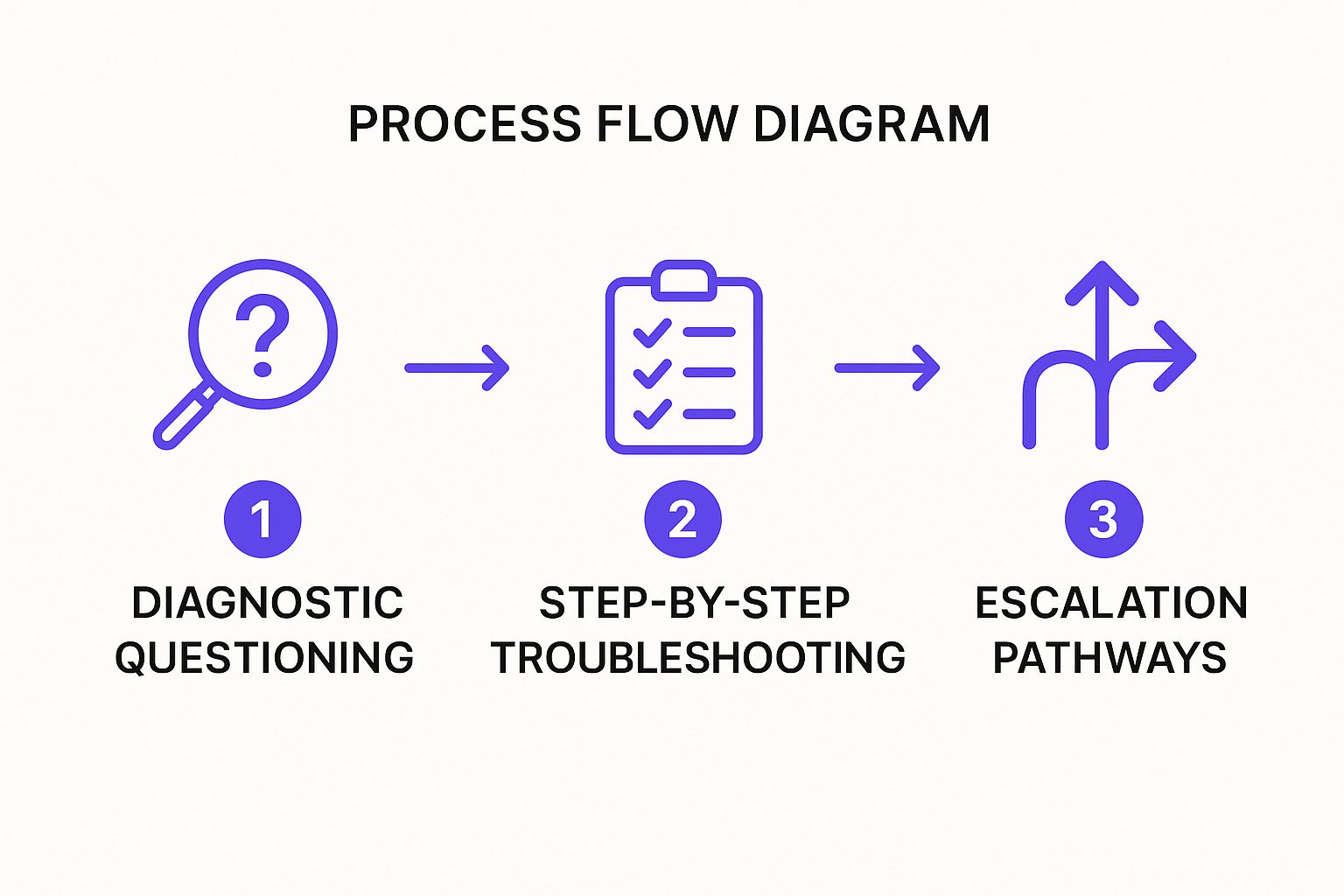
The visualization highlights how a structured flow ensures no step is missed, creating a consistent and reliable support experience for the customer.
Strategic Breakdown
The effectiveness of a Technical Support Troubleshooting Script comes from its logical, tiered structure. Tech giants like Cisco use these detailed protocols to troubleshoot vast and complex networking equipment, proving the model's scalability. The script breaks down a technical problem into manageable parts: verifying the basics, isolating the variable, testing a solution, and confirming the fix.
This systematic process builds customer confidence as they are guided through a logical set of steps, rather than random suggestions. It also serves as an invaluable training tool, enabling newer agents to handle technical calls with the poise and accuracy of a seasoned expert.
Key Insight: A robust troubleshooting script codifies expertise, turning complex technical diagnostics into a repeatable, step-by-step process. This empowers agents to resolve issues confidently and efficiently, boosting first-call resolution rates and customer trust.
Actionable Takeaways
To build powerful technical support customer service call scripts, focus on creating a clear, logical, and repeatable process.
- Start with the Simplest Fix: Structure your script to check for the most common and simple solutions first (e.g., "Is it plugged in? Have you tried turning it off and on again?"). This resolves a surprising number of issues quickly.
- Confirm Understanding at Each Step: Build in confirmation checkpoints. After guiding a customer through a step, ask, "Did you see the green light turn on?" This ensures they are following correctly and prevents compounded errors.
- Document Successful Resolutions: When an agent finds a new solution to a problem, create a process for adding it to the script. This evolving knowledge base keeps your troubleshooting steps current and effective.
- Provide Preventive Advice: End the call by offering a tip to prevent the issue from recurring. This adds value, reduces future calls, and shows the customer you are invested in their long-term satisfaction.
7. Multi-Channel Consistent Messaging Script
A Multi-Channel Consistent Messaging Script is a framework ensuring your brand’s voice, information, and service quality remain uniform across all customer touchpoints. It’s not a single script but a centralized guide that adapts core messaging for phone calls, emails, live chat, and social media interactions. The goal is to create a seamless and predictable customer experience, no matter how a client chooses to contact your home service business.
This omnichannel approach, championed by platforms like Salesforce Service Cloud and perfected by brands like Disney, is crucial in today's connected world. A customer might see a Facebook ad, email for a quote, and then call to book a plumbing repair. This script framework ensures the promises made on social media align perfectly with the details provided over the phone, preventing confusion and building trust.
Strategic Breakdown
The strength of a Multi-Channel Consistent Messaging Script is its ability to unify the customer journey. Companies like Bank of America use this strategy to ensure a query started on their mobile app can be seamlessly continued with a call center agent who has all the prior context. For a home service business, this means an agent on live chat can see the email thread a customer already had about their faulty air conditioner.
This strategy eliminates the frustration of customers having to repeat themselves. It transforms disparate interactions into a single, ongoing conversation, making your business appear organized, efficient, and deeply respectful of the customer’s time. It’s a core component of modern customer service call scripts that look beyond a single phone call.
Key Insight: Consistency across channels is no longer a bonus; it's a customer expectation. A unified messaging framework ensures that your brand promise is delivered reliably, whether an agent is typing a chat response or speaking on the phone.
Actionable Takeaways
To implement a powerful multi-channel messaging strategy, focus on creating a cohesive system rather than separate, isolated scripts.
- Establish a Core Message Bible: Create a central document outlining your brand voice, key service descriptions, pricing policies, and answers to common questions. This is the single source of truth for all channels.
- Adapt Tone for the Channel: While the core information remains the same, train your team to adapt the format. A phone call can be more conversational, while an email should be clearly structured and a social media reply concise and friendly.
- Ensure Seamless Handoffs: Use a CRM to track all customer interactions. When a conversation moves from email to a phone call, the agent should be able to access the previous communication instantly, creating a smooth transition.
- Audit Across Channels: Regularly review communications from all your channels-phone, chat, email, and social media. Check for consistency in the information and tone provided to ensure your standards are being met everywhere.
7 Key Customer Service Script Types Compared
| Script Type | Implementation Complexity 🔄 | Resource Requirements ⚡ | Expected Outcomes 📊 | Ideal Use Cases 💡 | Key Advantages ⭐ |
|---|---|---|---|---|---|
| Problem-Solving Script | Moderate to High: Requires structured training and updates | High: Extensive agent training and script maintenance | Improves first-call resolution; reduces call time | Tech support, SaaS, electronics manufacturers | Consistent problem-solving; builds customer confidence |
| Empathy and Acknowledgment Script | Moderate: Training in emotional intelligence needed | Medium: Focus on agent soft skills development | Reduces frustration; boosts satisfaction and loyalty | Customer relations, hospitality, premium support | Stronger emotional connection; positive brand image |
| Product Knowledge and Information Script | Moderate: Requires frequent product updates | High: Deep product training and technical knowledge | Accurate info delivery; reduces misinformation | Retail, technical sales, product advisory | Builds brand expertise; supports upselling |
| Sales and Upselling Script | Moderate: Needs skilled conversational training | Medium to High: Training in sales techniques | Increases revenue per interaction; maximizes lifetime value | Retail, finance, software service | Drives revenue; improves agent productivity |
| Complaint Resolution and Recovery Script | High: Complex protocols and authority delegation | High: Requires empowered agents and follow-up processes | Converts unhappy customers; reduces churn | Hospitality, retail, airlines | Protects brand; recovers customer loyalty |
| Technical Support Troubleshooting Script | High: Detailed diagnostics and regular updates | High: Technical training, documentation, and tools | Faster issue resolution; consistent support quality | IT, telecommunications, software support | Systematic diagnosis; builds knowledge base |
| Multi-Channel Consistent Messaging Script | Very High: Requires cross-channel coordination | Very High: Integrated platforms and cross-trained teams | Unified customer experience; reduces confusion | Omnichannel support in finance, entertainment, retail | Consistent brand voice; seamless channel switching |
Putting Your Scripts into Action: From Plan to Profit
Throughout this guide, we've explored seven distinct types of customer service call scripts, from initial lead follow-up and appointment booking to complex complaint resolution and strategic upselling. We’ve broken down the anatomy of effective communication, providing templates that serve as a powerful starting point for any home service business.
However, the most critical takeaway is this: a script is not a cage. It is a blueprint. The templates for problem-solving, empathy, product knowledge, and the others we've covered provide the essential structure and key phrases needed for consistency. But their true power is only unlocked when they are treated as living documents, continuously refined by real-world feedback and delivered by well-trained professionals.
From Static Text to Dynamic Conversations
The ultimate goal of using customer service call scripts isn't to create robotic interactions. It's to build a reliable framework that empowers your team to handle any situation with confidence, professionalism, and efficiency. This framework ensures that even on a busy day, no critical step is missed, every customer feels heard, and every opportunity to book a job or build loyalty is seized.
Key strategic principles to remember:
- Structure Creates Freedom: A solid script frees up a representative's mental energy to focus on listening and connecting with the customer, rather than worrying about what to say next.
- Consistency Builds Trust: When every customer receives the same high level of service, your brand's reputation for reliability grows, which is a massive competitive advantage in the home services industry.
- Training Unlocks Potential: The script is the tool, but training is the skill. Role-playing, call reviews, and ongoing coaching are what transform a good script into a great customer experience and, ultimately, more booked jobs.
The Implementation Challenge for Home Service Owners
We understand the reality for busy home service owners. You recognize the immense value in this structured approach, but the day-to-day demands of managing crews, running jobs, and handling finances leave little time for the intensive work of hiring, training, and managing a dedicated in-house phone staff. This is often the gap where potential revenue falls through the cracks, as missed calls and inconsistent follow-ups lead to lost leads.
This is where you can leverage a specialized solution to implement these proven strategies without adding to your workload. The goal is to ensure every call is answered promptly and professionally, using the exact kind of optimized scripts we've discussed, to turn those calls into profitable appointments on your calendar. This allows you to focus on what you do best: delivering exceptional service in the field.
Do you see the power of these scripts but lack the time to build and manage a team to execute them? The trained, U.S.-based virtual receptionists at Phone Staffer use proven processes to answer every call, convert more leads, and book jobs directly on your schedule. Learn how Phone Staffer can become your dedicated partner in growth, so you can focus on running your business.