

Before you can boost your first call resolution (FCR), you have to give your team the tools, training, and processes they need to actually solve a customer's problem on that first phone call. It all comes down to figuring out why people are calling back, building a rock-solid communication plan, and empowering your team to handle issues without needing to escalate or promise a callback.
Why First Call Resolution Is a Non-Negotiable Metric
For any home service business, a ringing phone isn't just a request—it's the moment of truth. First Call Resolution, or FCR, is simply the measure of how often you fix a customer's issue during that very first conversation. But it's so much more than just a performance stat; it's a direct reflection of your operational efficiency, customer happiness, and, ultimately, your bottom line.
Just put yourself in the customer's shoes for a second. They have a problem, and it's usually an urgent one, like a burst pipe in the basement or a dead AC unit in the middle of July. All they want is to get help, and fast. A high FCR means you're delivering on that core promise.
The Real Cost of a Callback
When a customer has to call you back, the damage is both immediate and widespread. That little bit of time between calls? That’s a golden opportunity for your competitors. A stressed-out homeowner with a flooded laundry room isn't going to sit by the phone waiting for your team to get back to them—they're already dialing the next plumber on their Google search.
Every single unresolved call eats away at customer trust and your company’s good name. We live in a world of online reviews, where one bad experience can quickly turn into a one-star review that scares off dozens of potential customers. The fallout isn't just a single lost job; it's a slow leak that can damage your brand for years.
Industry benchmarks tell us the average call center FCR is somewhere between 70-79%, which means a huge number of customers are forced to call back at least once. Here’s the kicker: for every 1% you improve FCR, customer satisfaction also goes up by 1%. On the flip side, it drops an average of 15% when someone has to make a second contact. With 81% of customers stating that first-contact resolution is crucial for their loyalty, the stakes couldn't be higher. You can learn more about these critical contact center statistics and how they directly affect business growth.
A low FCR rate is a hidden drain on your business. It silently drives up operational costs through wasted labor, tanks team morale by forcing them to deal with angry callers, and practically hands new customers over to your competition.
Before we move on, let's look at a quick comparison to see just how different the business outcomes can be when you focus on FCR.
The Tangible Impact of Low vs High FCR
| Business Outcome | Low FCR (Below 70%) | High FCR (Above 80%) |
|---|---|---|
| Customer Loyalty | High churn rate; customers easily switch to competitors after one bad experience. | Strong repeat business; customers feel valued and confident in your service. |
| Online Reputation | Prone to negative reviews on Google, Yelp, and Angi, citing poor communication. | Generates positive reviews praising quick, efficient, and professional service. |
| Operational Costs | Higher labor costs due to multiple touches per job; wasted time on callbacks. | Lower cost-per-acquisition; streamlined operations with fewer wasted staff hours. |
| Team Morale | CSRs are stressed, dealing with frustrated customers and feeling powerless. | CSRs feel empowered, successful, and contribute directly to company growth. |
| Revenue & Growth | Lost jobs and revenue leakage as customers book with competitors instead. | Higher booking rates, increased job value, and sustainable, profitable growth. |
The table makes it clear: the gap between a low and high FCR isn't just a small operational detail—it's the difference between a struggling business and a thriving one.
From Frustration to Loyalty
Let's paint a picture. A homeowner, panicked by a gushing pipe, calls your plumbing company.
-
Scenario A (Low FCR): The person who answers is unsure about a technician's availability, can't give a clear price range, and has to promise a callback. That homeowner, now even more stressed, hangs up and immediately calls another company. You just lost the job, and probably any future business from them, their friends, and their neighbors.
-
Scenario B (High FCR): The CSR calmly gets the essential details, confirms a technician can be there within the hour, clearly explains the emergency service fee, and sends a confirmation text before hanging up. The customer breathes a sigh of relief, feeling confident they made the right choice. You didn't just book a job; you created a loyal customer who will remember that great experience.
This stark contrast is exactly why mastering FCR is non-negotiable. It turns a simple phone call from a necessary chore into one of your most powerful tools for building lasting customer trust and cementing your spot as the go-to provider in your market.
Getting a Baseline: How to Audit Your Current Call Handling
Before you can fix the leaks in your customer service, you have to find them first. Improving your First Call Resolution (FCR) rate starts with taking a good, honest look at how your team is actually handling calls right now. This isn't about bringing in expensive consultants; it's about establishing a clear starting point so you can make changes that truly matter.
The first thing you need is a number. Let’s calculate your current FCR rate.
The formula is pretty simple: divide the calls you resolved on the first try by the total number of calls you received, then multiply by 100. You can track this on a basic spreadsheet for a week or two just to get a baseline.
(Total Resolved Calls on First Contact / Total Number of Calls) x 100 = FCR Rate
If you're using a CRM, it might already have a feature to help you track this. Don't stress about getting it perfect. A rough number is far better than no number at all, because this is the benchmark you'll measure all your future efforts against.
This isn't just a vanity metric. As you can see below, getting this right has a direct impact on whether a customer trusts you or gets fed up and calls a competitor.
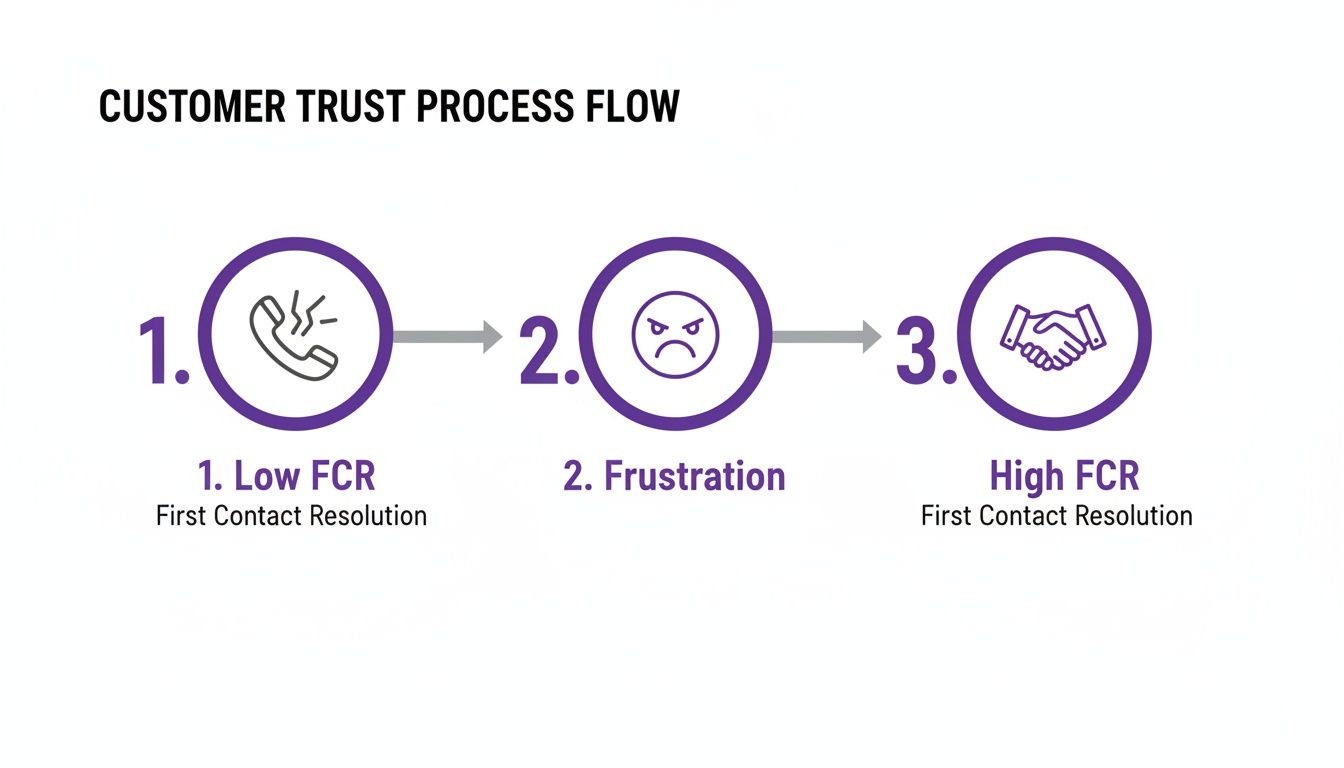
When you fail to solve a problem on that first call, it does more than just waste time—it actively chips away at the customer's confidence in your entire operation.
Pinpointing Why Customers Have to Call Back
Once you have that FCR rate, the real detective work begins. The number tells you what's happening, but now you need to figure out why. A low FCR is almost always a symptom of a deeper problem in your process.
Get your team together—your CSRs, your dispatchers, even a technician or two—and start asking some tough questions. Are customers calling back because your CSRs don't have the right information? Or maybe they don't have the authority to make a simple decision? As you dig in, it helps to compare your current workflow against some proven call center management best practices to see where the gaps are.
I’ve seen it time and again. The biggest reasons for callbacks in home service businesses aren't complicated. It usually boils down to simple gaps in information, authority, or a clear process, leaving both the customer and your CSR stuck.
To guide your investigation, use this checklist. Go through it with your team and be brutally honest about where the friction points are.
Your Low-FCR Diagnostic Checklist
-
Information Gaps:
- Can your CSRs see the technicians' schedules in real-time?
- Are they able to give confident, accurate price ranges for your most common jobs?
- Is key info like service areas and emergency availability right at their fingertips?
-
Process Breakdowns:
- Is your team consistently grabbing all the necessary details on the first call (address, best contact number, description of the problem, appliance model number, etc.)?
- Do you have a rock-solid procedure for handling after-hours or emergency calls?
- Is there a clear path for escalating a complex issue that doesn't require the customer to call back?
-
Empowerment Issues:
- Can your CSRs book appointments directly onto the schedule themselves?
- Are they empowered to offer a small discount or waive a fee to solve a minor complaint on the spot?
- Does your team feel confident answering common questions without having to say, "Let me check with a technician and call you back"?
This checklist will help you get past the FCR score and into the root causes. For example, if you find out your CSRs are constantly putting customers on hold to shout questions about scheduling to a tech across the room, you've found your problem. The fix might be a better scheduling tool or just better training. If pricing questions are the roadblock, it's time to build a clear price book for your team to reference.
For even more ideas on creating a system that never lets a customer fall through the cracks, check out these best practices for perpetual phone response: https://phonestaffer.com/best-practices-for-perpetual-phone-response/
By doing this audit, you're building a focused action plan. You’ll stop guessing and start fixing the real issues that are hurting your FCR, frustrating your customers, and costing you money.
Arming Your Team for First Call Success
Just tracking your First Call Resolution rate is like staring at a scoreboard without ever running a play. To actually win the game, you have to build an environment where success is the default. Your Customer Service Representatives (CSRs) are the architects of your FCR, but they can only build with the tools and blueprints you give them.
Equipping them properly transforms them from simple message-takers into expert problem-solvers. This starts with targeted training that actually reflects the real-world chaos of a home service business. Generic customer service fluff won't help when a panicked homeowner has a backed-up sewer line or a flickering circuit breaker.
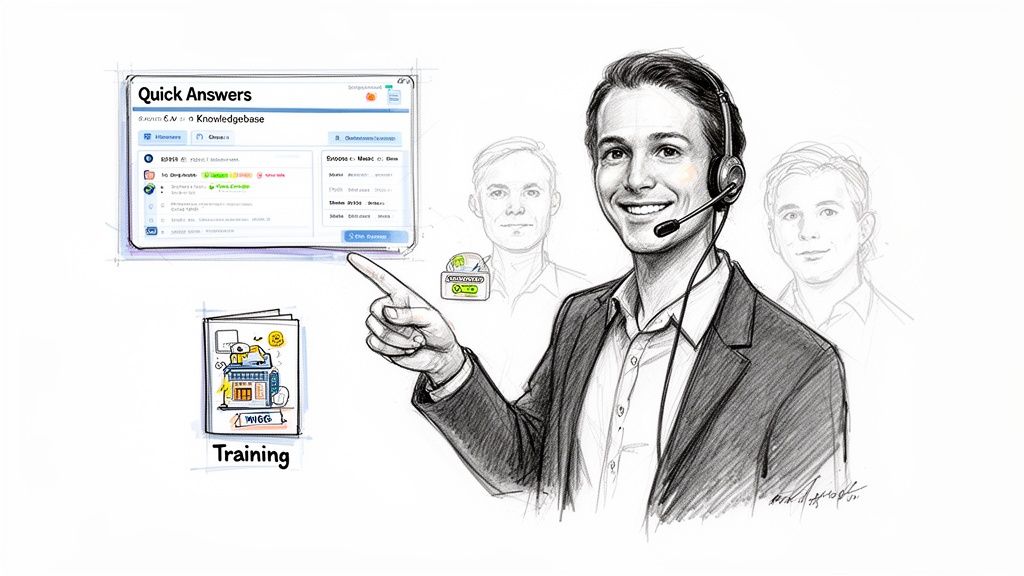
Your training has to be grounded in the day-to-day reality of your operations. I've found that role-playing common scenarios is one of the most powerful ways to build the confidence and muscle memory needed to handle those tough calls.
Core Training Modules for Home Service CSRs
Your training curriculum needs to laser-focus on the most frequent reasons customers call back. By helping your team master these core skills, you can eliminate a huge percentage of repeat calls right from the start.
- Emergency Dispatch Protocol: Train CSRs to calmly and efficiently gather the essential info during a crisis. They need to know how to assess urgency and dispatch the right technician without needing a supervisor’s sign-off.
- Service Quote Confidence: Give your team a clear, easy-to-use price book and train them on how to explain service fees, diagnostic charges, and potential costs. This kills the dreaded, "Let me check on that and call you back," which is a guaranteed callback every single time.
- Navigating Customer Complaints: Teach solid de-escalation techniques and, more importantly, empower your CSRs with the authority to resolve minor issues on the spot. Letting them waive a small fee or offer a discount on a future service can turn a complaint into a 5-star review.
This kind of focused training is the foundation. It gives your team the real-world skills they need to handle the majority of calls without fumbling for answers or escalating unnecessarily.
Building a Living, Breathing Knowledge Base
Look, even your best CSR can't memorize every detail about your services, pricing, and procedures. That’s where a dynamic, easy-to-search knowledge base becomes their most valuable tool. Think of it as your team's collective brain, accessible in seconds.
A great knowledge base isn't a static document you create once and forget. It's a living resource that provides instant, accurate information. This is absolutely critical for maintaining consistency, ensuring every customer gets the right answer no matter who they talk to.
A powerful knowledge base does more than just answer questions. It instills confidence in your CSRs, and that confidence is felt by the customer on the other end of the line. A confident agent creates a confident customer.
Your knowledge base should be the single source of truth for:
- Detailed Service Descriptions: What’s actually included in a standard HVAC tune-up? What are the tell-tale signs of a main drain clog?
- Accurate Service Area Maps: Can we service this address? Are there travel fees for certain zip codes?
- Common Troubleshooting Steps: Simple fixes a customer can try before you dispatch a technician (e.g., checking a circuit breaker, relighting a pilot light).
- Technician Skill Sets: Which plumber is certified for tankless water heaters? Who is your go-to expert on high-efficiency furnaces?
With this information at their fingertips, your CSRs can answer complex questions immediately, turning a potential callback into a one-touch resolution.
Integrating Remote CSRs for Maximum Impact
For many home service businesses, simply managing call volume is a massive hurdle to hitting a high FCR. When your in-house team gets swamped, calls are rushed, details get missed, and callbacks become inevitable. This is where integrating professionally trained remote CSRs can be a total game-changer.
These aren't just overflow operators. A specialized service can provide agents who are already trained in the specific nuances of the home service industry. They know how to qualify leads, book appointments efficiently, and handle that critical first intake with precision. If this is a path you're considering, our guide on how to hire a virtual assistant to handle phone orders walks through the detailed steps.
This kind of strategic partnership directly boosts your FCR by ensuring every single lead gets immediate, expert attention. It frees up your in-house team to focus on more complex customer issues, creating a much more efficient system overall.
The goal is to make every call a "one-and-done" interaction. That mission becomes much more achievable when your team is properly staffed and supported. While the call center industry benchmark for FCR is under 70%, high-performing teams consistently aim for 85% or more. That's a huge deal when you realize repeat calls can eat up 20-30% of a service budget. For a deeper dive, check out how FCR acts as a core operating philosophy to understand its full financial impact.
Building Call Frameworks That Empower Your Team
Throw out your rigid, word-for-word scripts. Seriously. They’re a surefire way to frustrate both your customers and your team. They turn natural conversations into robotic interrogations and stop your CSRs from actually listening and solving problems on the spot.
To genuinely improve first call resolution, you need to ditch the strict script and embrace a more flexible call framework.
Think of a framework as a roadmap, not a cage. It guides your CSRs through the essential checkpoints of a call—like gathering key info and setting clear expectations—while giving them the freedom to adapt, show some empathy, and use their own judgment. The goal is to empower them, not program them.
From Intake to Resolution: A Home Service Framework in Action
For any home service business, every incoming call has a mission: get the right information quickly, understand the customer's need, and get a tech scheduled. A solid framework makes sure no critical details get missed, which is one of the biggest reasons for those annoying, time-wasting callbacks.
Let's walk through a framework for a new customer calling about a leaking water heater. Instead of a script, your CSR has a mental checklist of goals for the conversation.
-
Goal 1: The Essentials. Nail down the customer's full name, complete address (including zip code!), and the best number to call them back on. This sounds basic, but you’d be shocked how often a rushed CSR misses one piece, forcing another call.
-
Goal 2: The Diagnosis. This is where the real work begins. Your CSR needs to ask smart, clarifying questions to understand the scope of the problem. Is it actively leaking right now? Is it a gas or electric unit? Where in the house is it located? This is the information that helps dispatch the right technician with the right parts.
-
Goal 3: Setting Expectations. Clearly communicate what happens next. Explain the dispatch fee, give them the arrival window, and let them know the technician will call when they're on the way. This kind of proactive communication stops the customer from calling back an hour later asking, "So… where's the tech?"
This approach changes the entire dynamic. The call goes from a simple data-entry task to a consultative process. Your CSR isn't just reading lines; they are actively guiding the customer toward a solution, building confidence and control from the very first interaction.
The best call frameworks are built on a simple principle: guide, don't dictate. Give your team the key destinations they need to hit during a call, but let them choose the best route to get there based on the live conversation. This is what fosters active listening and genuine problem-solving.
Mastering Positive Scripting for Those Tougher Calls
Let's be real—not every call is a straightforward booking. Customers call with complaints, frustrations, and sometimes, they're just plain angry. This is where "positive scripting" becomes a critical tool within your framework. It’s all about de-escalating tension and steering the conversation back toward a productive outcome.
Positive scripting isn’t about being fake or plastering on a smile. It’s about consciously choosing words that show you're competent and ready to help, instead of words that create conflict or uncertainty.
Let’s look at two ways a CSR could handle a customer who's upset about a technician running late.
| Negative Phrasing (What to Avoid) | Positive Phrasing (What to Use) |
|---|---|
| "I don't know where the tech is." | "Let me check the GPS for you right now." |
| "You'll have to wait for him to call." | "I can see he's just finishing his current job and will be heading your way next. I'll have him call you with a precise ETA." |
| "I can't do anything about the traffic." | "I completely understand your frustration. While I can't control the traffic, I can make sure you're our technician's very next stop." |
The difference is subtle but incredibly powerful. The negative phrases are conversational dead ends; they shut things down and offer no path forward. The positive phrases, on the other hand, are all about action. They prove to the customer you're on their side and actively working to fix their problem.
When you build these positive language patterns into your call frameworks and training, you give your team the tools to handle difficult situations with grace. This not only helps you achieve first call resolution on a complaint but can often turn a bad experience into a great one, saving the customer relationship and protecting your hard-earned online reputation.
Pairing Smart Tech with the Right People
Great training and solid processes are the bedrock, but even the best team can get bogged down by clunky, outdated systems. To really move the needle on your first call resolution, you have to marry that human expertise with the right tech and, sometimes, the right partners. These aren't just add-ons; they're force multipliers that clear up workflows and put crucial information at your team's fingertips exactly when they need it.
This isn't about chasing some crazy-expensive, enterprise-level software. It’s about being smart and deploying accessible tools that give you an outsized bang for your buck on day-to-day operations and, most importantly, on your customer's experience.
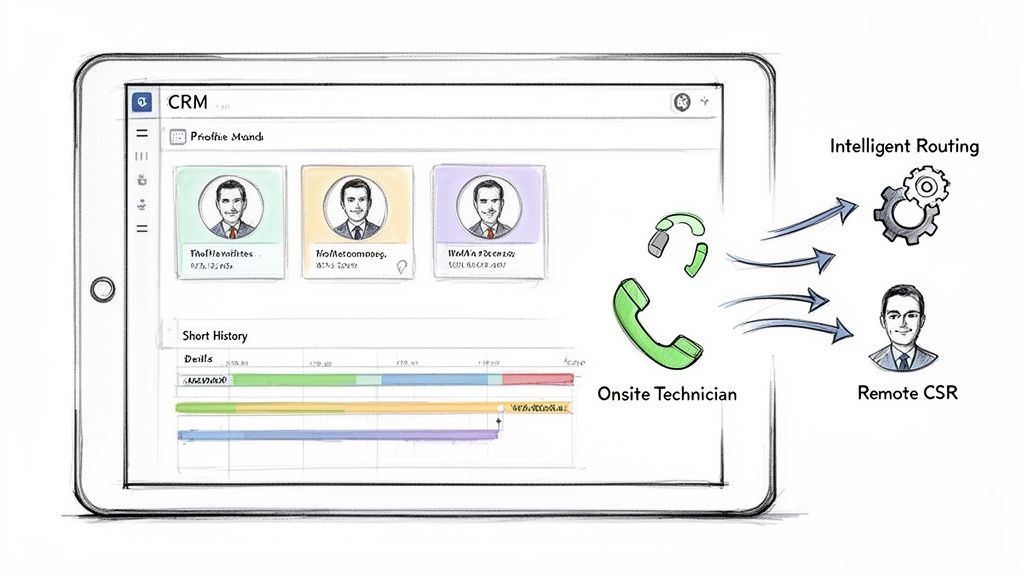
Squeezing Every Drop of Value from Your CRM
Your CRM should be so much more than a digital Rolodex. Think of it as the central nervous system for all your customer interactions. When it's set up right, it's a goldmine of information that directly fuels a higher FCR by killing the need for customers to repeat their life story every time they call.
Picture this: a customer calls in for the second time. Instead of the dreaded, "Have you worked with us before?" your CSR's screen instantly pops up with their entire history—every past job, notes from technicians, old quotes, even a mention that they prefer working with "Steve." That immediate context lets your CSR skip the interrogation and get straight to the solution.
A great CRM transforms your CSR from an interrogator into an informed advisor. It provides the full customer story upfront, allowing for a faster, more personal, and ultimately more effective conversation that gets resolved on the first call.
To make your CRM a true FCR powerhouse, nail these key features:
- Complete Customer History: Make it a rule that every single interaction, from the first call to the final payment, gets logged in one place.
- Integrated Scheduling: Your CSRs must be able to see real-time tech availability and book appointments directly in the CRM. No more "Let me check and call you back."
- Pop-Up Caller Info: Most modern phone systems can talk to your CRM. Set it up so an incoming call automatically pulls up the customer’s record on the screen. It's a game-changer.
The Simple Power of Intelligent Call Routing
Think about how many callbacks are caused by a customer getting passed around like a hot potato. Intelligent call routing, a feature in most modern phone systems, is the cure. Instead of every call landing in a single bucket, the system smartly directs callers to the right person based on who they are or what they need.
This isn't overly complex tech, but it can make a massive difference.
For instance, a call from a brand-new number can be routed directly to your sharpest, most sales-savvy CSR. A call from a known customer with an outstanding invoice? Send them straight to your office manager. This simple bit of logic stops the internal shuffle and connects the customer with the person most likely to help them from the get-go.
The Strategic Edge of Outsourced Talent
Sometimes, the biggest obstacle to a killer FCR is just plain old bandwidth. When your team is swamped, calls get rushed, key details get missed, and callbacks become inevitable. This is where bringing in a specialized outsourced team can be a brilliant strategic move.
This isn't about replacing your loyal in-house staff. It’s about strategically offloading certain types of calls so your core team can focus on what they do best: handling complex customer issues and managing your techs. You can see a detailed breakdown of how this works by learning more about an outsourced receptionist for home service businesses.
Here’s what that powerful one-two punch looks like in practice:
- Outsourced Team for New Leads: A dedicated team can handle all the initial lead intake and appointment setting. They’re experts at qualifying new callers, gathering the essential info, and getting the job on the board, fast.
- In-House Team for Existing Customers: With all the new bookings handled, your experienced in-house CSRs are freed up. They have the time and mental space to dive deep with existing customers, troubleshoot tricky situations, and manage dispatch with total precision.
This division of labor creates an incredibly efficient machine. New leads are captured without fail, and your veteran team has the capacity to deliver the kind of one-call resolutions that turn customers into lifelong fans. When you combine smart tech with smart staffing, you build a system where first-call success becomes the standard.
Got Questions About First Call Resolution? We’ve Got Answers.
As you start digging into first call resolution, you're going to have questions. That's a given. Improving this metric is a journey, not an overnight fix, and getting clear on the common sticking points is the only way to make real, lasting progress.
We hear the same questions from home service owners all the time. Here are the straight-up answers you need to get moving in the right direction.
What’s a Good First Call Resolution Rate, Really?
You might see generic call center stats that put a good FCR somewhere between 70-75%. For a home service business? That's not nearly good enough.
When a pipe bursts or the AC dies in July, your customers aren't just calling for a casual inquiry; they need help, and they need it now. Their patience is thin.
In our world, a "good" FCR starts north of 75%, but the businesses that are really crushing it are hitting 80% or higher. For emergency jobs, a high FCR isn't just a nice-to-have metric—it's how you keep customers. Every time you have to call a customer back, you're practically daring them to call your competitor.
The standard benchmarks don't tell the whole story for home services. The stakes are higher, customer stress is through the roof, and the odds they'll wait for a callback are next to zero. Aiming for an elite FCR isn't about bragging rights; it's about survival.
How Can a Remote CSR Actually Improve My FCR?
This is one of the most common questions we get, and the answer is simple: bringing on a professionally trained remote CSR is one of the fastest ways to see a jump in your FCR. Think of them less as an answering service and more as a strategic part of your team, dedicated to efficiency and making sure no lead ever slips through the cracks.
Here’s how they make an immediate impact:
- They Answer Every Single Time: A dedicated remote CSR means every call gets picked up by a real person. This instantly solves the problem of missed calls when your in-house team is on another line or out of the office.
- They Arrive Fully Trained: The best remote teams are already experts in the home service industry. They know the right questions to ask, how to qualify a lead, and how to gather all the critical details from day one.
- They Gather Intel Upfront: By handling the booking process and answering common questions right away, they collect all the necessary info on the first call. This nearly eliminates the need for your team to play phone tag just to get basic job details.
This frees up your key people to focus on the more complex jobs and escalations, making your entire operation run smoother.
What's the Very First Thing I Should Do to Improve FCR?
Before you buy software or overhaul your entire process, you have to do one thing: figure out where you stand right now. You can't improve what you don't measure.
Your first step is to get a baseline. It doesn't have to be fancy. Just track your calls for one full business week.
- Grab a spreadsheet and count the total number of incoming service calls.
- Next, track how many of those calls were completely handled without needing anyone to call the customer back.
- Do the math to find your percentage. That’s your FCR.
Got the number? Great. The next move is to figure out why the callbacks are happening. If you record calls, listen to a few. If not, just ask your CSRs: "What are the top three reasons you have to tell a customer you'll call them back?" Is it for pricing quotes? To check a technician's schedule? For technical questions they can't answer?
This is your starting point. This data stops the guesswork and shows you exactly where the leaks are in your process so you can fix the real problems.
At Phone Staffer, we provide professionally trained, remote CSRs who specialize in the home service industry. We handle lead generation and appointment setting so you can focus on what you do best. If you're ready to stop missing calls and start improving your FCR today, see how Phone Staffer can help.