
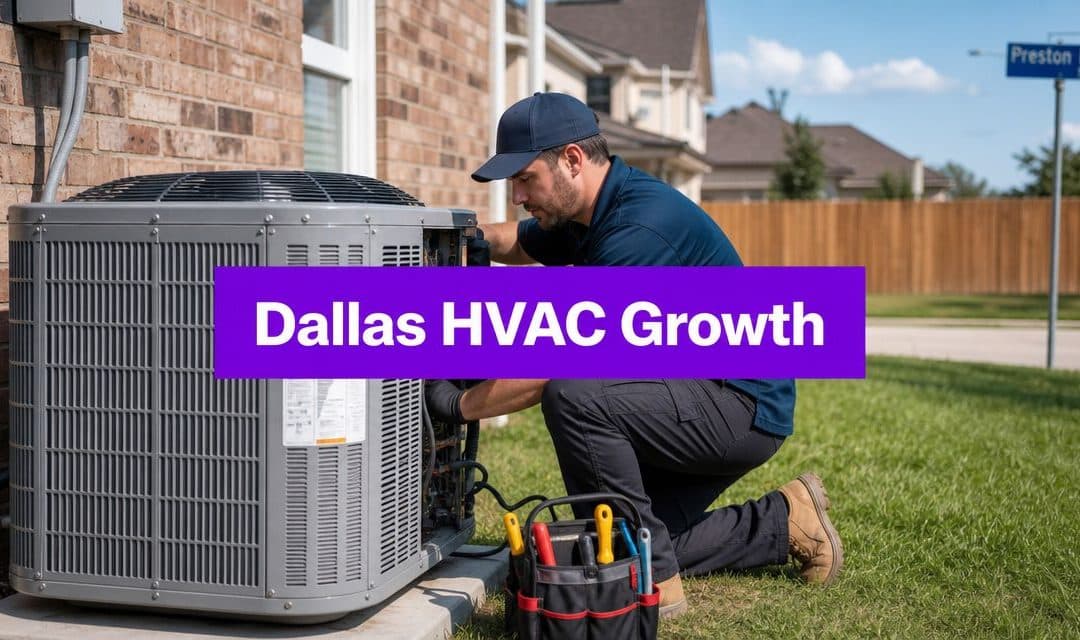
Your dispatch board looks decent on Monday. By Thursday, two technicians are waiting on work, one installer has a gap after lunch, and the phone is only ringing for shoppers comparing prices. That pattern is common in Dallas because too many HVAC companies build their marketing around breakdown demand and hope the weather carries the month.
A stronger plan pulls from two directions. Inbound marketing captures homeowners who are already searching for help. Outbound calling creates booked maintenance, tune-ups, IAQ visits, replacement follow-up, and lapsed-customer reactivation before the schedule softens. In Dallas, that second piece gets ignored far too often, even though it can steady revenue between peak swings.
The Dallas-Fort Worth market is large, crowded, and full of capable operators. The area also supports a huge HVAC workforce, with 10,060 HVAC workers in the metro, so generic claims like fast service and free estimates do very little to separate one company from the next. If your message sounds like everyone else, your only remaining differentiator is price, and that is a bad place to compete.
HVAC service in Dallas, TX needs a tighter system. Your local visibility has to produce calls, your reviews have to reduce hesitation, your paid ads have to protect margin, and your outbound team has to create opportunities your competitors leave on the table. That is how you keep trucks moving in peak season and in the slower weeks that expose weak marketing.
Your Blueprint for Winning in Dallas
Dallas is not a thin market. It's a dense, mature one.
Independent industry data puts the U.S. HVAC market at $30.41 billion in 2023, with more than $10 billion annually spent on repairs and maintenance. The same dataset lists 146,075 HVAC establishments in 2023, up from 119,635 in 2018, and names Texas as one of the top three states for HVAC business density with 9,096 businesses in this HVAC industry market summary. That tells you two things right away. Demand is real, and competition is not going away.
Most owners respond the wrong way. They chase volume. They buy broad-match clicks, stuff every service into one page, and train CSRs to answer calls instead of booking outcomes. Then they wonder why revenue feels unstable even when lead count looks decent.
The shops that win in Dallas usually do a few simpler things much better:
- They narrow their message. Their website speaks to the exact problems Dallas homeowners deal with, not generic HVAC language lifted from manufacturer brochures.
- They remove uncertainty. Their reviews, call handling, and service page copy answer practical questions before the customer asks them.
- They match marketing to operations. They don't scale ad spend faster than they can schedule, route, and complete jobs profitably.
- They create demand proactively. They don't wait for the weather or Google to decide whether the phone rings.
Practical rule: Don't market for “more leads.” Market for more booked, profitable jobs that your team can complete without chaos.
One Dallas-area operator I've seen follow this model didn't try to dominate every service at once. They tightened one local service page, cleaned up their Google Business Profile, and started calling past customers for maintenance scheduling before peak season. The result wasn't flashier branding. It was a steadier board and fewer dead gaps between demand spikes.
That's the playbook for HVAC service in Dallas, TX. Build the foundation first. Then add channels that make the calendar more predictable.
Build Your Digital Foundation in Dallas
A generic HVAC website fails in Dallas because it treats every visitor like they have the same problem. They don't.
Some require service because the system is down. Others are trying to figure out whether a noise, airflow issue, or hot-weather behavior means they need service. A Dallas-focused HVAC article points out that popping noises can be normal as ductwork adjusts to temperature changes, and it recommends basic checks like breakers and power switches before assuming the unit has failed in this Dallas HVAC troubleshooting article from Aire Serv. That kind of nuance is what most local pages miss.
Build one service page that actually converts
Your HVAC service Dallas TX page shouldn't read like a broad “about our company” page. It should work like a dispatcher on your best day. It needs to sort urgency, answer common homeowner doubts, and move people toward a call or booking request.

A page that performs well usually includes:
A direct opening above the fold
Say what you do, where you do it, and how the customer takes the next step. Don't make them hunt for a phone number or form.Dallas-specific symptom language
Use headings around real homeowner concerns. Strange noises. Weak airflow. Unit running but not cooling enough. Repeated cycling. Basic checks before service.A clear “normal vs abnormal” section
This is a trust-builder. If everything is framed as an emergency, the copy sounds salesy. If you explain what may be routine and what deserves prompt attention, you sound credible.Proof near the call to action
Put reviews, service area language, and process expectations right next to the booking action.
A practical structure looks like this:
| Page section | What it should do |
|---|---|
| Hero section | State HVAC service in Dallas, TX, the service area, and the booking action |
| Symptoms section | Help the visitor self-diagnose without overpromising |
| Process section | Explain what happens after they call |
| Trust section | Show reviews, licensing, brands serviced, neighborhoods served |
| FAQ section | Answer arrival times, pricing expectations, maintenance questions |
If you want a stronger blueprint for pages built to attract transactional HVAC customers, study how the page intent is tied to service intent, not just keyword placement.
Turn your Google Business Profile into a booking asset
Your Google Business Profile is often the first thing a Dallas homeowner sees. Treat it like a sales page, not a directory listing.
Use complete service categories. Add real photos from service calls, trucks, team members, and recognizable Dallas neighborhoods. Write service descriptions that sound local and practical. Keep hours accurate. Use posts to answer common concerns and seasonal maintenance questions.
A weak profile says, “We do heating and cooling.” A strong one says, “Here's what happens when you call, what we service, where we work, and why people trust us.”
The best GBP profiles reduce friction before the first call. They answer the customer's unspoken question: “If I contact this company, will this be easy?”
One useful reference point is this guide on home service lead generation strategies, especially if you're trying to connect your website, maps presence, and appointment flow into one system instead of treating them as separate tactics.
What doesn't work
A lot of Dallas HVAC sites still rely on the same tired formula:
- Thin location pages with city names swapped in
- Stock photos only and no real team or truck visuals
- Vague service menus that don't explain what the customer should do next
- No operational detail around arrival windows, communication, or parts delays
That setup may rank for some low-value terms or brand searches. It rarely becomes the obvious first choice.
Earn Trust with Citations and Five-Star Reviews
Trust beats discounts in this category more often than owners think. Homeowners don't just want a cheaper invoice. They want to feel sure the company will show up, communicate clearly, and not create a second headache.

A North American survey summarized by FieldBoss found that 38% of HVAC customers named communication or process problems such as scheduling difficulty, late arrivals, or lack of updates as their top frustration, which was more than the share frustrated by price alone in this review of HVAC customer frustrations. That should change how you think about reviews, citations, and even how you respond in public.
Clean up your citations first
Before chasing more reviews, make sure your core business information matches everywhere it appears. That means your name, address, phone number, hours, and service area should be consistent across Google, Yelp, Angi, BBB, and any major local directories you still appear in.
This sounds basic, but mismatched listings create doubt. If one site shows old hours, another shows an outdated phone number, and a third uses a slightly different business name, the customer starts asking whether your operation is buttoned up.
Use a simple review of:
- Primary data such as business name and main phone
- Service area wording so Dallas neighborhoods and surrounding areas are described consistently
- Business categories so your listings align with what you want to sell
- Photo freshness because old branding or retired trucks lowers confidence
Review responses are sales copy in disguise
The customer reading your reviews isn't judging only the stars. They're judging whether dealing with your company will feel organized.
That means your response style matters. Good responses mention scheduling, communication, technician professionalism, follow-through, and expectation-setting. Bad responses say “Thanks for your business” and nothing else.
A strong reply to a positive review might sound like this in substance: glad the customer received status updates, glad the technician explained options clearly, glad the repair was handled without surprises.
A strong reply to a negative review should show process, not defensiveness. Confirm that you're reviewing the appointment details. Acknowledge the missed expectation. State that the team is following up directly.
Here's a useful gut check. If your public responses only talk about price or quality, you're probably ignoring the exact trust signals prospects care about most.
Build a review workflow your team can repeat
Reviews don't come from hope. They come from timing and ownership.
A practical workflow looks like this:
- Ask right after resolution when the customer has felt the relief of the issue being handled
- Use the technician handoff so the request feels personal, not automated
- Follow with one text or email tied to the actual service date
- Route unhappy customers internally first so the office can solve the issue before it hardens into a public complaint
Customers read review responses to see how you behave when something goes wrong.
That's especially important in Dallas, where HVAC urgency creates stress fast. Reviews should show that your company communicates like a professional service business, not a mystery box.
Generate Immediate Calls with Targeted Paid Ads
Paid ads are useful when you need demand now, but Dallas HVAC owners get into trouble when they buy visibility before they've fixed response speed and dispatch flow.
For HVAC service in Dallas, TX, operational benchmarks matter. FieldPulse highlights first-time fix rate as a core metric and notes that a healthy target is 80%+. It also points to 3–5 completed jobs per technician per day, depending on service area and job type, while emphasizing average response time and booking rate as core service KPIs in this HVAC performance metrics guide. If your office is slow to answer, your dispatching is loose, or your technicians need repeat trips for common issues, ads won't fix the economics.
Local Services Ads versus Search Ads
Owners usually ask which is better. The answer is that they solve different problems.
Google Local Services Ads are often the better fit when you want calls from people who need a provider quickly and are comfortable choosing from a short list of trusted local options. The lead arrives warmer, and the ad unit itself carries trust signals.
Google Search Ads give you tighter control over keywords, landing pages, messaging, and service segmentation. They're usually better when you want to route a specific search intent to a specific offer, such as repair, maintenance, or replacement.

A simple way to put it:
| Ad type | Best use case | Main strength | Main risk |
|---|---|---|---|
| Local Services Ads | Fast-turn service demand | High-intent lead flow | Weak operations waste lead value |
| Search Ads | Tight offer control | Better page-message match | Easy to overspend on broad traffic |
What the landing page has to do
A Dallas HVAC ad doesn't need a clever landing page. It needs a page that removes hesitation fast.
The best ones usually include:
A headline tied to the ad intent
If the ad mentions service, the page should not open with an installation pitch.One main action
Call now or book now. Not six buttons competing for attention.Service area cues
Mention Dallas and nearby neighborhoods naturally.Process reassurance
Explain what happens after contact. Will the office confirm? Will the customer get updates? What if a part is delayed?
Many HVAC companies lose money. Their ads promise speed, but the page says almost nothing about what the customer experiences after submission.
A practical ad trade-off
If your team handles urgent calls well, LSAs can help capture immediate demand. If your business needs more control over what kind of lead comes in, Search Ads usually give you more room to shape intent and pre-qualify traffic.
The mistake is trying to run both aggressively before the office can support them. I've seen campaigns look weak when the underlying problem wasn't the ad account. It was a callback lag, poor intake notes, and unqualified scheduling.
Don't raise ad budget until the office can turn a lead into a booked appointment quickly and dispatch can support the promise made in the ad.
Paid media works best when operations and marketing are speaking the same language.
Fill Your Schedule with Proactive Outbound Calling
The easiest way to stay reactive is to wait for weather and Google. The harder but better move is to create your own pipeline, especially when the board starts thinning out between seasonal spikes.
One of the most reliable outbound angles for HVAC is preventive maintenance. A Dallas commercial HVAC source reports that regular maintenance can reduce energy costs by 15–20% annually, extend equipment lifespan by 40–50%, prevent 85% of emergency breakdowns, and often deliver 300–500% ROI over equipment lifetime in this Dallas maintenance ROI article. That gives your callers a real reason to call that isn't pushy. The message isn't “Do you need service today?” It's “Would you like to reduce the odds of an expensive breakdown and improve performance before peak demand?”

What a useful outbound campaign looks like
A Dallas HVAC company in a slower shoulder season doesn't need callers hammering through a generic script. It needs a list, an offer, and a routing plan.
A smart campaign starts with neighborhoods or zip code bands that make operational sense. The office already knows where trucks can stack jobs efficiently. Start there. Then build lists around homeowners likely to respond to a maintenance or inspection offer, and have the caller aim for a calendar slot, not a long sales conversation.
If you need a broader look at list-building and targeting tools, this guide to sales prospecting solutions is useful for understanding how teams organize prospect data before outreach begins.
The call has to feel helpful
The wrong script opens with pressure. The better script opens with context.
A practical framework:
Lead with who you are and why you're calling
Keep it short and local.Use the maintenance angle
Mention reliability, efficiency, and avoiding breakdowns during heavy-use periods.Offer a simple next step
Ask whether they'd like to schedule a checkup or hear available times.Handle hesitation without forcing it
If they're unsure, offer to send details or call back at a better time.
A caller might say something like this:
We're reaching out to Dallas homeowners in your area because many people wait until the hottest stretch to service their system, and that's when problems get expensive. We're helping people get ahead of that with a maintenance visit focused on performance and breakdown prevention. Would you like to see what appointment times are open this week or next?
That works because it sounds like a service recommendation, not a hard close.
The real story is in the schedule
The shops that use outbound well usually don't use it to replace inbound. They use it to smooth demand.
One common pattern goes like this. Early spring starts soft. The owner sees open technician capacity coming. Instead of discounting heavily, the office launches an outbound push into selected Dallas neighborhoods for maintenance scheduling, prior estimates that went quiet, and older customer lists that haven't booked in a while. The first wins are modest. Then the board starts to fill with tune-ups, follow-up repairs, and replacement conversations generated from those inspections.
That's where outbound pays off. The first appointment is only part of the value. Maintenance creates another chance to identify airflow issues, aging components, control problems, neglected coils, and filter issues before they become emergency calls.
A resource on lead generation for home services can help if you're thinking about how to tie outbound into the rest of your appointment pipeline rather than treating it as a one-off campaign.
What breaks outbound
Outbound calling usually fails for operational reasons, not because the phone channel itself is weak.
The most common failures are:
- Bad targeting that sends callers after people outside your real service lanes
- Weak scripting that sounds like telemarketing instead of homeowner service
- No dispatcher alignment so callers book times the field can't support
- No follow-up loop after “call me later” responses or no-shows
Good outbound is not random dialing. It's scheduled demand creation connected directly to route planning and service economics.
Measure Performance to Maximize Your ROI
A Dallas HVAC company can generate plenty of leads and still starve the board of profitable work. The gap usually shows up in the tracking.
If you cannot tie booked jobs, completed revenue, and technician results back to the original source, budget decisions turn into opinions. In a crowded market, that gets expensive fast. Labor, truck time, dispatch time, and missed routing opportunities all eat margin long before an owner notices the ad report looks fine.
Track the number that matters most
Cost per lead is too shallow for HVAC service.
A low-cost lead that never books creates extra phone time and no revenue. A higher-cost lead that books quickly, stays in your service lanes, and turns into a solid ticket usually wins. Start with cost per booked appointment. Then keep going until you can see revenue and job quality by source.
Here's a simple dashboard format:
| Channel | Spend | Leads | Booked Appointments | Cost per Booked Appointment |
|---|---|---|---|---|
| SEO | ||||
| Google Ads | ||||
| LSA | ||||
| Outbound calling | ||||
| Repeat customer outreach |
This matters even more if you are running both inbound and outbound. SEO and GBP often capture demand that already exists. Paid ads can buy speed, but often at a higher cost. Outbound creates demand on purpose, especially for maintenance, aging systems, prior estimates, and slow weeks on the calendar. If all three get lumped together, you cannot see which one is filling profitable time slots.
Use simple source tagging if that is what your office can maintain consistently. Clean data collected every day beats a complicated reporting setup nobody updates after two weeks.
Match marketing data to field performance
The actual scorecard starts after the phone call.
Marketing reports should connect to what happens in the field, because revenue quality is what pays for growth. For HVAC service in Dallas, TX, the useful chain looks like this:
- Lead source
- Booked appointment
- Show rate
- Completed job
- Average ticket by source
- Callback or repeat visit rate
- Technician close quality
That last point gets missed all the time. Some channels produce homeowners who are ready to act. Others bring in price shoppers, poor-fit zip codes, or jobs that look good on the board but create weak tickets and wasted drive time. A channel can produce volume and still hurt profit.
Here's the trade-off owners need to watch. Google Ads may deliver immediate calls, but if those jobs come from scattered areas your team does not route well, margins slip. Outbound calling may book fewer appointments on paper, yet those appointments can be more valuable if they target existing customers, older equipment, or neighborhoods you already serve heavily.
Use KPIs to make route and staffing decisions
Good KPI tracking does more than judge marketing. It also shows where operations are leaking money.
If booked appointments are healthy but revenue per tech stays soft, route spread may be the problem. If leads are coming in but booking rate is weak, the issue may sit with CSR response time, call handling, or after-hours coverage. If certain neighborhoods produce better show rates and stronger tickets, commit more budget there before expanding outward.
Review the numbers weekly, not quarterly.
One page is enough if it answers four questions clearly:
- Which channels are producing booked appointments?
- Which channels are producing completed, profitable jobs?
- Which zip codes are easiest to route and close?
- Where is the handoff breaking between marketing, office, and field?
That is how ROI improves. Not by chasing more leads, but by buying and creating the right work, in the right areas, at the right times, with a team that can convert it cleanly.
Putting the Playbook into Action
Dallas HVAC growth doesn't come from one lucky ranking, one good month of ads, or one hot week in summer. It comes from a stack of practical systems that support each other.
Start with the assets customers see first. Tighten your Dallas service page. Make your Google Business Profile look active, local, and credible. Then get serious about review generation and review responses, because that's where trust gets built before the phone rings.
After that, use paid ads carefully. They work when your office and dispatch can support the promise. Then add outbound calling to create appointments on purpose, especially for maintenance, prior estimates, and shoulder-season demand.
If you try to roll out everything at once, execution gets sloppy. Pick the weak spot that is costing you the most right now. For some companies, that's poor local search conversion. For others, it's inconsistent review flow. For others, it's an empty board every time demand cools off. Fix one bottleneck, then move to the next.
The Dallas market is big enough to reward disciplined operators. It's also crowded enough to punish random marketing. The companies that win usually aren't doing magic. They're doing the basics with more consistency, better messaging, and tighter follow-through.
If you want help turning outbound into a real appointment engine, Phone Staffer helps home service companies build cold-calling systems that support the field. They handle caller hiring, training, supervision, zip-code scraping, skip tracing, and large-scale calling so your team can focus on booked jobs instead of building the outbound machine from scratch.