

The whole inbound vs outbound call center discussion really boils down to one simple thing: are you reacting to customer needs or proactively creating them? An inbound setup is all about handling calls as they come in—think service requests and support questions. An outbound model, on the other hand, is built for making calls out to drum up new business and generate leads.
Your choice here directly shapes whether your team spends its day solving problems or building a sales pipeline.
Choosing Your Home Service Call Center Strategy
For any home service business, picking a call center model isn't just a small operational detail—it's a fundamental part of your growth strategy. Let’s break down the two approaches, inbound (customer-initiated) vs. outbound (business-initiated), to see which one makes the most sense for you.
An inbound center is your front line, catching immediate demand and delivering the kind of service that builds a great reputation. This is where emergency repair calls land, where customers get answers to billing questions, and where your team provides technical support over the phone.
An outbound center, however, is your engine for growth. It’s all about proactively filling your schedule by following up on quotes you sent out last week, calling past customers about seasonal maintenance packages, or scheduling preventative inspections to get ahead of problems.
In the home services world, where quick appointment setting and solid follow-ups can make or break you, this decision is critical. This guide will give you a clear roadmap to choosing the model that truly fits your business goals.
Key Takeaway: Inbound call centers build your reputation by solving immediate customer problems. Outbound call centers build your revenue by actively seeking new business and securing future jobs.
To make it even clearer, here's a quick look at how each model operates in the real world of home services.
Inbound vs Outbound Quick Comparison
The table below summarizes the core differences in focus and function for each type of call center.
| Attribute | Inbound Call Center Focus | Outbound Call Center Focus |
|---|---|---|
| Core Function | Reacting to customer-initiated calls for service or support. | Proactively initiating calls to prospects and existing clients. |
| Primary Goal | Resolve issues, schedule appointments, and ensure satisfaction. | Generate leads, set sales appointments, and secure future revenue. |
| Typical Activities | Answering service requests, troubleshooting, managing schedules. | Following up on leads, promoting special offers, scheduling inspections. |
As you can see, one is built for defense (customer retention and support), while the other is all about offense (customer acquisition and sales).
How Inbound Call Centers Drive Customer Loyalty
For a home service brand, your inbound call center is more than just a place where phones ring—it's your front line. This is where all customer-initiated conversations start, making it the central hub for capturing demand the moment it happens. It’s a reactive model, but that's its strength; you’re there to build trust and solve problems from the very first hello.
Think about it. When a homeowner's pipe bursts or their AC gives out in July, they're not just looking for a service; they're in a high-stress situation. How your team responds in that critical moment is what separates a loyal, lifelong customer from a scathing one-star review.
At its heart, an inbound center is all about providing immediate, effective solutions. This goes way beyond simply picking up the phone. It's about having skilled problem-solvers ready to offer a reassuring voice and a clear plan when your customers need it most.
Core Functions of a Home Service Inbound Center
A well-oiled inbound operation is a master of multitasking, handling a wide range of tasks that all funnel back to the customer's experience. Your agents quickly become experts at navigating urgent needs with a mix of efficiency and genuine empathy.
Key responsibilities typically include:
- Emergency Service Scheduling: Getting a plumber out for a major leak or an HVAC tech dispatched for a dead furnace, and doing it fast.
- Routine Appointment Booking: Smoothly scheduling non-urgent jobs like annual tune-ups or system inspections without any hassle.
- Billing and Account Inquiries: Walking customers through their invoices or resolving payment questions clearly to head off any frustration.
- Basic Troubleshooting Support: Guiding a homeowner through a simple fix, like how to relight a pilot light. This small act can build an incredible amount of trust.
Each of these functions turns a simple phone call into a chance to prove you're the reliable expert they hoped for. In the home services world, where trust is everything, you can't put a price on that.
A classic benchmark for high-performing inbound teams is the '80/20 rule': aiming to answer 80% of calls within 20 seconds. This speed is non-negotiable, especially when you consider that over half of customers with an urgent problem still prefer the phone to get help fast. You can discover more insights about call center statistics and see how they directly tie to happy customers.
Turning Service Calls into Relationships
The real magic of a great inbound call center is its power to turn a one-off service request into a lasting customer relationship. It’s what makes the difference between a single transaction and creating a customer for life.
Imagine a homeowner calling in a panic for a roof repair quote after a big storm. An agent who not only books the estimate quickly but also patiently answers questions about the insurance process provides incredible peace of mind.
Or consider a client who calls just to confirm an electrical appointment. A friendly, organized agent on the other end reinforces that they made the right choice in hiring your company. These positive, effortless experiences are the fuel for five-star reviews and word-of-mouth referrals. The inbound vs outbound call center debate often comes down to this: outbound is for selling, but inbound is for retaining.
Using Outbound Calls for Proactive Business Growth
While an inbound center is fantastic for handling customer requests as they come in, an outbound call center is all about creating opportunities. Think of it as switching from defense to offense. This isn't just about cold calling strangers; it's a smart strategy to fill your schedule, follow up on warm leads, and build a more predictable revenue stream for your home service business.
With an outbound model, your agents become consultants and relationship builders, not just problem-solvers. Their main job is to communicate your value and spur action, effectively turning your call center from a necessary expense into a powerful growth engine.
This proactive mindset is crucial if you want to scale. Instead of waiting for the phone to ring, your team is actively reaching out to potential and existing customers at just the right time, keeping your business top-of-mind and your calendar booked.
Strategic Outbound Activities for Home Services
In the home services world, outbound calls should feel more like surgical strikes than a shotgun blast. The whole point is to connect with the right person at the perfect moment with an offer that actually helps them, making the call feel welcome, not intrusive.
Some of the most effective outbound tactics include:
- Warm Lead Follow-Up: Calling a homeowner who just downloaded your "Kitchen Remodel Cost Guide" to see if they'd like a free, no-obligation consultation.
- Seasonal Service Promotions: Getting in touch with past clients in early spring to offer a discount on an A/C tune-up before the summer heat hits.
- Recurring Revenue Generation: Setting up systematic reminders to call customers about their annual roof, plumbing, or electrical inspections to lock in that repeat business.
- Customer Satisfaction Check-ins: A quick follow-up call a week after a job is done to make sure everything is perfect and gently ask for a review or referral.
These calls are built on a foundation of existing relationships or clear interest, which makes them far more successful than old-school cold outreach. For businesses looking to fine-tune this process, exploring how new tools like AI in Sales and Marketing Call Centers can elevate these conversations is a smart move.
An outbound model is fundamentally about creating your own opportunities. It allows you to control your sales pipeline by initiating conversations that lead directly to scheduled jobs and increased revenue, rather than waiting for demand to find you.
Measuring Proactive Success
Measuring success in an outbound center looks a lot different than in an inbound one. You’re shifting the focus from how efficiently you solve problems to how effectively you generate new business. The key metrics all revolve around proactive engagement and, ultimately, conversion.
Globally, the benchmark for conversion rates in outbound sales hovers around 2.5%. That might sound small, but when scaled up, it can drive significant revenue. Another critical metric is how quickly you respond to a new lead; many top-performing teams strive to make that first call just minutes after an inquiry comes in.
This data-first approach is a major differentiator in the inbound vs outbound call center debate, really underscoring the sales-focused nature of proactive outreach.
Operational and Financial Deep Dive: Inbound vs. Outbound
Choosing between an inbound and an outbound call center isn't just about who makes the first move. The two models are worlds apart in how they operate, what they cost, and how they measure success. For a home service business, getting this choice right means understanding the deep-seated differences in their operational DNA and financial structure.
One is a machine built for customer service and efficiency; the other is an engine designed for proactive growth and sales. Let's break down where they diverge.
Performance Metrics That Matter
In an inbound center, success is all about efficiency and customer happiness. The absolute gold standard is First Call Resolution (FCR). This metric tells you what percentage of customer problems get solved on the very first try. A high FCR is a sign of a well-trained team, happy customers, and fewer expensive callbacks bogging down your lines.
On the flip side, an outbound center lives and dies by its ability to generate new business. The key metric here is the Lead Conversion Rate. This tells you exactly how many calls turn into actual booked jobs or closed sales. It's a direct measure of your team's sales skills and the quality of the leads they're calling.
Key Takeaway: An inbound team wins by solving problems quickly and making customers feel heard. An outbound team wins by turning a cold call into a paying job on the schedule.
Agent Skills and Training Focus
The person you want answering the phone is very different from the person you want making the calls.
Inbound agents need to be champions of empathy and detailed knowledge. They’re on the front lines, often dealing with stressed-out customers who have a leaking pipe or a broken AC. Their training has to focus on deep product/service knowledge, structured problem-solving, and, most importantly, active listening.
Outbound agents, on the other hand, need thick skin and persuasive charm. They face constant rejection and have to bounce back with a positive attitude every single time. Their training is all about mastering the art of the pitch, handling objections gracefully, and steering a conversation toward a solid "yes."
Core Technology Stack
The tech that powers each type of center is tailored to its specific mission.
An inbound operation is built around tools that manage incoming traffic smoothly:
- Automatic Call Distributor (ACD): This is the traffic cop of your call center, routing incoming calls to the right agent based on their skills or availability.
- Interactive Voice Response (IVR): This is the automated greeter that helps customers help themselves or directs them to the right department, saving your agents' time for complex issues.
An outbound operation needs a toolkit built for high-volume outreach:
- Predictive Dialers: This is the secret weapon for efficiency. The software dials multiple numbers at once and only connects an agent when a real person answers, massively increasing the time agents spend actually talking to prospects.
- Lead Management Software: Think of this as the team's brain. It's crucial for tracking every interaction, scheduling follow-ups, and managing the entire sales pipeline from first contact to a done deal.
When you start digging into the technology and costs, it’s worth looking at how modern hosted VirtualPBX solutions can help manage call infrastructure affordably for either model.
To put these differences into a clearer perspective, here’s a side-by-side look at the core operational distinctions.
Operational Deep Dive Inbound vs Outbound
| Operational Aspect | Inbound Focus | Outbound Focus |
|---|---|---|
| Primary Goal | Resolve customer issues, provide support, and manage existing relationships. | Generate new leads, book appointments, and close sales. |
| Call Flow | Reactive. Agents wait for customers to initiate contact. | Proactive. Agents initiate contact with potential customers. |
| Agent Skillset | Empathy, problem-solving, active listening, deep service knowledge. | Resilience, persuasion, objection handling, sales-oriented communication. |
| Key Metric | First Call Resolution (FCR), Average Handle Time (AHT), Customer Satisfaction (CSAT). | Lead Conversion Rate, Appointments Set, Cost Per Acquisition (CPA). |
| Core Tech | ACD, IVR, CRM for customer history, ticketing systems. | Predictive Dialer, Lead Management Software, CRM for pipeline tracking. |
| Pacing | Unpredictable call volume based on customer needs and external factors. | Controlled and predictable, based on lead list size and dialing strategy. |
This table highlights that while both functions involve talking on the phone, their purpose, process, and required tools are fundamentally different.
This infographic breaks down some of the key growth areas an outbound strategy can unlock for your home service business.
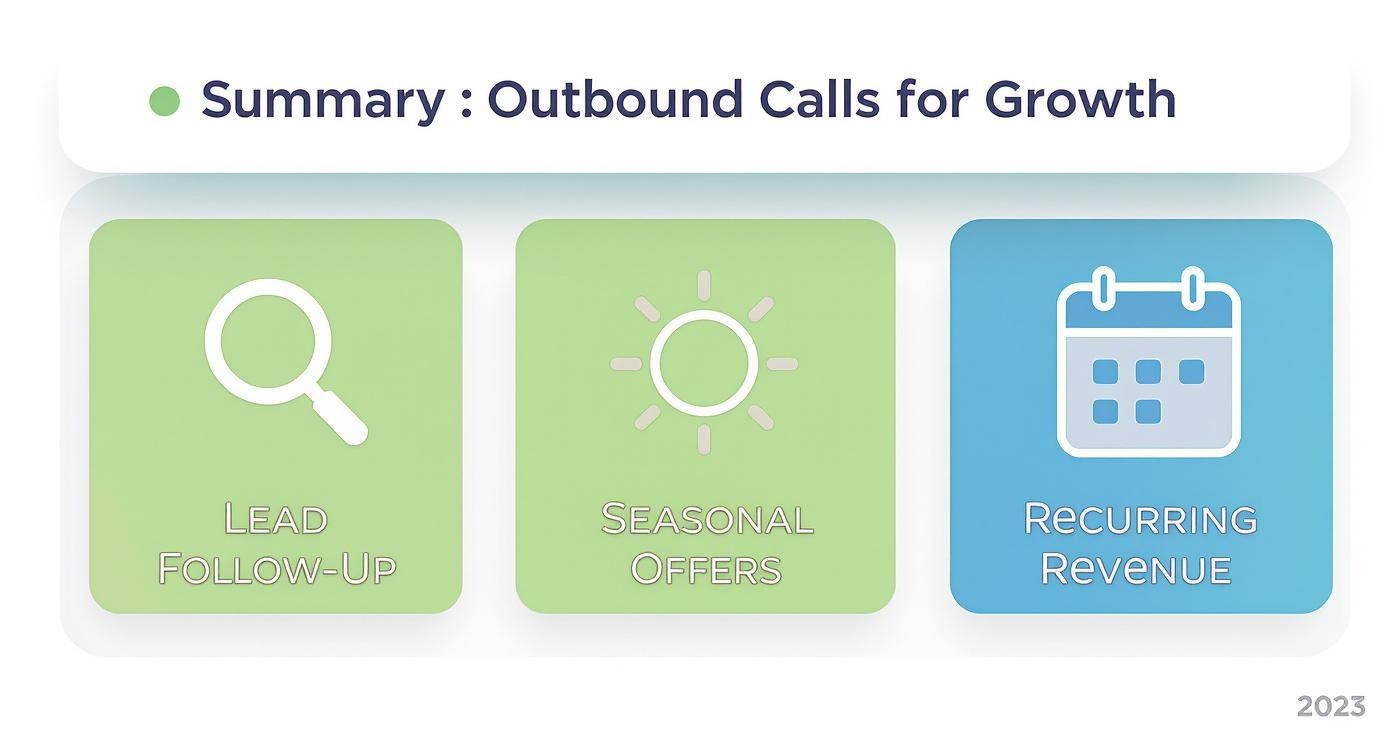
As you can see, a well-executed outbound plan is about more than just cold calling; it’s a systematic way to chase new business, push seasonal offers, and build a more predictable revenue stream.
So, Which One Do You Need—and When?
Understanding the difference between an inbound and outbound call center is a great start, but the real magic happens when you know exactly which one to deploy in the right situation. It all boils down to your immediate goals. Are you trying to field incoming demand or are you trying to drum up new business? The answer to that question points you directly to the right model.
For a home service company, some scenarios scream for one approach over the other. Making the right call means your resources are being used for maximum effect, whether that’s protecting your brand during a hectic time or actively growing your customer base.
Go with an Inbound Model When…
You need to prioritize an inbound strategy when your main job is to handle incoming calls quickly and professionally. This model is your best friend when the customer experience is everything.
Think about these classic home service situations:
- A Natural Event Hits: After a big storm rolls through, roofers and restoration companies get flooded with calls. A slick inbound system is non-negotiable here; you have to capture every single lead and calm down stressed-out homeowners.
- You Offer Emergency Services: If you run a 24/7 plumbing or HVAC company, your inbound call center is your business. A single missed call isn't just a lost job—it's a crack in your reputation for being reliable.
- Scheduling Gets Out of Control: During peak season, like spring for a landscaping business, an inbound team can take over appointment booking and answer basic questions. This frees the owner up from being stuck on the phone all day.
An Outbound Model Makes Sense When…
Switching gears to an outbound model is a strategic play for growth. This is the way to go when you need to create demand instead of just reacting to it.
Here’s where an outbound strategy really shines:
- You're Launching a New Service: Let's say you're a well-known landscaper adding a pest control service. An outbound campaign is the perfect way to let your existing, loyal customers know about the new offering.
- You Want to Do Proactive Maintenance: A roofing company could proactively call homeowners in a neighborhood with older homes to book pre-winter inspections. This fills up the schedule during slower months and helps customers avoid bigger problems down the road.
- You Need to Follow Up on Quotes: An outbound agent can be tasked with systematically following up on every open estimate. They can answer last-minute questions and close deals that might have otherwise gone cold.
The choice isn't always a simple "either/or." The sharpest home service businesses often build a rock-solid inbound system first to establish trust. Once that's in place, they layer on outbound campaigns to really drive growth. This blended approach gives you the best of both worlds.
The global contact center market is projected to reach an incredible $496 billion by 2027. This boom is happening because businesses recognize the power of both reactive service and proactive outreach. As companies get bigger, many are moving toward a blended model that combines inbound and outbound functions into one powerful communication engine. You can find more data on the growing contact center market on callcenterstudio.com.
Making the Right Choice for Your Business Stage
So, how do you decide between an inbound or outbound call center? It really boils down to where your business is right now and what you need to accomplish next. The best way to get clear is to ask one simple question: Is my immediate goal to make existing customers happy and build a rock-solid reputation, or is it to aggressively book new jobs and fill the calendar?
Your answer points you in the right direction. Think about a brand-new HVAC company just starting out. Their first and most critical job is to nail every single inbound call. Every service request, every inquiry—getting these right builds the trust and positive word-of-mouth they need to survive. Rushing into outbound calls without that foundation is a recipe for a damaged reputation before you even get off the ground.
Now, consider an established roofing company that’s been around for years and has a great track record. They're in a prime position to flip the script and go on the offense with an outbound strategy. They can start calling up past customers to offer preventative maintenance packages, turning their call center from a support function into a serious revenue driver.
Don't forget to look at your team's natural abilities. Are your people patient problem-solvers who shine when helping a customer in need? Or are they born salespeople who are great at persuasion? Playing to your team's strengths from the start makes everything run smoother and leads to much better outcomes.
Of course, your budget for technology and how you plan to compensate your team will also play a huge role in the decision. Weighing these factors honestly will give you a clear path forward. To get a better handle on the tech side of things, check out our guide on call center software for small business to see what tools fit each model.
Frequently Asked Questions
When you're weighing an inbound vs. outbound call center strategy for your home service company, a lot of specific questions can pop up. Let's get straight to the practical answers you need to make the right call for your business.
Can a Small Home Service Business Really Use Both?
Yes, absolutely. This is often called a “blended” model, and it's a game-changer for smaller teams looking to be more efficient.
Think about it this way: one of your team members could handle incoming customer calls during the busy morning rush when most people are trying to book a job. Then, during the slower afternoon hours, that same person can switch gears and start making outbound calls—maybe confirming tomorrow's appointments, following up to see how a recent job went, or even calling past customers about a new seasonal special.
Good call center software makes it simple to toggle between these tasks, so even a one-person "call center" can cover all the bases and drive more business.
What’s the Main Difference in Technology?
The biggest split comes down to how calls are handled and started.
Inbound call centers are all about the Automatic Call Distributor (ACD). This is the brain of the operation, acting like a smart traffic cop that directs incoming calls to the next available agent or the person with the right skillset. It’s designed to create a seamless experience for the customer who is calling you.
Outbound centers, on the other hand, live and die by their dialing software, like a predictive or power dialer. This tech does the heavy lifting by automatically dialing numbers from a list and only connecting your agent when a real person answers the phone. This one tool massively boosts how much time your team spends actually talking to potential customers instead of manually dialing and listening to voicemails.
How Do I Know if My Outbound Efforts Are Paying Off?
Measuring the return on investment (ROI) for an outbound campaign is actually pretty straightforward, and you absolutely should be doing it. You just need to compare what you spent against what you earned.
First, add up your total costs—agent pay, software fees, and the price of any contact lists you bought. Then, track the revenue that came directly from the jobs you booked through those calls.
The formula is simple: ((Revenue from Outbound Jobs – Total Outbound Cost) / Total Outbound Cost) * 100.
Running this calculation gives you a clear ROI percentage. It tells you in black and white whether your outreach is profitable and helps you decide if it's time to ramp things up.
At Phone Staffer, we build the teams that bring these strategies to life. Whether you need a dedicated cold calling service that books jobs right onto your calendar or skilled remote CSRs to manage your inbound calls, we have the people and the playbook to help your home service business grow. Learn how we can build your ideal call handling team.