
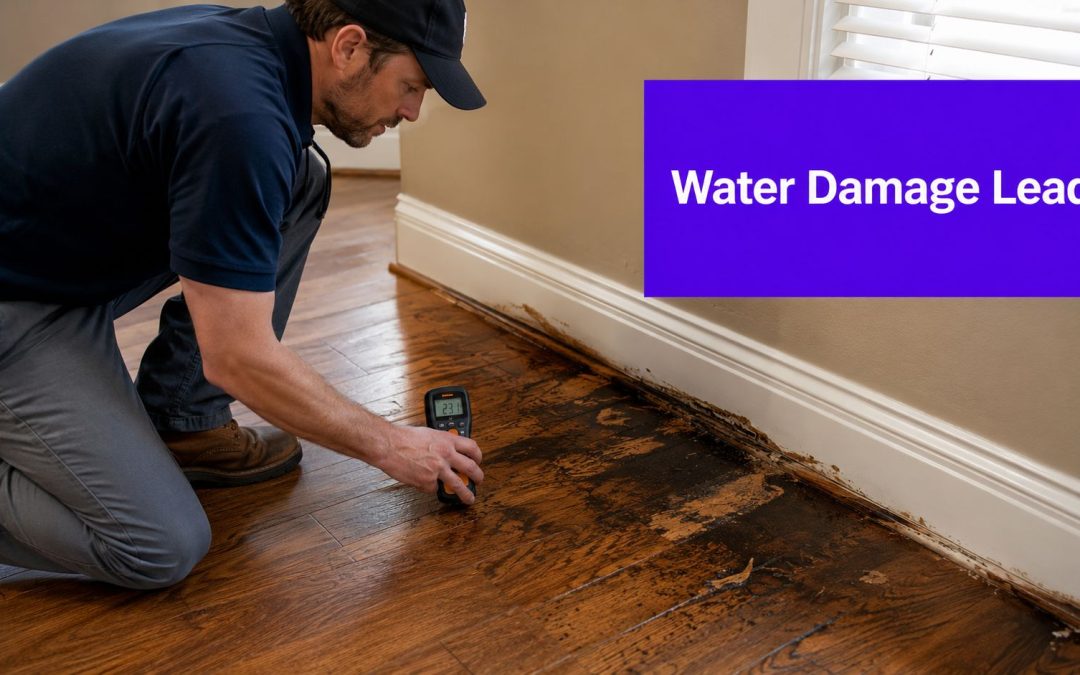
You're probably losing jobs you never even knew existed.
A pipe bursts at 10:40 p.m. The homeowner grabs a phone, searches for help, taps the first few listings, and hires the company that answers live and sounds organized. By morning, one restoration crew is setting air movers, another company is returning a voicemail, and everyone else is staring at a quiet board wondering why leads feel inconsistent.
That's how this category works. Water damage restoration leads don't arrive like a normal home service inquiry. They hit fast, they show up at odd hours, and they usually go to the operator with the cleanest intake process, not the operator with the nicest logo.
Most owners don't have a lead problem. They have a response system problem, a channel mix problem, or both.
Why Your Next Big Job Is Ringing Right Now
A missed water call doesn't feel expensive in the moment. It's one ring, one voicemail, one form fill that sits in the inbox until someone opens the shop. But in restoration, that gap matters because the buyer is in an emergency and ready to move now.

I've seen this pattern over and over. A company says leads are slow, but the actual problem is that calls after hours go to voicemail, web forms trigger a generic email, and nobody owns the first contact. Meanwhile, the competitor across town is answering with a live script, qualifying the loss, and dispatching before the homeowner finishes calling around.
The demand is already there
This isn't a niche with occasional demand. It's a constant-need category. In the U.S., water damage and freezing accounted for 23% of all property damage claims between 2017 and 2021, and home water-damage emergencies affect about 14,000 people every day, according to PuroClean's water damage restoration industry statistics.
That matters because it changes how you should think about lead gen.
You're not trying to create demand from scratch. You're trying to intercept urgent demand already happening in your market and route it into your dispatch workflow before someone else does.
Practical rule: In restoration, the next big job usually isn't a branding problem. It's a phone-answering, visibility, and routing problem.
Why this market behaves differently
Water leads are tied to stress, insurance questions, property damage, and time pressure. The buyer wants three things fast:
- Immediate contact so they know a real company is available
- Clear next steps so they don't feel lost
- Confidence that your crew can handle mitigation and documentation
That's why sloppy lead handling hurts more here than it does in slower categories. A homeowner shopping for a kitchen remodel may wait. A homeowner with water running through drywall won't.
The operators who win this space don't just “market better.” They build an intake machine that catches urgent demand every day, every night, and every weekend.
Build Your Digital Emergency Response System
Your digital setup should work like an emergency response desk. It needs to surface your company for those searching in panic, make it easy to call, and remove any friction between first click and booked inspection.

Start with Google Business Profile
For many restoration companies, Google Business Profile is the first battleground. If someone searches “emergency water cleanup near me” or “burst pipe cleanup,” the map results often get attention before a full website visit.
Set it up like an emergency service listing, not a brochure.
- Primary service clarity: Make sure your core water damage services are obvious.
- Phone-first layout: Use a number that's answered live. If the profile drives calls to a dead line, ranking won't save you.
- Photos with context: Show trucks, crews, equipment, drying setups, and real jobsite images.
- Service area accuracy: Don't overstate where you operate. Broad areas create wasted calls and weak close rates.
- Review language: Ask customers to mention the actual service. “Water extraction,” “flooded basement,” and “burst pipe cleanup” help reinforce relevance.
A lot of owners obsess over posting updates and ignore the basics. The basics close jobs.
Run PPC like a triage system
Paid search works in restoration because intent is high. It also burns cash fast when campaigns are built like general home service ads.
Split emergency terms from non-emergency terms. “Flooded basement cleanup” should not live in the same ad group as broad educational traffic. The ad copy, landing page, and call handling are different.
A simple structure works best:
- Emergency campaign for urgent service searches
- Local campaign built around city and service combinations
- Brand campaign to defend your own name from competitors and directories
- Remarketing layer for people who visited but didn't call
Keep your ads aligned with your operations. Don't promise “Immediate response” if the phone rolls to voicemail after hours.
Build pages for calls, not compliments
Most restoration websites are too slow, too vague, or too polite. A water damage page has one job. Get the visitor to call now.
Your core water page should include:
- A headline tied to the emergency
- A visible call button above the fold
- A short list of services like extraction, drying, moisture mapping, demolition, and cleanup
- Trust cues such as local coverage, insurance familiarity, and rapid dispatch
- A short form only if it triggers an immediate callback workflow
If the page makes the visitor hunt for your number, you've already increased drop-off.
Don't treat restoration like generic trades marketing
A lot of what works in local service SEO carries over from other urgent trades. If you want a useful parallel, this guide on marketing for HVAC and plumbing explains local search fundamentals that also apply to restoration, especially around service-area visibility and intent-heavy searches.
The difference is that water traffic is more urgent. That means the website, ads, and profile all need stronger call-to-action placement and tighter phone coverage than a typical maintenance-driven service business.
A digital setup that actually converts
When a restoration company says “our SEO isn't working,” I usually check four things first:
| Checkpoint | What good looks like | What loses jobs |
|---|---|---|
| Google profile | Accurate categories, real reviews, live phone | Outdated info, weak service detail |
| Paid ads | Tight emergency keywords, local landing pages | Broad traffic, mixed intent |
| Website | Call-first layout, simple mobile experience | Long forms, clutter, slow pages |
| Tracking | Call source and booking outcome logged | No source tracking, no close data |
Digital lead gen works. But only when the marketing side and the operations side are built together.
Unlock High-Trust Leads Through Partnerships
Some of the strongest water damage restoration leads never come from Google. They come from people the customer already trusts.
A plumber finds the failed supply line. A property manager walks into a unit with soaked flooring. An insurance contact gets a panicked call and needs a company that won't make them look bad. Those leads behave differently because trust is transferred before your phone even rings.
The referral lead is usually easier to close
Referral traffic tends to come in warmer because the homeowner or manager isn't starting from zero. Someone has already said, “Call this company. They handle this.”
That changes the sales conversation. You spend less time proving you're real and more time qualifying scope, timing, access, and documentation.
The mistake most restoration companies make is waiting passively for these relationships to happen. Good partnership channels are built on repetition.
The best local partners
If you want more high-trust lead flow, start with the people who see water first or hear about it first.
- Plumbers: They're often first on scene when the source needs to be stopped.
- Property managers: They control repeat opportunities across units and buildings.
- Insurance agents and adjuster-side contacts: They value vendors who communicate cleanly.
- General contractors and flooring companies: They often find secondary water issues during other work.
- Realtors and home watch contacts: They hear about vacant-property problems early.
A plumber referral isn't just a lead source. It's a field sales channel with a truck.
How to approach without sounding needy
Most outreach to partners fails because it sounds like begging for referrals. A better angle is operational support.
Say what you solve:
- you answer fast,
- you show up,
- you document well,
- and you don't create chaos for the referring party.
A simple opener works:
“We handle emergency water mitigation for homeowners and property teams in your area. If you run into leaks or overflows that need drying, demo, or insurance documentation after the plumbing fix, we can take that piece off your plate.”
That lands better than “Can you send us work?”
How to keep the relationship alive
Partnerships die when there's no follow-through. If a plumber sends you a loss and never hears what happened, they'll stop thinking of you.
Use a tight process:
- Acknowledge the referral fast
- Update the partner when the job is booked
- Close the loop when mitigation is underway
- Thank them after the job without overdoing it
- Stay visible with occasional check-ins
A lot of owners want a magic source that competitors can't buy. This is it. Ad budgets can crowd the search results. They can't easily replace a local partner who trusts your team to protect their reputation.
Create Your Own Leads with Proactive Outbound Calling
Most restoration companies sit back and wait for damage events, search traffic, or paid lead vendors. That leaves too much control in someone else's hands. If you want a more predictable pipeline, build outbound into your mix.
This isn't about cold calling random homeowners and asking if they have water damage. It's about targeting commercial properties, multi-family operators, facility contacts, and trade partners before the emergency happens so your company is already on the list when it does.

Why outbound makes sense in restoration
The economics support it. One provider reports an average water damage job value of $5,618, and says restoration companies using pay-per-lead models often report around 8.5x ROI. The same source notes exclusive leads often cost about $400 to $750+. That context from Bullseye Internet's water damage pay-per-lead breakdown is why proactive prospecting can work. If one booked job carries enough value, a disciplined outbound engine can be worth the effort.
The key is targeting accounts where one relationship can produce repeated work.
Who to call first
Go after contacts that control buildings, tenant issues, or vendor lists.
- Commercial property managers
- Apartment operators
- Facility managers
- HOA managers
- Senior living and hospitality operators
- Plumbing shops without an in-house restoration arm
Don't overcomplicate your list-building. Pull target properties by ZIP code, organize by asset type, and get direct dials where possible. Skip tracing can help when front-desk numbers go nowhere. What matters is list quality and consistent follow-up.
A practical outbound workflow
Here's the workflow I like for restoration teams:
Build a narrow list first
Start with a defined geography and a defined buyer type. Don't mix apartments, retail, and industrial in one sequence.Create a reason for the call
Your message should focus on emergency readiness, not a generic service pitch.Use call blocks
Prospecting gets ignored when it's treated as leftover work. Put it on the calendar.Log every outcome in CRM
No spreadsheets floating around between the office and sales rep. Track who answered, who asked for info, who needs follow-up, and who already has a vendor.Follow up with something useful
A short vendor-intro email, emergency contact sheet, or coverage summary works better than a glossy brochure.
If you want a baseline framework for call handling and follow-up discipline, this article on cold calling conversion rates is a useful companion.
Script that gets the meeting
Keep the call short. You are not trying to close a water loss over a cold call. You're trying to earn a vendor conversation.
Front desk version
“Hi, I'm calling from a local water mitigation company. We help property teams when leaks, overflows, or drain backups turn into drying and cleanup work. Who handles emergency vendor approvals on your side?”
Decision-maker version
“Thanks for taking the call. We work with properties in your area on emergency water mitigation. I'm reaching out to see how you currently handle after-hours leaks or water events when the plumbing fix is only part of the problem. If you're open to it, I can send over our emergency contact info and see if it makes sense to be a backup vendor.”
Don't pitch equipment. Don't ramble through company history. Ask about their current process and where it breaks.
What outbound is really doing
Outbound cold calling gives you an advantage. Instead of competing only when a crisis hits search results, you create familiarity before the crisis happens. That's useful for commercial and managed-property work where preferred-vendor status matters as much as ad placement.
It's also one of the few channels that lets you manufacture conversations on your schedule.
Win the Job in the First Five Minutes
Most owners think lead generation ends when the phone rings. In restoration, that's where actual conversion work starts.
One restoration lead source says that responding within the first 5 minutes can increase water-damage lead conversions by as much as 8x, and that results fall off sharply after that initial window, according to ResultCalls' guidance on water damage restoration leads.

That number matches what operators already know from the field. Emergency buyers don't sit still. They call until someone answers, sounds competent, and gives them a next step.
What the first five minutes should look like
A strong intake flow is simple and fast.
| Minute | Action | Owner |
|---|---|---|
| 0 to 1 | Answer live or call back immediately | CSR or answering team |
| 1 to 2 | Qualify loss type, location, urgency, and contact details | Intake |
| 2 to 3 | Reassure homeowner and explain next step | Intake |
| 3 to 4 | Dispatch or escalate to on-call manager | Office or dispatch |
| 4 to 5 | Send confirmation text and ETA expectations | Office system |
If any of those steps break, close rates slide.
The intake script needs to calm and qualify
Your team should sound like a control room, not a call center. The opening matters.
A strong opener is direct:
“Thanks for calling. Tell me what happened and whether the water source is still active.”
That question does three things fast. It shows urgency, starts qualification, and tells the caller you know what matters first.
After that, gather the basics:
- where the damage is,
- whether the source is contained,
- when it started,
- whether insurance may be involved,
- and how quickly access is available.
Then move to the next action. Don't leave them hanging with “someone will call you back.”
Here's a helpful walkthrough on lead response and call handling:
The biggest conversion killer
The biggest mistake is relying on delayed callbacks. A form comes in at night, an email notification gets buried, and the office calls back in the morning. By then the homeowner has already booked someone else, or worse, they've started doubting whether your company can handle an emergency at all.
Speed-to-lead is not a marketing metric in restoration. It's an operations metric that decides revenue.
If you can't staff live response around the clock, use a real answering and qualification layer, an on-call rotation, and a dispatch handoff process that's tested. Don't assume your team will “just watch the phones.” Emergency lead handling has to be a system.
Track Your ROI to Fuel Sustainable Growth
Friday night, two water-loss calls hit the board within ten minutes. One came from Google Ads. One came from a plumber referral. Both looked like wins. Thirty days later, one turned into a high-margin mitigation and rebuild job, and the other ate up after-hours labor, never got signed, and produced zero insurance dollars. If those two leads sit in the same bucket in your reporting, you will keep spending in the wrong places.
Lead flow is easy to overestimate in restoration. Revenue is harder to fake.
A restoration company can pull inquiries from SEO, paid search, referrals, lead vendors, and outbound prospecting. That mix only helps if you can trace each source to booked work, collected revenue, and gross margin. Shared leads may arrive fast, but they often come with price pressure and multiple competitors. Referral leads usually close better, but they take longer to build and are easy to underreport if CSRs log them loosely.
What to measure every week
Start with source-level tracking that your office can maintain without a BI project.
Track these by channel:
- Lead volume: How many calls, web forms, or chat starts came in
- Live contact rate: How many you reached on the first attempt
- Inspection or dispatch rate: How many turned into an actual site visit
- Booked jobs: How many signed and entered production
- Closed revenue: What each source produced in real dollars
- Cost per lead: What you spent to generate each inquiry
- Cost per booked job: What it cost to create actual work, not just phone activity
- Close rate: Which sources your team consistently converts
One more metric matters in this trade. Track time from lead to first human contact by source. A PPC lead answered in 45 seconds is a different asset than the same lead answered in 12 minutes.
If your team cannot answer, "What produced the last three water jobs we ran?" attribution is too loose.
Lead Generation Channel Comparison
| Channel | Typical Cost Per Lead | Time to First Lead | Lead Quality / Intent | Scalability |
|---|---|---|---|---|
| Local SEO and Google Business Profile | No fixed per-lead cost | Slower to ramp | High intent when emergency pages and profile are strong | Strong once established |
| PPC for emergency searches | Varies by market and setup | Fast | High intent if keywords are tight | High with budget control |
| Referral partnerships | No fixed per-lead cost | Slower to build, then steady | Very high trust | Moderate, depends on relationships |
| Shared lead providers | $200 to $350 based on Docusketch's restoration lead guide | Fast | Mixed, depends on source quality and response process | Easy to increase, risky without tracking |
| Exclusive lead providers | Higher than shared, often justified by job value as covered earlier | Fast | Usually stronger than shared | Moderate to high |
| Outbound calling to property contacts | No fixed per-lead cost | Medium | High when aimed at vendor-list buyers | High with list quality and process |
What good decision-making looks like
The operators who grow cleanly do not judge channels on lead count alone. They judge them on job value, close rate, response burden, and how reliably the channel can be repeated.
Here is a common example. PPC may show the highest CPL in your stack, but if it produces urgent category calls, tight service-area matches, and same-day dispatches, it can still be one of your best sources. On the other side, a cheap batch of shared leads can make the phones look busy while producing low contact rates, heavy estimate chasing, and weak close percentages. Cheap leads get expensive fast.
Outbound needs the same discipline. If your callers are setting meetings with property managers but those meetings never turn into vendor approvals, the issue may be the offer, the list, or the follow-up sequence after the call. Track each stage separately: connects, conversations, meetings set, meetings held, vendor packets submitted, and accounts won. That is how you fix the machine instead of blaming the channel.
The healthiest mix usually looks like this:
- digital channels capture active emergency demand,
- partnerships bring in higher-trust referrals,
- outbound builds tomorrow's pipeline with adjusters, plumbers, facility contacts, and property managers,
- and intake operations protect all of that spend by converting fast.
That last part is where a lot of ROI disappears. Marketing reports may say a source is working, while the actual problem is inside the handoff. Calls get tagged wrong. CSRs skip source notes. Estimators fail to update outcome status. No one closes the loop on whether a job was signed, lost, or referred out. Bad attribution usually comes from bad operations.
Set one owner for lead reporting. Use consistent source names in your CRM. Audit call recordings against booked jobs every week. Tie every marketing source to the production schedule and final invoice amount, not just the initial call.
Commit more budget only after a channel proves it can produce booked work repeatedly. Cut or rework channels that create noise without margin. That is how a restoration company grows without burning cash.