

When a homeowner has a pipe burst at 2 AM, they aren't flipping through the Yellow Pages. They're grabbing their phone and searching "plumber near me." Internet marketing for plumbers is simply about making sure your business is the one they find and call in that moment of crisis.
It all boils down to showing up on Google, having a website that converts visitors into callers, and using social media to build trust. A smart online strategy is the single most effective way to keep your trucks full and your schedule booked with profitable jobs.
Building a Digital Foundation That Generates Calls
Before you can even think about ads or social media, you have to get the basics right. This isn't about having the flashiest website; it's about being visible and looking credible when someone desperately needs your help. Your entire online presence rests on two core pillars: your website and your Google Business Profile.
Think of your website as your virtual showroom and your best salesperson, working 24/7. It needs to be fast—loading in under 3 seconds—and ridiculously easy to use on a smartphone. A stressed-out homeowner needs to see a huge, clickable phone number and a simple "Book Now" button the second they land on your page. No exceptions.
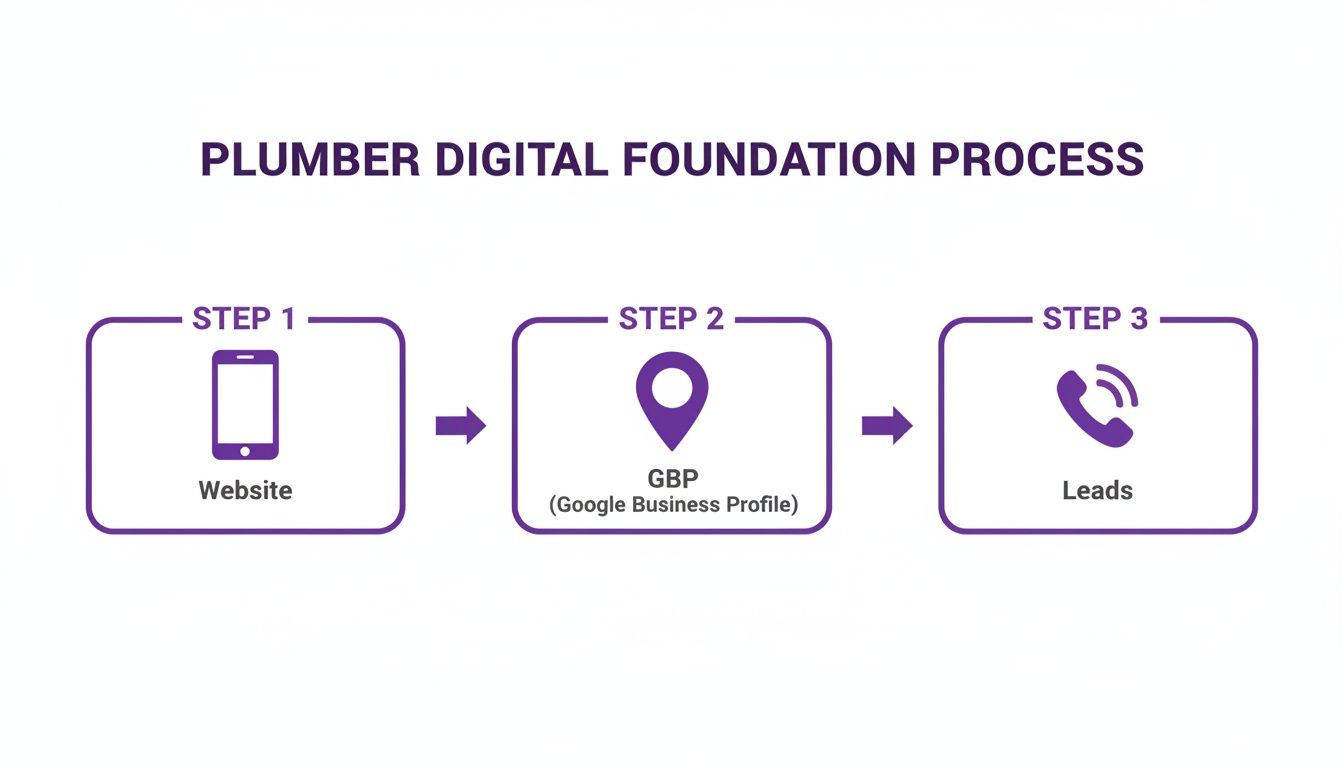
This simple flow shows how everything works together. A solid website and a powerful Google profile are the engines that drive real, paying jobs to your business.
Your Google Business Profile: The New Front Door
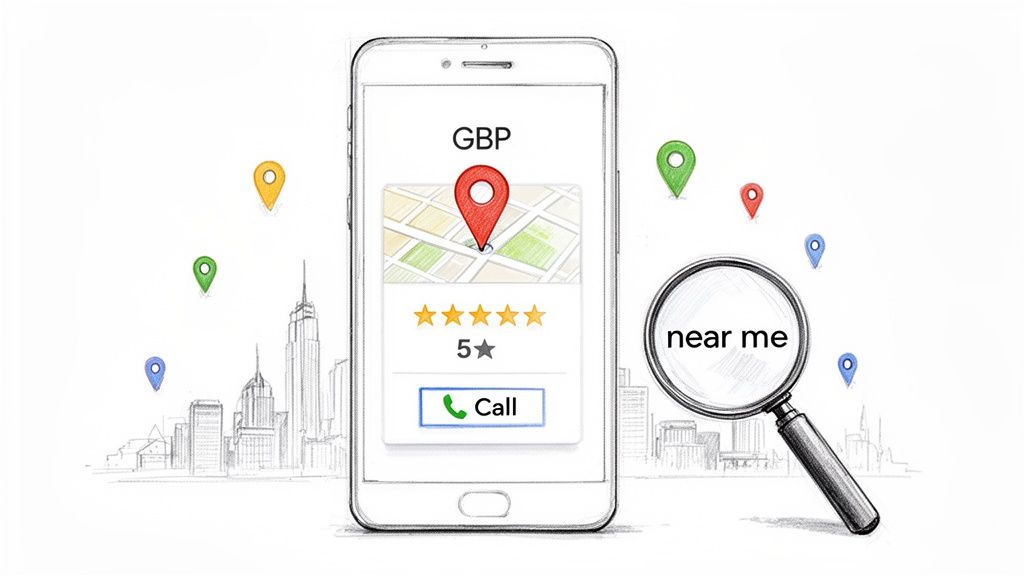
As important as your website is, your Google Business Profile (GBP) is often the first thing a potential customer will see. For getting immediate phone calls, it’s even more critical. Think of it as your digital storefront right on the Google search results page. Nailing your GBP optimization is the difference between getting buried on page five and showing up in the coveted Google Maps "3-Pack," where all the action is.
To get it right, you need to be meticulous.
- Be Specific with Categories: Your primary category must be "Plumber." But don't stop there. Add every single service you offer as a secondary category—think "Water heater installation," "Drain cleaning service," and "Sewer line repair."
- Define Your Turf: Don't just list your city. List every single suburb, neighborhood, and zip code you're willing to drive to. This tells Google exactly where to show your business.
- Use Geotagged Photos: Upload tons of high-quality photos of your team in uniform, your branded vans, and before-and-after shots of your work. Before you upload them, use a free online tool to "geotag" the images with the location data of the job. It's a powerful local signal.
- Write a Real Description: Use the business description to answer questions before they're even asked. Mention you offer 24/7 emergency service, talk about your warranties, and highlight how many years you've been in business.
Here's the hard truth: potential customers are making a split-second decision. When they see a fully fleshed-out Google profile with dozens of recent 5-star reviews, it screams competence and trust. They're going to call you over the competitor with a blank profile every single time.
Why You Can't Afford to Be Invisible Online
Let's be blunt: ignoring your online presence today is like operating with an unlisted phone number 20 years ago. The customer journey starts online. We're talking about a staggering 98% of people searching the web to find local services.
Even better for you, a full 80% of those local searches convert. That means if you’re not showing up on the first page of Google, you are literally invisible to 8 out of every 10 potential customers in your area.
To help you prioritize, here’s a quick look at the most crucial marketing channels and what they do for your plumbing business.
Essential Digital Marketing Channels for Plumbers
| Marketing Channel | Primary Goal | Key Action for Plumbers |
|---|---|---|
| Google Business Profile | Generate immediate phone calls & map visibility | Fully optimize with services, photos, and get reviews. |
| Local SEO | Rank organically for "plumber in [city]" searches | Build local citations and create service-area pages. |
| Website | Convert visitors into leads & build trust | Ensure mobile-first design with clear calls-to-action. |
| Paid Ads (Google Ads) | Capture high-intent, emergency service leads | Run targeted "Local Service Ads" for top placement. |
| Content Marketing | Answer customer questions & build authority | Write blog posts on topics like "signs of a slab leak." |
| Social Media | Build community trust & showcase your work | Post before-and-after photos and team highlights. |
This digital foundation is the bedrock for everything else. Once it's solid, any money you put into ads or other efforts will go so much further. If you're tackling this yourself, staying organized is key. If you're looking to grow and offload some of this work, our guide on how to hire a virtual assistant for internet marketing can help you delegate these foundational tasks effectively.
Master Local SEO to Show Up When It Counts
Let’s be honest. When a pipe bursts and water is flooding a basement, that homeowner isn't comparison shopping. They're grabbing their phone, frantically typing "emergency plumber near me," and calling one of the first names that pops up. That's it. Decision made.
This is the entire game for a local plumber, and local SEO is how you win it. It's the work you do to make sure Google sees your business as the most relevant, trustworthy, and authoritative plumber in your specific service area. Get this right, and your phone will ring with high-quality jobs, all without you having to pay for every single click.
It all boils down to two things: what’s on your website (on-page SEO) and your reputation across the web (off-page SEO).
Nail Your On-Page SEO
Your website needs to speak Google's language, making it dead simple for the search engine to understand what you do and where you do it. This isn’t about spamming keywords; it’s about being incredibly clear.
The single most effective thing you can do here is to build out separate, dedicated pages for each of your core services. A generic "Our Services" page just doesn't cut it anymore. You need specific pages for "Water Heater Repair," "Drain Cleaning," and "Slab Leak Detection."
Then, on each of those pages, you have to tie the service to the location.
- A page titled "Water Heater Repair" should become "Water Heater Repair in Manchester."
- The content on that page should include phrases like, "If you need a reliable plumber for a water heater replacement in the Manchester area, give us a call."
This level of detail is exactly what Google is looking for. It removes all guesswork and tells the algorithm precisely which local searches your business should show up for.
Build Your Authority with Off-Page SEO
What happens away from your website is just as critical. Off-page SEO is all about building your reputation and proving to Google that you're a legitimate, active local business. For a plumber, this really comes down to two key ingredients: local citations and online reviews.
Local citations are just online mentions of your business’s Name, Address, and Phone number (NAP). Think of business directories like Yelp, Angi, and other local listings. The number one rule here is consistency. Your NAP information must be 100% identical everywhere online.
Using "St." on one directory and "Street" on another creates confusion for search engines and can drag your rankings down. A quick audit to standardize your NAP across the web is one of the fastest, easiest local SEO wins you can get.
The Undeniable Power of Online Reviews
In the home services world, trust is everything. Nothing builds trust faster than a constant stream of recent, positive online reviews. This is probably the biggest factor in ranking in the Google Maps "3-Pack" and is often the final tie-breaker when a customer is deciding who to call.
Put yourself in their shoes. They see two companies. One has 150 reviews and a 4.9-star average. The other has 12 reviews and a 4.2-star average. Who gets the call? It's not even a question.
You can't just hope for reviews; you have to build a system to get them.
A Simple Script Your Techs Can Use
The best time to ask is right after the job is done, when the customer is happy and relieved. Your tech can say something simple and genuine:
"Glad we could get that sorted out for you today! We're a local business and honestly, feedback from customers like you is how we grow. Would you mind taking 30 seconds to leave us a review on Google? It would be a huge help."
To make it foolproof, follow up with a text or email containing a direct link to your Google review page. By making this a standard part of your process, you turn every satisfied customer into a marketing asset. This steady flow of positive social proof is the bedrock of any successful internet marketing for plumbers strategy.
Driving Immediate Leads with Paid Advertising
SEO is your long game. It's an incredible strategy for building a steady, reliable flow of organic leads over time. But let's be real—when you've got a technician with an empty schedule and truck payments coming up, you need the phone to ring now.
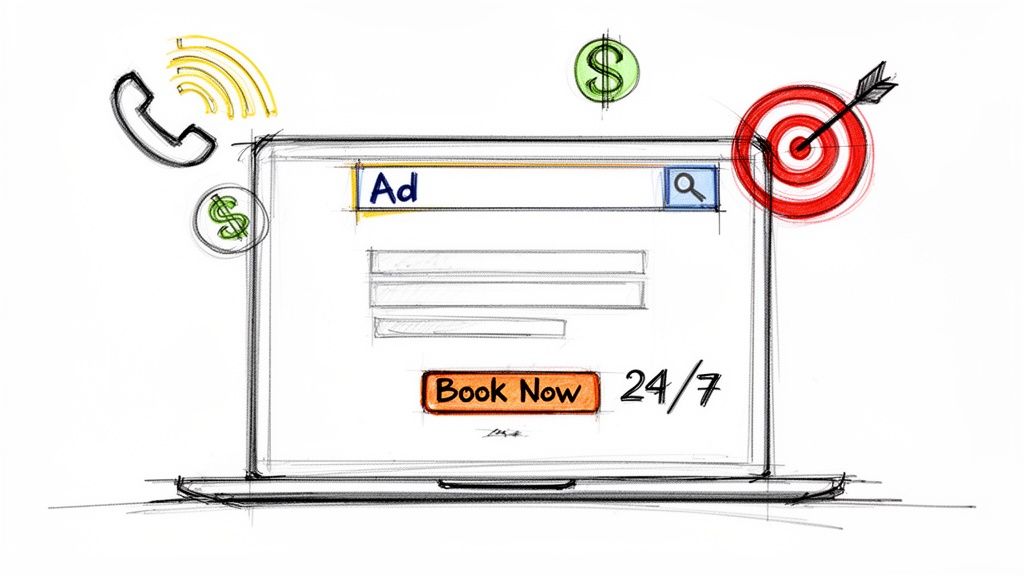
This is where paid advertising, especially Pay-Per-Click (PPC), becomes your most powerful tool. Unlike SEO, which can take months to really gain traction, a well-built ad campaign can put your business in front of homeowners with urgent problems in a matter of hours. It’s the digital equivalent of flipping a switch for more calls.
Your Main Ad Options on Google
For plumbers, the paid ad world really boils down to two heavy-hitters from Google: Local Services Ads (LSAs) and the classic Google Ads. They show up in different spots on the search results page and, crucially, you pay for them in completely different ways.
- Google Local Services Ads (LSAs): You've seen these at the very top of the search results, even above the traditional ads. They showcase your company name, star rating, and that all-important "Google Guaranteed" badge. The best part? You pay per valid lead—meaning an actual phone call from a potential customer—not just for a click. This makes LSAs a lower-risk, high-reward choice perfect for snagging those emergency service calls.
- Google Ads (PPC): These are the text-based ads that appear just below the LSAs. With these, you pay per click, whether that click results in a call or not. While this can sometimes feel more expensive, it gives you far more control over your keywords, ad copy, and targeting. This makes them fantastic for going after specific, high-profit jobs like a full repipe or a water heater installation.
For most plumbing companies I've worked with, the sweet spot is running both. Let LSAs be your first line of defense, grabbing the most urgent, high-intent leads. Then, use traditional Google Ads to fill in the gaps and specifically target those niche jobs that really boost your bottom line.
Targeting Keywords That Actually Make You Money
The success of your Google Ads campaigns lives and dies by your keyword selection. You have to get inside the head of a customer who has an urgent, painful problem and needs a pro—fast. Bidding on broad terms like "plumber" is a quick way to burn through your budget.
You need to zero in on what we call "buyer-intent" keywords. These are the phrases people type when they're ready to open their wallets.
High-Intent Keyword Examples
| Keyword Category | Specific Examples | What the Customer is Thinking |
|---|---|---|
| Emergency Services | "burst pipe repair," "24 hour plumber," "emergency drain unblocking" | I have a crisis and need someone here NOW. Price is not my main concern. |
| Specific Problems | "water heater not working," "leaking toilet tank," "sewer line backup" | I know exactly what's wrong, and I know I can't fix it myself. |
| Service + Location | "drain cleaning services in Manchester," "gas line repair Bristol" | I need this specific service, and I need it from someone local. |
By focusing your ad budget on these kinds of terms, you make sure your ads are only shown to people who are actively looking to hire a plumber, not just someone searching for DIY tutorials. This kind of precision is the bedrock of effective internet marketing for plumbers.
Remember, every click costs you money. Your goal isn't just to get website traffic; it's to get traffic that turns into a booked job. Targeting hyper-specific, problem-focused keywords is the fastest way to get a better return on your ad spend.
The Critical Role of Landing Pages
Here's where I see a ton of plumbers waste their ad money. They create a perfect ad that gets clicked, but then they send that person straight to their website's homepage. This is a massive mistake.
A homepage is built for browsing. It has navigation, different service pages, and a blog—tons of distractions for a potential customer who's in a hurry with a flooded basement.
Instead, every single ad campaign needs to point to a dedicated landing page. Think of it as a simple, one-page website built for one reason and one reason only: to get the visitor to call you.
A high-converting landing page for a plumbing ad must include:
- A bold, clear headline that mirrors the ad copy (e.g., "Fast & Reliable Emergency Drain Cleaning in [Your City]").
- Your phone number, "above the fold" (visible without scrolling) and clickable on a mobile phone.
- A simple contact form with as few fields as possible—name, phone, and maybe a small box for the problem.
- Trust signals everywhere. Prominently display your Google review count, the "Google Guaranteed" badge, and any local awards or certifications.
By sending ad traffic to a focused landing page, you cut out all the noise and make it incredibly easy for a customer to take the one action you want them to. This one change can radically improve the number of leads you get from the exact same ad budget.
Using Content and Social Media to Build Local Trust
Think about it this way: SEO and paid ads are fantastic for grabbing the attention of people whose basement is currently flooding. They need a plumber, and they need one now. But what about everyone else?
That's where content and social media come into play. This isn't about going viral or becoming an internet celebrity. It's about playing the long game—methodically building trust so that when a pipe does burst, your company is the first and only one they think to call.
By consistently sharing useful, practical advice, you slowly become the go-to plumbing authority in your town. You're not just a name on a van; you're a trusted resource.
Create Content That Answers Real Questions
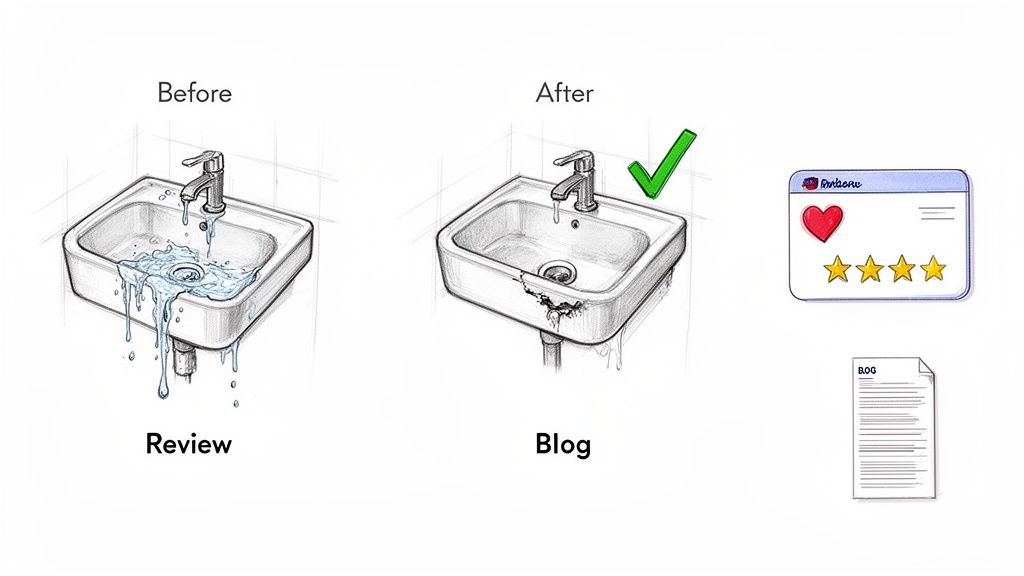
Your blog is one of the most powerful, and most underutilized, tools you have. Forget company announcements. Instead, treat it as a machine for answering the exact questions your customers are typing into Google every single day.
Just think about the calls you get. The repetitive questions, the common worries, the small problems people try to solve themselves before calling you. Every single one of them is a perfect blog post topic.
Here are a few ideas straight from the field:
- "5 Telltale Signs Your Water Heater Is About to Fail"
- "DIY vs. Pro: When Is a Leaky Faucet an Easy Fix?"
- "That Gurgling Drain Sound: What It Means and What to Do"
- "A Homeowner's Checklist for Preventing Frozen Pipes This Winter"
Answering these questions does two things. First, it genuinely helps people. Second, it gets your website showing up in search results for all sorts of plumbing-related problems, not just "plumber near me." You become the solution before they even know they need to hire you.
Use Social Media to Showcase Your Work
Let’s be realistic. For a plumber, social media isn't about getting a million followers. It’s about building a solid, professional portfolio on the one platform most local homeowners are actually on: Facebook.
The most effective social media strategy for a plumber is dead simple: show, don't just tell. Post clean, high-quality before-and-after photos of your jobs. Screenshot those five-star Google reviews and share them. Put a face to the name by introducing your techs with a friendly picture. It’s all about humanizing your business and building confidence.
A well-tended Facebook page acts as undeniable social proof. When a potential customer checks you out, they'll see a feed full of pristine installations, happy customer testimonials, and a professional team. It instantly calms their nerves and tells them they're making the right call.
Of course, this takes time you might not have. Many owners find success by delegating these tasks. It's worth looking into options like hiring a virtual assistant for Instagram or other platforms to keep your feed active and professional without pulling you away from the actual work.
When you put all of these pieces together, the results speak for themselves. One agency that combined smart SEO, targeted PPC, and consistent social media for their plumbing clients saw a 140% increase in website traffic, a massive 344% surge in search traffic, and 148% more online leads—without spending a single extra dollar on ads. It's a clear signal that a smart, multi-channel approach is how you win in your local market.
Turning Calls Into Jobs and Scaling Your Business
All the effort you've poured into local SEO, your website, and those carefully crafted ads funnels down to one single moment: a customer in need picking up the phone. Getting the phone to ring is only half the battle. If that call goes unanswered or is fumbled by an unprofessional response, every dollar you spent on marketing just went down the drain.
The real money is made when that call turns into a booked job. This critical process begins the instant your phone rings.
When a customer is dealing with a plumbing emergency, they're stressed out and desperate for a calm, confident expert to take charge. Every single call has to be treated with that level of urgency and professionalism.
A slow answer or an unsure voice will have that customer hanging up and calling the next plumber on the Google search results page. This is the make-or-break moment in your entire marketing strategy.
Answering the Phone for Maximum Conversion
When a potential customer calls, they aren't just looking for a service; they're looking for peace of mind. The person answering your phone instantly becomes the voice and face of your company. They need to be more than just a message-taker.
The single most important goal is to turn that caller into a scheduled appointment. This takes a specific set of skills:
- Empathy and Urgency: They must immediately connect with the caller's problem ("Wow, a burst pipe sounds incredibly stressful. Don't worry, we can absolutely get someone out there for you right away.") and project a sense of immediate action.
- Efficient Information Gathering: They need to get the essential details—name, address, phone number, and a clear rundown of the issue—without making the caller feel interrogated.
- Confident Booking: The call has to end with a firm appointment time and the clear promise that a qualified technician is on their way.
While a simple script can help with consistency, it's the tone that really seals the deal. A professional, reassuring voice builds instant trust and stops that customer from calling anyone else.
The Problem with Promise vs. Reality
I see it all the time. Plumbers sink a ton of money into marketing campaigns only to be frustrated and disappointed by the results. It’s a huge issue in the industry.
In fact, some research shows that around 70% of plumbers who work with marketing agencies are deeply dissatisfied. That’s a massive problem, especially when you realize that over 70% of clicks come directly from the Google Maps 3-Pack or organic search. This points to a huge disconnect between the promise of "more leads" and the reality of booked jobs, often because the most important step—handling the call correctly—is broken.
This is where your internal process becomes your secret weapon. If your competitors are letting calls go to voicemail or handling them poorly, your ability to convert those leads into paying jobs will put you miles ahead.
Scaling Your Business with Outsourced Support
As your business grows, you simply can't be chained to the phone. You've got techs to manage, parts to order, and a business to run. Every call you miss while you're out on a job is revenue you'll never get back. At this stage, trying to do it all yourself is what stops you from scaling.
This is where outsourcing becomes a brilliant strategic move. Bringing on remote Customer Service Representatives (CSRs) or Virtual Assistants (VAs) is how you build a system that can grow with you.
Think of a remote CSR as your dedicated lead-conversion specialist. Their only job is to answer every single call with the professionalism and urgency it deserves, ensuring no lead ever slips through the cracks. This frees you up to focus on growing the business, not just answering its calls.
These professionals can be trained on your specific scripts, scheduling software, and business practices. They make sure that even when you’re elbow-deep in a drain repair, your business is still booking jobs and delivering amazing customer service.
This is the step that transforms a plumbing business from a one-man show into a thriving, scalable company. For a closer look at how this works, our guide on plumbing virtual receptionists breaks down how to implement this system effectively.
Your Plumbing Marketing Questions Answered
Jumping into online marketing can feel like trying to fix a leak in the dark. You know you need to do it to grow, but the "how" and "how much" often stop you in your tracks. Let's clear the air and tackle the most common questions I hear from plumbing business owners every day.
How Much Should a Plumber Budget for Internet Marketing?
This is the big one, and the honest answer is, "it depends." But that's not very helpful, so here’s a real-world starting point. A good rule of thumb for an established plumbing business is to set aside 5-10% of your total revenue for marketing. That’s enough to keep the phone ringing and stay top-of-mind in your service area.
Now, if you're the new kid on the block or you’re looking to really grab market share from the big guys, you’ll need to be more aggressive. Pushing that budget closer to 10-12% gives you the firepower to make some noise and get noticed.
The specific percentage isn't as important as your mindset. Start with a number you can live with and pour it into the channels that deliver the fastest results—your Google Business Profile and Google Local Services Ads. These are ground zero for capturing homeowners with burst pipes and clogged drains.
Keep a close eye on your return on investment (ROI). For every dollar you spend, you should be able to track several dollars in new revenue. Once you see that happening, you can confidently turn up the dial on your budget and watch your business grow.
Is SEO or PPC More Important for Plumbers?
This isn't the right question to ask. It’s not an "either/or" situation; it’s about using both, strategically. Think of SEO and PPC as two essential tools in your truck—you wouldn't choose between a wrench and a drain snake, right? You need both for different jobs.
SEO (Search Engine Optimization) is your long-game. It’s like building a great reputation in town—it doesn’t happen overnight. This is the foundational work of optimizing your website and GBP to show up in the free, organic search results. It takes patience, but it eventually delivers a steady stream of high-quality leads that don't cost you a penny per click.
PPC (Google Ads & LSAs) is your "right now" solution. It’s the fastest way to get in front of a customer who just searched "emergency plumber near me." You pay to play, but it puts you at the very top of the page, generating calls and revenue from day one.
The smartest plumbers run these in parallel. Use PPC ads to get the phone ringing immediately while your SEO efforts build momentum in the background. As your organic rankings improve over time, you can ease back on your ad spend, making your overall cost to acquire a customer much, much lower.
Can I Do My Own Marketing or Should I Hire Someone?
You can absolutely do this yourself, especially when you're starting out and have more time than cash. Focusing on the basics can get you surprisingly far. If you dedicate time to mastering your Google Business Profile, beefing up your website's service pages, and hounding every customer for a review, you will see results.
But let's be real—effective internet marketing for plumbers is a full-time job. It’s a specialized skill, just like plumbing.
Most business owners find their time is better spent running the business, managing crews, and making sure the work gets done right. Handing the marketing off to a specialized agency or even a trained virtual assistant often gets you better results, faster. The trick is to find a partner who gets the trades and gives you clear, no-fluff reporting. That way, you can focus on what you do best: solving your customers' plumbing problems.
At Phone Staffer, we know getting the lead is just the beginning. Our trained remote CSRs and VAs make sure every call gets answered and every opportunity gets booked, while our cold calling teams can fill the empty spots on your schedule. See how we turn marketing spend into profitable jobs at https://phonestr.com.