

If keeping a steady flow of jobs on the calendar feels like your biggest headache, you're definitely not alone. For most small business owners, especially in home services, finding qualified leads has become the single biggest marketing hurdle. Just throwing more money at ads isn't cutting it anymore.
But the right partnership with a lead generation company can be a game-changer, delivering a real return and helping you grow your business the right way.
Why Finding the Right Lead Partner Is So Hard
For a plumber, electrician, or roofer, the daily grind isn't just about fixing things—it's the relentless hunt for the next customer. That constant pressure to keep the schedule full is exhausting, and it often feels like you're gambling with your marketing budget.
This struggle is far more common than you might think.
Many business owners have a tough time picking the right partner because they're not entirely sure what effective automated lead generation truly involves. This gap in understanding can lead to some expensive mistakes and partnerships that drain your bank account instead of filling your pipeline.
The Real Cost of Bad Leads
The problem isn't just a lack of leads; it's getting the wrong ones. Bad leads are more than a simple waste of time—they actively damage your business.
They burn out your team, clog your sales process with dead ends, and completely mess up your performance data. How can you know what's working if your metrics are based on tire-kickers?
The hidden cost of a bad lead isn't just what you paid for it. It's the payroll hours wasted chasing it, the real customer you could have been talking to instead, and the hit to your team's morale.
This challenge has become a massive pain point for entrepreneurs everywhere. Here's a quick look at where lead generation stacks up against other common marketing challenges.
Common Small Business Marketing Challenges
A quick look at the top marketing hurdles small business owners face, highlighting the prominence of lead generation.
| Marketing Challenge | Percentage of Businesses Reporting |
|---|---|
| Generating Traffic & Leads | 30% |
| Providing a Strong ROI | 25% |
| Securing a High Enough Budget | 21% |
| Identifying the Right Technologies | 18% |
| Training Our Team | 16% |
As you can see, 30% of small business owners now name lead generation as their number one obstacle—even more than finding the budget for it. And despite companies spending an average of $198.44 per lead, the results often don't follow. There's a clear disconnect between what's being spent and what's being achieved.
Moving Beyond the DIY Approach
That do-it-yourself spirit is what gets a business off the ground, but lead generation has evolved into a highly specialized skill. Handing this off to an expert partner isn't giving up; it's a smart, strategic move. It frees you up to focus on what you do best: running your business and delivering fantastic service to your customers.
A dedicated lead generation partner brings a lot to the table:
- Deep Expertise: They live and breathe this stuff. They understand the channels, tactics, and technology that would take you years to learn on your own.
- Serious Efficiency: They have proven systems to find and qualify leads, meaning your team only talks to people who are actually interested and ready to move forward.
- Scalable Growth: As your business grows, they can ramp up their efforts to match your needs. You get more leads without having to hire more people.
What Does a ‘Good Lead’ Actually Mean for Your Business?
Before you even start looking at lead generation companies, you need to get brutally honest about what you're trying to buy. It's a common mistake to think all leads are the same, but that mindset is a fast track to wasted money and a lot of frustration. The goal isn't just to make your phone ring; it's to connect with real people who need what you do and are ready to book a job.
Think about it. If you're a plumber, a "lead" could be a DIY enthusiast watching videos on how to unclog a drain. Or it could be a homeowner with a burst pipe flooding their kitchen. One is an immediate, high-value customer. The other is just noise.
Leads vs. Real Opportunities: Know the Difference
Getting this right is the bedrock of any good partnership with a lead gen service. A lead is just contact information—a name, a phone number, an email. An opportunity, on the other hand, is a qualified contact who has been vetted and actually wants to talk to you.
- Raw Lead: This is someone who filled out a generic "learn more" form. You have no idea what they want or if they're a serious buyer.
- Marketing Qualified Lead (MQL): This might be a homeowner who downloaded your "10-Point HVAC Maintenance Checklist." They're interested, sure, but probably not ready to replace their furnace tomorrow.
- Sales Qualified Lead (SQL) or Opportunity: This is the gold standard. It’s the homeowner who calls asking for a specific quote to replace their entire air conditioning unit. They are ready to buy.
Before you sign any contracts, you need to get this definition nailed down by mastering the sales lead qualification process. Knowing exactly what you need allows you to communicate it clearly to any potential partner.
A lead generation partner that sends you 100 unqualified contacts a month is far less valuable than one that delivers 10 sales-ready appointments. Quality will always trump quantity.
Set Concrete Goals and Metrics
Once you know the type of lead you're after, you have to attach real numbers to it. Vague goals like "get more customers" are useless. You need to get specific with your key performance indicators (KPIs).
For instance, a roofing contractor might lay out their goals like this:
- Target: We need 5 qualified, in-person estimate appointments every single week.
- Budget: We cannot spend more than $250 per booked job (cost-per-acquisition).
- Exclusivity: Every lead must be exclusive to us. We're not getting into a bidding war with three other roofers.
See the difference? Suddenly, you're not just looking for a "lead gen company." You're looking for a partner who can deliver five exclusive roofing estimate appointments each week at or below a $250 CPA. That clarity makes it infinitely easier to find the right fit and hold them accountable.
There’s a reason the lead generation market is expected to skyrocket to $21.43 billion by 2033. More and more businesses are realizing that outsourcing this strategically is a powerful way to grow. When you have your goals defined this clearly, you're positioned to make the most of that trend.
Decoding Pricing Models to Find the Right Fit
Figuring out how a lead generation company charges is a make-or-break moment. The right model can feel like a true partnership, fueling your growth and fitting neatly into your cash flow. The wrong one? It can turn into a money pit, fast.
This isn't about hunting for the cheapest price tag. It's about finding a structure that aligns with how your business actually operates, how you close deals, and how much risk you’re comfortable with. I’ve seen too many home service business owners get burned by contracts that looked good on paper but were a terrible fit in reality.
Let’s walk through the common models you’ll encounter so you can look at a proposal and know exactly what you’re getting into.
Pay-Per-Click (PPC) and Retainer Models
With a PPC or retainer model, you're paying for two things: the lead gen company's time and expertise, plus the actual ad spend on platforms like Google Ads or Facebook. Think of it as hiring a marketing manager—you're paying for the effort, not necessarily the results.
The upside is total control. You get to dictate the ad copy, the targeting, and the overall strategy. The downside? The financial risk is all yours. If the campaigns flop and the phone doesn't ring, you still owe the management fee and have to cover the ad budget. It’s a model best suited for businesses with a bit of marketing budget to experiment with.
Cost-Per-Lead (CPL) Model
The Cost-Per-Lead (CPL) model is probably the most common one you'll see, and for good reason. It’s a straightforward deal: you agree on a set price for every qualified lead they send your way. A lead here is usually defined as someone who hands over their contact info and meets certain criteria you’ve agreed upon beforehand.
This little flowchart gives you a good visual of how a raw inquiry gets filtered down into a genuinely valuable lead.
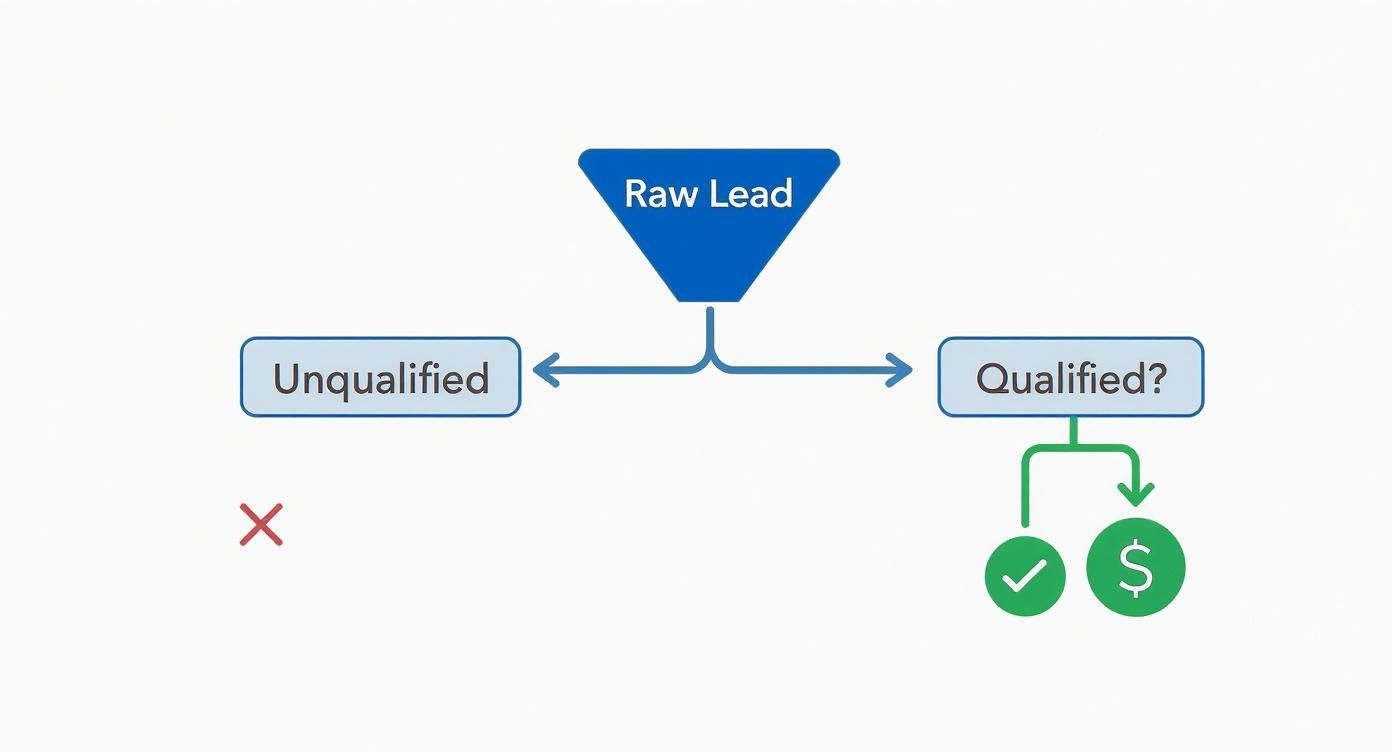
As you can see, not every person who clicks a link is a real opportunity. That’s what makes CPL so appealing—you’re not paying for the tire-kickers, just the people who pass that first crucial filter.
Pro Tip: Before you sign anything on a CPL deal, get crystal clear on the definition of a "qualified lead." Does it mean they're in your specific zip code? Asking for a service you actually offer? Is it an exclusive lead? Nail this down in writing to avoid future headaches.
For many home service pros, CPL hits the sweet spot. A roofer, for example, might pay a predictable fee for each homeowner in their area who requests a quote. The risk is shared. If a lead is bogus, you can usually dispute it. If it’s solid, the cost is easy to factor into your job pricing.
High-Performance Models
If you’ve got your sales process dialed in, these next models can be game-changers. They tie the lead gen company’s paycheck directly to your success, creating a powerful incentive for them to send you only the best opportunities.
-
Appointment-Setting: This takes CPL a step further. You only pay when the company successfully books a qualified appointment right on your calendar. You're not just buying contact info; you're buying a scheduled meeting with a potential customer. This is fantastic for services like HVAC or plumbing, where getting a technician on-site for an estimate is the key to closing the sale.
-
Revenue Share: Here, the lead gen company gets a percentage of the revenue from every single job you land from their leads. They don't make a dime unless you do. This is the ultimate partnership model, often used for high-ticket services like kitchen remodels or pool installations where the potential reward for both parties is significant.
To help you compare these options at a glance, here’s a quick breakdown of the most common pricing structures you’ll come across.
Lead Generation Pricing Models Compared
| Pricing Model | How It Works | Best For… | Key Risk |
|---|---|---|---|
| PPC/Retainer | You pay a management fee + ad spend costs. | Businesses with a marketing budget who want control over campaigns. | You pay for effort, not results. If campaigns don't convert, you still pay. |
| Cost-Per-Lead (CPL) | You pay a fixed price for each qualified lead. | Most home service businesses wanting predictable lead costs. | Lead quality can vary. A clear "qualified lead" definition is critical. |
| Appointment-Setting | You pay a fee only when a qualified appointment is booked. | Businesses with strong in-person sales processes (e.g., HVAC, plumbing). | Can be more expensive per opportunity, and you rely on their booking quality. |
| Revenue Share | The company takes a percentage of the revenue from closed deals. | Businesses selling high-ticket services (e.g., remodeling, solar). | You give up a portion of your revenue, and it requires transparent tracking. |
Ultimately, the right choice boils down to your business. Look at your sales cycle, your average ticket price, and your team's ability to close. Matching the model to your reality is the secret to finding a partner that helps you grow, not one that just sends you a bill every month.
How to Vet a Company's Credibility and Past Performance
Any agency can throw together a slick website and promise you the moon. But when you’re looking for a lead generation partner for your home service business, you aren't buying promises—you're investing in real, measurable results.
This is your due diligence phase. It's where you look past the sales pitch and dig for actual, verifiable proof that they can deliver. Frankly, this is your best defense against getting locked into a contract that drains your bank account and delivers nothing but headaches.
Look for Relevant Case Studies
Your first stop should be their portfolio of case studies. But don't just get dazzled by big numbers. You need to look for relevance. A glowing success story from a SaaS company means absolutely nothing to your roofing business.
You're looking for proof that they genuinely understand the home services world. Find case studies featuring businesses that look and feel like yours:
- Similar Industry: Do they have wins with other plumbers, electricians, or HVAC contractors?
- Similar Scale: Have they helped businesses your size, or do they only show off massive national brands?
- Similar Goals: Did they help a client achieve a specific goal you share, like booking a certain number of high-ticket installation appointments?
If their website is all vague testimonials and lacks concrete, industry-specific examples, that’s a big red flag.
A great case study doesn’t just show a chart going up and to the right. It tells a story: "Here was the client's problem, here's exactly what we did to solve it, and here are the specific, measurable results."
Talk to Real, Live References
Case studies are polished marketing materials. References are where you get the unvarnished truth.
Any company worth its salt will have no problem connecting you with a few of their current or past clients. If they hem and haw or make excuses when you ask, that’s your cue to walk away. Seriously, just end the conversation.
When you get that list of contacts, don't just ask, "Were you happy with them?" That's a softball question that won't give you the insights you need. You need to be prepared with targeted questions to get the real story.
Vetting Questions for Past Clients:
- "What was the onboarding process really like? How long did it take before you started seeing leads you could actually use?"
- "Tell me about the quality of the leads. What percentage would you say were genuinely qualified opportunities for your business?"
- "How was their communication and reporting? When things went wrong, how responsive were they?"
- "Was there anything about their service that surprised you, for better or for worse?"
- "Knowing what you know now, would you hire them again? Why or why not?"
These types of questions get you past the surface-level answers and give you a much clearer picture of what it’s actually like to work with them day in and day out.
Verify Compliance and Professionalism
Finally, there’s a crucial but often-overlooked step: checking their handle on compliance. This is non-negotiable, especially if the company uses calling or texting to generate leads.
Ask them directly how they stay compliant with regulations like the Telephone Consumer Protection Act (TCPA). A legitimate, professional outfit will have clear, established protocols for managing consent and opt-outs. Their ability to speak confidently and clearly on this topic is a huge indicator of their professionalism.
Getting this right protects your business from some serious legal and financial headaches down the road. This diligence is how you ensure you're partnering with a team that's not just effective, but also credible and professional.
Ensuring a Smooth Technical and Operational Handoff
A great lead generation partner should feel like a natural extension of your team, not just another bill you pay every month. But for that partnership to actually work, the handoff—both technically and operationally—has to be absolutely seamless. If it's not, you'll be stuck wrestling with manual data entry and, worse, losing track of the very leads you paid for.
The best lead generation companies for small businesses get that efficiency is everything. When a hot lead comes in from a homeowner who needs a new roof or a plumber ASAP, it can't just sit in an email inbox for hours. It needs to land directly where your team works, instantly and automatically.
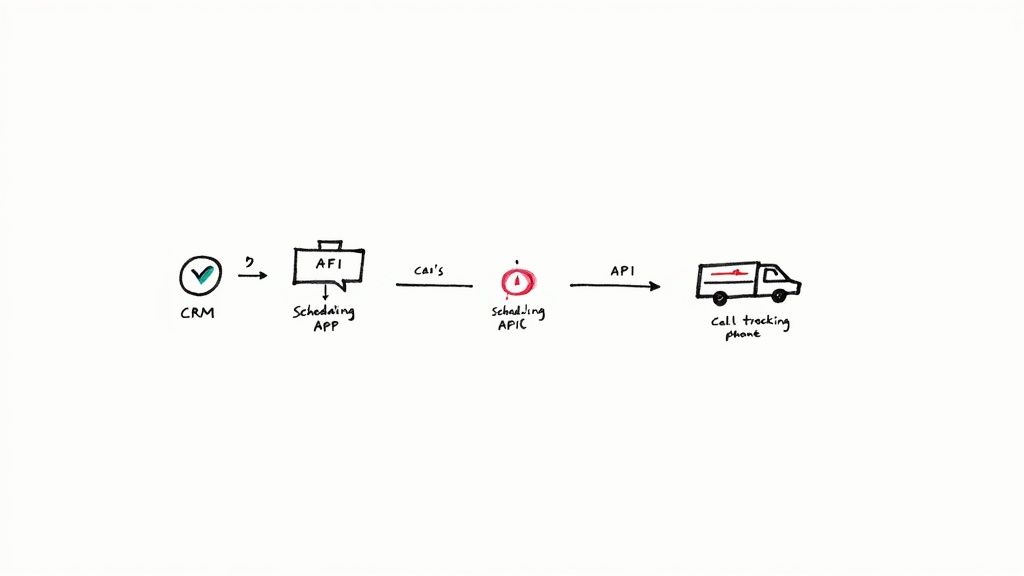
This is where asking the right questions upfront becomes your biggest advantage. Don't just ask if they can send you leads. Dig into exactly how they're going to deliver them.
Key Integration Questions to Ask
Before you sign on the dotted line, you need total confidence that their technology plays nicely with yours. A technical breakdown at this stage can completely wipe out the value of even the best leads.
Here’s what you need to nail down:
-
CRM Integration: Can they push new leads directly into your Customer Relationship Management (CRM) software? Manually keying in data is a surefire way to introduce errors and slow everything down. A direct API connection is what you should be looking for.
-
Lead Delivery Method: How are you going to get notified? Do they offer a few different options like email, text messages, or a direct push into your scheduling app?
-
Call Tracking: This is a big one. Do they use unique, trackable phone numbers for their campaigns? It's the only real way to prove which calls came from their efforts, which is absolutely essential for calculating your ROI.
Think about it from your perspective. If you're a busy electrician out on a job, you don't have time to stop, open an email, and copy-paste a customer's details into your scheduling software. You need that lead to just show up in your field service app, ready for you to dispatch a tech. This isn’t a luxury feature; for a modern home service business, it’s a basic necessity.
The goal is to eliminate friction. Every single manual step between a lead being generated and your team acting on it is a potential failure point where a customer can get lost forever.
Ensuring a Seamless Handoff
A smooth operational flow also means having the right people ready to handle the increased volume. It's a common story: a contractor starts getting a ton of new leads, but their front office gets totally swamped.
This is where an answering service for contractors can be a total game-changer, making sure every call gets answered quickly and professionally.
Ultimately, doing this technical homework ensures the leads you invest in are tracked, managed, and converted as efficiently as possible from day one. It’s what turns a simple lead delivery service into a powerful, integrated growth engine for your business. Don't gloss over these details.
The Final Handshake: What to Check Before You Sign
You've done the hard work. You’ve vetted the companies, checked their references, and confirmed they can plug into your systems. Now, you’re looking at a contract from a company that feels like the right fit.
Before you put pen to paper, it's time for one last, careful pass. This isn’t just about the fine print; it's about making sure the agreement truly protects your business and sets you both up for a successful partnership. A solid contract prevents headaches down the road.
Key Clauses to Scrutinize
This is where the rubber meets the road. Get crystal-clear answers on these points, because they will define your day-to-day relationship with your new partner.
-
Contract Length & Auto-Renewal: Are you signing up for a 3-month trial or a 12-month commitment? Be very wary of auto-renewal clauses. You don't want to get stuck in another year-long agreement simply because you missed a cancellation window.
-
The "Out" Clause: What happens if the leads just aren't converting? A good contract will have a clear, reasonable cancellation policy. Look for a fair notice period (30 days is pretty standard) and make sure there are no massive termination fees.
-
Lead Exclusivity & Quality Guarantees: This is a big one. The contract should state, in no uncertain terms, that the leads are 100% exclusive to your business. It also needs a clear definition of what counts as a "bad" or "invalid" lead and a simple process for getting credit for them.
A partnership should feel like a two-way street. If the contract heavily favors the lead generation company with long lock-in periods and vague performance metrics, it’s a major red flag. True partners are confident enough in their service to offer fair, flexible terms.
Got Questions? We’ve Got Answers.
When you're diving into the world of lead generation, a few questions always pop up. It's a big decision, so let's clear up some of the most common things business owners ask.
What’s a Realistic Lead Generation Budget for a Small Business?
There’s no one-size-fits-all answer, but a solid rule of thumb is to earmark 5-10% of your total revenue for marketing and lead generation. If you're really hitting the gas and trying to scale up quickly, bumping that up to 12-15% is a smart move.
The key is to think in percentages, not fixed dollar amounts. This approach lets your marketing budget grow naturally right alongside your business. As more jobs come in, you can confidently pour a little more fuel on the fire that’s bringing you that growth in the first place.
Isn't Lead Generation Just a Fancy Word for SEO?
This is a really common mix-up, but the distinction is important. Think of it like building a house: SEO is one of the essential tools, but lead generation is the entire construction project.
- Search Engine Optimization (SEO) is all about the technical work of getting your website to show up high on Google when someone searches for "roof repair near me." It’s how you get organic traffic to your site.
- Lead generation is the whole strategy of finding those interested people and turning them into actual, paying customers. SEO is a huge part of it, but so are things like paid ads, social media, follow-up emails, and having someone ready to answer the phone when they call.
In short, SEO gets potential customers to find you online. A complete lead generation service makes sure they actually pick up the phone and book a job.
Can’t I Just Do This Myself and Save Some Money?
Of course you can, but it’s a classic trade-off: what you save in cash, you pay for in time. The obvious benefit of a DIY approach is avoiding management fees. But the downsides can sneak up on you fast.
Finding a steady stream of good, qualified leads takes a unique set of skills, a lot of time spent staring at analytics dashboards, and constant campaign tweaking. It’s a full-time job. Trying to master it while also running your crews and managing your business is a recipe for burnout and mediocre results.
Partnering with one of the specialized lead generation companies for small businesses is an investment in focus. It brings in expertise and lets you get back to what you do best—delivering fantastic service to your customers.
Ready to stop worrying about where your next job is coming from? At Phone Staffer, we don't just find leads; we help you convert them with our expert cold calling and virtual CSR services. Book a call with us today and let's build your growth engine.