
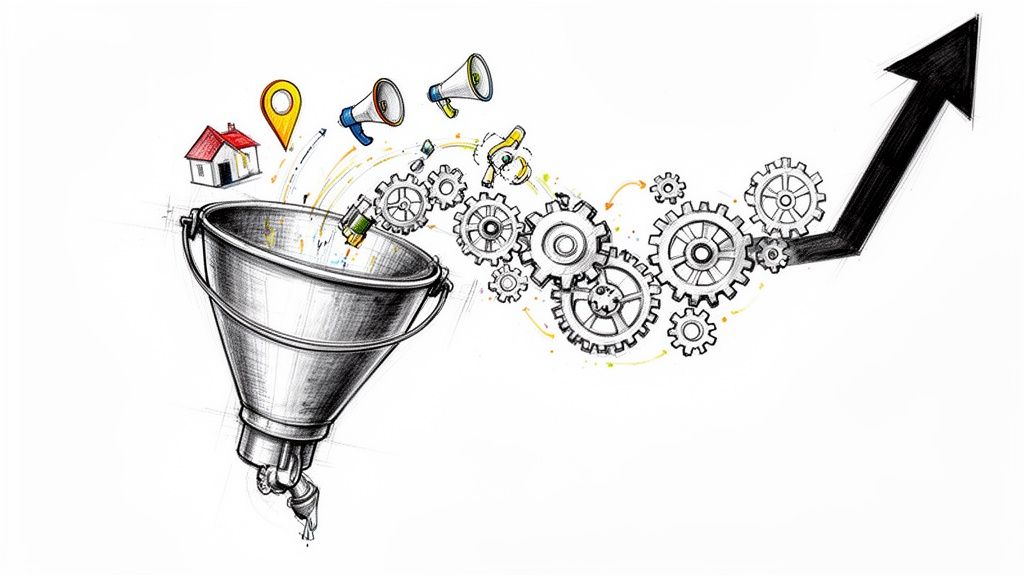
For any home service business, lead generation is all about getting in front of homeowners who are actively looking for what you offer. It's more than just general advertising; it’s the engine that creates a steady stream of opportunities to turn interested people into paying customers. This is the lifeblood that keeps your crews busy and your business growing.
Why Your Marketing Feels Like a Leaky Bucket

Does this sound familiar? You're sinking good money into marketing—maybe Google Ads, SEO, or even old-school flyers—but the phone isn't ringing off the hook. It’s a classic frustration for so many owners, leaving you feeling like you're just throwing cash into a black hole.
Here’s the thing: the problem probably isn't your marketing. Think of your business as a bucket. Your marketing efforts are the water you pour in, representing all those potential customers, or "leads." You might be doing a great job filling it up, but if that bucket is full of holes, the water just drains out before you can do anything with it.
This is called lead leakage, and it's the quiet killer of marketing ROI.
Where the Leaks Happen
These "leaks" aren't complicated mysteries. They're simple, everyday breakdowns in how you handle an inquiry from a potential customer. For most small businesses, the biggest problems show up long before you even get to talk about making a sale.
The most common sources of lead leakage are painfully simple:
- Missed Phone Calls: When a customer calls and gets your voicemail, they almost never leave a message. In fact, over 80% of callers who hit voicemail will just hang up and dial your competitor. That's a lead you paid for, gone in an instant.
- Slow Response Times: A potential customer is hottest the moment they fill out a form on your website. If you wait hours—or even a whole day—to get back to them, you’re giving your competition a massive head start.
- No Follow-Up: Let's be real, most people aren't ready to book an appointment on the first call. Without a consistent process for following up, these warm leads go cold and eventually get forgotten.
The core issue is simple: Pouring more leads into a leaky bucket doesn't fix the problem; it just wastes more water. Before you spend another dollar on advertising, you must first plug the holes.
That’s exactly what this guide is all about. We’re going to shift your focus from just getting more leads to building a rock-solid system that captures, nurtures, and converts the leads you’re already paying for.
By tightening up your internal processes, you can turn your marketing from a frustrating expense into a predictable growth machine. You'll finally make every single dollar you invest work harder for your business.
Building Your Customer Attraction Engine
If you feel like you're constantly pouring leads into a leaky bucket, it's time to build a system that brings the right customers to you, consistently. Don't think of this as a random list of marketing tasks. Think of it as building an engine. Each part has a job, and when they all work together, they create a reliable, predictable flow of high-quality jobs for your business.
For most home service companies, this engine has three core parts: Local SEO, Paid Ads, and Referrals. Sure, they can work on their own. But the real magic happens when you get them running in sync, creating multiple ways for homeowners in your area to find you when they need you most.
Let's break down how to build each part of this engine.
Dominate Your Service Area with Local SEO
When a homeowner's pipe bursts, what's the first thing they do? They grab their phone and search "plumber near me." For a home service business, showing up right then and there isn't just important—it's everything. That's the power of Local Search Engine Optimization (SEO). The goal isn't to be famous worldwide; it's to be the most visible, trusted choice in the towns you actually serve.
Your Google Business Profile (GBP) is the foundation of all your local SEO efforts. A huge part of building your customer attraction engine involves mastering Google Business Profile management so you can be found right where your customers are looking. It's your digital storefront, right on Google Maps and Search.
To get the most out of your GBP, you need to treat it like a top priority. Here's what to focus on:
- Fill Out Everything: Don't leave any section blank. Complete your services, hours, all your specific service areas, and write a detailed business description. Add plenty of photos.
- Upload Geo-Tagged Photos: Make a habit of snapping high-quality pictures of your work. When you upload them, make sure they are "geo-tagged" with the location of the job. This sends powerful local signals straight to Google.
- Go All-In on Reviews: Customer reviews are a massive ranking factor. You have to ask for them. Make it a standard step in your process to ask every happy customer for a review right after the job is done.
Think of Local SEO as earning your visibility. It's a long game that requires consistent effort, but it pays off by building a powerful asset that generates "free" leads from highly motivated local customers, month after month.
Comparing Top Lead Generation Channels for Home Services
Choosing where to invest your marketing dollars can be tough. Each channel offers a different mix of cost, speed, and effort. This table breaks down the main options to help you decide which part of your engine to build first or where to allocate more fuel.
| Channel | Typical Cost | Time to See Results | Best For |
|---|---|---|---|
| Local SEO (GBP) | Low (mostly time/effort) | 3-6 months | Building a long-term, sustainable source of "free" organic leads and establishing local authority. |
| Paid Ads (Google LSAs) | Pay-per-lead | Immediate (within days) | Generating immediate lead flow, filling gaps in the schedule, and getting top visibility fast. |
| Referrals | Low (some incentives) | Varies | Acquiring high-quality, high-trust leads that close at a much higher rate. |
| Cold Calling | Medium (time or hiring) | Immediate | Proactively targeting specific commercial clients or multi-property owners for larger contracts. |
Ultimately, the most resilient businesses don't rely on just one of these channels. They build a diversified engine that combines the long-term asset of SEO, the on-demand flow of paid ads, and the high-trust pipeline of referrals.
Target Ideal Customers with Paid Ads
While Local SEO is building your long-term momentum, sometimes you just need the phone to ring right now. That's where paid advertising comes in, specifically channels like Google Local Services Ads (LSAs). Paid ads are the turbocharger for your engine—you pay for a guaranteed spot at the very top of the search results, right when a customer needs help.
LSAs are especially powerful for home services because they're built on trust. To even get in the program, you have to pass Google's background checks. This earns you the coveted "Google Guaranteed" or "Google Screened" badge, which instantly tells homeowners you're a legitimate, vetted professional.
The best part? It's a pay-per-lead model. You only pay when a potential customer actually calls or messages you directly through the ad. This makes it an incredibly efficient way of handling lead generation for a small business. You set a weekly budget based on how many jobs you can handle, giving you direct control over your lead flow.
Cultivate a Powerful Referral Network
The final piece of your engine runs on one thing: relationships. Your referral network is often the source of your best leads, because they arrive with trust already built-in. When a past customer or another local pro recommends you, most of the "selling" has already been done for you.
But great referral networks don't just happen by accident. You have to build them with intention.
- Partner with Other Pros: Get to know other non-competing home service businesses in your area. A roofer can be a great source of leads for a gutter cleaner. A painter can refer work to a pressure washer. A plumber can refer an electrician. Build real relationships.
- Create a Customer Referral Program: Give your past customers a reason to talk about you. Offer a small thank you—like a $25 gift card or a discount on a future service—for any referral that turns into a booked job. It doesn't have to be huge, it just has to be a real incentive.
When you combine the long-term authority of Local SEO, the immediate results from Paid Ads, and the high-quality leads from a strong Referral Network, you create a powerful and resilient customer attraction engine that will fuel your growth for years to come.
How to Capture and Qualify Leads Effectively
Getting a potential customer's attention is just the first domino to fall. The real race begins the moment they reach out. If your system for grabbing and sorting through that interest is slow, confusing, or just a pain to use, they'll be gone. They'll find a competitor who makes it easy.
Think of it this way: a new lead is like someone knocking on your business's front door. Capturing the lead is opening the door and inviting them in. Qualifying them is starting a friendly conversation to figure out what they need and if you can help. If you fumble either of those steps, you’re essentially leaving a paying customer standing on the porch in the rain.
The goal here is to turn a random stream of phone calls and form submissions into a clean, organized pipeline that puts the most urgent, ready-to-buy customers right at the top.
This is how your marketing efforts—SEO, ads, and word-of-mouth—all work together to bring those potential customers to your door in the first place.

This whole system is about creating a predictable flow of new opportunities for your home service business.
Create Simple Lead Capture Points
For a home service business, you have two front doors: your website and your phone. You need to make it incredibly simple for people to walk through either one. That means hunting down and eliminating every single bit of friction.
Let's start with your website's contact form. So many businesses get this wrong by asking for a potential customer's life story upfront. A long form with ten different fields feels like homework. Most people will just give up and click away.
Instead, strip your form down to the bare essentials needed to start a conversation:
- Name: So you know who you're talking to.
- Phone Number: The most direct way to get in touch.
- Email Address: Perfect for sending quotes and follow-ups.
- A simple text box: "How can we help?" or "Tell us about your project."
Every extra field you add to a form is another reason for someone to abandon it. Make it ridiculously easy to get the ball rolling. You can always gather more details once you're on the phone with them. To really dial this in, check out these actionable conversion rate optimization tips for forms that can make a huge difference in how many people fill yours out.
Next up, your phone. Stop using your personal cell. It looks unprofessional and makes it impossible to track where your calls are coming from. Get a dedicated business line that's answered professionally every time. It builds instant trust and shows you're a serious, legitimate operation.
Qualify Leads with a Simple Script
Once you have their contact info, the next step is to qualify them. This isn't about giving a hard sell or being pushy. It’s a quick, respectful process to see if you're a good fit for them and, just as importantly, if they're a good fit for you.
Using a simple script ensures you—or anyone on your team—can handle these initial calls consistently and effectively. The goal is to figure out three key things: their problem, their timeline, and their budget.
Here’s a basic script you can adapt.
Sample Lead Qualification Script
- Confirm the Need: "Thanks for reaching out! Just to confirm, you're looking for help with [repeat what they said in the form], is that right?"
- Gather Key Details: "Got it. To give you the most accurate info, could you tell me a little more about the situation? Also, how soon were you hoping to get this handled?"
- Set Expectations: "Okay, that's super helpful. For a project like that, our clients are typically in the [provide a realistic price range] range. Does that line up with what you were budgeting for?"
This approach gets right to the point without being rude. You quickly figure out who is serious and ready to go, and you avoid wasting hours on tire-kickers or jobs that aren't a good match. This lets you focus all your energy where it actually counts.
Turning Qualified Leads Into Booked Jobs
This is the moment of truth. All your hard work in generating leads comes down to this: turning a person with a problem into a paying customer with a job on your schedule. A qualified lead isn't just a contact; it's someone who has raised their hand and said, "I think you can help me." Your job is to prove them right.
Success here boils down to two things: speed and professionalism. In the home services game, the first company that provides a confident, easy booking experience usually gets the business. It’s that simple. Every single interaction is your chance to build trust and show them they made the right call.
Think of this process as the final, crucial bridge between your marketing dollars and your revenue. A clunky or slow booking experience is like building a beautiful bridge that crumbles right before the finish line. Get it right, and you not only close the deal but also immediately set yourself apart from the competition.
Mastering the Inbound Call
When a qualified lead calls, it’s showtime. The way that phone call is handled can make or break the entire deal. The person answering your phone isn't just a receptionist; they are the voice of your company. They need to sound confident, empathetic, and in control from the very first "hello."
If they sound rushed or hesitant, a potential customer instantly feels like they're an inconvenience. But a calm, professional tone puts people at ease and tells them they’re in good hands.
This is where active listening is your secret weapon. You’re not just waiting for your turn to talk; you're trying to understand the customer’s frustration. Repeating their problem back to them—"Okay, so just to confirm, the water heater is leaking from the bottom"—is a simple trick that shows you're paying attention and builds instant rapport.
The goal of that first call isn’t just to collect information. It's to take charge of the situation and guide the customer smoothly to a solution. A seamless booking experience is the first promise you deliver on.
Navigating Customer Questions and Objections
Even the best leads are going to have questions, and the big one is almost always about price. It’s critical to handle this conversation with skill. The last thing you want to do is get defensive or start dropping your price right away. When a customer asks, "How much will this cost?" what they're really asking is, "What's the value I'm getting?"
Instead of blurting out a number that might cause sticker shock, frame the conversation around your process. A great response sounds something like this: "That's a great question. For a project like that, the price can really depend on what we find when we get there. The best way forward is to schedule a free, no-obligation visit so we can give you a precise quote."
This approach does a few things beautifully:
- It defers the price conversation: You avoid getting pinned down to a number before you know the full scope of the job.
- It establishes value: It frames your service as a professional solution that needs a proper diagnosis, not just a price off a menu.
- It moves toward the goal: The conversation naturally swings back to what you want: booking the appointment.
The Simple Follow-Up Cadence That Works
So, what happens when a lead doesn't book on the spot? A huge mistake owners make is to assume that "I'll think about it" means "no." The reality is people get busy or they're still shopping around. A simple, persistent follow-up system can easily convert a huge chunk of those leads you thought were lost.
Don't just stick to one channel. A mix of calls, texts, and emails makes sure your message actually gets through.
The "2×2" Follow-Up Formula
- Day 1 (Right After the Call): Send a quick text thanking them for their time. Follow that up with an email summarizing your chat and, if you have it, a link to your online booking page.
- Day 3: Make another phone call, maybe in the late afternoon. If they don't pick up, leave a short, friendly voicemail and immediately send a text like, "Hi [Name], just tried giving you a quick call back. Let me know if you had any other questions!"
This simple rhythm is persistent without being annoying. It keeps your business top-of-mind and dramatically increases your odds of turning that warm lead into a booked job. This kind of follow-through is a hallmark of strong lead generation for a small business because it squeezes every drop of value out of the leads you fought so hard to get.
Measuring the Metrics That Drive Real Growth
Trying to grow your business without tracking your marketing is like driving blindfolded. You're definitely moving, but you have no clue if you're headed toward a cliff or a goldmine. The only way to get better at lead generation for a small business is to measure what matters so you can make smart decisions based on real data, not just gut feelings.
I know, marketing analytics can feel overwhelming. But you don't need a PhD in data science to figure this out. You just need to keep a close eye on a few key performance indicators (KPIs). Think of these as the dashboard for your business—they tell you when to hit the gas and when to pump the brakes.
Cost Per Lead (CPL)
Your Cost Per Lead (CPL) is one of the most important numbers in your business. It tells you, in plain dollars and cents, how much it costs to get a potential customer to raise their hand and show interest. It’s the price you pay for every phone call or form submission.
Calculating it is dead simple:
Formula: Total Marketing Spend on a Campaign ÷ Total New Leads Generated = Cost Per Lead (CPL)
Let's say you spend $500 on Google Local Services Ads and get 20 leads from it. Your CPL is $25. Easy. Knowing this number is powerful because it lets you compare your different marketing channels. Maybe your Facebook ads bring in leads for $40 a pop, while your SEO work is generating leads for way less. This is how you decide where to put your hard-earned money.
Lead to Appointment Conversion Rate
Getting a lead is just the start—the real goal is getting that job on your calendar. Your Lead-to-Appointment Conversion Rate shows how good you are at turning a simple inquiry into a scheduled appointment. This metric puts a spotlight right on your sales and booking process.
It’s shocking, but many small businesses are completely in the dark here. About one in four small businesses don’t know their lead conversion rates, which makes it impossible to know if their marketing is actually working. If you want to dive deeper into this, you can find additional lead generation statistics on Growthlist.co.
Here's how to figure out your rate:
- Formula: (Number of Booked Appointments ÷ Total Number of Leads) x 100 = Lead-to-Appointment Rate (%)
So, if you got 50 leads last month and turned 15 of them into booked jobs, your conversion rate is 30%. If that number feels low, it's a huge red flag. It means you have a "leaky bucket"—you're getting leads, but they're slipping through the cracks before they become jobs. This tells you to fix your call handling or follow-up process, and fast.
Customer Acquisition Cost (CAC)
Finally, we get to the bottom line: Customer Acquisition Cost (CAC). This is the granddaddy of them all. It tells you the total cost to land a new, paying customer. While CPL measures the cost of an opportunity, CAC measures the cost of actual business.
Here’s the formula:
- Formula: Total Sales and Marketing Costs ÷ Number of New Customers Acquired = Customer Acquisition Cost (CAC)
Let's say your total marketing spend for the month was $1,000 and you signed up 10 new customers. Your CAC is $100. This number is everything when it comes to profitability. If your average profit on a job is $500, a $100 CAC is a home run. But if your average profit is only $75, you're literally paying to lose money.
By tracking these three simple metrics—CPL, conversion rate, and CAC—you get a crystal-clear financial picture of your marketing. You stop hoping for the best and start knowing exactly what it takes to grow your business.
How to Scale Your Bookings Without In-House Staff
As your home service business grows, you’ll inevitably hit a ceiling. It’s that frustrating point where you physically can't answer every call, reply to every web form, and book every job yourself. This bottleneck doesn't just slow you down; it costs you real money every time a good lead slips through the cracks.
But scaling up doesn't have to mean taking on the massive overhead and headache of hiring a full-time, in-house team. There’s a much smarter way to handle the flood of new leads from a successful marketing strategy. The secret is tapping into a professionally trained team on-demand, making sure no opportunity is ever missed.
This move gets you off the phone and back to doing what you do best—leading your crews, ensuring top-notch work, and planning your company's next big step.
The Two Models for Outsourced Growth
When it comes to scaling your booking process, you can be reactive or proactive. Both solve the administrative bottleneck, but they attack different parts of your sales funnel. One makes sure you catch every lead that comes your way, while the other actively goes out and finds new ones to fill your calendar.
Picking the right one really just depends on your most pressing need right now:
- Remote Customer Service Representatives (CSRs): Think of this as your solution for handling all inbound interest. A remote CSR becomes the professional voice of your business—answering calls, responding to website forms, qualifying leads, and booking jobs right into your schedule. They essentially plug the leaks in your bucket.
- Outbound Cold Calling Services: This is the proactive approach. Instead of waiting for the phone to ring, a dedicated team calls a targeted list of potential clients, like commercial properties or property managers. Their sole mission is to drum up new business and book high-value appointments, actively filling any empty spots in your schedule.
Outsourcing isn't just about hiring someone to answer phones. It's about strategically plugging in a trained, scalable system that converts leads into revenue without the complexities of managing an internal team.
Making the System Work for You
For either of these models to truly work, they have to feel like a seamless part of your own company. The outsourced team needs to know your services inside and out, understand your ideal customer, and match your brand’s tone. That all comes down to having clear processes and documentation from day one.
This is exactly why having well-defined scripts and standard operating procedures is so critical. A professional outsourced team will take your guidelines and make sure every single customer interaction is consistent and professional. To get this right, it helps to know how to create training materials that clearly spell out your company's standards and way of doing things.
Getting this initial setup right ensures that whether a customer is calling you for the first time or getting a call from your team, the experience is top-notch and builds trust. By handing off these critical functions, you get the power of a full-time staff without the cost, freeing you up to focus on growing the business.
Got Questions About Lead Generation? We've Got Answers.
Jumping into lead generation for your home service business can feel like you're trying to solve a puzzle with a million pieces. Let's clear up a few of the most common questions we hear from owners just like you.
"How Much Money Should I Actually Be Spending on Marketing?"
There's no one-size-fits-all answer here, but a solid rule of thumb is to set aside 7-10% of your total revenue for marketing. If you're really looking to hit the gas and grow fast, you might even want to bump that up a bit.
The most important thing is to stop thinking of it as an "expense" and start seeing it as an investment. Pick a number you can live with, track what you get back for every dollar spent, and then double down on what’s working. Once you nail down your Customer Acquisition Cost (CAC), you can stop guessing and start making decisions backed by real data.
"Which Lead Source Should I Try First?"
If you need your phone to ring right now, your best bet is probably Google Local Services Ads (LSAs). You only pay when a legitimate lead comes through, and that little "Google Guaranteed" badge does wonders for building instant trust with homeowners who are ready to book a job today.
For the long game, though, your focus should be on your Google Business Profile (GBP). It's more of a marathon than a sprint—it takes time and consistent effort to climb the local rankings. But once you're there, it becomes a powerful engine for high-quality, free leads that can fuel your business for years. The smartest move? Use LSAs for that instant gratification while you invest in your GBP as a long-term asset.
Pro Tip: Never put all your eggs in one basket. Relying on a single lead source is risky. If that channel dries up or Google changes an algorithm, your entire business could be in trouble. A healthy mix is always the way to go.
"When Is the Right Time to Hire Someone to Answer My Calls?"
The minute you start missing them. Seriously. Every single call that hits your voicemail is a customer you just sent straight to your competitor. If you’re trying to answer the phone from a ladder or just letting it ring because your hands are full, you're already losing money.
Bringing on a remote CSR or an answering service isn't a luxury; it's about fixing a massive hole in your sales funnel. A friendly, professional voice answering every time ensures you actually capture all those expensive leads you worked so hard to get.
Ready to stop missing calls and start booking more jobs? Phone Staffer provides professionally trained remote CSRs and proactive cold calling services to ensure you never lose a lead again. Learn how we can help you scale your business.