
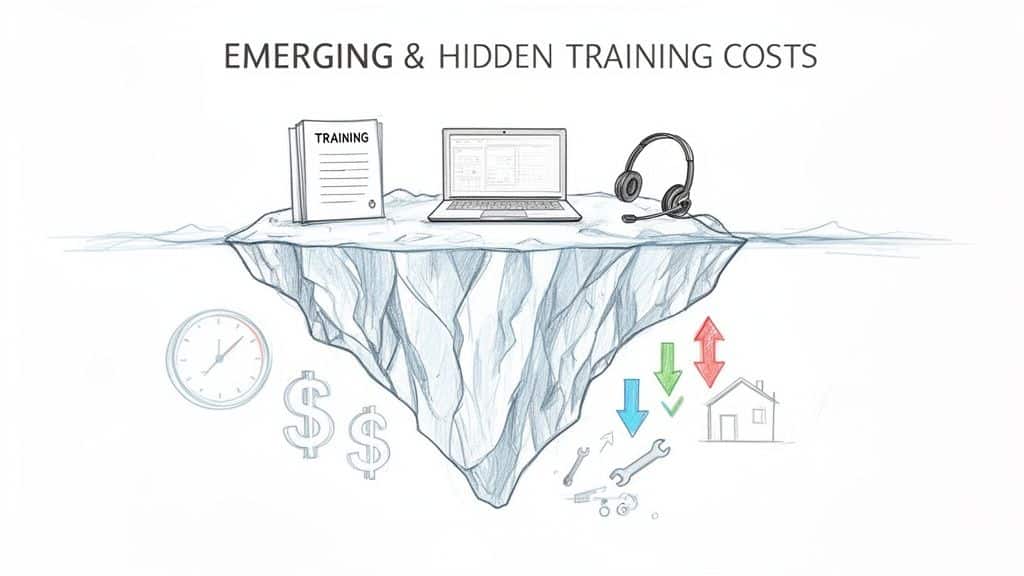
When you bring on a new hire, it's easy to focus on their salary and think you've got the costs covered. But in reality, the sticker price of a new employee is just the beginning. The real training costs for new employees run much deeper, involving a mix of direct expenses and hidden, indirect costs that can quietly eat into your home service business's profits.
The Hidden Costs of Hiring Your Next Team Member
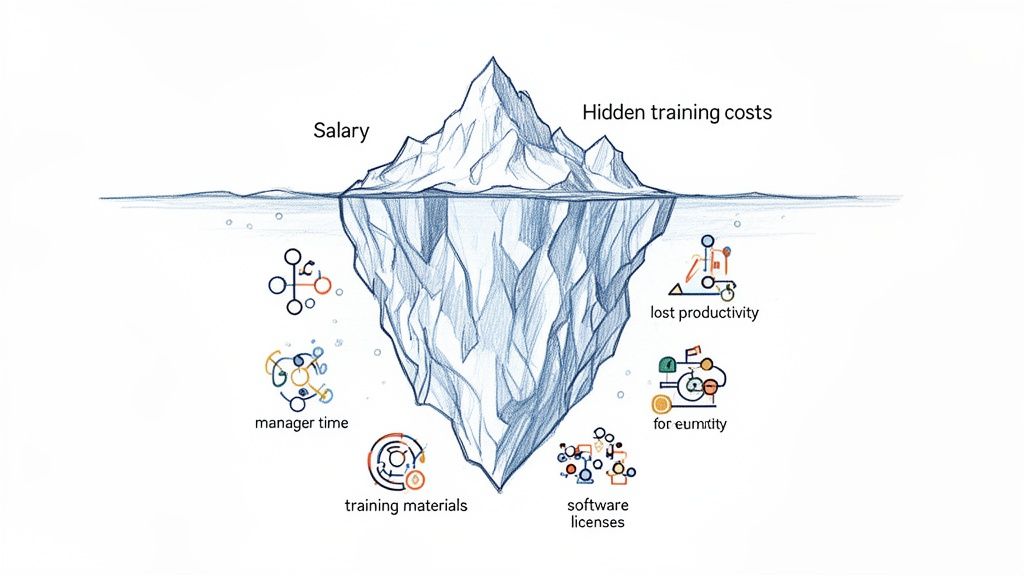
Let's say your home service business is booming. The phone is ringing off the hook, and you desperately need a new customer service representative to keep up and book more jobs. You've budgeted for their hourly wage, but is that the whole story? Not even close. That salary is just the tip of the iceberg.
Lurking beneath the surface is a massive, unseen chunk of expenses that are easy to miss but can have a huge impact on your bottom line. This is where so many business owners get blindsided, watching their profits shrink without knowing exactly why. The true investment in a new team member is far more than what you see on their paycheck.
Uncovering the Real Investment
To really understand the full financial picture, you have to look beyond the obvious. The total cost is a blend of both visible and invisible expenses. Think about all the resources that go into getting someone truly ready for the job:
- Manager's Time: Every single hour your manager or lead CSR spends training is an hour they're pulled away from their own critical, revenue-generating tasks.
- Trainee's Ramp-Up Period: For the first few weeks, or even months, your new hire is a net cost. They're learning the ropes and not yet contributing at full capacity.
- Training Materials and Tools: This isn't just a manual anymore. It's software licenses, access to online training platforms, and any other tools they need to do their job effectively.
The costs to properly train a new employee can be shocking. For a local plumbing, HVAC, or electrical company, that investment feels even bigger and can really strain the budget.
The Staggering National Average
Recent industry studies put some hard numbers to these costs, and they’re eye-opening. As you bring on a new CSR to handle your valuable incoming leads, those hidden training expenses can add up fast. On average, U.S. companies are now spending $874 per learner, a noticeable increase from the year before.
For small businesses like yours, that number jumps even higher to $1,091 per learner, while larger corporations get to take advantage of training at scale. You can dig into more data about how businesses are increasing their training spend on LearnExperts.ai. That statistic alone shows just how crucial it is to get a handle on these expenses instead of letting them catch you by surprise.
The True Cost of Training: More Than Meets the Eye
When you think about the cost of training a new employee, what comes to mind? Probably the obvious stuff, like the trainer's time or the price of a software license. But that’s just the tip of the iceberg. The real financial hit isn't in what you see on a spreadsheet; it's hidden beneath the surface.
To get a real handle on what it costs to bring someone new into your home service business, you have to look at two distinct categories: direct and indirect costs. Direct costs are the easy-to-spot, out-of-pocket expenses. The indirect ones? They’re the silent killers of your profit margin.
The Tip of The Iceberg: Direct Costs
Direct training costs are the line items you can easily budget for. When you’re onboarding a new Customer Service Representative (CSR) or Virtual Assistant (VA), these are the expenses you expect to pay.
Think of these as the predictable, upfront investment needed to get someone started. They’re necessary, but they’re far from the whole story.
Some of the most common direct costs include:
- Trainer's Salary and Time: If your office manager or a senior CSR is doing the training, their hourly wage for every minute they spend with the new hire is a direct, measurable cost.
- Training Materials: This covers everything from printed manuals and cheat sheets to any digital guides you’ve created specifically for onboarding.
- Software and Licenses: Your new CSR needs a login for your CRM, scheduling software (Jobber, Housecall Pro, etc.), and phone system. The cost of adding that new user is a direct expense.
- External Training Courses: Did you send them to a workshop on communication skills or a certification class for your specific industry? The registration fee is a clear-cut direct cost.
These expenses are straightforward. You can plan for them, track them, and manage them. But if you stop here, you're missing the biggest part of the financial picture.
The Hidden Bulk: Indirect Costs
Now, let's dive below the waterline. Indirect costs are the sneaky expenses that drain your resources through lost time, missed opportunities, and reduced productivity. They don't appear on an invoice, which is precisely why they’re so dangerous and so often ignored.
The real threat to your bottom line isn’t the price of a training manual. It’s the revenue you lose from a fumbled sales call or the senior tech you had to pull off a high-dollar job to show a rookie the ropes.
For a home service company, these hidden costs can be massive. The Society for Human Resource Management (SHRM) has found that fully replacing an employee can cost six to nine months of their salary when you factor in all these hidden variables. It’s a staggering figure.
So, what do these costs actually look like in your business?
- Lost Productivity of the Trainer: While your office manager is patiently explaining the booking process, they aren't chasing down unpaid invoices, optimizing schedules for fuel efficiency, or dealing with a high-priority customer complaint. That’s a real opportunity cost.
- Trainee's "Ramp-Up" Time: A new hire doesn't become a rockstar overnight. For the first few weeks—or even months—they’re drawing a full salary while only operating at a fraction of their potential.
- Errors and Mistakes: This one stings. A rookie CSR might misquote a service, book a plumber for an HVAC job, or forget to get a callback number from a new lead. Every one of those slip-ups can mean a lost job, a bad review, and wasted marketing spend.
- Managerial Oversight: It's not just the main trainer. You or other managers will spend extra time checking the new hire's work, answering their questions, and generally keeping a closer eye on them. That's time you could have spent on growing the business.
- Team and Culture Impact: A new person changes the team's dynamic. Your seasoned staff might have to pick up the slack or answer the same questions over and over, which can cause a temporary dip in both efficiency and morale.
To help you see this more clearly, let's break down how these costs show up for a new home service CSR.
Direct vs. Indirect Training Costs for a Home Service CSR
| Cost Category | Type of Cost | Example in a Home Service Business |
|---|---|---|
| Trainer's Wages | Direct | Paying your senior CSR $25/hour for 20 hours of dedicated, one-on-one training ($500). |
| Lost Productivity (Trainer) | Indirect | While training, that senior CSR isn't on the phones, potentially missing out on booking several high-value jobs. |
| Software Licenses | Direct | Paying $75/month for a new user seat in your CRM and scheduling software. |
| New Hire's Wages | Direct | Paying the trainee $18/hour during their first 80 hours of non-productive training time ($1,440). |
| Booking Errors | Indirect | The new hire misquotes a job, leading to a lost sale worth $600 in profit. |
| Training Materials | Direct | $100 spent on printing a training manual and creating a welcome kit. |
| Managerial Oversight | Indirect | An operations manager spending an extra 4 hours a week reviewing the trainee's call logs and schedules. |
| Reduced Team Efficiency | Indirect | Other team members slow down to answer the new hire's questions, causing a slight dip in overall call handling capacity. |
Seeing it laid out like this makes it obvious: the indirect costs, while harder to pin down to an exact dollar amount, add up quickly and can easily dwarf the direct expenses you budgeted for.
Grasping this full spectrum of costs is the first critical step. When you acknowledge both the visible and the hidden expenses, you can start making truly informed decisions about how you hire, train, and build your team for long-term success.
How to Calculate Your True Cost to Train an Employee
Talking about training costs in the abstract is one thing, but seeing the actual numbers on a spreadsheet? That’s something else entirely. Let's get out of the clouds and onto the ground with a real-world example. This will give you a simple framework you can use to figure out what it really costs to bring a new person onto your home service team.
Let's say you run a local HVAC company and you've just hired a new remote Customer Service Representative (CSR) named Alex. You’re starting them at $18 per hour. Your veteran office manager, Sarah, who makes $25 per hour, is going to handle the training.
The iceberg infographic below is a great visual for what we're about to break down. It perfectly separates the obvious, on-the-surface costs from all the hidden expenses lurking underneath.
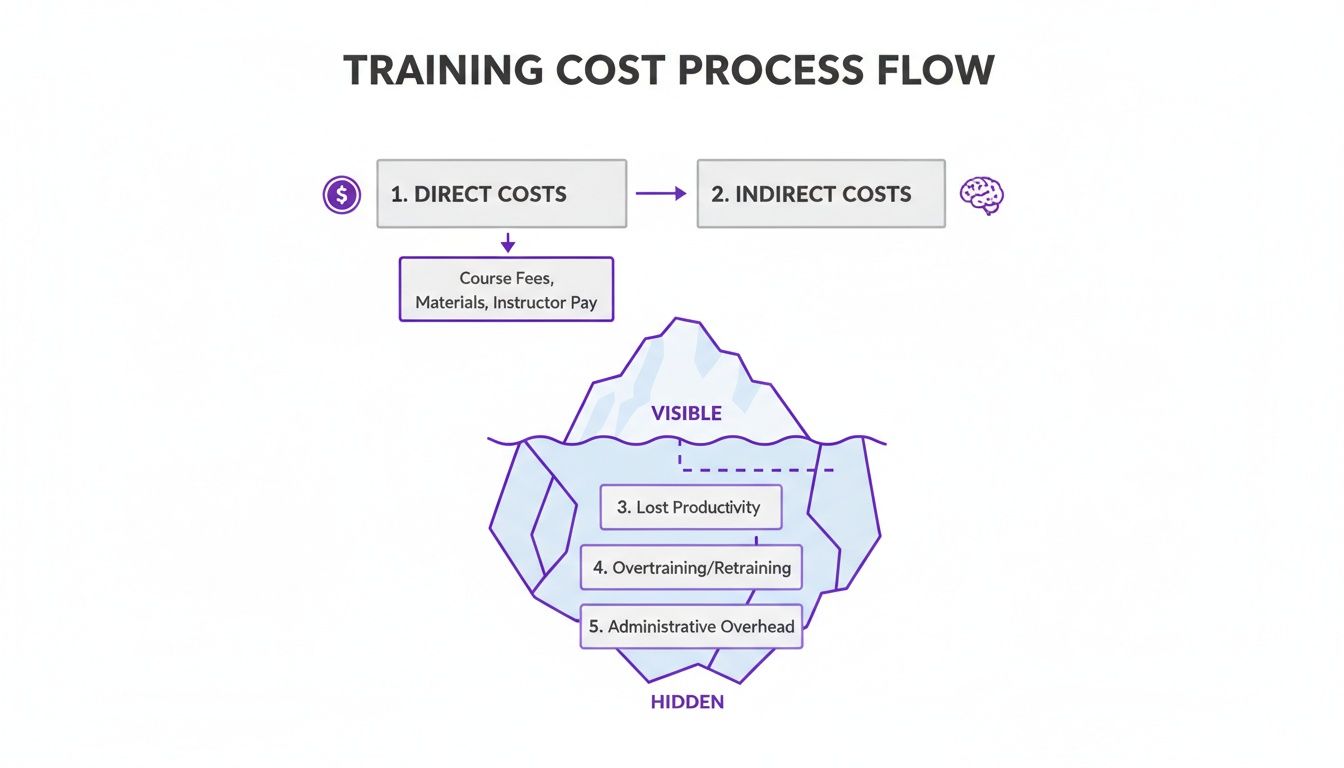
As you can see, the expenses you write checks for are just the tip of the iceberg. The real financial weight comes from the stuff that's harder to track, like lost productivity and missed opportunities.
Tallying the Direct Training Expenses
First up, the easy stuff—the direct, out-of-pocket expenses. These are the numbers you probably already budget for, the visible part of our iceberg.
New Hire’s Wages During Training: Alex needs two full weeks (80 hours) of focused training before you can let them fly solo on the phones. During this time, they’re on the payroll but not yet bringing in revenue.
- Calculation: 80 hours x $18/hour = $1,440
Trainer’s Wages: Sarah will spend about 20 hours over those two weeks personally training Alex, walking them through your CRM, call scripts, and booking process.
- Calculation: 20 hours x $25/hour = $500
Software and Materials: You’ll need to add a seat to your scheduling software, set them up on the phone system, and maybe print out a training manual.
- Calculation: $75 (software licenses) + $25 (materials) = $100
Total Direct Costs: $1,440 (Alex's Wages) + $500 (Sarah's Wages) + $100 (Tools) = $2,040
Right out of the gate, you're looking at $2,040 before your new CSR has booked a single job. That’s already a decent chunk of change.
Uncovering the Indirect Training Expenses
Now, let's dive below the surface to find the hidden costs. These are trickier to pin down but they often have a much bigger impact on your bottom line. This is where the true cost of training really starts to add up.
Trainer’s Lost Productivity: For those 20 hours Sarah spent with Alex, she wasn't doing her normal job—dispatching techs, managing schedules, or smoothing over customer issues. If her work normally generates about $50/hour in value for the business, that’s a real loss.
- Calculation: 20 hours x $50/hour of value = $1,000
New Hire’s Reduced Productivity (Ramp-Up Period): After the initial training, Alex still isn't going to be a superstar. It takes time. For the next four weeks (160 hours), let’s be realistic and say they're working at about 50% productivity while they get their sea legs.
- Calculation: 160 hours x $18/hour x 50% inefficiency = $1,440
Cost of Errors: Newbies make mistakes. It's inevitable. Let's conservatively say Alex makes two big goofs in their first month—maybe they misquote a big job or fail to book a hot lead—costing you $300 in lost profit each time.
- Calculation: 2 errors x $300/error = $600
Total Indirect Costs: $1,000 (Sarah’s Lost Productivity) + $1,440 (Alex’s Ramp-Up) + $600 (Errors) = $3,040
Calculating the Grand Total
When you put both direct and indirect costs together, you finally get the complete picture of your investment in one new hire.
- Direct Costs: $2,040
- Indirect Costs: $3,040
- Grand Total: $5,080
That $5,080 can be a real shock to the system. The $18/hour role you hired for has actually cost your HVAC business over $5,000 in just the first six weeks. For any small business running on tight margins, that's a massive hit.
And you're not alone. Total U.S. training spending is expected to reach a staggering $102.8 billion in 2025, with small companies paying an average of $1,091 per learner. Your experience is part of a much bigger trend.
Knowing this total figure is powerful. It forces you to look at hiring differently and really appreciate the value in making your training process more efficient. Before you commit to this kind of steep upfront cost, it’s worth exploring other options. In fact, this guide breaks down the cost-saving benefits of different staffing models. When you truly know your numbers, you can make smarter decisions that protect your profit and set your business up for sustainable growth.
Viewing Effective Training as a Revenue Driver
After adding up all the direct and indirect training costs, it’s easy to look at that final number and see it as just another expense to be slashed. It's a common trap for business owners. But looking at training this way completely misses the point.
The smartest home service owners don't see training as a cost center. They reframe it as one of the most powerful revenue drivers they have. It’s not just about teaching a new hire how to use your CRM; it's about turning them into a productive, efficient, and profitable member of your team as fast as humanly possible. This is where real growth happens.
The Link Between Training and Profitability
The line between solid onboarding and your bottom line is straight and clear. A well-trained Customer Service Representative (CSR) isn't just a warm body answering phones—they become a crucial part of your sales and customer retention engine.
Think about what great training actually produces:
- Higher Lead Conversion: A confident, knowledgeable CSR knows how to handle common objections, explain why you're the best choice, and turn a hesitant caller into a solidly booked job. That's a direct boost to your conversion rate.
- Happier Customers: When a customer's first call is handled by someone professional, empathetic, and efficient, it sets the stage for a great relationship. This leads to five-star reviews and, more importantly, repeat business.
- Better Employee Retention: People who feel like they know what they're doing—and feel supported while doing it—are far less likely to quit. Cutting down on turnover means you stop bleeding money on the high training costs we've already broken down.
This isn't just a gut feeling; the numbers prove it. One eye-opening statistic shows that companies with strong training programs pull in 218% higher income per employee compared to businesses that don't. These same companies also enjoy 17% higher productivity and 21% better profits because their teams are well-trained and engaged. You can dig into more of these employee training trends yourself. For a home service business, this is huge—it means your CSR is actively turning phone calls into cash flow.
Transforming a CSR into a Revenue Generator
Let's paint two very different pictures. In the first, an undertrained CSR fumbles through a call, unsure about your service area or how your pricing works. They put the caller on a long, awkward hold to ask a manager a basic question. The frustrated lead hangs up and immediately calls your competitor. That's what happens when you treat training as an expense to be minimized.
Now, picture this. A properly trained CSR answers with confidence. They quickly diagnose the caller's problem, explain the value of your premium service package, and book a high-ticket job right there on the spot. That’s training treated as an investment in revenue.
A well-trained CSR is your front-line sales force. They are the first voice a potential customer hears and have the power to either secure a new job or lose it in under a minute. Investing in their skills is a direct investment in your sales pipeline.
When you equip new hires with the right scripts, service knowledge, and people skills, you’re not just filling a seat—you’re creating an asset. They learn how to upsell maintenance plans, follow up on unsold leads, and build the kind of rapport that turns one-time customers into lifelong clients. Their growth is your growth, and understanding that is key, because a career as a CSR in home services is demanding but incredibly rewarding when done right.
This shift in thinking changes everything. Suddenly, the training costs for new employees no longer look like a financial drain. They look like a strategic investment with a clear, measurable return. With that in mind, the next logical step is to find smarter, more efficient ways to get that world-class training without all the traditional headaches.
Smarter Alternatives to the In-House Training Burden
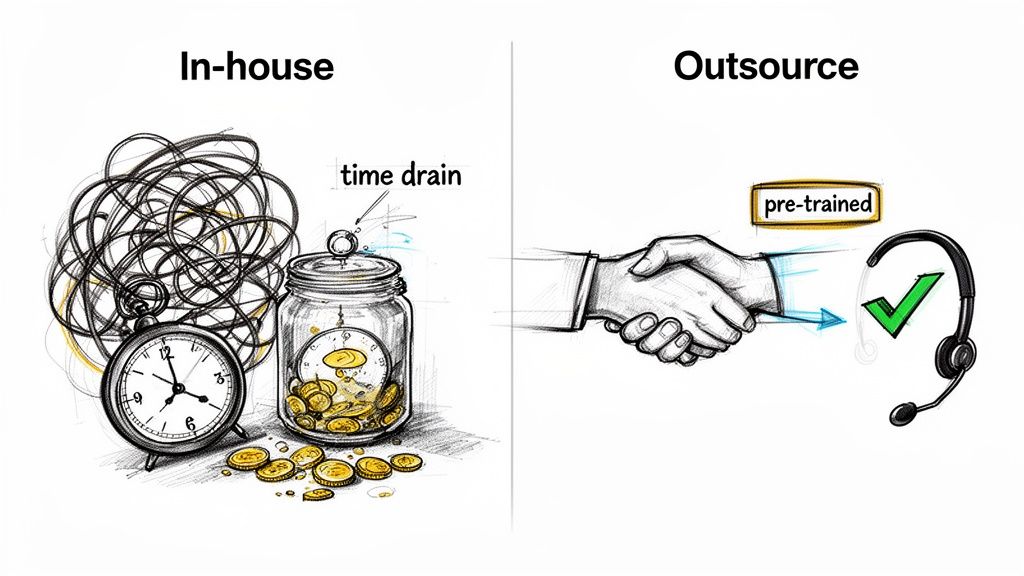
When you lay out all the direct and indirect costs, the reality of training a new employee can be a tough pill to swallow. It's a massive investment of time, money, and energy. For a growing home service business, that traditional in-house training model can feel less like an investment and more like a heavy anchor.
But what if there's a different way? The solution is to stop thinking you have to do everything yourself and start looking at specialized services that can give you better results without the headache. This is where outsourcing stops being a buzzword and starts becoming a serious growth strategy.
The Power of Job-Ready Professionals
Picture this: your new Customer Service Representative (CSR) starts on Monday, and by Tuesday, they're already navigating your dispatch board and confidently talking to homeowners. They already get the lingo, understand the urgency of a service call, and know their way around common CRM software.
This isn't a fantasy. It's the whole point of using a specialized placement service.
Companies like Phone Staffer were created to solve this exact problem. They do the heavy lifting for you—finding, vetting, and training remote professionals to excel in the home service industry. Instead of you spending weeks and a small fortune on basic training, they deliver a person who is ready to contribute from the get-go.
The goal isn't just to fill an empty seat; it's to get a productive, revenue-generating team member up to speed as fast as humanly possible. A specialist service flips the script from "cost to train" to "time to value."
This completely changes the dynamic. Your team gets to skip the A-B-Cs of the industry and jump straight to what really matters: teaching the new hire your company's unique culture, brand voice, and specific processes. You're no longer a basic training academy; you're a finishing school for a professional who's already 80% of the way there.
A New Model for Reducing Training Costs
This approach is about more than just saving a few hours. It’s a direct attack on the high training costs for new employees. Think back to all those hidden expenses we talked about. A service that provides pre-trained talent systematically wipes most of them off the board.
- Reduced Managerial Drain: Your top people stay focused on their actual jobs instead of being pulled into weeks of hand-holding.
- Faster Productivity: The new hire hits the ground running, shortening that painful, money-draining ramp-up period to just a few days.
- Fewer Rookie Mistakes: A professional trained on industry best practices is far less likely to make those cringe-worthy (and costly) errors that can damage your reputation.
When you partner with a company specializing in remote CSRs and Virtual Assistants, you're essentially outsourcing the most expensive and inefficient part of hiring. To see how this works in the real world, you can explore a full breakdown of how to hire a virtual assistant.
In-House Training vs. Outsourced Placement (Phone Staffer Model)
To really see the difference, it helps to put the two approaches head-to-head. The comparison makes it clear that this isn't just about the initial cost; it's about speed, quality, and the overall return on your investment.
| Factor | DIY In-House Training | Using a Service Like Phone Staffer |
|---|---|---|
| Upfront Cost | High and unpredictable, including wages, lost productivity, and management time. | A predictable, one-time placement fee. |
| Time to Productivity | Several weeks or months before the new hire is fully effective. | Job-ready from day one, requiring only company-specific training. |
| Managerial Burden | Significant time investment from your senior team members, pulling them from other tasks. | Minimal. The service handles vetting, foundational training, and onboarding logistics. |
| Quality & Consistency | Varies greatly depending on the trainer's skill and available time. | Consistent, professional training based on industry-wide best practices. |
| Risk of Bad Hire | High. If the employee doesn't work out, you've lost thousands in sunk training costs. | Low. The service provides vetted candidates, often with replacement guarantees. |
In the end, this model transforms outsourcing from a simple cost-cutting measure into a powerful tool for scaling your business. It allows you to add top-tier talent to your team without the expense and distraction of building an entire internal training program from scratch.
Choosing the Right Path for Your Business Growth
Growing a home service business means making tough, strategic calls, especially when it comes to your people. As we've seen, the real training costs for new employees aren't just about an hourly wage. They're a mix of hidden expenses—lost productivity, your best people being pulled away from their work, and those inevitable (and expensive) rookie mistakes.
The upfront cost to get a new hire truly ready to contribute can easily run into the thousands. That’s a big pill to swallow for any business owner.
But great training is the one thing you can't skip. It’s what transforms a new hire into someone who actually makes you money. So, the question isn't if you should train, but how you can get fantastic results without draining your bank account and distracting your A-team. This is where you have to weigh the old-school way against a more modern, efficient approach.
Making the Right Call for Your Business
To figure out what’s best, you need a brutally honest look at your resources and priorities. Forget "this is how we've always done it" and ask yourself some hard questions:
- What's the real opportunity cost when my senior staff spends hours on basic training instead of high-value tasks?
- Can my business truly afford the weeks—or even months—it takes for a new person to get up to full speed?
- Do I have a rock-solid, repeatable system for high-quality training, or is it different every time?
- How much is a single fumbled customer call or a lost lead costing me while someone is learning the ropes?
Thinking through these questions really changes the game. The focus shifts from, "How much does a new hire cost?" to "What's the fastest, most effective way to get a fully productive person on my team?" That shift is the key to scaling your business without the growing pains.
This is exactly where a service like Phone Staffer flips the script. Instead of starting from square one, you get access to pre-vetted, industry-trained remote professionals. This lets you skip the most expensive and time-sucking parts of onboarding altogether. You get a job-ready CSR or VA who starts adding value on day one, which means no more training headaches and a much faster return on your investment.
Ultimately, the choice is yours. You can keep paying the high, hidden price of the traditional hiring and training model. Or, you can adopt a smarter strategy that delivers skilled talent ready to help you grow from the get-go. Take a hard look at your process, run the numbers on your true costs, and decide if it’s time to stop training from scratch and start hiring for impact.
Frequently Asked Questions
When it comes to training new staff, every home service business owner has questions. Let's tackle some of the most common ones I hear about training, productivity, and outsourcing to give you some real-world clarity.
What Is the Single Biggest Hidden Training Cost I Am Probably Overlooking?
It’s easy to focus on the new hire’s slow start, but the single biggest hidden cost is almost always the lost productivity of your trainer or manager.
Think about it: every hour your best office manager or senior CSR spends holding a new hire's hand is an hour they aren't doing what they do best. They're not smoothing over a tricky customer complaint, optimizing a technician's route, or upselling a high-margin maintenance plan. That opportunity cost is a massive, invisible drain on your business.
How Long Does It Typically Take to Fully Train a New CSR?
Be realistic here. For a new CSR in a home service business to get truly up to speed—to the point where they are fully autonomous and consistently productive—you're looking at two to three months.
Sure, the initial onboarding and learning the software might only take a week or two. But real proficiency is something else entirely. It's about knowing your services cold, handling an angry customer with grace, and intuitively knowing how to turn a simple query into a booked job. Expecting someone to be a top performer in their first month is a recipe for frustration on both sides.
Don't confuse basic competence with full productivity. A new hire might know the software after a week, but it takes months for them to develop the intuition and deep knowledge needed to maximize every single phone call.
Is Outsourcing a Remote CSR More Expensive Than Hiring In-House?
If you're just comparing the hourly rate on a spreadsheet, an in-house hire might look cheaper at first glance. But that's a classic case of missing the forest for the trees. When you account for the total investment, outsourcing through a specialized service is often significantly more cost-effective.
Remember our example where that $18/hour in-house hire really cost over $5,000 just to get them started? That's what a placement service helps you skip entirely.
You completely bypass the expensive ramp-up period, the drain on your manager's time, and all those costly rookie mistakes. You get a pre-vetted professional who starts contributing from day one. The conversation needs to shift from "hourly rate" to "total cost and speed to ROI." On that front, outsourcing is a clear winner for most growing businesses.
Stop sinking thousands into training and start seeing immediate returns. Phone Staffer provides home service companies with pre-vetted, job-ready remote CSRs who are ready to book jobs from their first day. Learn how we can eliminate your training headaches at https://phonestaffer.com.