

Let's be honest, as a business owner, you're constantly pulled in a million directions. There's a never-ending flood of small, but crucial, tasks that steal your focus from the big picture—the work that actually grows your company.
What if you had a professional on standby, ready to jump in and handle those tasks? That’s the real magic behind virtual assistant services.
What Are Virtual Assistant Services, Really?
Forget the idea of just a remote secretary. Think of a virtual assistant (or VA) as a strategic partner you can bring on board for specific jobs or ongoing projects, all without the costs and commitments of hiring a full-time employee.
You're not signing someone up for a rigid 9-to-5 schedule. Instead, you're tapping into a professional service, often from an agency, to achieve a specific result. This could be anything from finally getting your chaotic calendar under control, to making sure customer calls are always answered, or even running your entire social media presence. This model is a game-changer because it gives you access to top-tier talent you might not otherwise be able to afford or find locally.
It's Not One-Size-Fits-All: Generalists vs. Specialists
A common mistake is lumping all virtual assistants into the same "admin support" bucket. The truth is, the VA world is incredibly diverse, and knowing the difference is key to getting real value.
- General Administrative VAs: These are your operational MVPs. They're masters of the day-to-day grind—managing emails, scheduling appointments, handling data entry, and answering phones. They are the ones who keep the engine of your business humming smoothly in the background.
- Specialized VAs: These are experts who bring a deep skill set in a specific field. You might hire a marketing VA to handle your SEO and content strategy, a technical VA to keep your website secure and updated, or a creative VA to design your marketing materials. They deliver focused, high-impact results.
Here’s a good way to think about it: A general VA is like your trusted first mate, making sure the ship runs efficiently day-to-day. A specialized VA is the expert navigator you bring on to chart a course through new, profitable waters.
Understanding this distinction is what separates businesses that just save a little time from those that truly accelerate their growth. When you match the right kind of VA to the right challenge, you're not just offloading tasks—you're making a strategic investment.
This strategic power is exactly why the virtual assistant market is exploding. It was valued at around $6.37 billion and is expected to surge to $8.17 billion next year, marking an incredible compound annual growth rate (CAGR) of 28.2%. Businesses everywhere are realizing the power of this model to run more efficiently and deliver better customer experiences. By understanding the different hats a VA can wear, you can find the perfect fit to help your business thrive. For more details, you can read about the virtual assistant market growth and what's fueling its rise.
Key Benefits of Using a Virtual Assistant

Bringing a virtual assistant on board is about more than just checking items off your to-do list. It's a strategic move that can seriously improve your company's finances and, just as importantly, free you up to act like the business owner you're meant to be. This isn't just about delegating—it's about building a smarter, more resilient operation from the ground up.
These aren't just abstract ideas. The advantages of using a VA directly solve the biggest headaches that growing businesses face, from ballooning overhead to finding the right talent at the right time. Let’s get into the real-world impact a VA can have.
Slash Overhead Costs and Boost Your Bottom Line
When you hire a full-time employee, the salary is just the beginning. You're also on the hook for payroll taxes, health insurance, paid time off, retirement plans, and the cost of a desk, computer, and office space. It’s no surprise these hidden costs can tack on an extra 30% or more to their base pay.
Virtual assistants work on a completely different playing field. You pay for productive time, plain and simple. Whether it's by the hour or for a specific project, there are no benefits to worry about, no sick days to cover, and no need to buy another computer. This model gives you incredible financial agility.
Think of it like this: A full-time employee is like buying a car—you've got the monthly payment, plus insurance, gas, and constant maintenance. A virtual assistant is like calling an Uber—you pay only for the ride you need, exactly when you need it.
This cost-saving approach is a huge driver behind the industry's explosive growth. The global virtual assistant market recently jumped from $4.97 billion to $6.37 billion and is on track to hit $15.88 billion soon. That's a growth rate (CAGR of 25.7%) that shows just how many businesses are catching on to this flexible way of working. You can discover more insights about these global VA statistics to get the full story.
Amplify Your Productivity and Renew Your Focus
Every business owner knows the grind of "low-value" tasks—the work that has to get done but doesn't directly make you money. Think of things like managing social media replies, scheduling appointments, or endless file organization. It’s a time sink.
Handing these administrative duties over to a VA gives you back your most precious resource: your time. When you aren’t drowning in the details, you can finally put your energy where it counts—on growing the business.
- Strategic Planning: You get the headspace to think about the big picture and plan your next move, not just survive the day.
- Client Relationships: You can focus on building stronger connections with your best clients and closing more valuable deals.
- Innovation: You have the freedom to develop new services, perfect your existing ones, and find creative ways to get ahead of the competition.
By outsourcing the work that keeps you busy, you empower yourself to do the work that actually makes you successful.
Gain Immediate Access to Specialized Skills
What do you do when you need a professionally designed brochure, a website tuned for search engines, or someone to clean up your messy books? Most small businesses face a tough choice: hire an expensive agency or waste time trying to do it themselves, usually with so-so results.
A virtual assistant offers a fantastic third way. You can hire a VA who is a specialist in that exact field—graphic design, digital marketing, bookkeeping—for just the project or a few hours a month.
This gives you a serious competitive edge. You can tap into top-tier talent without the hefty price tag or long-term commitment of a full-time hire. You get to build a flexible team of experts, bringing them in only when you need them, to make sure every part of your business is handled by a true professional.
Finding the Right Type of Virtual Assistant
So, you're ready to hire a virtual assistant. That's a great step. But diving into the world of VA services can feel a bit like walking into a massive hardware store for the first time—you know you need a tool, but the sheer variety of options is overwhelming.
The key is to remember that "virtual assistant" isn't a single job title. It's a broad term for professionals with all sorts of different skills. Hiring the right one is the difference between just handing off tasks and actually solving a deep-rooted problem in your business. You wouldn't call an electrician to fix a leaky pipe, right? The same logic applies here. Match the expertise to your biggest pain point, and you'll see a real impact.
To help you find that perfect fit, let's look at the common specializations out there.
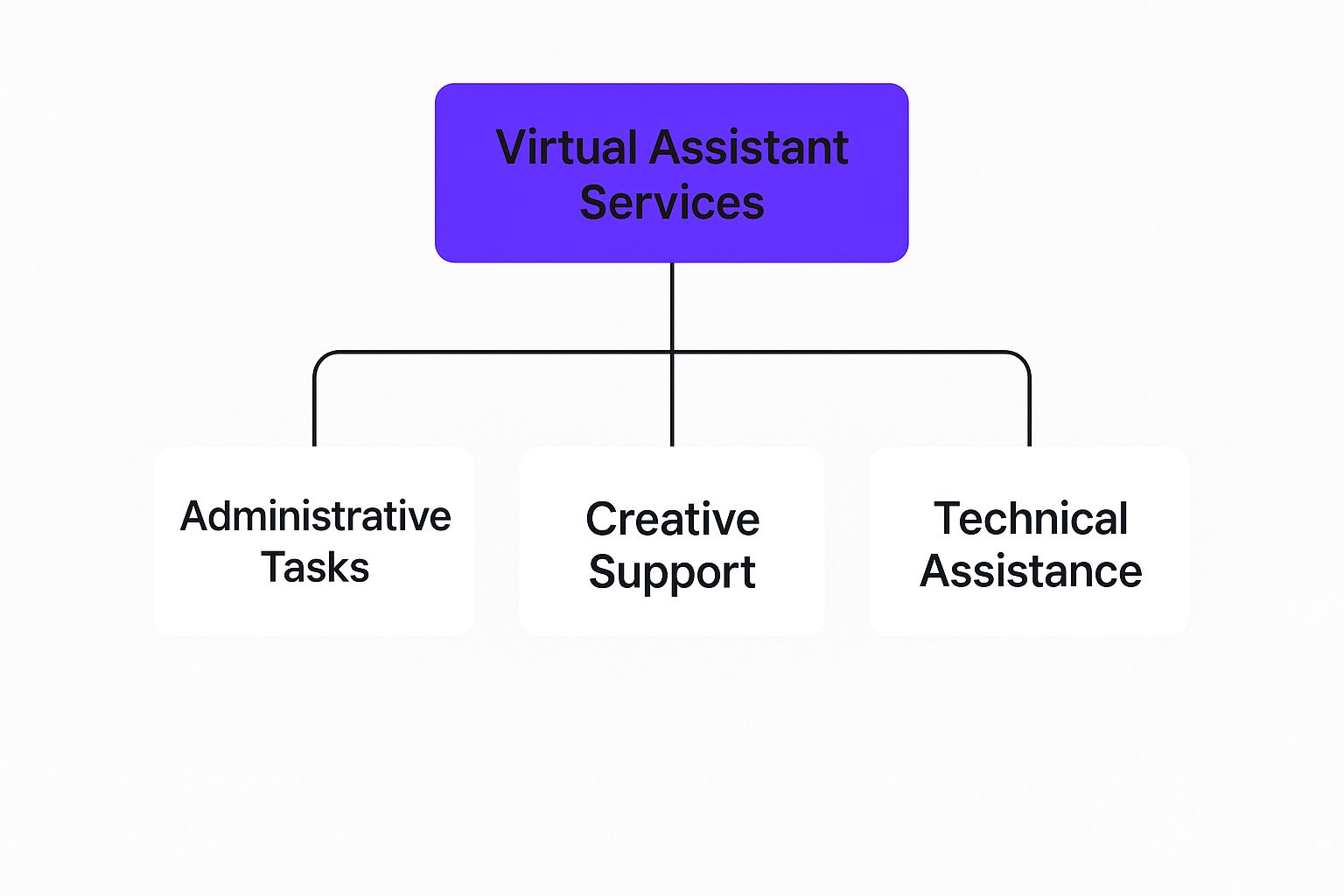
As you can see, different VAs tackle different parts of a business. This allows you to bring in the exact help you need, right where you need it most.
To give you an even clearer picture, let's compare some of the most common specializations. Each type of VA is equipped to handle specific tasks and solve very different business challenges.
Virtual Assistant Services by Specialization
| VA Specialization | Common Tasks Handled | Ideal For Businesses Needing To… |
|---|---|---|
| Administrative VA | Calendar management, answering phones, data entry, email correspondence. | …free up the owner's time from daily operational tasks and improve organization. |
| Technical VA | Website maintenance, CRM setup, software troubleshooting, IT support. | …implement or manage business technology without hiring a full-time IT person. |
| Marketing VA | Social media posting, blog writing, email newsletter creation, basic SEO. | …attract more leads and build a stronger online brand presence. |
| Bookkeeping VA | Invoicing, expense tracking, payroll assistance, financial reporting. | …keep finances organized and ensure accurate, timely bookkeeping. |
| Bilingual VA | Customer service in multiple languages, translating documents, community outreach. | …effectively communicate and serve a diverse, multilingual customer base. |
This table should help you start thinking about which "aisle" of the VA store you need to be in. Now, let's dig a little deeper into the most common types home service pros hire.
Administrative Virtual Assistants
Think of an Administrative VA as the person who keeps the engine of your business running. They are masters of organization, tackling all those critical but time-draining tasks that keep you from focusing on the work that actually makes you money.
Their main job is to bring order to the chaos. If your desk is a mess, your inbox is a nightmare, and your schedule feels out of control, an Administrative VA is exactly what you need.
Common tasks they handle include:
- Calendar and Schedule Management: Booking jobs, managing your technicians' schedules, and confirming appointments with clients.
- Customer Service: Being the first point of contact—answering phones, handling initial inquiries, and routing calls to the right team member.
- Data Entry: Keeping your CRM updated with new client info, organizing digital job files, and logging payments.
- General Correspondence: Managing your main email inbox and handling routine communications with customers and suppliers.
Technical and Specialized Virtual Assistants
This is where you move beyond day-to-day support and into very specific skill sets. Technical and specialized VAs are the experts you call on to handle complex jobs that require dedicated training or industry knowledge. They aren't just helping with your workload; they're solving specific technical problems.
For instance, a home service company might hire a technical VA to manage their website's backend or get a new scheduling software up and running properly. This ensures your business systems are solid and efficient, and you don't have to become a tech guru yourself. The demand for this kind of specialized help is exploding.
In the healthcare field alone, the market for intelligent virtual assistants was valued at $1.785 billion and is expected to soar past $10.7 billion. That's a staggering 21.8% compound annual growth rate, showing just how much businesses are relying on specialized VAs for complex tasks. You can read more details on this specialized VA market growth and what's driving it.
Other specialized VAs can include:
- Website Maintenance VAs: Someone to handle WordPress updates, run security checks, and make small content changes on your site.
- Bookkeeping VAs: Experts in programs like QuickBooks who can manage your invoices, track expenses, and prep your financial reports.
- Bilingual VAs: A huge asset for companies serving diverse areas, handling calls and customer communication in multiple languages.
Creative and Marketing Virtual Assistants
Okay, so your operations are finally running like a well-oiled machine. What's next? Growth. This is where Creative and Marketing VAs come in. They are the specialists who help you get your name out there, attract more customers, and build a brand people trust.
These VAs are a mix of strategist and creator. They know how to grab attention online and guide potential leads toward becoming paying customers. For a local plumber or HVAC company, this could be the difference between waiting for the phone to ring and having a steady stream of new jobs.
Their services often cover:
- Social Media Management: Creating and scheduling posts for Facebook and Instagram, responding to comments, and running local social media ads.
- Content Creation: Writing helpful blog posts (e.g., "5 Tips to Prepare Your AC for Summer"), creating email newsletters, or designing simple marketing flyers.
- Basic Graphic Design: Using tools like Canva to create professional-looking social media images, business cards, or truck magnets.
- SEO and Digital Marketing: Helping with local SEO so your business shows up on Google Maps, or even managing small pay-per-click (PPC) ad campaigns.
The first step is always to identify your biggest bottleneck. Are you drowning in admin work? Struggling with technology? Or do you just need more leads? Once you know the problem, you can find the right type of virtual assistant to solve it.
How to Hire Your First Virtual Assistant

Turning the idea of getting help into a real, live person on your team can feel daunting. But hiring your first virtual assistant doesn't have to be a shot in the dark. With a clear, strategic plan, you can confidently find a professional who truly clicks with your business and your way of working.
This isn’t about just posting a job and hoping for the best. It’s about being intentional. The goal here is to build a partnership that genuinely saves you time and cuts down on stress, and that starts with a solid approach from day one. Let's walk through it, step-by-step, to take the guesswork out of the equation.
Step 1: Clearly Define and Document the Work
Before you can find the right person, you have to know exactly what you need them to do. Vague requests like "help with admin tasks" are a recipe for confusion and mediocre results. You have to get specific.
For one week, keep a running list of every single task you do that makes you think, "I wish someone else could handle this." This list is your gold mine. Once you have it, group similar items together. For instance, things like answering phones, replying to new customer emails, and scheduling appointments can all be bundled under "Client Coordination & Scheduling."
This simple act of defining the role brings incredible clarity. It not only helps you write a compelling job description that attracts the right people but also sets crystal-clear expectations from the get-go—the foundation of any great working relationship.
Step 2: Choose Your Hiring Platform
Once you know what you need, you have to decide where to look. You generally have two main paths for finding quality virtual assistant services, and each has its own set of pros and cons.
-
Dedicated VA Agencies: Think of companies like Phone Staffer. They specialize in finding, training, and managing VAs for specific industries, including home services. They do all the heavy lifting—the recruiting, the vetting, the training. This is a fantastic "done-for-you" option if you want a reliable, pre-trained professional without sinking your own time into the hiring maze.
-
Freelance Platforms: Sites like Upwork or Freelancer open the doors to a massive global talent pool. You can find VAs with just about any skill imaginable at a wide range of price points. The catch? The responsibility for sifting through candidates, interviewing, and managing them is all on you. This route offers more control but demands a much bigger time investment.
Your choice really boils down to your priorities. Are you looking for convenience and proven reliability, or do you prefer to manage the entire process yourself for maximum control?
Step 3: Conduct Thorough Interviews and Vetting
The interview is your chance to see beyond the resume. Skills are important, of course, but you're also evaluating reliability, communication style, and problem-solving instincts. A polished resume is one thing; how a candidate thinks on their feet is another.
Don't just ask about their past jobs. Give them real-world scenarios that they'd actually encounter in your home service business.
Examples of Powerful Interview Questions
- "Imagine an angry customer calls because a technician is running late. Walk me through the exact steps you would take to handle that call."
- "You need to schedule five jobs across town, but you realize two of the locations create an impossible travel schedule. How do you resolve this?"
- "Describe your personal system for keeping multiple tasks and deadlines organized."
The goal of the interview is to understand how a candidate thinks, not just what they know. Look for answers that show proactivity, clear communication, and a focus on customer satisfaction—the cornerstones of excellent service.
Step 4: Start With a Paid Trial Project
Finally, before you sign a long-term contract, start with a paid trial project. This is arguably the single best way to confirm you’ve made the right hire. A trial eliminates the guesswork and shows you exactly how this person operates in a real-world setting.
Give them a small, self-contained task with a clear deadline and pay them for their time. This could be something like organizing a messy customer spreadsheet, handling a batch of email inquiries, or scheduling one week of appointments. This small-scale test gives you the ultimate confidence before you fully bring them into your daily operations, setting the stage for a successful partnership right from the start.
Integrating Your VA for Lasting Success
Hiring a virtual assistant is a great start, but the real magic happens after the contract is signed. The long-term success of this new relationship all comes down to how well you bring them into your daily operations. A little bit of thoughtful onboarding can turn a contractor into what feels like a genuine extension of your team.
Think of it like being a pilot and bringing on a new co-pilot. You wouldn't just point to the controls and walk away. For a smooth flight, you need clear communication, well-defined roles, and to make sure you're both flying toward the same destination. The exact same idea applies to your virtual assistant services.
Build Your Operational Playbook
You can't expect your new VA to be a mind reader. The secret to delegating work without headaches is creating simple, clear instructions they can actually follow. This doesn't mean you need to write a 100-page novel; it just means creating straightforward Standard Operating Procedures (SOPs) for the tasks you'll hand off.
Honestly, the best way to do this is with quick video recordings. Using a free tool like Loom, you can record your screen while you talk through a process, like how to add a new lead into your CRM or schedule a job on the calendar. It’s way faster for you and a whole lot clearer for them than just typed-out instructions.
These SOPs become the "playbook" for your business, making sure things are done the right way, every time, no matter who's doing them. That kind of consistency is how you build an operation that can actually scale.
The most successful VA relationships are built on clarity, not assumptions. A small investment in creating clear processes upfront pays massive dividends in efficiency and accuracy down the line, preventing misunderstandings before they start.
Choose the Right Tools for Collaboration
To make things work with a remote team member, you need a shared digital workspace. The right set of tools keeps everyone on the same page, cuts down on the endless back-and-forth emails, and gives you one central place for all your project communication.
The good news is you don't need to shell out for expensive or complicated software. Plenty of fantastic tools are easy to use and won't break the bank.
- Project Management: Apps like Trello or Asana are perfect for assigning tasks, setting due dates, and seeing progress at a glance. You’ll know exactly what your VA is working on without having to ask.
- Communication: A dedicated chat tool like Slack or even a specific channel in Microsoft Teams keeps conversations organized and out of your already-crowded inbox.
- File Sharing: Using a cloud system like Google Drive or Dropbox is a must. It gives your VA secure access to the documents they need without anything having to live on their personal computer.
Getting these systems set up from the start creates a professional and efficient remote work environment from day one.
Establish a Rhythm for Feedback and Growth
Finally, building a partnership that lasts takes a bit of effort. You have to intentionally build trust and create a clear path for feedback—it's a two-way street.
My advice? Start small. Give your VA a few low-risk tasks to begin with. As they knock those out of the park, you can gradually hand over more responsibility. This approach lets them learn the ropes of your business while giving you the confidence to trust their work.
Make sure to schedule regular, quick check-in meetings. Seriously, even 15 minutes once a week can make a world of difference. Use that time to:
- Look over their completed work and offer helpful feedback.
- Answer any questions they have about their next set of tasks.
- Talk through any challenges or roadblocks they're running into.
This simple communication rhythm ensures tiny issues get sorted out before they snowball into big problems. When you invest in a solid integration plan, you're not just delegating tasks—you're building a powerful, long-term partnership that will fuel your company's growth.
Common Mistakes to Avoid With VAs

Bringing on a virtual assistant can absolutely change the game for your business, but a few common missteps can turn a great opportunity into a frustrating mess. If you want to get this right from the start, you'll need to sidestep some of the most common pitfalls I see owners make.
The number one mistake? Vague instructions. Just telling your new VA to "handle customer emails" is like telling a new hire to "do sales" without any training. It's a recipe for disaster. They have no idea what your company's voice sounds like, how to answer common questions, or when to loop you in on a serious problem. This ambiguity forces them to guess, which almost always leads to inconsistent service for your customers.
The fix here is simple: be painfully clear. Instead of a vague command, give them specific, repeatable processes. A quick video walkthrough is often the best way. Use a tool like Loom to record your screen as you handle a few real-world inquiries. Talk through your process out loud—why you're phrasing something a certain way or where you find specific information. This gives your VA a playbook to follow, not a puzzle to solve.
Micromanaging Instead of Managing Outcomes
Another trap business owners fall into is micromanagement. It's so tempting to watch the clock and track every single minute your VA is working, but this kills trust and motivation. You're basically telling them you don't believe they can manage their own time. Focusing on hours logged instead of work completed is a classic rookie mistake.
You have to shift your mindset from managing activities to managing outcomes. What actually matters? Set clear goals and deadlines that are tied to results. For example, instead of worrying about how they're working, measure their success by a clear metric: Were all new leads from yesterday contacted by 10 AM today? This approach empowers your VA, respects their ability to work independently, and lets you focus on the results, not the process.
A successful VA relationship is built on trust and clarity, not control. The goal is to delegate responsibility, not just tasks. When you give your VA ownership over their outcomes, you free yourself to focus on growing your business.
Setting Unrealistic Expectations
It’s crucial to remember that your VA is a person, not a piece of software. Expecting them to be on call 24/7, master a complex CRM in an hour, or never make a single mistake is a fast track to burnout and disappointment.
Set realistic goals and build in time for a learning curve, especially in the first few weeks. Check in with them regularly. Ask how they're handling the workload and if they have what they need. Be ready to adjust your expectations as you both get into a rhythm. A little patience upfront pays off big time down the road.
Neglecting Data Security
Finally, and this is a big one, don't overlook security. Handing over the keys to your kingdom—your email, your customer list, your financial software—without thinking through the risks is a massive error.
Always, always follow security best practices from day one.
- Use a Password Manager: Tools like LastPass or 1Password are perfect for this. You can grant access to specific accounts without ever revealing the actual passwords.
- Limit Access: Follow the principle of least privilege. Your VA should only have access to the systems and information they absolutely need to do their job. Nothing more.
- Sign an NDA: Before they start, have your VA sign a Non-Disclosure Agreement. This is a standard professional step that legally protects your confidential business information.
By sidestepping these common mistakes, you're not just hiring help—you're building a strong, trusting, and highly effective partnership that can help you take your business to the next level.
Got Questions About VAs? We've Got Answers.
Even when you see the potential, it's smart to have a few questions before bringing a virtual assistant on board. This is a big move for your business, and you want to be 100% sure you're making the right call. Let's walk through some of the most common things business owners ask.
Getting these practical details ironed out will give you the confidence to move forward, knowing you’ve covered all your bases.
How Much Do Virtual Assistant Services Typically Cost?
This is usually the first thing on everyone's mind, and the honest answer is: it really depends. The price tag is shaped by the VA's location, how much experience they have, and the specific skills you need. You're not just buying someone's time; you're investing in their expertise.
Here’s a rough breakdown to give you a ballpark idea:
- General Administrative VAs: For core tasks like answering phones, booking jobs, and managing calendars, you can expect to pay somewhere between $15 and $35 per hour.
- Specialized VAs: If you need an expert in something like digital marketing, website management, or complex bookkeeping, their rates will naturally be higher—often in the $40 to $75+ per hour range. Their unique skills bring a different level of value.
You'll also find different ways to pay. Some VAs charge by the hour, which is great for flexibility. Others offer monthly retainer packages, which give you a set number of hours for a predictable cost. And for one-off projects, a fixed fee is pretty common. It all comes down to finding the right balance between cost and the skills you actually need.
How Do I Keep My Business Information Secure?
Security is a huge deal, and it's a perfectly valid concern when you're giving a remote team member access to your business. The good news is that protecting your company's sensitive data is straightforward with a few professional habits.
The best way to secure your VA relationship is with proactive steps from the very beginning. A few simple protocols set up on day one will protect your business, your customers, and your own peace of mind.
Start with these non-negotiable steps:
- Sign a Non-Disclosure Agreement (NDA): This should be the very first thing you do. A legally binding NDA is standard practice and protects your confidential information before any work even begins.
- Use a Password Manager: Never, ever email or text passwords. Use a secure tool like LastPass or 1Password to share access to specific accounts without ever revealing the actual login credentials.
- Limit Access on a Need-to-Know Basis: Your VA should only have access to the information and tools they absolutely need to do their job. It's easy to create a separate user profile for them within your software with limited permissions. This simple step is a powerful safeguard.
Should I Hire from an Agency or a Freelance Platform?
This choice really boils down to what you value more: convenience or control.
Going through an agency that specializes in placing VAs, like Phone Staffer, means they do all the heavy lifting. They find, vet, and train professionals, handle all the HR and payroll, and can even provide a backup if your VA is out sick. You get reliability and a ready-made solution, though it may come at a premium.
On the other hand, platforms like Upwork give you a massive global pool of talent to choose from, often at lower rates. The trade-off is that you're responsible for everything—the searching, interviewing, vetting, and managing. It just depends on whether you'd rather have a turnkey solution or invest your own time to find the perfect fit yourself.
Ready to stop drowning in admin tasks and start focusing on growth? Phone Staffer can help. We hire, train, and place expert VAs and CSRs in home service businesses just like yours, ensuring your leads are called, your phone is answered, and your operations run smoothly. Book a call with Phone Staffer today and discover how a professional VA can transform your business.