
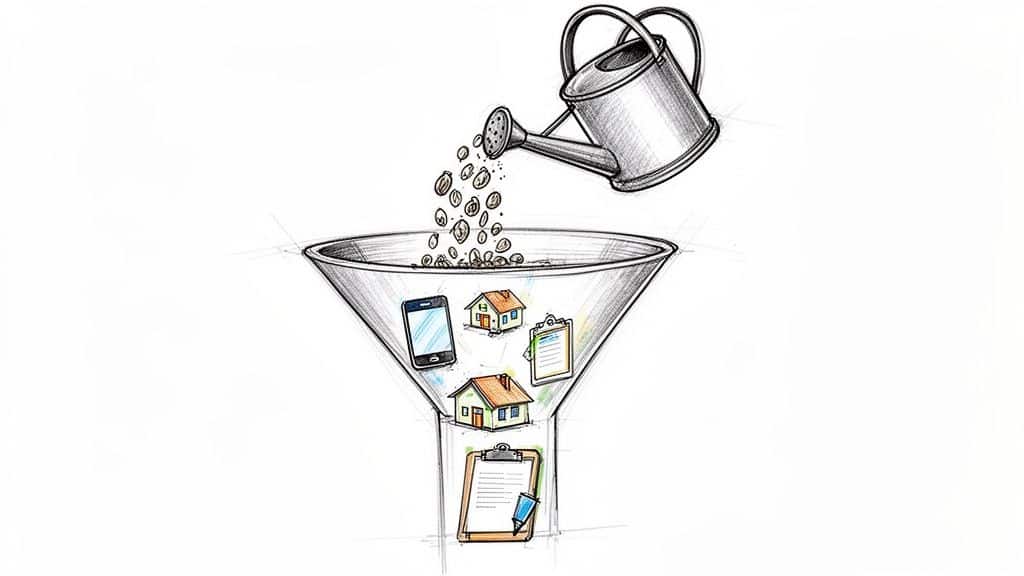
Let's get straight to it: what is a lead? Forget the jargon for a moment. A lead is simply someone who has raised their hand and shown some interest in what your business offers.
Think of it as the very first step in the journey from a curious stranger to a loyal, paying customer. It's that initial spark—a phone call, a website form submission—that your team can nurture into a real business opportunity.
What a Lead Really Means for Your Home Service Business
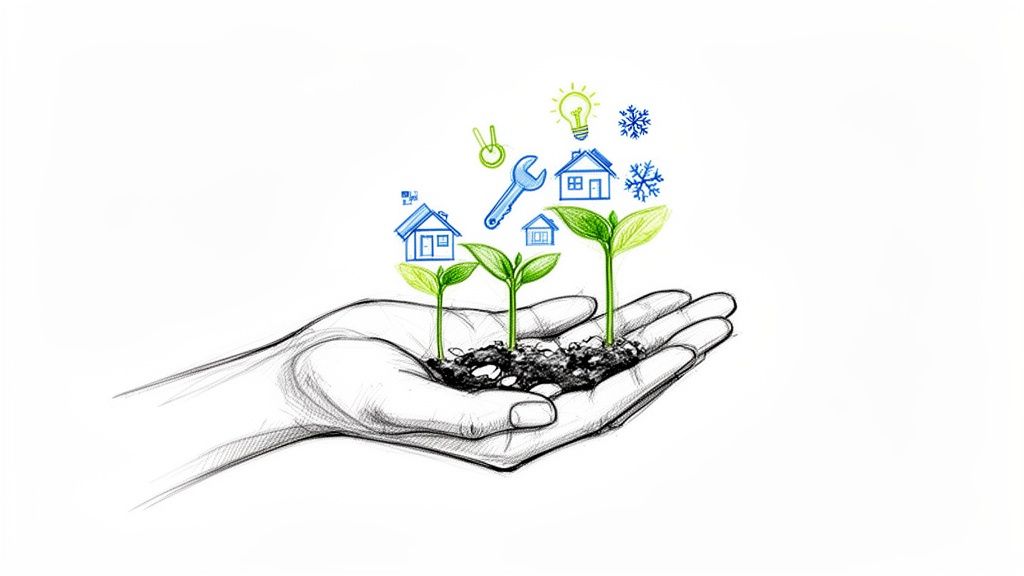
For a home service company, a lead isn't just a name and phone number on a spreadsheet. It's a potential job. It's a homeowner with a problem you are perfectly equipped to solve.
Whether that's a busted AC unit on the hottest day of the year, a flickering light that’s driving them crazy, or a plumbing leak that needs immediate attention, a lead is someone actively looking for a pro.
A great way to think about leads is like planting seeds for your business. Some are ready to sprout into jobs right away ("hot leads"), while others might need a bit more time and nurturing before they're ready to grow ("warm leads"). The one constant is that without a steady supply of these seeds, your business can't flourish.
The Lifeblood of Your Growth
In the booming home services industry, leads are the absolute lifeblood of your business. The market is projected to grow at an incredible 18.91% annually between 2019 and 2026. To get your slice of that pie, you need a predictable flow of interested customers.
A lead isn't just a contact; it's an opportunity. It’s the starting point for every customer relationship, every sale, and every five-star review that builds your reputation.
To truly capitalize on these opportunities, it helps to first understand exactly what is a business lead in the context of your daily operations. This foundation lets you build smart strategies to attract, manage, and turn that initial interest into real revenue.
To boil it all down, here's a quick look at how to think about leads in your business.
Lead Fundamentals at a Glance
| Concept | What It Means for Your Business | Primary Goal |
|---|---|---|
| A New Lead | A local homeowner has a problem and thinks you might be the one to fix it. | Make contact, understand their needs, and show them you're the right choice. |
| Lead Nurturing | Not every lead is ready to buy right now. Some need follow-up or more info. | Stay top-of-mind so they call you when they're finally ready to book the job. |
| Lead Conversion | This is the finish line—turning that initial inquiry into a scheduled, paying job. | Get the appointment booked and turn that opportunity into revenue. |
Having a solid grasp of what a lead means to your business is the first step. It allows you to build a system that works.
This fundamental understanding helps you:
- Focus Your Marketing: Stop wasting money and start targeting the exact people who need your services.
- Streamline Your Sales Process: Create a clear, repeatable path from the first phone call to a signed contract.
- Measure Your Success: Actually track how well you're turning those phone calls and web forms into paying customers.
The Different Types of Leads You'll Get
Just like you wouldn't use a wrench to hammer a nail, you can't treat every lead the same way. Understanding the different kinds of leads is the first real step toward building a process that turns more of those inquiries into paying jobs. Think of it as sorting your tools before you start a project—each one has a specific purpose.
The simple truth is that not all leads are created equal. Some folks are just starting their research, kicking the tires, so to speak. Others are ready to book a service today. Knowing the difference helps you focus your energy where it’ll have the biggest impact and stop you from wasting time on opportunities that just aren't ripe yet.
Marketing Qualified Leads (MQLs)
A Marketing Qualified Lead (MQL) is a homeowner who has shown some early interest but isn't quite ready for a sales conversation. They're still in the information-gathering stage, trying to understand their problem or potential solutions.
For example, an MQL might be someone who:
- Downloads your free "Winter HVAC Maintenance Checklist."
- Signs up for your email newsletter to get home improvement tips.
- Spends a good chunk of time reading a few different blog posts on your website.
These actions all signal curiosity. This person knows they have a potential need, like keeping their furnace running efficiently, but they haven't raised their hand to ask for a quote. They’re browsing the aisles of the hardware store, not standing at the checkout counter.
Sales Qualified Leads (SQLs)
A Sales Qualified Lead (SQL), on the other hand, is much further down the path. This is someone who has taken a specific action that screams, "I'm ready to talk business and make a decision." They know they have a problem and are pretty sure you might be the one to solve it.
Think of it this way: An MQL is browsing kitchen remodel ideas on Pinterest. An SQL is filling out your "Request a Free Estimate" form. One is dreaming, the other is ready to build.
SQLs are the hot leads your team needs to jump on immediately. They are actively looking for a solution, and in the home services world, the first contractor to give them a call often wins the job. This could be someone calling your office directly to ask about availability or submitting a detailed service request through your website.
Inbound vs. Outbound Leads
Beyond how ready they are to buy, leads are also defined by how they found you in the first place.
Inbound Leads: These are the customers who find your business and reach out to you. They might have found you through a Google search, seen one of your posts on social media, or read a stellar online review. They’re the ones starting the conversation.
Outbound Leads: These are potential customers that you proactively contact. This could be your team making calls to a targeted list of homeowners in a new neighborhood or a local business you think could use your services. In this case, you're the one kicking things off.
A healthy business usually has a solid mix of both. And, of course, there’s one more category that’s often the most valuable of all: the referral lead. These prospects come from word-of-mouth recommendations from happy customers, which means they already trust you before you've even spoken—making them far more likely to book a job.
How a Sales Funnel Turns Interest into Income
Knowing the different types of leads is the first piece of the puzzle. But how do you actually turn that initial curiosity into a paying job, time and time again? That's where a sales funnel comes into play. For any home service pro, it helps to think of it like a plumbing system you'd install yourself.
A solid sales funnel guides potential customers from the moment they first hear about you all the way to signing on the dotted line. And just like with plumbing, a poorly designed system springs "leaks"—those frustrating spots where you lose potential customers because of slow follow-ups, bad communication, or a confusing process. The goal is to build a seamless path that plugs those leaks for good.
This process is all about how different leads, like MQLs and SQLs, move through your business until they become loyal customers.
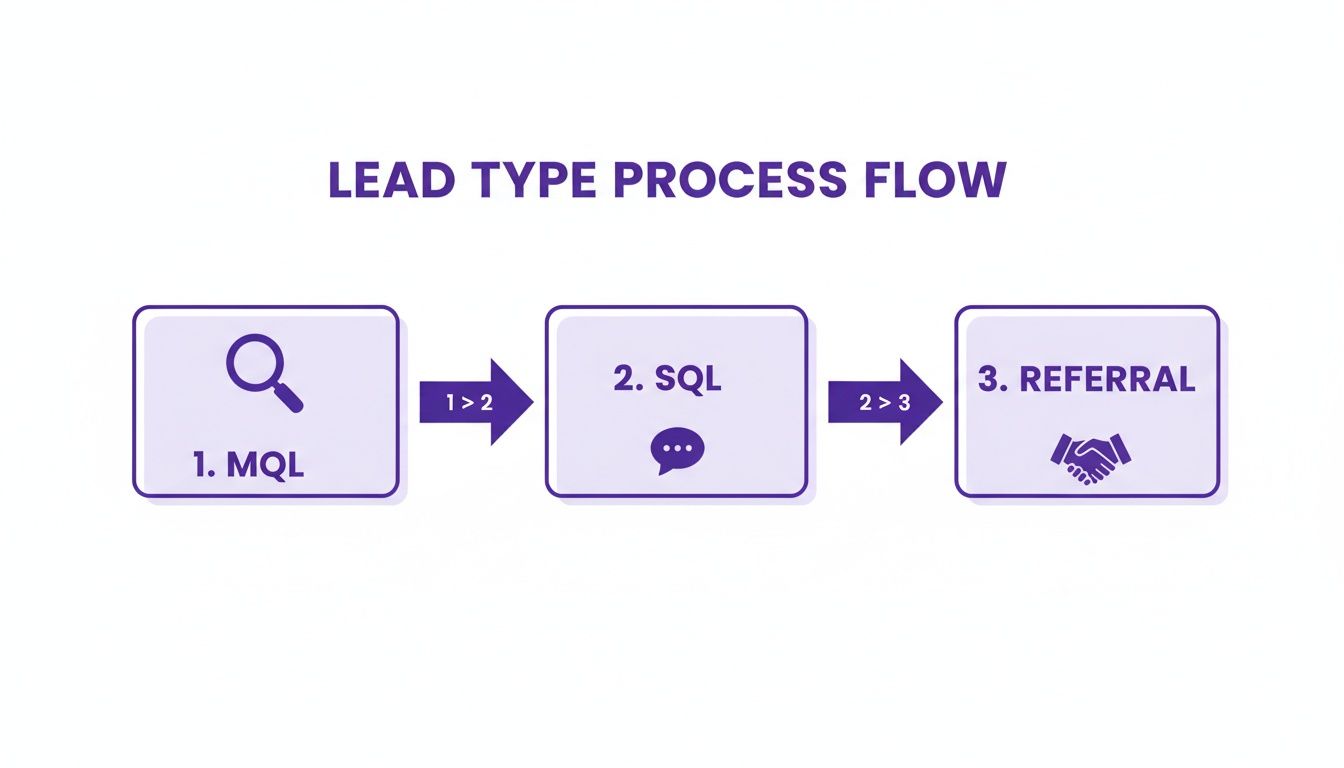
As you can see, the journey typically starts wide with general interest (MQLs) and gets narrower as people become ready for a real sales conversation (SQLs). Of course, a great referral can jump right in as a highly qualified opportunity from the start.
Tracing the Customer Journey
Let’s walk through the typical stages of a sales funnel with a real-world example. Picture a homeowner named Sarah who notices her kitchen faucet has started dripping.
Awareness: This is the very top of the funnel. Sarah knows she has a problem and starts searching for a fix. She might Google "plumbers near me" or "how to fix a leaky faucet." Right there, she enters your world as a potential customer.
Interest & Consideration: Sarah stumbles upon your company's blog post about the top five causes of faucet leaks. She finds it helpful and decides to download your "Home Plumbing Maintenance Checklist," giving you her email in return. At this point, she's an MQL—she knows who you are and is interested, but she isn't quite ready to pick up the phone.
Decision: A day later, that slow drip has turned into a steady trickle. Now Sarah is motivated. She remembers your handy checklist, finds your website again, and sees your five-star reviews and a big, clear "Request a Quote" button. She fills out the form, explaining her issue. Just like that, she’s become an SQL.
A sales funnel isn't just some abstract business chart; it's a map of your customer's mind. When you understand that map, you can put up the right signposts—like helpful articles and easy-to-find contact forms—that lead them straight to you.
From Inquiry to Income
The final step is where your customer service process really makes or breaks the deal.
- Action: Your team gets the notification and calls Sarah back within five minutes. You listen to her problem, give a clear estimate over the phone, and find a time to send a tech out. She agrees, and you book the job. You've just converted a lead into a paying customer.
This journey shows how a "lead" evolves from a simple Google search into actual revenue for your business. Each stage requires a slightly different touch, from offering useful advice at the beginning to providing a fast, decisive solution at the end. By seeing the whole flow, you can pinpoint exactly where your process is working and where potential jobs might be slipping through the cracks.
Proven Tactics to Generate More Home Service Leads
Knowing what a lead is and how the sales funnel works is one thing. Actually keeping that funnel full is a whole different ball game. To keep your phone ringing and your schedule packed, you need a smart mix of tactics that attract homeowners who are actively looking for the services you provide. This means building a rock-solid digital presence while also knowing when to make the first move.
The real goal isn't just to get any leads, but to pull in high-quality opportunities that have a real shot at turning into profitable jobs. This usually requires a multi-channel approach where you meet potential customers right where they are, whether that's online or in a neighborhood you're looking to break into.
Mastering Your Digital Toolkit
In today's world, your online presence is your single most powerful tool for bringing in leads. When a homeowner has a leaky pipe or a broken AC unit, the first place they go is Google.
- Optimize Your Website: Your website has to do more than just look pretty. It needs clear calls-to-action (CTAs) on every single page. Think "Request an Estimate" or "Call Now." And your phone number? It should be big, bold, and impossible to miss.
- Dominate Local SEO: You need to own the "near me" searches. That means claiming and optimizing your Google Business Profile, consistently getting fresh customer reviews, and making sure your business name, address, and phone number are identical everywhere online.
- Use Pay-Per-Click (PPC) Ads: SEO is a marathon, not a sprint. But PPC ads on platforms like Google Ads can vault you to the very top of the search results almost instantly. You pay each time someone clicks, putting your business directly in front of homeowners who are ready to buy.
For a home service business, your website is your digital storefront. A confusing site or one that’s hard to find is like having a shop with no sign on the door—potential customers will just walk right on by.
To figure out where to put your marketing dollars, you have to understand the return you're getting. For instance, email marketing can bring in a staggering $36-$42 for every $1 spent, and a well-run PPC campaign can easily net a 200% return. For more on what to expect, check out these 2025 home service lead generation strategies and costs on leadtruffle.co.
To help you decide where to focus your energy, here’s a quick breakdown of the most common channels for home service companies.
Comparing Lead Generation Channels
| Channel | Pros | Cons | Best For |
|---|---|---|---|
| Local SEO | High-intent leads, builds long-term trust, cost-effective over time. | Takes time to see results (months), requires ongoing effort. | Building a sustainable, long-term lead flow in your service area. |
| PPC Ads (Google/Bing) | Immediate visibility, highly targeted, measurable ROI. | Can be expensive, requires constant management to be profitable. | Getting leads now for high-value services or during peak season. |
| Social Media Ads (Facebook/Instagram) | Great for visual services (landscaping, remodeling), precise audience targeting. | Leads can be lower-intent, often requires a compelling offer. | Raising brand awareness and generating leads for non-emergency services. |
| Door-to-Door / Door Hangers | Hyper-local targeting, low cost, effective when you're already in a neighborhood. | Time-consuming, low conversion rate, can feel old-fashioned. | Generating business in a specific area you're already working in. |
| Referrals / Word-of-Mouth | Highest trust factor, often the best quality leads, zero acquisition cost. | Unpredictable and hard to scale on demand. | Every business, all the time. The foundation of a healthy company. |
Each channel has its place. The key is to find the right mix that keeps your pipeline full without breaking the bank.
Powerful Outbound Strategies
Waiting for inbound leads is great, but sometimes you need to be proactive to fill gaps in your schedule or expand your territory. Outbound methods put you back in the driver's seat.
This approach works especially well when you're launching a new service or want to target a specific subdivision. For example, after your crew finishes a roof replacement, have them leave door hangers on the 20 neighboring houses. Showcasing your work right next door with an offer for a free inspection is incredibly powerful.
But let's be realistic—executing these strategies takes time, and that's a resource most business owners just don't have. This is where having a team that can handle lead generation and qualification for you becomes a game-changer. Professional support ensures every call and every inquiry is handled promptly, which is critical when a homeowner needs a fast solution.
By dedicating a team to this, you make sure no opportunity ever slips through the cracks—a common and costly problem for busy contractors. You can learn more by exploring the benefits of a 24/7 phone answering service for home service pros.
How to Qualify Leads and Book More Jobs
Getting a phone to ring or a form to be filled out is a great start, but it's just that—a start. The real money is made when you turn that initial flicker of interest into a confirmed job on your calendar.
This bridge from interest to appointment is called lead qualification, and mastering it is what separates a packed schedule from a week full of gaps. It’s all about asking the right questions upfront to figure out if a potential customer is a genuine fit before you invest your valuable time and fuel.
Think of it like being a detective at a crime scene. Your goal is to quickly gather the essential facts to decide if this is a case worth pursuing. Once you have leads coming in, the next step is to learn how to effectively qualify sales leads so your team only chases the best opportunities.
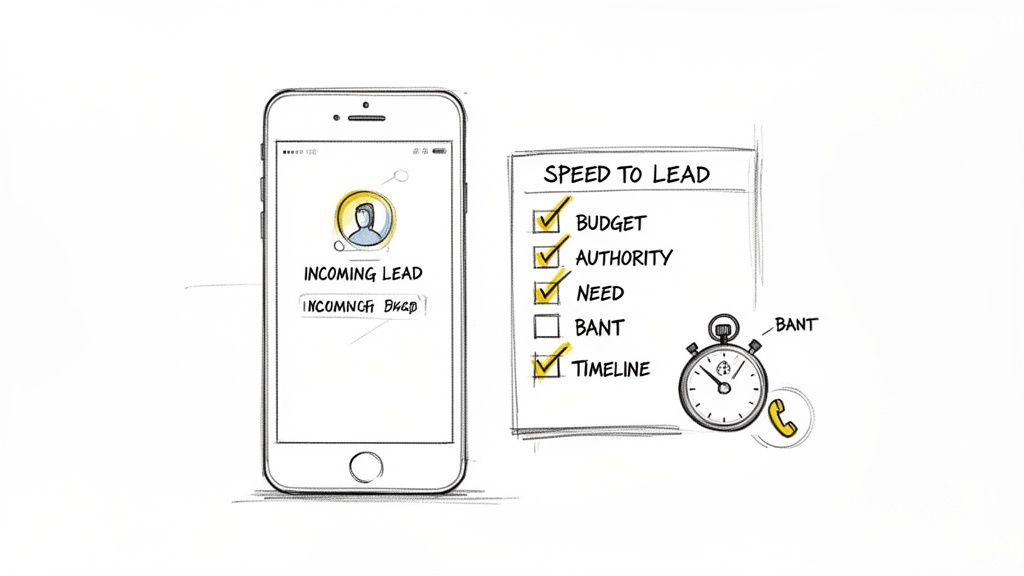
A Simple Framework for Vetting Callers: BANT
There’s a classic sales framework called BANT that works beautifully for home service businesses. It’s not a rigid script, but a mental checklist to help you quickly sort the hot leads from the tire-kickers by touching on four key areas:
- Budget: Do they have a realistic idea of what this kind of work costs? You don’t need an exact number, but simply asking, "Do you have a budget in mind for this project?" can set realistic expectations right away.
- Authority: Are you talking to the person who actually makes the decisions? Confirming you’re speaking with the homeowner who can approve the work saves you from endless games of phone tag.
- Need: How bad is the problem? A burst pipe is a five-alarm fire, while a kitchen remodel might be a slow burn. Understanding their urgency helps you prioritize who needs your attention now.
- Timeline: When are they hoping to get this done? This simple question uncovers their real motivation and tells you if their schedule even lines up with your availability.
Using this framework helps make every conversation more productive. You’re not just a passive order-taker; you’re actively guiding promising inquiries toward a booked appointment. This is where having a trained home service receptionist can be a game-changer, ensuring these crucial questions get asked on every single call.
In the home services world, speed isn't a feature—it's everything. The first contractor to respond to a motivated homeowner often wins the job. End of story.
The Make-or-Break Role of Speed
This brings us to what is arguably the single most important factor in turning a lead into a job: speed. A homeowner with a broken AC in July isn't going to leave a voicemail and patiently wait for your call back. They're already dialing the next name on the list.
Every missed call is a potential job handed directly to your competition. The data backs this up, too. For instance, home services search ads see an average conversion rate of 10.22%, with plumbing leads hitting an impressive 15.61% and HVAC at 15.11%.
Those numbers prove just how many motivated buyers are actively searching for help. But you can only win that business if you have a system to respond instantly. It’s a massive challenge for any owner-operator trying to be on a job site and answer the phone at the same time, and it highlights the urgent need for a process that can capture and qualify every opportunity the second it comes in.
Turn Your Lead Strategy into Business Growth
Getting a handle on leads is the first real step toward building a home service business that's both predictable and profitable. When you boil it all down, a lead is simply a job opportunity—a chance to win new work.
As we've covered, not all leads are created equal. You have to treat a curious MQL differently than a ready-to-buy SQL, and a structured sales funnel is the roadmap that guides them all from "just looking" to "job complete." Without a solid process, it's just too easy for potential customers to slip through the cracks. The secret sauce that makes it all work? Speed. More often than not, the first contractor to respond wins the job.
But for a busy owner who's out in the field focused on doing quality work, juggling lead generation, instant follow-up, and proper qualification feels like a monumental task. This is the point where a professional lead management system stops being an expense and starts becoming a powerful investment in your company's growth.
A systematic approach to leads allows you to stop being tied to your phone and start building a scalable process that turns inquiries into consistent revenue.
Making this shift lets you get back to what you do best, knowing a dedicated team is making sure no opportunity is ever missed. If you're ready to build a system that handles this for you, check out our guide on how to hire a virtual assistant to take on these critical tasks and start driving your business forward.
Common Questions We Hear About Business Leads
Even after you get the hang of the basics, a few questions always pop up when talking about leads. Nailing down these details is key to building a smarter strategy that turns a simple inquiry into a paying job. Let's tackle a few of the most common points of confusion for home service business owners.
What’s the Real Difference Between a Lead and a Prospect?
It really just boils down to who made the first move. Think of a prospect as someone who fits your ideal customer profile but hasn't reached out yet. For a roofer, that might be every single-family home in a neighborhood hit by a recent hailstorm. You know they probably need you, but they haven't raised their hand.
A lead is what happens when one of those homeowners does raise their hand. They call your office, fill out the "Request a Quote" form on your website, or message you on Facebook. So, while every lead was once a prospect, not every prospect becomes a lead until they show some kind of interest in your business.
How Can You Tell if a Lead Is Actually a Good One?
A high-quality lead isn't just a name and a phone number; it's a genuine opportunity that’s very likely to turn into a booked job. You can usually spot one by looking for a few tell-tale signs.
A high-quality lead is someone with a clear, urgent problem, the power to say "yes" to the work, and a budget that matches the service. It’s a perfect-fit problem that you can solve for them right now.
For example, a Sales Qualified Lead (SQL) calling about a burst pipe is a much hotter, higher-quality lead than a Marketing Qualified Lead (MQL) who simply downloaded a free guide on "DIY plumbing tips." The first person has an immediate, painful problem and is ready to hire someone. The second person is just kicking the tires. Your goal is to build a system that brings in more of those emergency calls.
Should I Just Buy Leads for My Business?
You absolutely can. Plenty of services will sell you lists of potential customers. This can be a fast way to fill your pipeline if things are slow, but it's not without its downsides.
The biggest issue? Those leads are almost never exclusive. They're sold to you and three of your competitors, which means it becomes a race to see who can call back first. While buying leads can give you a short-term boost, investing in your own lead generation through things like local SEO, online reviews, and great customer service will almost always deliver better, more profitable customers in the long run.
Stop letting good opportunities slip through the cracks and go to your competition. The expert team at Phone Staffer answers every call, qualifies every lead, and books jobs directly into your calendar, so you never miss a chance to grow. See how we help you convert more leads into booked jobs.