

So, what exactly is a qualified lead?
In simple terms, it's a potential customer who's been checked out and confirmed to have the need, budget, and authority to actually hire you for your home services. This is the critical difference between a curious browser just kicking tires and a serious buyer who’s ready to book a job.
The True Meaning of a Qualified Lead
In the home service world, let's be honest: not all inquiries are created equal. A phone call or a form filled out on your website is just the starting gun—that's an unqualified inquiry. A true qualified lead, on the other hand, is someone you've vetted. They have a real problem you can fix, the money to pay for it, and the power to say "yes" to the job.
Think of it like this: anyone can call for a ballpark quote on a new AC system. That’s just an inquiry. But a homeowner calling you in the middle of a July heatwave because their AC just died, who confirms they can approve the replacement and understands it’s a significant investment? Now that is a qualified lead.
This distinction is everything. It’s how you separate the genuine sales opportunities from the folks who will just waste your time. To get a broader look at this concept, this article on what is lead qualification and how to build a framework is a great resource.
From Inquiry to Real Opportunity
The journey from a raw inquiry to a solid lead is what we call qualification. This is the exact step where so many businesses drop the ball and burn through cash. Why? Because chasing every single person who shows a tiny bit of interest is a massive drain on your team's time and your marketing budget. Your goal shouldn’t be just getting more leads; it's about getting better leads.
A qualified lead is a prospect who not only wants to buy but is also able to buy and fits the profile of your ideal customer. Focusing on this quality is the secret to sustainable growth.
Industry data shows that the average conversion rate from lead to paying customer is a surprisingly low 7.8%. That number tells you just how many initial contacts go nowhere because they were never properly qualified. This is precisely why simple frameworks like BANT—which stands for Budget, Authority, Need, and Timeline—are so incredibly valuable. They give your team a clear, structured way to focus their energy on the people most likely to become happy, paying customers.
The Four Pillars of Lead Qualification
So, how do you consistently tell a great lead from a time-waster? The trick is to have a repeatable framework. We've adapted the classic BANT (Budget, Authority, Need, and Timeline) model specifically for home services, boiling it down to four simple pillars for your qualification process.
This isn't about some abstract business theory; it's about turning those concepts into straightforward questions you can ask on every single call. It’s how you stop guessing and start building a structured process that protects your team's valuable time for jobs that actually move forward.
Pillar 1: Budget (Matching Price to Expectation)
First up is Budget. For a home service pro, this isn't about grilling a customer on their finances. It’s simply about making sure their expectations are in the same ballpark as your pricing. The easiest way to do this? Mention your service call fee or minimum job cost right at the beginning of the conversation.
Think about it: if a caller balks at a $99 diagnostic fee, there's almost no chance they're going to be a good fit for a $5,000 HVAC replacement. This one simple step gently weeds out the price-shoppers, letting you focus on serious buyers who value professional work. It saves your techs a ton of windshield time on dead-end appointments.
Pillar 2: Authority (Finding the Decision-Maker)
Next is Authority. You need to know if you're talking to the person who can actually say "yes" and sign the check. In our world, that usually means the homeowner or property manager—not a tenant or a well-meaning relative who can't actually approve the work.
A simple question like, "Just to confirm, are you the homeowner who can authorize the work?" can save you a world of headaches. It keeps your team from spending an hour walking a property and writing up a detailed quote for someone who has no power to move forward.
Pillar 3: Need (Separating "Now" from "Maybe Later")
The third pillar is Need. This is all about separating an immediate, burning problem from a "someday" wish. A customer whose AC dies in the middle of July has a very high, very urgent need. Someone calling around for a kitchen remodel "sometime next year" is on the opposite end of that spectrum.
Understanding a lead's true need is the key to prioritizing your schedule. An urgent, high-need lead is the very definition of a qualified lead because they are motivated to find a solution now, not months down the road.
This lets you focus your energy and your schedule on the customers who need you most, which is the fastest way to boost revenue.
Pillar 4: Timeline (Locking in the Schedule)
Finally, we have Timeline. This one is tied directly to need and helps you figure out where they fit on your calendar. A customer who says, "I need a plumber out this week," is a much hotter lead than someone who is "just gathering quotes" for a project six months from now.
This simple decision tree helps visualize how to move from a new inquiry to a genuinely qualified lead.
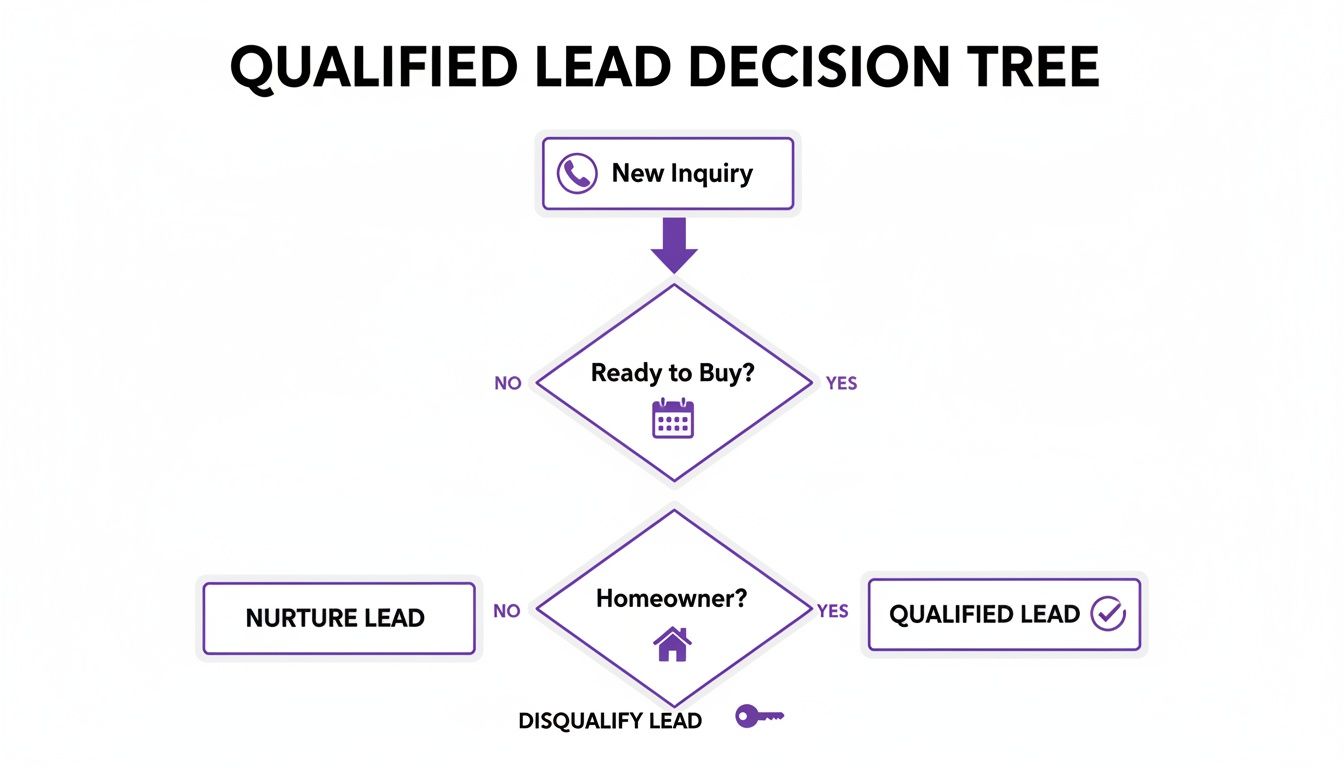
As you can see, the fastest path to a qualified lead is quickly identifying who can make the decision and how soon they're ready to buy. By getting a clear timeline, you can fill your schedule with profitable, ready-to-book jobs instead of chasing opportunities that are still months away.
MQLs vs. SQLs: Know the Difference to Win the Job
Not all leads are the same. Far from it. That's why understanding the difference between a Marketing Qualified Lead (MQL) and a Sales Qualified Lead (SQL) is so critical for any home service business. Nailing this down is how you stop wasting time and start turning your marketing spend into actual booked jobs, efficiently.
Think of it as two different levels of interest. An MQL is someone who’s just started looking around. They’ve interacted with your marketing—maybe downloaded a guide or signed up for your newsletter—but they're not ready to commit. An SQL, however, is the person who has their hand up, actively asking to talk about a project. They’ve shifted from just browsing to being ready to buy.
From Just Looking to Ready to Book
Let’s make this real. Imagine a homeowner downloads your free guide, "10 Ways to Improve Your Home's Air Quality." That person is a perfect MQL. They’re obviously thinking about their HVAC system, but they're still in the information-gathering stage. Pushing them for a sale right now would be premature.
Now, picture someone who fills out your "Request an Estimate" form for a new furnace or calls your office asking about service. That's your SQL. They have a specific need, they're signaling they're ready to hire someone, and they expect a prompt conversation with your team.
The handoff from MQL to SQL is where most businesses drop the ball. It’s a delicate transition. You either spook the MQLs by being too pushy, or you let the red-hot SQLs go cold by being too slow.
This is where potential jobs vanish into thin air. The trick is to gently guide MQLs with useful information until they're ready to become SQLs. And when they do, you need to be ready to act—fast.
Why Speed is Your Secret Weapon
When it comes to turning a lead into a booked appointment, especially one on the phone, speed is everything. A qualified lead calling you needs an answer now. Research on phone behavior shows that while a solid 35% of calls from digital ads are qualified leads, a shocking 18% of those calls go unanswered on weekdays. On weekends? That number jumps to over 40%.
Each missed call is a missed opportunity. A lead only stays "qualified" if you’re there to answer, confirm their needs, and get them on the schedule. You can learn more by checking out these essential home services industry benchmarks.
Letting the phone ring is the business equivalent of watching a customer with cash in hand walk out of your shop. They won’t wait. They’ll just call the next name on their list. Having a rock-solid process for handling these calls is the only way to make sure your marketing dollars actually turn into revenue.
Your Practical Lead Qualification Checklist and Script
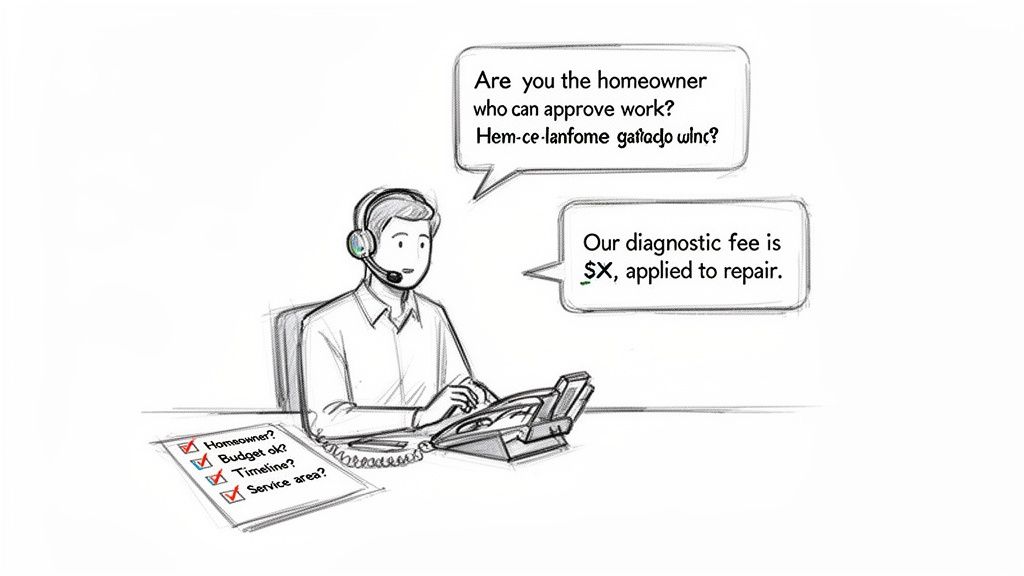
Theory is great, but your team needs tools they can actually use on a busy Monday morning. To get from knowing what a qualified lead is to actually spotting one on the phone, you need a clear, repeatable process. This is where a simple checklist and a few go-to script snippets become absolute gold for your customer service representatives (CSRs).
This isn't about high-pressure sales tactics. The whole point is to gather information efficiently and respectfully, so your technicians are only heading out to jobs that are a perfect fit—profitable and ready to go. Good qualification is just about asking the right questions in the right way.
The Essential Qualification Checklist
Think of these five checkpoints as a quick filter your team can run every new caller through. It should feel like a natural conversation, not an interrogation.
- Confirm the Service Area: Is the property actually within your service radius? No sense in booking a job you can't get to.
- Verify the Service Type: Is this something you do? If you’re a plumber, you don’t want to waste time on a call about roofing.
- Identify the Decision-Maker: Are you talking to the person who can say "yes" and authorize payment?
- Establish a Realistic Timeline: Is this an emergency, or are they just kicking tires for a project six months from now?
- Acknowledge the Cost: Have you mentioned your service call or diagnostic fee, and are they okay with it?
If you get a solid "yes" on all five, you’ve landed a red-hot lead that’s ready to be booked.
Proven Script Snippets for Your CSRs
Giving your team the right words can make all the difference. These phrases are designed to be polite, direct, and incredibly effective at getting the info you need without scaring customers away.
To Confirm Authority:
"Great, I can definitely help with that. Just to confirm for our records, are you the homeowner who can authorize the work to be done?"
This one little question saves a ton of headaches. It instantly clarifies if you're talking to the actual decision-maker, not a tenant or relative who can't approve the job.
To Address the Budget:
"Our diagnostic fee for a licensed technician to come out is [Price], and the great news is that we apply that entire amount toward any repair you approve. Does that work for you?"
This wording is brilliant. It positions the fee as a credit toward the final bill, not just an entry fee. It shows value right away and gently weeds out the price-shoppers.
To Understand Urgency:
"To make sure we get the right technician out to you, could you tell me a bit more about what's happening? How long has this been an issue?"
This open-ended question lets the customer tell you their story. A busted AC in the middle of July is a completely different conversation than a slow drain that’s been bothering them for a few months. It helps you prioritize and understand their real needs.
For those looking to automate this initial screening, you can even build a chatbot for lead generation that actively qualifies prospects. With these tools in hand, your team can book better jobs with a lot more confidence.
How Outsourcing Can Turn Phone Calls Into Booked Jobs
What if you had a team of experts ready to qualify every single lead for you, 24/7? For most home service businesses, just keeping up with the constant ringing of the phone is a huge headache. This is where bringing in outside help for your customer service can take your lead conversion from a bottleneck to your biggest strength.
Think of a service like Phone Staffer as your dedicated qualification crew. Instead of calls going to voicemail or getting a hurried "hello" from a technician juggling tools, every inquiry is answered live by a trained pro. They become a genuine extension of your business, armed with your exact rules for what a qualified lead really is.
Your Secret Weapon for Vetting Leads
The process is straightforward but makes a world of difference. Our remote CSRs follow your custom script and checklist to instantly figure out if a caller is a good fit. This isn't just about taking a message; it's an active qualification process that starts the moment they pick up the phone.
Here’s what that looks like on a real call:
- Service Area Check: First things first, the agent confirms the caller is actually in your service area. No more wasted trips.
- Job Type Vetting: They make sure the caller's problem is something you actually fix, filtering out requests for services you don’t offer.
- Budget Alignment: The CSR professionally mentions your service call fee or diagnostic charge upfront, gently filtering out extreme price-shoppers.
- Authority Check: They politely ask if they're speaking with the homeowner or someone who can actually approve the work.
This simple, step-by-step approach means only the best potential customers ever make it to your team. All the tire-kickers and time-wasters are filtered out, which saves your crew countless hours and makes every dollar you spend on advertising work harder.
From Good Lead to Booked Appointment
The real magic of outsourcing goes way beyond just answering the phone. The whole point is to fill your calendar with jobs that make you money. As soon as a lead is confirmed as qualified, our team immediately moves to get them on the schedule.
By plugging directly into your scheduling software, a remote CSR team doesn't just pass along a message—they drop pre-qualified, appointment-ready jobs right onto your calendar.
This smooth handoff is a total game-changer. It gets rid of the frustrating delays that often cause hot leads to go cold. While your competitors are stuck playing phone tag, your technicians are already heading to a confirmed job with a customer who’s ready to hire you. That’s how you start building a schedule packed only with high-quality, profitable work.
Tracking the Metrics That Actually Matter

If you're not measuring your lead quality, you're flying blind. It’s so easy to get hung up on vanity metrics like "Cost Per Lead," but that number alone doesn't tell you much. To really get a pulse on your business, you have to track the key performance indicators (KPIs) that connect your marketing dollars to actual, paying jobs on the calendar.
These are the numbers that show you precisely where your process is humming along and where it's falling apart. A ton of leads but a terrible appointment rate? That's a massive red flag. It probably means your ads are attracting the wrong people. Making decisions based on real data is the only way to fine-tune your marketing, tighten up your sales process, and actually get a return on your investment.
Core KPIs for Lead Quality
To get a crystal-clear picture of your performance, let's zero in on three crucial metrics. They go way beyond just counting leads and show you what’s really happening as a potential customer moves from a phone call to a finished job.
-
Cost Per Qualified Lead (CPQL): This is the real cost of getting a genuine opportunity in the door. It tells you exactly how much you have to spend to find a customer who actually fits your ideal job profile.
- Formula: Total Marketing Spend ÷ Number of Qualified Leads = CPQL
-
Lead-to-Appointment Rate: This percentage shows how good your team is at turning a qualified lead into a booked appointment. If this number is low, it almost always points to problems with how you’re handling the phones or how quickly you’re following up.
- Formula: (Number of Appointments Booked ÷ Number of Qualified Leads) x 100 = Lead-to-Appointment Rate
This might be one of the most important numbers in your entire business. It's a direct measure of how well your front line—whether that’s an in-house CSR or a service like Phone Staffer—converts real interest into a scheduled job.
- Appointment-to-Close Rate: This one’s all about your technicians' performance in the field. It tracks how many of those scheduled appointments they successfully turn into paid work.
- Formula: (Number of Closed Jobs ÷ Number of Appointments Run) x 100 = Appointment-to-Close Rate
When you track these numbers religiously, you stop guessing and start knowing. You can spot the bottlenecks, double down on what’s working, and build a predictable engine for growth.
Got Questions About Lead Qualification? We’ve Got Answers.
Even with the best game plan, questions pop up. Let's tackle some of the most common ones we hear from home service owners trying to separate the real opportunities from the time-wasters.
How Can I Be Sure a Lead Is Actually Qualified?
A genuinely qualified lead is someone who ticks all the essential boxes. A handy way to remember this is the BANT framework: Budget, Authority, Need, and Timeline.
Stripped down, it means they're in your service area, they have a problem you can actually fix, they're the one who can say "yes" to the job, and they're looking to get it done soon. If a caller hits all four of those marks, you're looking at a golden opportunity.
What’s the Real Difference Between an MQL and an SQL?
Let's make this simple. A Marketing Qualified Lead (MQL) is like someone who downloaded your "Winter Furnace Prep" checklist. They're showing interest and kicking the tires, but they aren't pulling out their wallet just yet.
A Sales Qualified Lead (SQL) is the person who calls you in a panic because their heater just died in the middle of a cold snap. They have an urgent problem and are ready to hire someone—now. The whole point of marketing is to gently guide those MQLs along until they become urgent, ready-to-book SQLs.
Should I Just Forget About Unqualified Leads?
Absolutely not. But you do need to handle them differently. A lead who isn't qualified today could easily become your best customer in six months.
Instead of trying to force a booking, shift gears. Add them to a long-term email list where you can send out helpful maintenance tips or seasonal promotions. This keeps your company on their radar in a low-pressure way. When their "not yet" finally turns into a "right now," you'll be the first person they think to call.
Stop letting great jobs fall through the cracks. Phone Staffer provides expert remote CSRs who answer every call, qualify every lead using your criteria, and book profitable appointments right on your calendar. Discover how our team can fill your schedule with work that pays.