

So, what exactly is a virtual assistant?
Forget the old idea of a temp worker. Think of a VA as a remote partner for your business—a professional who handles the administrative, technical, or even creative tasks that bog you down, all from their own location. They're not just a contractor; they're your co-pilot, helping you navigate the day-to-day operations so you can focus on the big picture.
Your Remote Mission Control
For a busy home service owner, a VA is like having a mission control center for your business, but without the cost and hassle of a physical office. They are the skilled pros who take on the essential, time-sucking tasks that keep you from doing what you do best: completing jobs and growing your company.
This isn't just about handing off work; it's a strategic move. While you’re out on a job or meeting a new client, your VA is in the background, making sure the business engine keeps running.
Go From Overwhelmed to Organized
A virtual assistant is your secret weapon against the operational chaos that grinds so many businesses to a halt. Instead of spending your evenings buried in paperwork and returning calls, you can have a professional manage it all during work hours. It's a game-changer for scaling up without burning out.
They can seamlessly take over critical functions like:
- Customer Communication: Fielding phone calls, replying to emails, and handling those first-touch inquiries.
- Scheduling and Dispatch: Managing the job calendar, booking appointments, and coordinating your techs in the field.
- Back-Office Support: Chasing down unpaid invoices, keeping your CRM updated, and prepping daily summaries.
By offloading these tasks, you get back your most precious resource—time. It's the key to finally stop working in your business and start working on it, focusing on strategy, leading your team, and planning your next big move.
A Smart Move More Businesses Are Making
Hiring remote help isn't some fringe idea anymore. It's a mainstream strategy for businesses looking to get a leg up on the competition and deliver better customer service.
The numbers don't lie. There are roughly 40 million virtual assistants worldwide, and demand for their services shot up 29% in just the last year. This isn't a fad; it's a fundamental shift in how work gets done. You can see the full breakdown of this trend in the latest report from Startus Insights.
And it’s not just about human VAs anymore. Technology is blurring the lines. To get a better handle on how human support compares to automated tools, it's worth exploring the world of AI Virtual Assistants and Chatbots. Whether powered by a person or smart software, the end goal is always the same: building a more efficient, responsive, and profitable business.
Finding the Right Virtual Assistant for Your Needs
Knowing you need help is one thing. Pinpointing the exact kind of help you need? That’s where the real magic happens.
The term “virtual assistant” gets thrown around a lot, but it's a massive umbrella term. Not all VAs are created equal; they come with specific skill sets designed to solve different business headaches.
Think of it like hiring for a job on your crew. You wouldn’t hire a roofer to fix a burst pipe. In the same way, you have to match the VA’s skills to your company's biggest bottleneck. Get this right, and you'll see a massive return on your investment.
This image breaks down the main categories of VAs that are perfect for a home service business.
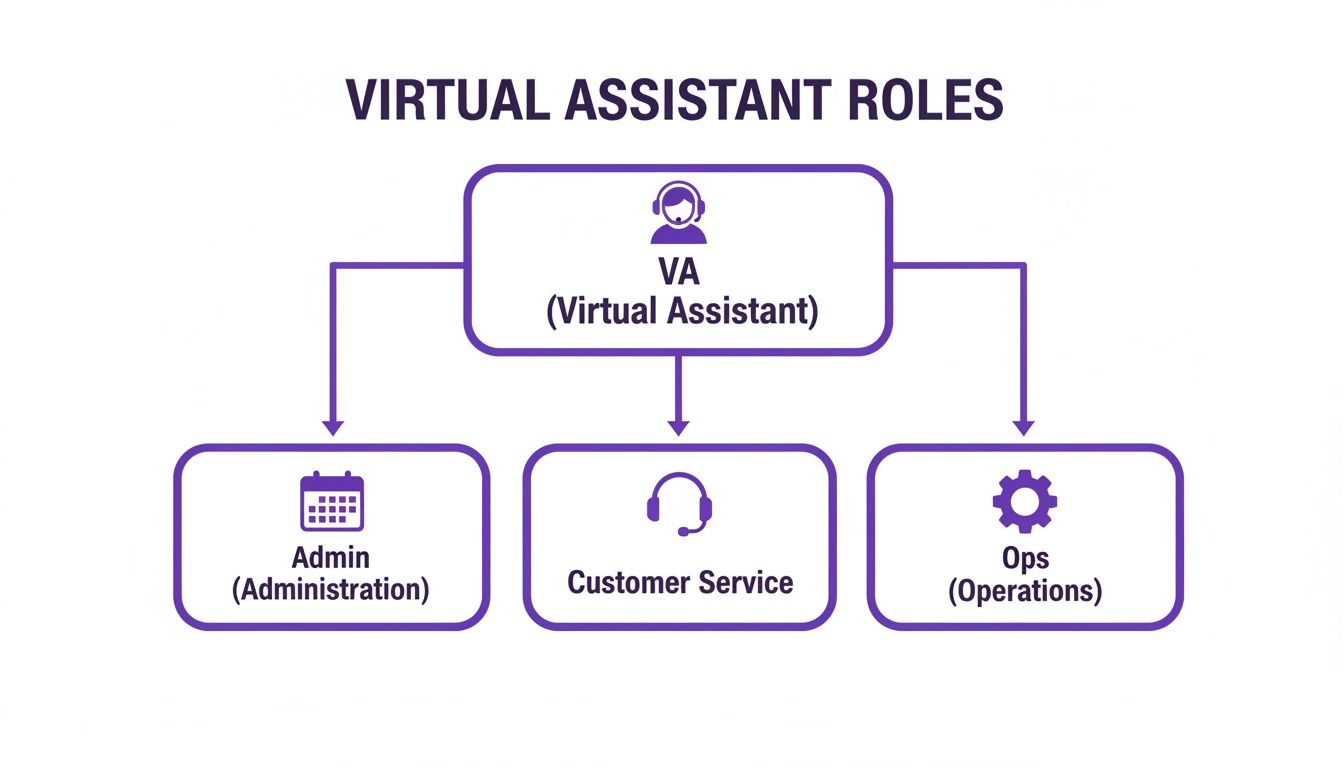
As you can see, the general VA role splits into distinct specialties. This allows you to hire someone to tackle specific functions like administration, customer service, or operations. Let's dig into what each of these roles actually does.
The Administrative VA
An Administrative VA is the organizational powerhouse your business has been missing. They live for the details, thrive on process, and make sure nothing slips through the cracks while you and your crew are out in the field. Their whole job is to bring order to the daily chaos.
Here’s what they typically take off your plate:
- Calendar Management: Juggling job schedules, client appointments, and team meetings so everyone knows where they need to be.
- Data Entry: Keeping your CRM up-to-date with customer info or plugging in the details from a new work order.
- Email and Inbox Management: Sifting through your inbox, answering common questions, and flagging the messages that actually need your attention.
For an HVAC company, an Admin VA could run the entire dispatch board. They’d map out the most efficient routes for technicians and make sure every tech has the right job info before they even start their truck. That simple step prevents wasted time and keeps the whole day moving.
The Remote Customer Service Representative
For most home service businesses, the phone is the lifeblood of new leads. A Remote Customer Service Representative (CSR) is a specialized VA who becomes the voice of your company. They’re your first line of defense, making sure every single call is answered quickly and professionally.
A missed call isn't just a missed conversation; it's potentially thousands of dollars in lost revenue walking straight to your competitor. A remote CSR ensures that phone line is always covered.
Their world revolves around customer interaction:
- Answering Inbound Calls: Fielding service requests, answering questions about what you do, and making a killer first impression.
- Problem Solving: Handling customer concerns or complaints gracefully and knowing when to escalate an issue to you.
- Lead Capture: Pulling all the essential info from a potential customer to get them into your system as a new lead.
Just imagine a homeowner with a flooded basement calling at 10 PM. A remote CSR can calmly take that emergency call, reassure the customer, and get your on-call plumber dispatched immediately. They turn a moment of panic into a high-value job.
The Appointment Setter
An Appointment Setter is a more proactive kind of VA, focused on one thing and one thing only: filling your calendar with qualified leads. While a CSR is great at handling incoming calls, an appointment setter is often making outbound calls to turn lukewarm interest into a booked job. They are a pure sales-support function.
They are laser-focused on a single outcome: getting solid, qualified appointments on the books.
They’re the ones who follow up on every web form submission, call old leads to see if they’re ready to buy now, or even make prospecting calls. For a roofing contractor, this might mean calling a list of homeowners who downloaded a "storm damage checklist" to offer them a free, no-obligation inspection.
The Specialized Operations VA
Once you get past the core administrative and customer-facing roles, you can find Specialized VAs who bring a much deeper level of expertise to the table. These aren’t generalists; they have specific industry knowledge or technical skills to manage more complex parts of your business.
Common specializations for home service pros include:
- Bookkeeping VAs: Managing invoices, paying bills, tracking expenses, and even handling payroll.
- Marketing VAs: Running your company’s social media, sending out email newsletters, or making updates to your website.
- Dispatching VAs: A role dedicated entirely to managing technician schedules, optimizing routes for fuel efficiency, and re-routing crews on the fly.
Hiring a specialized VA is like getting a seasoned expert on your team for a fraction of what a full-time employee would cost. They can completely own a critical function, freeing you up to finally work on your business instead of just in it.
The Real-World Benefits of Hiring a Virtual Assistant
So, you know what a virtual assistant is and the different hats they can wear. Now for the important part: what does a VA actually do for your home service business? This isn't just about handing off a few tasks; it's a strategic move that can fundamentally change how your business runs and grows.
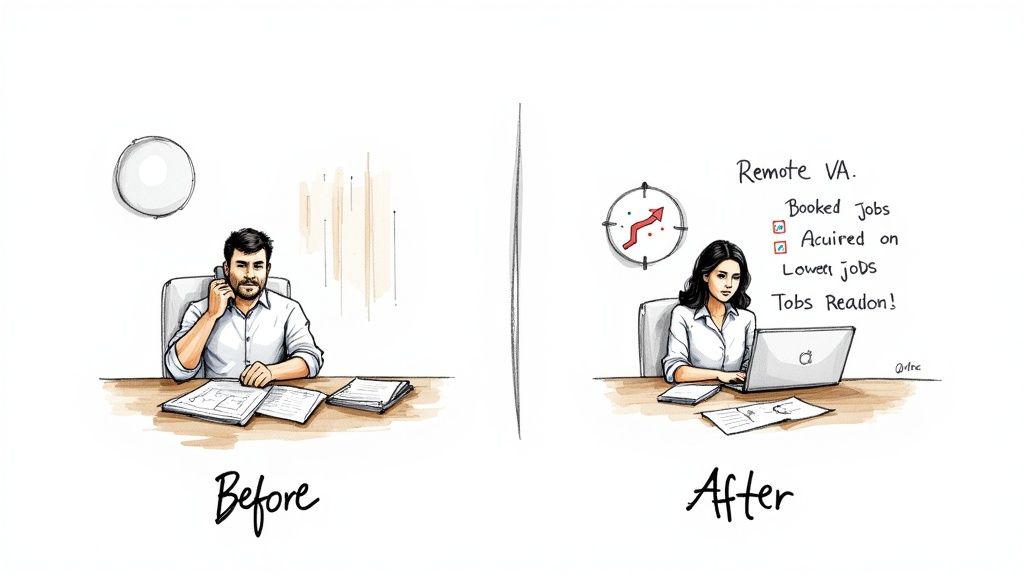
Think about a guy like Mike, who runs "Reliable Pipes Inc." He’s a fantastic plumber but gets buried in the day-to-day grind. He's missing calls while on a job, spending his evenings catching up on invoices, and letting new website leads go cold. His business is stuck. That’s the "before" picture so many of us in the trades know all too well.
Now, let's see what happens when Mike brings a VA into the picture.
Experience Significant Cost Savings
Right out of the gate, the most obvious win is the money you save. A VA is an independent contractor, not a W-2 employee, and that single distinction is a game-changer for your budget.
You get to dodge all the heavy costs that come with a traditional, in-house hire. We're talking about huge savings from things like:
- Payroll Taxes: No more matching Social Security, Medicare, or paying unemployment taxes.
- Benefits Packages: Forget about budgeting for health insurance, paid vacation, or retirement plans.
- Overhead Costs: You aren’t paying for a desk, a computer, office space, or the power to run it all.
This approach gives you access to high-caliber talent without the financial weight of a full-time employee, freeing up cash you can pour back into marketing, equipment, or your own pocket.
Scale Your Team Effortlessly
The home service world is a roller coaster of demand. Spring might be slammed with HVAC tune-ups, but the dead of winter is crickets. Hiring a full-time person to handle a seasonal rush is a massive, and often wasteful, financial commitment.
This is where a VA provides the perfect solution. You can dial your support up or down based on what's happening right now. Need someone for 40 hours a week during your busy season? Done. Want to pull back to just 10 hours a week when things slow down? You can do that, too.
This flexibility turns your administrative help from a fixed, unavoidable cost into a variable expense that moves in lockstep with your revenue. You only pay for what you need, when you need it.
Improve Lead Follow-Up and Conversion
Let’s be honest: every call you miss is a job you just handed to your competitor. Every web form that sits in your inbox for a few hours is a customer who has already moved on. In this business, speed wins.
A great VA becomes your front line, making sure no opportunity slips through the cracks.
- Immediate Response: They’re the professional voice that answers the phone right away, catching that customer when they are most ready to buy.
- Persistent Follow-Up: They can call back online leads within minutes, which massively increases your chances of getting the appointment.
- Professional First Impression: A friendly, organized person on the phone instantly builds trust and makes your company look more polished than the competition.
Just by having someone dedicated to fast, professional follow-up, a VA can directly increase how many leads turn into booked jobs. This is a huge deal, especially for smaller businesses. In fact, small and medium businesses (SMBs) are on track to grab 44.4% of the market revenue by 2025, largely by using smart, efficient tools like VAs to level the playing field. To learn more about how VAs are reshaping the industry, you can explore the full virtual assistant industry trends report.
For Mike at Reliable Pipes Inc., this means he's no longer losing a big job because he was under a sink when a call came in. His VA grabs the lead, qualifies them, and puts the appointment right on his calendar. That’s not just delegating work—that’s creating real, measurable growth.
How to Hire and Train Your First Virtual Assistant
Bringing a virtual assistant onto your team is a huge step, but let's be honest, it can feel a little daunting if you've never done it. The secret isn't about finding some magical, do-it-all candidate right out of the gate. It's about having a straightforward, repeatable process for hiring, training, and managing them.
Forget complicated corporate HR procedures. This is all about practical steps a busy home service owner can actually use to find the right person and get them contributing from day one. With a good plan, you'll build a strong, productive remote relationship that actually helps you grow.
Finding and Vetting the Right Candidate
It all starts with the job description. Your goal here is to attract the kind of person you actually want to work with. Don't just list a bunch of tasks. Instead, describe the impact they'll have.
Instead of saying "answer phones," try something like, "Be the friendly, professional first impression of our company and make sure every customer feels heard." See the difference?
Once the applications roll in, you need a quick way to sort the good from the bad. A killer tactic is to hide a small, specific instruction in your job post. Something simple like, "Start your application with the word 'Ready'." This one little trick instantly weeds out anyone who doesn't sweat the details.
For the interview process, you want to see what they can do, not just what they say they can do. Here’s a simple three-step approach that works wonders:
- The Quick Screen: A 15-minute video call is perfect for this. You're just getting a feel for their personality, how they communicate, and their general professionalism.
- The Skills Test: Give them a short, paid practical test that mirrors a real-life task. Have them transcribe a voicemail or draft a polite email response to a customer complaint.
- The Final Interview: Now you can have a longer chat. Dig into their experience, ask how they solve problems, and throw a few real-world scenarios at them that are specific to your business.
Following a process like this takes the guesswork out of it. You’re not just hiring help; you’re investing in a team member who will be on the front lines with your customers.
Training Your VA for Success
Good training doesn't mean handing someone a giant, dusty operations manual. It’s all about giving them clear, repeatable instructions for your most important tasks. The absolute best way to do this is by creating simple Standard Operating Procedures (SOPs).
An SOP can be a basic checklist or even just a short video of you doing the task. Use a free tool like Loom to record your screen and voice as you walk through a process, like how to enter a new lead into your CRM or schedule a job on the calendar.
Think of it this way: you are building a playbook for your business. Every time you document a process, you make your business stronger and less dependent on any single person—including yourself.
Be crystal clear with your expectations right from the start. Define their working hours, how you'll communicate (maybe Slack for quick questions and email for daily summaries), and what they should do when they run into something they can't solve. This clarity prevents a ton of frustration down the road and empowers your VA to work confidently.
Managing and Building a Strong Remote Relationship
Managing someone remotely is all about trust and communication. You don’t need to be a micromanager; you just need to find a good rhythm. A simple daily check-in can make a world of difference. This could be a 5-minute call each morning or a quick Slack message to get on the same page about the day's priorities.
When it comes to tracking performance, stick to simple, clear metrics. Focus on the results, not just the activity. For a remote CSR, you might track:
- Number of calls answered
- Appointments booked
- Positive customer feedback
This gives both of you a clear picture of what a "win" looks like. Just as important, though, is building a real relationship. Remember you've hired a person, not a robot. Acknowledge their hard work, celebrate successes together, and treat them like a valued member of the team.
This approach creates loyalty and builds a true partnership that can help your business thrive. And that partnership model is only going to become more important. The market for intelligent virtual assistants is forecasted to hit $20.7 billion in revenue in 2024 and is expected to explode to $309.9 billion by 2033. You can discover more insights about intelligent virtual assistant statistics to get a sense of where remote support is heading.
Breaking Down VA Costs and Calculating Your ROI
Bringing a virtual assistant onto your team isn't just another line item on your expense sheet. Think of it as a strategic investment, one that should—and will—pay for itself if you do it right. The good news is that VA pricing is a lot more straightforward than dealing with the complexities of employee salaries, benefits, and payroll taxes.
Most VAs and the agencies that place them work on two simple models. The first is a straight hourly rate, where you only pay for the time they put in. The second, which is usually a better deal for consistent work, is a monthly retainer. You basically buy a block of hours upfront each month, often at a discounted rate, which guarantees you have someone ready to go when you need them.
So, what's the damage? Rates can be all over the map depending on the VA's skills and where they're located, but a good ballpark is anywhere from $15 to $50 per hour. A VA handling your calls and scheduling will be on the lower end of that scale, while someone with specialized skills in, say, bookkeeping or digital marketing will naturally command a higher rate.
How to Figure Out Your Return on Investment
Alright, so you're spending the money. How do you actually know if it's making a difference? Calculating the ROI on a VA is simpler than it sounds. It’s not just about what you save by not hiring a full-time employee; it’s about the new value and opportunities they create for your business.
It really boils down to three key things:
- Getting Your Time Back: First, what’s an hour of your time really worth? If you bill out your own skilled labor at $100 an hour, every hour your VA spends on $20-an-hour admin work is an $80 win for you. You're trading up.
- Bringing in New Money: How many new jobs did your VA book this month? If their follow-up calls turned into just two new projects worth $1,500, they’ve directly added to your top-line revenue.
- The Obvious Cost Savings: This one is easy. Just compare what you pay your VA each month to what it would cost to hire an in-house person to do the same job. Don't forget to factor in salary, payroll taxes, insurance, and benefits.
An investment in a VA isn't about finding the cheapest possible labor. It's about buying back your most valuable asset—your time—and building a system that generates more money than it costs. You're turning an expense into a profit engine.
Looking at it this way changes everything. Hiring a VA goes from a vague "that would be nice" idea to a smart, data-driven business decision. You can actually put a number on the impact they have on your time, your sales, and your bottom line.
A Practical ROI Example
Let's run some real numbers to see how this plays out. Imagine you hire a VA for 20 hours a week (that’s 80 hours a month) at a rate of $20 per hour. Your total monthly investment is $1,600.
Now, let's look at a hypothetical ROI calculation to see how that investment pays off.
Sample ROI Calculation for a Home Service Business
| Metric | Calculation | Value |
|---|---|---|
| Owner's Time Saved | You get 60 hours back from admin tasks. Valuing your time at $75/hr, that’s 60 x $75. | $4,500 |
| New Jobs Booked | The VA follows up on old quotes and books 5 new jobs, each worth an average of $500. | $2,500 |
| Direct Cost Savings | An in-house admin would cost ~$4,500/month with salary and benefits. The savings are $4,500 – $1,600. | $2,900 |
| Total Monthly Value | Sum of Time Saved + New Jobs + Direct Savings. | $9,900 |
| Net ROI | (Total Value – VA Cost) / VA Cost. That's ($9,900 – $1,600) / $1,600. | 518% |
As you can see, that $1,600 investment didn't just cover its own cost—it delivered a massive return. By offloading the administrative grind, you freed yourself up to focus on the high-value work that actually grows the business, unlocking potential that was always there but just out of reach.
Integrating a Virtual Assistant into Your Daily Workflow
Hiring a great virtual assistant is only half the battle. The real magic happens when you properly plug them into your day-to-day operations. Think about it: a top-notch VA who can't access your calendar or doesn't know your process is like sending a master plumber to a job without any tools. Useless.
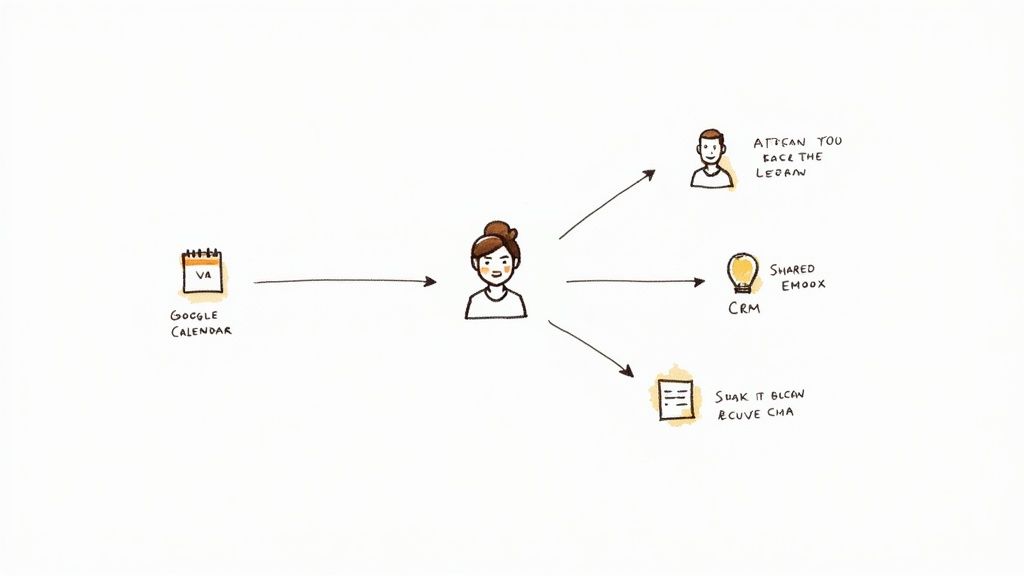
The goal is to build a system that lets them hit the ground running, adding value from day one without tripping over your existing workflow. This starts with getting the tech right and creating a shared digital space where information moves smoothly between you, your VA, and your crew in the field.
Essential Tools for a Seamless Workflow
Let's call this the VA’s digital toolbelt. Giving them the right software from the get-go is non-negotiable. For most home service businesses, you really only need a few key platforms to get started.
Here’s the core toolkit I recommend:
- Shared Calendars: Something like Google Calendar is an absolute must. This will be the command center for all job scheduling, appointments, and technician availability. It gives everyone a single, reliable source of truth.
- Communication Hub: A platform like Slack or Microsoft Teams is perfect for those quick questions and daily check-ins. It gets communication out of cluttered email inboxes and messy text chains, creating a searchable history of everything you've discussed.
- CRM or FSM Software: Your Customer Relationship Management (CRM) or Field Service Management (FSM) software is the brain of your business. Giving your VA access lets them update customer info, create work orders, and track jobs. If you're looking for the right fit, you can explore the https://phonestaffer.com/blog/top-field-service-management-software to see what works best for your trade.
Setting Up Secure Access and Clear Processes
Okay, you've picked the tools. Now it's time to hand over the keys—safely. Security is a big deal, so always use a password manager like LastPass or 1Password. This lets you share access to accounts without ever actually giving out your passwords.
The trick is to give your VA everything they need to do their job well without handing over the keys to the entire kingdom. Grant access on a need-to-know basis to keep sensitive company data protected.
With access handled, the next step is to create dead-simple processes for core tasks like booking calls and dispatching techs. Write down a simple, step-by-step guide for how a new lead call becomes a confirmed job on a technician's schedule. This removes all the guesswork and gives your VA the confidence to handle things correctly every single time.
A good VA can also be a game-changer for implementing better work-life planning strategies, helping you organize your own schedule beyond just the business. When you lay this groundwork upfront, your new hire goes from being just a helper to a true operational partner.
Common Questions About Hiring a Virtual Assistant
Deciding to bring on a virtual assistant is a big step, and it’s completely normal to have questions. A lot of home service owners I talk to are hesitant—not because they don’t need the help, but because of a few common uncertainties. Let's tackle those big questions head-on so you can get the clarity you need to move forward.
How Do I Know if My Business Is Ready for a VA?
The signs are usually pretty obvious once you know what to look for. If you're consistently missing calls from potential customers because you're busy on a job, you’re ready. If your evenings are spent buried in paperwork instead of planning your next big move, it’s definitely time.
Think about your biggest daily frustrations. Are you the bottleneck in your own business? The moment you realize administrative tasks are costing you billable hours or time with your family, your business is more than ready for a VA. This isn't about reaching a certain company size; it's about recognizing your time is better spent on the high-value work only you can do.
What Is the Difference Between a Freelance VA and an Agency VA?
This is a huge decision, and it directly affects reliability, cost, and the time you'll spend training someone. When you hire a freelance VA directly from a platform, you get a one-on-one relationship, but you're also on the hook for all the vetting, training, and ongoing management. What happens if they get sick or take a vacation? You’re suddenly left without support.
Working with an agency is a different ballgame. They do the heavy lifting of recruiting and initial training, presenting you with a professional who is already vetted and prepared.
An agency acts as your safety net. They typically have backup VAs ready to step in at a moment's notice, ensuring your business operations never skip a beat. For a service business where one missed call can mean a lost job, that kind of reliability is a game-changer.
How Can I Trust a Remote Person with My Business Information?
Handing over the keys to your systems can feel daunting, but there are standard, straightforward security practices that make it safe. Trust isn't just a feeling; it's built through solid processes. Protecting your business information is non-negotiable, and a few simple tools can keep it secure.
Start with these three essential steps:
- Use a Non-Disclosure Agreement (NDA): This is a basic legal document that contractually binds your VA to keep your business information confidential. It immediately sets a professional and secure tone for the relationship.
- Share Credentials Securely: Never, ever send passwords over email or text. Use a password manager like LastPass or 1Password to grant access to your accounts without ever revealing the actual password. You can also revoke access instantly if you need to.
- Grant Role-Based Access: Your VA doesn’t need access to everything. Only give them permissions for the specific tools required to do their job. This simple step dramatically limits your exposure.
At Phone Staffer, we don’t just find you a VA; we find you the right VA. We handle the hiring, training, and security protocols, so you get a trusted professional who is ready to contribute from day one. Learn how we can place a dedicated remote CSR or VA in your business.