
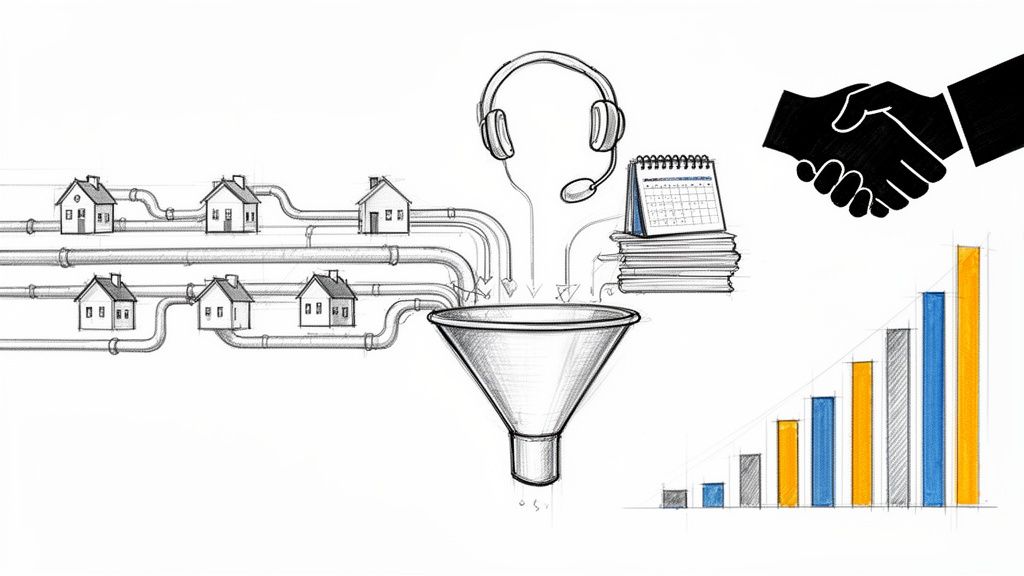
Ever found yourself wondering where the next job is coming from? A contractor leads service is built to answer that question. It’s a specialized business that finds, qualifies, and hands off potential customers directly to your company.
Think of it as your dedicated, outsourced sales team—one that's laser-focused on keeping your project pipeline full. Instead of you or your team spending countless hours making cold calls or chasing down dead-end inquiries, these services deliver a steady flow of real job opportunities. This frees you up to do what you do best: win bids and get the work done.
What Is a Contractor Leads Service
I like to think of a contractor leads service as a supply chain for business growth. Your material supplier brings you lumber and paint, right? Well, a lead service delivers your most valuable asset: interested clients who are actively looking for the exact skills you offer. It’s the bridge between someone searching online for a contractor and an appointment appearing on your calendar.
This whole approach takes the guesswork out of finding new jobs. Too many great contractors are stuck in a feast-or-famine cycle, relying on unpredictable methods like word-of-mouth or a sign in a yard. A professional service gives you a much more reliable and scalable way to bring in business.
From Digital Search to Your Doorstep
A lead’s journey starts long before you ever see it. It all begins when a homeowner or project manager types something like "local roofer for repair" or "best kitchen remodeler" into a search engine. A good contractor leads service is an expert at capturing that initial spark of interest using a variety of digital marketing strategies.
Here’s a quick look at how it generally works:
- Lead Generation: The service runs targeted online ads, optimizes its website to rank high in search results (SEO), and uses other proven tactics to attract people with a specific need.
- Initial Contact and Qualification: As soon as someone submits their information, a real person contacts them—often within minutes. They confirm the person is serious, get a feel for the project's scope, and make sure they're in your service area.
- Appointment Setting: If the lead checks all the boxes, the representative schedules an estimate or consultation directly on your calendar. You get all the key details you need to walk in prepared.
This system is all about saving you a massive amount of time and hassle. Instead of you having to filter through a dozen unqualified calls just to find one good one, you get pre-vetted opportunities that actually fit what you do. The goal is to automate lead generation, giving you a consistent flow of potential work without all the manual effort.
To make this crystal clear, let's break down the process into a simple table.
How a Contractor Leads Service Works at a Glance
This table shows you the core components of a lead service, what each one does, and why it's a game-changer for your business.
| Component | What It Is | Why It Matters for Your Business |
|---|---|---|
| Marketing & Advertising | Running targeted ads on platforms like Google, Facebook, and industry-specific sites. | Reaches homeowners actively searching for your services, putting you in front of them at the exact moment they need you. |
| Lead Capture | Using optimized websites and landing pages to collect contact information from interested prospects. | Creates a direct and easy path for potential customers to raise their hand and say, "I'm interested!" |
| Initial Vetting | A quick, initial screening process (often automated) to filter out spam or irrelevant inquiries. | Saves you from wasting time on junk leads, so you only deal with legitimate prospects. |
| Human Qualification | A trained representative calls the prospect to verify details, project scope, and readiness to hire. | Ensures the leads you receive are from serious buyers, not just tire-kickers, dramatically increasing your closing rate. |
| Appointment Setting | The qualified lead is booked directly into your calendar as a confirmed estimate or consultation. | Eliminates the back-and-forth of scheduling and fills your calendar with revenue-generating opportunities. |
Seeing it laid out like this really highlights how each step is designed to deliver value and efficiency.
The fundamental goal is to transform your sales process from an unpredictable hunt for work into a predictable, well-oiled machine that consistently delivers revenue-generating opportunities.
Ultimately, these services act as your front-line filter. They take on the critical but time-consuming job of attracting, engaging, and qualifying potential clients. This lets your skilled team focus their energy on what they're paid to do: creating winning proposals, closing profitable deals, and delivering top-notch work.
Understanding Different Lead Types and Sources
When you start looking into a contractor leads service, you're doing more than just buying a list of names and phone numbers. You're buying opportunities. And the key thing to realize is that not all opportunities are created equal. The quality, cost, and how likely a lead is to turn into a paying job all hinge on what kind of lead it is and where it came from.
Think of it like this: are you fishing in a private, well-stocked pond or a crowded public lake? The answer completely changes your odds of catching anything. Getting this difference is the first step to making a smart investment in your business's growth.
Exclusive vs. Shared Contractor Leads
The biggest dividing line in the world of contractor leads is whether they're exclusive or shared. This one factor probably has the biggest impact on your closing rate and your overall return on investment.
-
Exclusive Leads: This is your private, stocked pond. An exclusive lead is sold to you and only you. You're not in a mad dash against three other companies that got the same contact info a few minutes ago. This gives you a massive leg up, letting you build a real connection without the pressure of a race to the bottom on price.
-
Shared Leads: Welcome to the crowded public lake. Shared leads are sold to multiple contractors at the same time. Sure, they’re usually cheaper upfront, but they immediately throw you into a competition based on price. Your main advantages become how fast you can dial and how low you can bid, which can eat away at your profit margins in a hurry.
While exclusive leads often cost more at the outset, their conversion rates are almost always much higher, which means a better ROI in the long run. You're paying for a genuine shot at a job, not just a chance to compete.
The Source of the Lead Matters Most
After exclusivity, where the lead came from is the next most critical piece of the puzzle. A lead from a homeowner who was actively searching online for your exact service is worlds apart from one that came from a generic "what's your roof's age?" quiz. Every source has its own DNA.
This chart gives you a visual of how a simple search can evolve into a fully qualified, bookable job on your calendar.
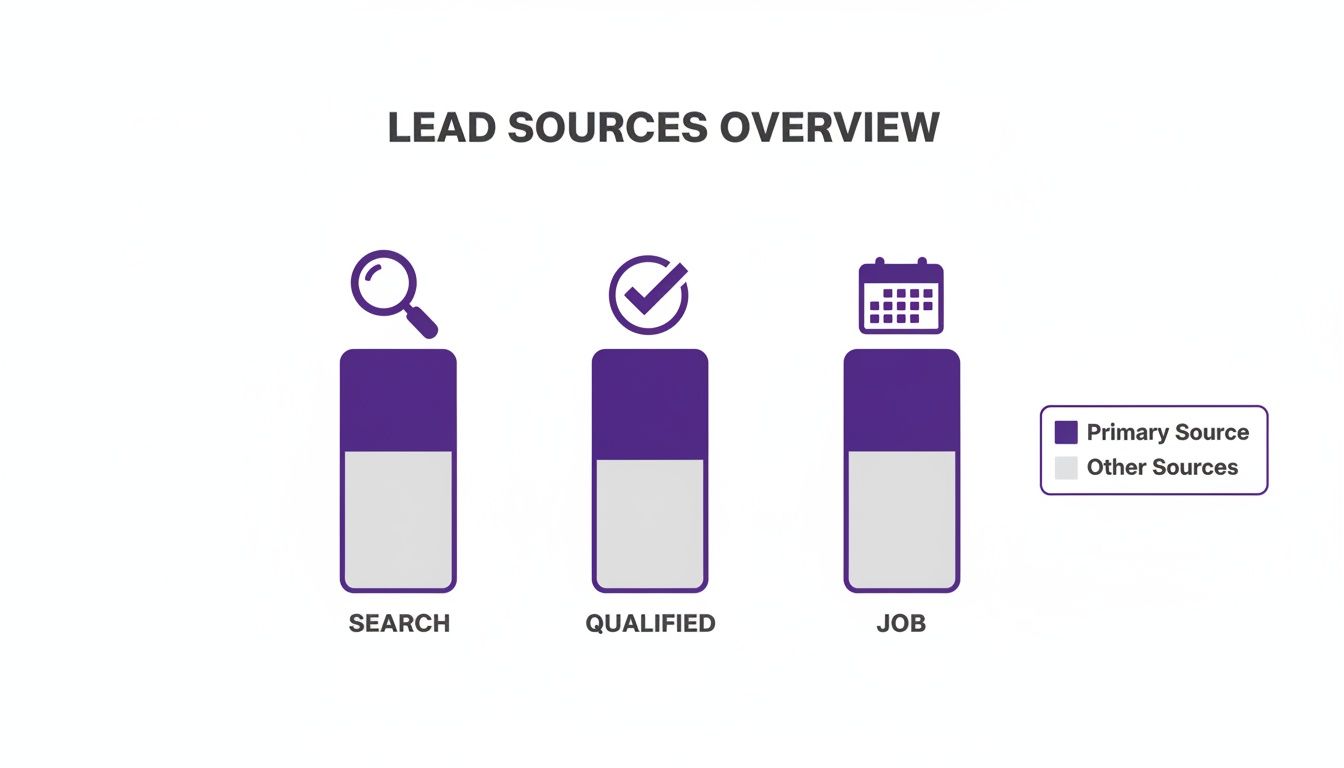
The data makes it crystal clear: the best opportunities come from prospects who have been properly vetted and qualified.
Time and again, research shows that the lead source directly impacts your bank account. Cross‑market contractor lead studies for 2025 show that referral leads convert at an impressive 35–40%. Compare that to leads from big lead-aggregator sites, which convert at a dismal 6–10%.
Let that sink in. For every 100 leads, referrals could land you nearly six times more jobs than a low-quality aggregator. You can explore more data on how different channels impact your ROI to start making smarter marketing decisions.
Sourcing Models Pay-Per-Lead vs Pay-Per-Appointment
Finally, the way the contractor leads service structures its business model defines the value you're actually getting. The two main models you'll run into are Pay-Per-Lead (PPL) and Pay-Per-Appointment (PPA).
A Pay-Per-Lead model sells you the raw ingredient—the contact information. A Pay-Per-Appointment model sells you the finished meal—a qualified, scheduled estimate on your calendar.
With a PPL model, all the risk is on your shoulders. You pay for the contact info, whether you ever reach the person, whether they're even qualified, or whether they agree to a meeting. You're on the hook for the entire follow-up process, which takes up a ton of time and energy.
The PPA model, on the other hand, flips the script and puts the risk on the service provider. You only open your wallet when their team has successfully contacted the lead, qualified their needs, and booked a confirmed appointment that fits the criteria you set. This model means their success is tied directly to yours—they don't get paid unless they deliver a real, revenue-generating opportunity. For most busy contractors, it's a much more predictable and valuable way to grow.
Why Turning Leads Into Appointments Is Everything
Getting a new lead is like a fish hitting your line—it’s a great start, but you haven't landed it yet. For any contractor, the real prize isn’t the lead itself; it's the confirmed appointment on your calendar. That's where you get to build a relationship, show off your expertise, and actually win the job.
A raw lead is really just a name and a phone number. An appointment, on the other hand, is a real business opportunity. It’s the critical moment where a marketing expense begins its journey to becoming revenue. Without that step, even the best leads are just money down the drain.
The Enemy of Every Lead Is Time
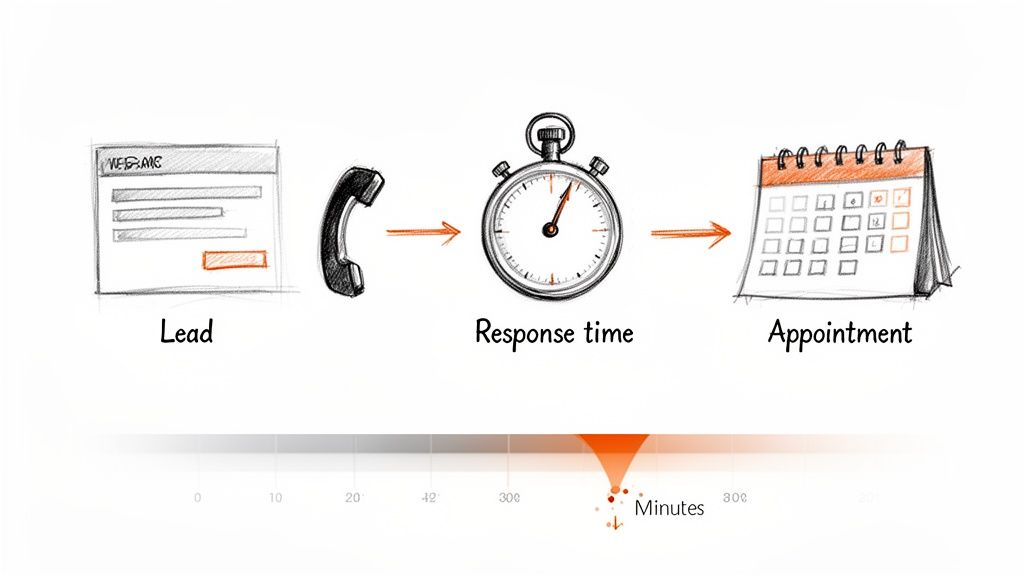
Think of every lead as having an invisible expiration date. The clock starts ticking the second a homeowner fills out your form. This is a concept we call lead decay, and it's one of the biggest silent killers of your sales pipeline. The longer a lead sits, the colder it gets, and your chances of closing it plummet.
Today's customers expect an immediate response. They aren't just contacting you; they've likely reached out to two or three of your competitors at the exact same time. The first contractor to make contact and get a visit on the books often wins the business, plain and simple.
Waiting even a few hours can be the difference between a booked estimate and a lost cause. This is precisely where a dedicated contractor leads service that includes appointment setting becomes an absolute game-changer.
The Problem With DIY Lead Follow-Up
Let's be honest—the person most qualified to answer a homeowner's technical questions is probably you or your lead technician. But you're also the busiest person on the job site. Pulling a roofer off a roof or a plumber from under a sink to chase down a new lead is a terrible use of time. It forces you into a no-win situation:
- Stop Billable Work: You can drop what you're doing on a paying job to call a potential one, which kills your crew's momentum and messes with project timelines.
- Delay the Follow-Up: You can wait until you’re back in the truck at 5 PM, but by then, the lead has probably moved on or already booked with a competitor who answered first.
This dilemma is getting worse with the current skilled labor shortage. With an estimated need for 340,000 new skilled trade workers in 2024 and wages climbing around 5.2% year-over-year, every hour your field team spends on non-billable tasks is incredibly expensive. Swapping that high-cost field labor for a professional remote customer service rep is just a smart financial move. You can dig deeper into how these market trends are affecting contractors in this 2025 contractor market report.
How an Appointment Setting Service Creates a Bridge
An appointment setting service is the perfect link between getting a lead and meeting a potential customer. Instead of a new lead notification sitting in your inbox waiting for "later," a trained professional is on it immediately.
Their entire job is to be fast, professional, and effective. They exist to eliminate lead decay and turn every viable inquiry into a scheduled meeting on your calendar.
This system completely changes your workflow. Your crew can stay focused on the work at hand, delivering high-quality results, knowing that someone else is expertly managing the front end of your sales pipeline.
Here’s how it works in practice:
- A new lead comes in from your website or advertising.
- Within minutes, a trained representative from the service calls the prospect.
- They qualify the lead based on your specific criteria (like service area, project scope, or budget).
- If it's a match, they book an estimate directly into your calendar.
This seamless handoff means that by the time you're involved, you're talking to a qualified, engaged prospect who is expecting to hear from you. You step into the conversation when the opportunity is hottest, which dramatically increases your closing rate and ensures you get the most out of every single dollar you spend on marketing.
Choosing the Right Contractor Leads Service
Picking a partner to generate leads is one of the biggest decisions you'll make for your contracting business. The right service can become a dependable engine for growth, feeding you a steady stream of profitable work. But the wrong one? It can be a massive drain on your time, money, and morale.
The secret is to treat this decision like you're hiring a key team member. You need to look past the flashy sales pitches and get down to what a provider actually delivers. It's not about getting a ton of leads; it's about getting the right leads that you can turn into paying customers. A little due diligence now will save you a world of headaches later.
Essential Questions for Any Potential Provider
Before you even think about signing a contract, you need to ask some direct questions. The answers will tell you everything you need to know about their process, transparency, and whether they're a good fit for your business. Think of it as your pre-flight checklist.
Here are the questions I always recommend asking:
- Where do your leads come from? A good company will be completely open about their methods, whether it's Google Ads, SEO, or social media. If you get a vague, hand-wavy answer, that's a huge red flag.
- Are these leads exclusive to me? This is a deal-breaker. You have to know if you're the only one getting this lead or if you're about to get thrown into a bidding war with three other contractors for the same job.
- What happens when I get a bad lead? Let's be real—every service sends a few duds. A solid partner will have a clear and fair policy for giving you credit or a refund for leads that are bogus, outside your area, or have a wrong number.
- What's your qualification process? Ask them to walk you through it, step-by-step. Does an automated bot just forward the info, or does a real human being get on the phone to verify the lead's needs and intent? The difference is massive.
- Will this integrate with my CRM? This is all about saving time. You want new leads and appointments to pop right into the system you already use to run your business, without you having to manually type everything in.
Getting straight, confident answers to these questions is the first step toward building a partnership you can actually trust.
Comparing Pricing Models and True ROI
The price tag on a lead is just one part of the equation. What really matters is your return on investment (ROI). A cheap lead that goes nowhere is way more expensive than a qualified appointment that costs more upfront but turns into a $10,000 job. You'll mostly run into two models: pay-per-lead and pay-per-appointment.
The core difference lies in where the risk falls. With pay-per-lead, the risk is entirely on you. With pay-per-appointment, the service provider shoulders the risk of qualifying and booking the prospect.
The pay-per-lead model often looks cheaper at first glance, but you're paying for every name they send you, good or bad. If 70% of those leads are tire-kickers or don't even answer the phone, your real cost for a good lead just went through the roof.
On the other hand, a flat-fee-per-appointment model, like the one we offer at Phone Staffer, gives you total cost certainty. You know exactly what you're paying for a confirmed meeting with a homeowner who is ready to talk. This makes it so much easier to budget for your customer acquisition and calculate your actual ROI.
How to Maximize Your Return on Investment
Signing up for a contractor leads service can be a game-changer, but let's be real—it's not a magic button for instant cash. Think of it like buying top-of-the-line performance tires for your work truck. The tires have incredible potential, but they’re useless if the engine isn't tuned, the alignment is off, and the driver has no idea where they're going.
Your business is the truck. The lead service is just one critical part. To squeeze every bit of value out of your investment, you have to look inward. The service’s job is to tee up the opportunity—a homeowner who's ready for an estimate. Your job is to have a rock-solid system in place to catch that opportunity and turn it into a signed contract. The contractors who crush it get this; it’s a partnership where both sides have to pull their weight.
Your Internal Sales Process Is Half the Battle
A flood of new appointments is a great problem to have, but it's still a problem if you're disorganized. Before you even flip the switch on a lead service, you need a seamless process for handling those meetings. This isn't optional. It means having a clear, repeatable system for everything that happens after the phone rings.
Here’s what that looks like in practice:
- Pre-Appointment Confirmation: A quick, professional text or email the day before an estimate. This simple step dramatically cuts down on no-shows and tells the client you’re on top of your game.
- On-Time Arrival and Professionalism: This one’s a no-brainer. Being punctual, having a clean truck, and wearing company gear builds trust before you even open your mouth.
- A Polished Sales Presentation: You need a consistent pitch. You should have a go-to way of presenting your value, explaining the project, and confidently answering the questions you know are coming.
- Fast, Accurate Proposals: How quickly can you get a detailed, professional-looking proposal back to the homeowner? Getting it to them within 24-48 hours can be the single biggest reason you win the job over a slower competitor.
Nailing these internal steps ensures you don't drop the ball. It gets your business ready to handle the speed and volume a good service will send your way.
Your Online Reputation Seals the Deal
Let's walk through a real-world scenario. A homeowner gets a call to book an estimate with your company. What's the very first thing they do next? They Google you.
What they find online can either validate their decision to meet with you or kill the lead right then and there. Your website and online reviews are your digital handshake. A professional, easy-to-use website with a gallery of your best work is non-negotiable—it proves you're a legitimate, quality business. Just as important are your reviews on Google, Yelp, and Angi. A high star rating with recent positive feedback gives homeowners the social proof they need to feel confident they're making a good choice.
For a deeper dive into this, check out these proven strategies for contractor lead generation.
Calculating the True Value of a Booked Appointment
Okay, let's run some numbers to see how a contractor leads service really pays for itself.
Imagine you're a remodeler, and your average project size is $15,000. Through experience, you know you close about 30% of the qualified estimates you run. Now, let’s say the service delivers 20 qualified appointments this month.
- Appointments Run: 20
- Closing Rate: 30%
- Jobs Won: 20 appointments x 0.30 = 6 new jobs
- Total New Revenue: 6 jobs x $15,000/job = $90,000
If you paid the service $3,000 for those 20 appointments, you just turned a $3,000 marketing expense into $90,000 in revenue. That's a 30x return on your investment.
This simple math shows exactly why your closing rate is so crucial. Every tiny improvement you make to your sales process and online reputation makes each appointment that much more valuable. This is how you build a predictable growth engine, turning a steady stream of leads into a steady flow of profitable work.
Every month in the United States, there are roughly 1.7 million online searches for independent contractors. Best-in-class contractor websites convert at 11% or higher—that's nearly five times the industry average. By pairing a professional lead service with a top-tier internal process, you position your business to grab a much bigger piece of that massive market.
Putting a Leads Service to Work in Your Business
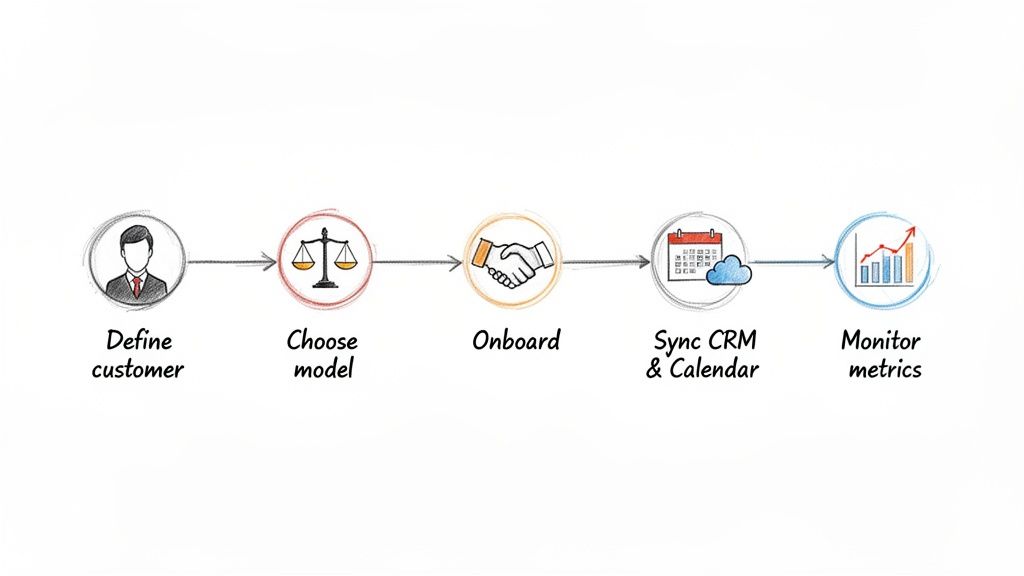
Alright, enough theory. Let's talk about how to actually get a contractor leads service plugged into your business and making you money. This isn't some massive, disruptive overhaul. Think of it as methodically installing a new, high-performance engine into your existing sales machine.
The whole point is to create a smooth, unbroken line from a potential customer's first inquiry all the way to a signed contract. When done right, the service should feel like a natural part of your team, not just another piece of software you have to manage.
Here’s a practical look at how to make it happen.
Step 1: Pinpoint Your Ideal Customer
You can't hit a target you can't see. Before a lead service can find you the right customers, you have to tell them exactly who you're looking for. This is the bedrock of the entire strategy.
Don't just say, "I work with homeowners in this city." That's too vague. You need to get granular about the jobs that actually make you money.
- Service Area: Are you covering the whole county, or just specific zip codes on the north side of town? Be precise.
- Project Type: Do you specialize in kitchen remodels over $50k, emergency roof repairs, or full HVAC system replacements?
- Job Size: What's your minimum project value? You don't want to waste time driving across town for a $500 job if you're set up for $15,000 projects.
- Property Type: Are you focused on single-family homes, or do you also handle condos and small commercial buildings?
Nailing down this Ideal Customer Profile (ICP) turns your lead service into a powerful filter. They'll stop sending you duds and only book appointments with prospects who tick all your boxes, which means no more wasted trips for estimates you were never going to win.
Step 2: Pick Your Service Model
Once you know who you're after, you can decide how you want to get them. This is where you choose the service model that fits your business style and how much risk you're comfortable with. As we covered, the main two flavors are Pay-Per-Lead (PPL) and Pay-Per-Appointment (PPA).
A PPL model means your phone will ring, but it's on you or your team to answer, qualify, and set the appointment. A PPA model takes all of that off your plate. This decision is a major fork in the road and dictates how you'll interact with your new partner.
Your choice of service model determines where the responsibility for lead conversion lies. With PPL, it's on you. With a service like Phone Staffer, which specializes in appointment setting, the responsibility shifts to the provider.
This is a big reason why many contractors prefer to start with a PPA model. It delivers a more predictable result—a qualified homeowner ready for an estimate—and lets them focus on what they do best: pricing jobs and closing deals.
Step 3: Nail the Onboarding Process
After you've picked a provider, it's time for onboarding. This is where the service gets to know the nuts and bolts of your business so they can represent you accurately and professionally. A thorough, organized onboarding is usually a great sign you've chosen a solid partner.
Here’s what you should expect to cover:
- Kickoff Call: This is the initial meeting to go over your ICP, confirm your service area, and establish your business hours for appointments.
- Calendar Integration: They’ll need to sync with your calendar. This is crucial for booking appointments directly without creating conflicts or double-booking you.
- CRM Sync: A good service will connect directly to your CRM, automatically piping new leads and appointments into your system so nothing gets lost.
- Script Development: You'll provide key details about your business so their scripts sound authentic. You want them using your company's language, not some generic call-center talk.
By being actively involved here, you're basically training them to be an extension of your company. The time you invest upfront pays off tenfold in the quality of the appointments you get down the line.
Frequently Asked Questions
Jumping into a contractor leads service can bring up a lot of questions. Let's tackle the most common ones I hear from contractors so you can feel confident about how you're growing your business.
How Much Does a Contractor Leads Service Typically Cost?
The price tag really depends on what you're buying. With a pay-per-lead model, you could be paying anywhere from $20 to over $100 for a single lead. The cost fluctuates based on your trade and whether that lead is exclusive to you or sold to five other contractors.
Pay-per-appointment services charge a higher flat fee, but you're paying for a qualified, scheduled meeting. For a lot of contractors, this gives a much more predictable return. The best way to figure it out is to know your numbers—what's your average job worth and what's your closing rate? That simple math tells you exactly what a booked appointment is worth to your bottom line.
What Is the Difference Between Buying Leads and an Appointment Setting Service?
Think of it this way: buying leads is like getting a list of phone numbers. It's on you to do all the legwork—the follow-up, the qualifying, and finally, booking the meeting.
An appointment setting service does all of that for you. They take the initial contact, have a real conversation to qualify the homeowner's needs, and then put a confirmed estimate directly on your calendar.
It's the difference between buying raw ingredients and having a professional chef prepare the meal. One gives you potential; the other delivers a finished result.
How Quickly Can I Expect to See Results?
With a dedicated appointment setting service, you can see new jobs on your calendar almost immediately. Once everything is synced up and the service is live, qualified appointments can start rolling in within just a few days.
On the other hand, services that rely on long-term strategies like SEO will naturally take several months to gain traction and build momentum. If you need to fill your schedule fast, an appointment setting model is almost always the most direct path to getting there.
What Happens If I Receive a Bad Lead?
This is a make-or-break question for any provider you're considering. A good, reputable service will have a crystal-clear policy for bad leads. They'll typically offer credits for contacts that are outside your service area, have bogus information, or were never truly interested.
This is where a pay-per-appointment model really shines, though. The risk of a "bad lead" is pretty much gone because you're not paying for leads at all—you're only paying for successfully booked and qualified meetings. The burden of quality control falls completely on the service provider, which means you only invest in real, tangible opportunities.
Ready to fill your calendar with qualified, pre-set appointments without all the hassle? Phone Staffer offers a done-for-you cold calling service and can place trained, remote CSRs directly into your business. Stop chasing leads and start closing deals. Book a call with Phone Staffer today to see how we can build your project pipeline.