

In the competitive home service industry, every phone call represents a critical, make-or-break opportunity. A generic, one-size-fits-all script simply doesn't work when a homeowner is dealing with an urgent issue like a burst pipe, a malfunctioning HVAC system, or an electrical failure. The difference between a successfully booked job and a lost lead often hinges on the precise words your team uses in the crucial first 30 seconds of the conversation. This guide is designed to move your team beyond basic, ineffective templates by providing a comprehensive collection of powerful sales call script examples.
Each script is specifically engineered for the unique pressures and customer needs within home service trades, including plumbing, electrical, and HVAC. We won't just give you the words; we will deconstruct the underlying strategy behind each one. You'll gain a deep understanding of why they are effective, from handling high-stress emergency calls with calm authority to strategically turning a simple service inquiry into a multi-service, high-ticket job.
This article delivers actionable frameworks and tactical insights that will empower your team to convert more calls into profitable appointments. Whether you manage an in-house customer service team, utilize remote CSRs, or partner with a dedicated answering service, these sales call script examples provide the structure and confidence needed to improve booking rates immediately. You will learn not just what to say, but how to adapt each conversation to secure the appointment and build lasting customer trust.
1. The Discovery Call Script for Home Service Companies
A discovery call is the foundational first conversation your team has with a potential customer after they’ve shown interest, such as submitting an online form or calling in for the first time. The goal isn't to make a hard sale but to qualify the lead, understand the scope of their problem, build initial rapport, and successfully book a service appointment. This script is one of the most crucial sales call script examples because it sets the stage for the entire customer relationship.
This initial contact, often handled by a Customer Service Representative (CSR) or a virtual assistant from a service like Phone Staffer, is less about selling and more about diagnosing. By gathering key details upfront, you ensure the right technician with the right parts is dispatched, preventing wasted trips and improving first-time fix rates.
Strategic Breakdown
This script focuses on a structured yet flexible conversation flow designed to gather critical information efficiently.
- Opening: Immediately confirm the customer's details and the reason for their inquiry to show you're prepared. Example: "Hi [Customer Name], this is [Your Name] from [Company Name]. I'm calling about the request you sent online regarding your leaking pipe. I want to make sure we get this sorted out for you quickly."
- Problem Diagnosis: Use open-ended questions to understand the issue. For an HVAC company, this could be: "Can you tell me a bit more about what's happening with your AC unit? How old is the system?"
- Urgency Triage: Determine the priority level. A plumber would differentiate by asking: "Is this an active leak causing damage right now, or something you've noticed over time?" This helps schedule emergency calls appropriately.
- Appointment Setting: Guide the customer toward a resolution by scheduling a visit. "Based on what you've described, our next step is to have a technician take a look. I have an opening tomorrow between 10 AM and 12 PM. Does that work for you?"
Actionable Tips for Implementation
- Listen for Keywords: Train CSRs to listen for emotional cues like "frustrated," "worried," or "urgent." Responding with empathy builds instant trust.
- Localize Your Language: Mentioning a local landmark or neighborhood name can build familiarity and position your company as a local expert.
- Prepare Alternatives: Always have a backup list of two to three alternative appointment slots ready in case the customer's first choice is unavailable.
- Document Everything: Note any specific customer requests (e.g., "please call before arriving," "beware of the dog") in the job notes for the technician. This small detail dramatically improves the customer experience.
2. The Emergency Service Callback Script
When a customer calls with a burst pipe or a failed furnace in freezing temperatures, the conversation is no longer about a standard sale; it's about providing an urgent solution. The emergency service callback script is designed for these high-stakes situations. Its primary goal is to de-escalate customer panic, gather critical information swiftly, and dispatch help immediately. This is one of the most vital sales call script examples for any trade offering 24/7 or emergency services.

This script prioritizes a calm, authoritative, and reassuring tone. Handled correctly by a well-trained CSR or a remote professional from a service like Phone Staffer, this call transforms a moment of crisis into a display of your company's reliability and expertise, often creating a loyal customer for life.
Strategic Breakdown
This script is built for speed and clarity, focusing on immediate action and reassurance to manage a stressful situation effectively.
- Opening: Start with calm authority to instantly take control and reassure the caller. Example: “You’ve reached [Company Name], this is [Your Name]. I understand you have an emergency, and I’m here to help. What is your address?” Getting the location first is critical in case the call drops.
- Problem Triage & Safety First: Quickly assess the severity and provide immediate safety instructions. For an electrician: "Okay, I've got your address. Can you tell me exactly what's happening? If you see sparks or smell smoke, please evacuate and call 911 immediately."
- Information Capture: Gather only the essential details needed for dispatch. A plumber handling a water leak might ask: "Do you know where the main water shut-off valve is? If so, please turn it clockwise to stop the flow. We are dispatching a technician now."
- Dispatch & ETA: Provide a clear, confident timeline for arrival to manage expectations. "I have a technician who will be at your home in the next 60 to 90 minutes. You will receive a text message when they are on their way. Can I confirm your best callback number?"
Actionable Tips for Implementation
- Remain Calm: Your tone is contagious. Train staff to speak slowly and clearly. A calm voice conveys competence and helps reduce the customer's anxiety.
- Confirm Key Details: Always repeat the address and the nature of the emergency back to the customer to ensure there are no misunderstandings before dispatching a technician.
- Integrate with Dispatch: Use dispatch software that allows your CSR to see real-time technician availability and provide an accurate ETA, which is a key factor in an emergency.
- Provide Transparent Pricing: Briefly explain your emergency service fee structure (e.g., "Our emergency dispatch fee is [amount], and the technician will provide a full quote on-site before any work begins"). This prevents surprises and builds trust.
3. The Referral and Repeat Customer Script
This script focuses on leveraging your most valuable asset: your existing customer base. Instead of cold outreach, this call reconnects with satisfied customers to request referrals, offer maintenance plans, or introduce relevant new services. The goal is to maximize customer lifetime value by turning a one-time service call into an ongoing relationship that generates both repeat business and new leads. This approach is one of the most profitable sales call script examples because it builds on established trust.
This conversation is less about a hard sell and more about relationship nurturing. Handled correctly by your in-house team or a virtual assistant from a service like Phone Staffer, it reinforces that you care about the customer's long-term satisfaction. By re-engaging them at the right time, you stay top-of-mind and position your company as their go-to provider for any future needs.
Strategic Breakdown
This script prioritizes a warm, conversational, and value-driven approach that feels more like a check-in than a sales call.
- Opening: Immediately reference the past service to establish context and jog their memory. Example: "Hi [Customer Name], this is [Your Name] with [Company Name]. We were out about six months ago to replace your water heater, and I just wanted to call and see how everything has been working for you."
- Relationship Check-In: Ask an open-ended question to gauge their satisfaction and re-open the conversation. For an HVAC company, this could be: "With summer just around the corner, I was calling to check in on how that new AC unit has been performing for you since the installation."
- The Pivot: Seamlessly transition from the check-in to your reason for calling, whether it’s a referral request or a new offer. "That's great to hear! The reason I'm calling today is that we're expanding in your area and are looking for a few more great customers like you. I was wondering if you knew just one person who might need help with their plumbing."
- Easy Ask & Incentive: Make the referral process simple and provide a clear reason for them to act. "If you can think of anyone, you can just text me their name and number. As a thank you, we'll send you a $50 gift card if they book a service with us."
Actionable Tips for Implementation
- Timing is Everything: Wait 2-6 months after the initial service. This gives the customer enough time to appreciate the quality of your work without forgetting who you are.
- Reference Specific Details: Mentioning the specific service performed ("your new garage door opener") or even the technician's name shows you value their business and aren't just making a generic call.
- Leverage Seasonality: Use seasonal changes as a natural reason to call. For instance, an electrician can call in the fall to offer a pre-holiday generator inspection.
- Simplify the Referral: Don't ask customers to do heavy lifting. Provide a simple mechanism like a direct text, an email intro, or a link to an online form they can forward. The easier it is, the more likely they are to do it.
4. The Objection Handling and Rebooking Script
Even the most qualified leads can hesitate. An objection handling and rebooking script is a specialized tool for navigating customer pushback, whether it’s about price, timing, or a need for other quotes. Instead of losing a potential job at the first sign of resistance, this script empowers your team to acknowledge the customer's concern, re-establish value, and guide the conversation back to booking an appointment. It's one of the most powerful sales call script examples for turning a "maybe" or "no" into a confirmed service call.
This script isn't about being pushy; it's about being prepared. When a customer says, "That's more than I expected," a trained CSR from a service like Phone Staffer can pivot gracefully instead of ending the call. The goal is to understand the root of the hesitation and address it with confidence and empathy, keeping the lead in your pipeline.
Strategic Breakdown
This script provides a framework for de-escalating concerns and redirecting the conversation toward a solution.
- Acknowledge and Validate: Always start by validating the customer's concern. This immediately lowers their defenses. Example: "I completely understand that budget is a major consideration. Thank you for being upfront about that."
- Isolate and Clarify: Dig deeper to find the real issue behind the stated objection. For a customer who says "I need to think about it," you could ask: "I get that. To make sure I've given you all the information, was it the timeline or the estimated cost that you had questions about?"
- Reframe and Reposition Value: Pivot from the objection back to the value your company provides. When handling "I'm getting other quotes," a roofer might say: "That's a smart decision. While you compare, keep in mind our 25-year workmanship warranty and the fact that we use GAF-certified installers, which not all companies do."
- Propose a Low-Commitment Next Step: If booking a full service call is too much, offer an easier alternative. "Instead of committing to the full repair, how about we schedule a no-obligation diagnostic visit for just $49? Our tech can pinpoint the exact issue, and we'll apply that fee to the final cost if you decide to move forward."
Actionable Tips for Implementation
- Listen First, Respond Second: Train your team to let the customer finish their thought completely before jumping in with a rebuttal. Active listening is key.
- Use Social Proof: Counter price sensitivity with evidence of quality. "We have over 500 five-star reviews from neighbors right here in [City Name] who were thrilled with the long-term value."
- Create Urgency Ethically: If a customer is on the fence about timing, gently remind them of the consequences. "I understand wanting to wait, but a small leak like this can lead to serious water damage if not addressed soon."
- Know Your Bottom Line: Equip your CSRs with pre-approved options, such as a small first-time customer discount, a flexible payment plan, or a tiered service package to offer when necessary. To ensure your sales call scripts are robust and effective, it's essential to master how to handle sales objections like a pro, turning resistance into opportunities.
5. The Multi-Service Upsell and Cross-Sell Script
An upsell or cross-sell script is a powerful tool used during appointment confirmations or even by technicians in the field to increase the average ticket value. The goal is not to pressure the customer but to identify and offer relevant, additional services that solve problems they may not have considered. For home service companies, this means turning a single-service call into a multi-service visit, boosting revenue and demonstrating comprehensive expertise.
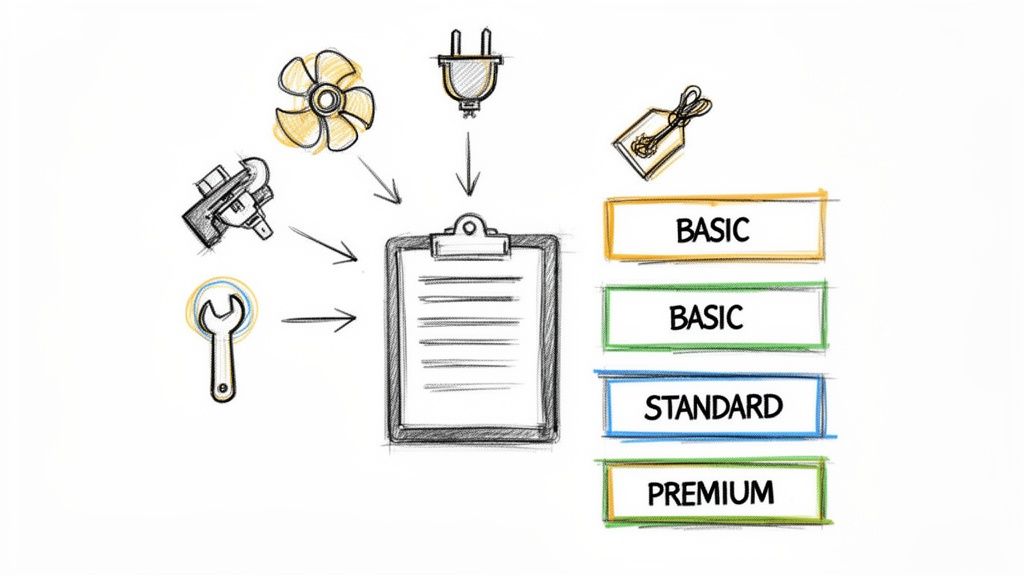
This approach, often integrated into CSR protocols by services like Phone Staffer, shifts the conversation from transactional to advisory. By suggesting a furnace inspection during an AC repair call or a whole-house water pressure assessment during a leak repair, you position your company as a proactive partner in home maintenance, not just a reactive problem-solver. These sales call script examples are designed to uncover and address related needs efficiently.
Strategic Breakdown
This script is built on observation and helpful suggestions, using the initial service request as a natural entry point for a broader conversation.
- Opening: Confirm the primary appointment and create a smooth transition. Example: "Hi [Customer Name], I'm just calling to confirm your appointment for the leaking faucet tomorrow. While we have our expert plumber on-site, are there any other plumbing concerns you've noticed recently?"
- Diagnostic Questioning: Use open-ended questions based on the initial problem. For an electrical service: "Since we're installing the new outlet in your home office, have you noticed any lights flickering or breakers tripping elsewhere? Sometimes that can indicate a larger issue with the panel."
- Proactive Suggestion: Frame the upsell as a value-add or preventative measure. For an HVAC company: "While our technician is there for the AC tune-up, many of our clients ask us to also check their furnace to ensure it's ready for winter. We offer a bundled rate that saves you a separate service fee later on."
- Benefit-Driven Close: Focus on the value, not just the service. "By checking the water pressure now, we can prevent future leaks and extend the life of your pipes and appliances. Would you like me to add that to the work order?"
Actionable Tips for Implementation
- Lead with Questions, Not Pitches: Instead of saying "You should buy X," ask "Have you ever experienced Y?" This uncovers needs organically.
- Bundle and Discount: Create service packages that offer a clear discount compared to booking each service individually. This increases the perceived value.
- Use 'While We're There': This phrase is a low-pressure way to introduce additional services, leveraging the fact that a technician is already scheduled to be on-site.
- Train Techs to Observe: Equip technicians with a checklist to note other potential issues (e.g., an aging water heater, a noisy furnace) that CSRs can use for a follow-up call. This creates a powerful feedback loop for future sales opportunities.
6. The Franchise or B2B Partnership Outreach Script
For home service franchise owners or business development managers, growth often comes from strategic alliances. This script is designed for outreach to other businesses like home builders, property managers, or real estate agents to propose mutually beneficial partnerships, sub-contracting work, or referral programs. Unlike a direct-to-consumer call, this B2B approach involves a longer sales cycle and a focus on demonstrating clear, long-term value.
This type of outreach is a powerful engine for scalable growth. For example, an HVAC franchise can secure a steady stream of new installation jobs by partnering with a new home construction firm. Similarly, a plumbing company can gain consistent, high-quality leads by establishing a referral relationship with local real estate agents who need reliable contractors for home inspections and repairs. This is one of the more advanced sales call script examples as it requires a blend of sales acumen and strategic business development.
Strategic Breakdown
This script focuses on professionalism, value proposition, and a clear call to action for a follow-up discussion.
- Opening: Start with a clear, professional introduction that establishes your credibility and purpose. Example: "Hi [Contact Name], this is [Your Name] with [Your Franchise]. I’m calling because I’ve been following [Their Company]’s work in the [Local Area] and was impressed with your recent [Project or Accomplishment]."
- Value Proposition: Immediately present a clear, concise "what's in it for them" statement. "We specialize in [Your Service], and we've developed a partnership program for home builders that helps streamline installations and reduce project delays. I believe we could offer significant value to your upcoming projects."
- Credibility Building: Briefly mention a success story or the structure of your proposed partnership. "We currently work with [Similar Company], and we've helped them increase their project efficiency by 15%. Our referral program is straightforward, with a clear commission structure."
- Closing & Next Steps: The goal isn't to close a deal but to schedule the next conversation with the right person. "I know you're busy. Would you be open to a brief 15-minute call next week to explore how a partnership could benefit both our businesses? My goal is to see if there's a good fit."
Actionable Tips for Implementation
- Do Your Homework: Before calling, research the prospect's company. Reference a specific project, a recent award, or a new development to show you’ve made a genuine effort.
- Lead with Mutual Benefit: Frame the conversation around a partnership, not just lead generation for your company. Use words like "collaboration," "mutual growth," and "streamline."
- Define the Terms Clearly: Be prepared to discuss referral fees, margins, or sub-contracting rates. Transparency builds trust and speeds up the decision-making process.
- Propose a Pilot: Suggesting a trial period, like a 30-day pilot or partnering on a single project, can lower the barrier to entry and make saying "yes" much easier.
7. The Window of Time and Urgency Script
This tactical script leverages genuine, time-sensitive factors like seasonal demand, limited appointment availability, or special promotions to encourage customers to book a service sooner rather than later. The goal is to create a sense of beneficial urgency, helping a customer who is already considering a service to act now to avoid future inconvenience or to take advantage of a real incentive. It’s one of the most effective sales call script examples for managing seasonal peaks and filling the schedule efficiently.
Unlike high-pressure sales tactics, this approach is grounded in authentic business realities. For home service companies, this means communicating that waiting could genuinely result in longer wait times or missed opportunities. When used correctly by a CSR or a virtual assistant from a service like Phone Staffer, it frames the decision as a helpful recommendation, not a forced choice.
Strategic Breakdown
This script works by connecting a customer’s needs to a specific, verifiable timeframe, motivating a decision without creating pressure.
- Opening: Start by referencing the customer's interest and immediately introduce the time-sensitive context. Example for an HVAC company: "Hi [Customer Name], this is [Your Name] with [Company Name]. I saw you were interested in an AC tune-up. I wanted to reach out because we're booking up fast ahead of the first heatwave expected next week."
- Explain the "Why": Clearly and honestly explain why acting now is beneficial. For a plumbing company, this could be: "With the heavy spring rains forecast, our schedule for sump pump inspections is filling up. We want to make sure our clients are protected before the basement flooding risk increases."
- Present the Offer/Solution: Provide a clear call to action tied to the urgency. For a pool service: "We have an early-bird maintenance special that saves you $150, but that offer expires this Friday. We still have a few spots left this week."
- Booking the Appointment: Guide them directly to the next step. "To make sure you don't miss out, I can schedule your service for Thursday morning. Would that work for you?"
Actionable Tips for Implementation
- Ground Urgency in Reality: Use real factors like weather forecasts, seasonal demand, or legitimate supply-chain updates. Manufactured scarcity erodes trust.
- Be Specific with Timeframes: Instead of saying "for a limited time," use concrete deadlines like "through the end of the month" or "before the holiday weekend."
- Tie Urgency to Protection: Frame the call as a way to help customers avoid problems, such as "getting your furnace checked before the first freeze hits."
- Document the Incentive: If offering a discount, make sure it's clearly noted in the customer’s file and on the work order to ensure a smooth customer experience.
8. The CSR Qualification and Transfer-to-Technician Script
This script is a precision tool for Customer Service Representatives (CSRs) or virtual assistants who act as the first line of contact. Its purpose is to quickly qualify inbound leads, diagnose the issue, and determine the correct next step. This process is essential for efficiency, ensuring that a valuable technician’s time isn’t wasted on a non-emergency or a query that could be handled differently. This is one of the most operationally critical sales call script examples for scaling a home service business.
By properly routing calls, a well-trained CSR can prevent unnecessary truck rolls and ensure the right specialist is assigned to the right job. This structured approach, a core component of effective administrative support, improves both customer satisfaction and operational profitability by resolving issues faster and more effectively. It’s the difference between a chaotic schedule and a streamlined, productive one.
Strategic Breakdown
This script is built around a decision tree model, guiding the CSR through a series of questions to determine the best course of action for the customer.
- Initial Triage: Quickly identify the service needed and its urgency. Example: “Thank you for calling [Company Name]. To get you to the right person, could you tell me if you're experiencing a plumbing emergency, like a major leak, or are you looking to schedule routine maintenance?”
- Qualifier Questions: Use specific, targeted questions to gather details that determine the next step. For an electrical company, this might be: “Are you noticing flickering lights throughout the house, or is the issue isolated to a single outlet? Have you checked your circuit breaker?”
- Routing and Transfer: Confidently direct the customer to the appropriate resource with a warm handoff. "Based on what you've shared, our senior HVAC technician is the best person to help. I'm going to transfer you now. I've already shared your details with him, so you won't have to repeat anything."
- Appointment Funneling: If an in-person visit is required, guide them into the scheduling process. "It sounds like we definitely need to get a technician out there. Let me check our schedule. I can have someone there this afternoon. What's the best number to reach you at just before they arrive?"
Actionable Tips for Implementation
- Create Clear Decision Trees: Develop a flowchart for each service (Plumbing, HVAC, Electrical) with specific questions that lead to clear outcomes: "Schedule Visit," "Transfer to Technician," or "Provide Phone Quote."
- Empower Your CSRs: Train your team and give them the authority to make routing decisions. Confidence in their role translates to a more confident and reassuring customer experience.
- Document Meticulously: Ensure all information gathered is entered into your CRM or job management software before the transfer. This prevents the customer from having to repeat themselves.
- Use Positive Language: Frame the transfer as a benefit to the customer. Instead of "I have to transfer you," say, "I'm connecting you with our specialist who can give you the best possible solution."
Comparison of 8 Sales Call Scripts
| Script | 🔄 Implementation Complexity | ⚡ Resource Requirements | 📊 Expected Outcomes | 💡 Ideal Use Cases | ⭐ Key Advantages |
|---|---|---|---|---|---|
| The Discovery Call Script for Home Service Companies | Moderate — structured branching and role training required | Low–Moderate — CSRs/VA, booking/CRM integration | Higher appointment bookings; better job intel; shorter tech prep time | Initial inbound homeowner leads (plumbing, HVAC, electrical) | ⭐⭐⭐ — Reliable first-contact qualification and rapport |
| The Emergency Service Callback Script | High — rapid protocols and safety flows under time pressure | High — 24/7 staffing or outsourced on-call teams, dispatch integration | Fast same-day bookings; reduced liability; higher premium conversions | Urgent issues (burst pipes, no heat, electrical hazards) | ⭐⭐⭐⭐ — Converts high-value urgent calls quickly |
| The Referral and Repeat Customer Script | Low–Moderate — conversational scripts with personalization | Low — accurate CRM history, incentive tracking | Increased referrals and CLV; higher close rates; lower CAC | Post-service follow-ups, upsell maintenance plans, referral asks | ⭐⭐⭐⭐ — Strong ROI from existing customer base |
| The Objection Handling and Rebooking Script | High — extensive objection libraries and role-play practice | Moderate — trained CSRs, updated rebuttal content, manager escalation | Recovers lost leads; improved rebooking rates; fewer cancellations | Customers hesitating on price/timing or comparing quotes | ⭐⭐⭐ — Recovers 20–40% of at-risk appointments |
| The Multi-Service Upsell and Cross-Sell Script | Moderate — diagnostic flows and bundling paths to train | Moderate — technician notes handoff, pricing tiers, CRM prompts | Higher average ticket (25–50% lift); more comprehensive service coverage | Appointment confirmations; technician visit handoffs | ⭐⭐⭐⭐ — Significant revenue lift per job when done well |
| The Franchise or B2B Partnership Outreach Script | High — multi-stage cadence and complex negotiation language | High — senior reps, sales collateral, legal for agreements | Opens referral channels; recurring high-volume leads; longer sales cycle | Franchise partnerships, builders, commercial contractors | ⭐⭐⭐ — Generates scalable partner-sourced leads |
| The Window of Time and Urgency Script | Low — tactical messaging with limited-time mechanics | Low — calendar visibility, clear operational constraints | Faster booking rates (30–50% in peak seasons); reduced no-shows | Seasonal promotions, peak-demand service pushes | ⭐⭐⭐ — Effective at accelerating bookings when authentic |
| The CSR Qualification and Transfer-to-Technician Script | Moderate — clear decision trees and warm-transfer protocols | Moderate — CSRs/VA, routing rules, technician availability data | Better dispatch efficiency; fewer wasted tech visits; improved SLAs | Inbound triage to determine visit vs. phone quote vs. waitlist | ⭐⭐⭐⭐ — Maximizes technician productivity and routing accuracy |
From Script to System: Implementing Your High-Conversion Call Strategy
You now have a comprehensive playbook filled with powerful sales call script examples designed specifically for the unique demands of the home service industry. From the initial Discovery Call to nuanced Objection Handling and strategic Multi-Service Upsells, these templates are your starting point for transforming conversations into booked jobs. But as we've explored, a script is not a magic wand; it's a tool. The real power is unlocked when you move from simply reading lines to building a repeatable, high-performance communication system.
The core takeaway is this: structure creates freedom. A well-defined script doesn't make your team sound like robots. Instead, it provides a solid foundation, freeing up their mental energy to actively listen, build genuine rapport, and confidently guide the customer toward a solution. It ensures that every critical piece of information is gathered, every value proposition is clearly stated, and every potential objection is anticipated.
Key Insights to Operationalize Immediately
To truly elevate your sales process, focus on these critical pillars we've discussed throughout this guide:
- Adaptation Over Adoption: Never copy and paste a script verbatim. The most effective sales call script examples are those you’ve tailored to your specific trade, brand voice, and local market nuances. A plumber’s urgency script will sound different from a landscaper’s seasonal upsell script.
- Training and Role-Playing are Non-Negotiable: A script is only as good as the person delivering it. Consistent role-playing sessions are where your CSRs and technicians build muscle memory, learn to handle unexpected questions, and master the tone that turns a hesitant lead into a loyal customer.
- The Goal is Always the Next Step: Every script, whether for a cold call or an inbound query, should have a single, clear objective. Is it to gather information? Is it to book an appointment? Is it to get a "yes" for a follow-up? Define the win for each call and build the script around achieving it.
- Listen More Than You Talk: Notice how the best scripts are filled with discovery questions. They are engineered to get the customer talking. The information you gather is the ammunition you need to present your service not as a commodity, but as the perfect solution to their specific problem.
Turning Scripts into a Conversion Engine
Building this system requires dedication. It involves recording calls (with consent), analyzing performance, and continuously refining your approach based on what works. To truly transform scripts into a high-conversion system, exploring practical applications is essential, such as reviewing these 10 proven customer service scripts examples for diverse scenarios. This process of review and refinement is what separates average home service businesses from the market leaders who dominate their local area.
However, for a busy owner juggling estimates, managing crews, and handling inventory, overseeing this entire process can feel like a second full-time job. This is where the true bottleneck often lies, not in a lack of good scripts, but in the lack of time and expertise to implement them systemically. The ultimate goal is to create a seamless, professional experience for every single lead that contacts your business, ensuring no opportunity is wasted. By systemizing your sales calls, you build a predictable pipeline of booked jobs, which is the lifeblood of any growing home service company.
Ready to turn these scripts into a fully managed, high-converting system without adding to your workload? The team at Phone Staffer specializes in providing expertly trained remote CSRs and VAs who live and breathe these advanced call-handling strategies every day. Let us build and manage your sales call engine, so you can focus on what you do best: delivering exceptional service.