
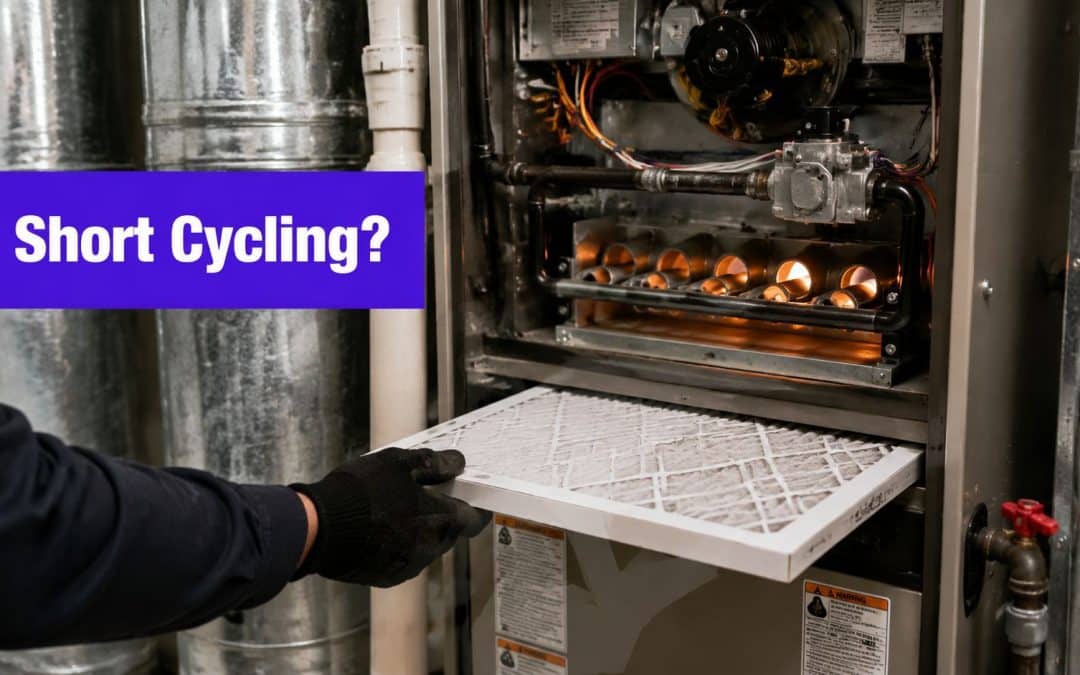
You hear the furnace click on. The burners fire. The blower starts. Then, before the house feels any warmer, everything shuts down. A minute later it tries again.
That pattern gets old fast, especially at night when the sound keeps pulling your attention back to the hallway thermostat. Most homeowners describe it the same way: “My furnace keeps turning on and off, but it never seems to finish the job.”
In the trade, that behavior is called short cycling. It's not just annoying. It's your system telling you something isn't right, and the smart move is to diagnose it in the same order a technician would. Start with the easy, cheap checks. Then move toward the internal faults and design issues that need tools, testing, and experience.
The Annoying Click That Signals a Furnace Problem
When a furnace keeps turning on and off, the first thing noticed isn't the temperature. It's the rhythm. Click. Whoosh. Fan. Silence. Then the same sequence again.
A lot of homeowners assume the furnace is “working, just not very well.” That's the trap. A furnace that starts and stops too often usually isn't operating normally at all. It may be overheating, getting bad thermostat signals, failing to prove flame, or satisfying the thermostat too quickly because the equipment isn't matched well to the house.
The sound matters because it tells you the unit is trying. It has power. It's attempting a heat cycle. But something is interrupting that cycle before the house reaches a steady comfortable temperature.
Field rule: If the furnace runs briefly, shuts off, and keeps repeating the pattern, don't start by replacing random parts. Start with airflow and controls.
Over the phone, I usually ask three simple questions right away:
- Did this start suddenly after the system had been working fine?
- Did anything change in the house, like a new filter, furniture moved over a return, or thermostat batteries ignored for too long?
- Has it done this since installation or since you moved in?
Those answers often point you in the right direction before anyone touches a screwdriver.
Sometimes the fix is simple. I've seen a clogged filter, a thermostat in bad sunlight, or a blocked return grill cause what sounded like a major breakdown. Other times, the short cycling is the symptom of a deeper issue that needs proper testing.
Either way, the repeated clicking is a warning, not background noise.
Understanding Furnace Short Cycling
Short cycling is the industry term for a furnace that turns on and off too frequently. HVAC guidance places a normal furnace cycle at roughly 7 to 15 minutes per run, and when a unit runs for less than about 5 minutes and keeps restarting, it's considered short cycling, according to this furnace short cycling explainer.

What that means in plain language
A normal cycle gives the furnace enough time to warm the heat exchanger, move heat through the ductwork, and bring the house toward the thermostat setting in a steady way.
A short cycle does the opposite. The system starts, stops early, then starts again before it has really done useful work. It's similar to starting your car, backing out of the driveway, parking again, then repeating that all morning. The equipment can do it, but it's not the way it's meant to run.
Here's what homeowners usually feel when this is happening:
- Rooms heat unevenly
- The thermostat setting takes too long to reach
- The furnace sounds busy without delivering comfort
- The house feels warm for a moment, then cool again
Why it matters
Short cycling usually points to one of two broad problems. The first is a fault that interrupts the heating cycle, like restricted airflow or a control issue. The second is a system that heats too fast for the space, which often points to oversizing.
That second one catches people off guard. A family I helped a while back had a newer furnace and assumed the fast starts and stops meant the new unit was “strong.” It wasn't. The equipment had too much capacity for the home, so it blasted heat, shut off quickly, and repeated the pattern all day. The complaint wasn't “no heat.” It was uneven comfort, constant cycling, and a furnace that never seemed to settle down.
A furnace can be brand new and still be wrong for the house.
That's why “it's new” doesn't rule anything out. If the furnace has behaved this way since day one, the problem may not be wear. It may be setup, control, or sizing.
Safe DIY Checks You Can Do in Five Minutes
When a furnace keeps turning on and off, technicians usually start with the same sequence because it avoids wasted money. Check the thermostat first. Then the filter. Then the airflow through the house.

Is the thermostat getting a bad reading
Start at the wall, not at the furnace.
A thermostat with weak batteries or a bad location can send the wrong signal. If it sits near direct sunlight, a warm supply register, or another heat source, it may think the room is warmer than it really is. That can make the furnace turn off early and restart often.
Check these first:
- Battery power. If your thermostat uses batteries, replace them.
- Mode and setpoint. Make sure it's set to heat and the target temperature is above room temperature.
- Location clues. If the thermostat is near a lamp, sunny window, kitchen heat, or supply vent, it may be reading a false temperature.
A lot of homeowners skip this because the thermostat “looks fine.” Looking fine and reading accurately are not the same thing.
Is the filter choking the system
This is the most common place to look because it's fast, safe, and cheap. Trane recommends replacing furnace filters every 1 to 3 months, depending on filter type, because dirty or clogged filters can restrict airflow, cause overheating, and shut the furnace down before a cycle is complete, as noted in Trane's guidance on furnace short cycling.
Pull the filter out and look at it under good light. If it's packed with dust, pet hair, or construction debris, replace it with the correct size and airflow direction.
What doesn't work is guessing. I hear “we changed it recently” all the time. Recently doesn't mean clean. A new filter can load up fast in a house with pets, remodeling dust, or heavy winter runtime.
Here's a helpful walkthrough with expert heating system advice from Bear Valley Plumbing & Heating if you want another homeowner-friendly checklist.
Is the house starving the furnace for air
A furnace needs air moving in and air moving out. If return air is blocked or supply vents are closed, the system can overheat and shut itself down.
Ask yourself:
- Are supply registers closed? Open them.
- Are return grilles blocked by furniture, rugs, or boxes? Clear them.
- Did anyone close vents in unused rooms? Reopen them.
- Is anything covering the furnace area or nearby intake path? Remove it.
One of the simplest service calls I ever ran involved a “failing furnace” after a room makeover. The homeowner had added a large bookshelf and it covered the main return enough to choke airflow. The furnace would fire, heat up, trip out, cool down, and try again. We moved the furniture, confirmed airflow, and the problem stopped.
That's why random part swapping is a bad idea. A blocked return can look like a control problem if you don't check the house first.
This video gives a useful visual on the kind of basic checks worth doing before you schedule service:
One safe order that works
A practical field sequence from HVAC troubleshooting guidance is to check thermostat settings and batteries, inspect or replace the air filter, verify all supply and return vents are open and unobstructed, and then inspect the flue or venting path for debris or ice buildup, as outlined in this step-by-step short cycling diagnosis.
If the easy airflow checks don't change the behavior, stop there. That usually means the next step involves internal components or combustion-side diagnosis.
Common Causes That Require a Professional
Once the thermostat, filter, and basic airflow checks are done, the remaining causes usually move into technician territory. That's where the diagnosis matters more than the symptom, because several different faults can make a furnace keep turning on and off in almost the same pattern.

Dirty flame sensor
The flame sensor has one job. It tells the control board that flame is present. If that sensor is coated with oxidation or residue, the board may shut the burner down shortly after ignition, creating a start-stop pattern even when gas and ignition are otherwise working, according to this explanation of flame-sensor and thermostat misbehavior.
Homeowners sometimes watch the burners light and assume the ignition side is fine. Not necessarily. If the flame sensor doesn't prove flame correctly, the furnace may light, run briefly, and then cut out.
I've also seen DIY cleaning attempts go sideways. One homeowner pulled the sensor, used the wrong abrasive method, reinstalled it poorly, and ended up creating a bigger problem than the original one. The service call became more about correcting the attempted repair than solving the short cycling.
High-limit and overheating faults
Sometimes the furnace is doing exactly what it's supposed to do. It overheats, the safety opens, and the system shuts the burners off to protect itself.
That can come from airflow trouble that wasn't fully obvious during a quick visual check. It can also come from internal blower issues, duct restrictions, or limit-related faults that need proper testing. Such situations require technicians to stop guessing and start measuring, inspecting, and confirming what's happening during a heat call.
If the furnace is stopping to protect itself, the goal isn't to force it to keep running. The goal is to find out why it got too hot.
If you smell gas at any point, don't keep troubleshooting. Leave the area and follow a proper safety process. This homeowner-facing Harrlie Plumbing's gas leak guide is a useful refresher on warning signs to take seriously.
Oversized furnace or control mismatch
This one frustrates people because there may be no “bad part” to replace.
Multiple HVAC sources note that an oversized furnace can heat a space too quickly, shut off, and restart repeatedly, and thermostat placement or calibration can create a similar effect. The question is whether this is a repair issue or whether the equipment is too large for the home, as discussed in this overview of oversizing and short cycling.
A common real-world version sounds like this: “The furnace always heated fast, but the house never felt evenly warm.” That's different from “It worked fine for years and suddenly started acting up.” The first story points more toward design or setup. The second points more toward maintenance or failure.
What pros do differently
A technician won't just ask whether the furnace runs. They'll look at the timing and pattern.
One practical benchmark used in the field is to run a timed test cycle over about 60 minutes and count restarts. That helps separate nuisance cycling from intermittent faults and oversized-system behavior. That's not a casual homeowner check. It's part of building a pattern before replacing components.
Deciding When to Make the Call to an HVAC Pro
There's a point where more homeowner troubleshooting stops being helpful and starts wasting time. If the furnace keeps turning on and off after you've done the basic checks, the next step should be a proper service visit.

Call a pro if any of these are true
- You changed the filter and cleared vents, but nothing changed. That usually means the problem is no longer a simple airflow issue.
- The burners light and then shut off quickly. That points toward flame proving, controls, or safety shutdowns.
- You hear banging, scraping, or harsh buzzing. Those sounds need inspection, not guessing.
- You smell gas or strong burning odors. Stop and treat it as a safety issue.
- The furnace has acted this way since installation. That raises the possibility of oversizing or setup mismatch rather than a routine repair.
One reason to make the call sooner is that repeated short cycling can be a design problem, not just a failed component. As noted earlier, an oversized furnace can heat the space too quickly, shut off, and restart repeatedly, which changes the solution completely. It may not be a simple repair at all.
Furnace fixes cost and responsibility guide
| Issue | Who Fixes It | Estimated Cost |
|---|---|---|
| Dead thermostat batteries | Homeowner | Low |
| Dirty air filter | Homeowner | Low |
| Closed or blocked vents | Homeowner | Low |
| Thermostat placement or calibration issue | HVAC professional | Moderate |
| Flame sensor diagnosis and service | HVAC professional | Moderate |
| High-limit or internal overheating diagnosis | HVAC professional | Moderate to high |
| Oversized furnace or design mismatch | HVAC professional | Higher, depends on correction |
That table is intentionally broad. Real repair pricing varies by market, brand, access, and what testing reveals. What matters is the decision logic. Free checks come first. Internal diagnosis comes second.
Make the service call easier on yourself
When you call, don't just say “the heat isn't working.” Give the pattern.
Tell the office what it's doing, when it started, whether the filter was changed, and whether the furnace shuts off before the thermostat setting is reached. Clear notes help the company schedule the right tech and shorten the diagnosis. If you run a service business yourself, good intake matters just as much as good wrench work, and these customer communication strategies for home service teams show why the first conversation often shapes the whole job.
Your Furnace Action Plan for a Warm Home
If your furnace keeps turning on and off, treat it like a symptom, not the final diagnosis. The pattern has a name, and it usually points to either airflow trouble, a control or sensor problem, or a system that was never matched properly to the house.
Start with the checks that cost little or nothing. Verify the thermostat. Inspect the filter. Walk the house and make sure air can move. Reputable HVAC guidance notes that blocked return-air paths, closed or obstructed vents, or an undersized return can create airflow restriction that triggers overheating and safety shutoffs. That's why one of the best questions to ask is whether the system is being starved for air, as explained in this airflow-focused short cycling article.
The cheapest fix is usually the one you check first. The expensive mistake is skipping the basics and guessing.
After that, know where the DIY line ends. If the problem involves flame sensing, safety switches, internal overheating, or equipment sizing, you're into professional diagnosis. That's where experience saves money, because the wrong repair can leave you with the same problem and a bigger bill.
A warm home usually comes down to a simple sequence. Check airflow first. Respect the safety controls. Call for help when the fault moves inside the cabinet.
If you're in doubt, schedule the diagnostic. It's the fastest path back to safe, steady heat.
If you run a home service company and want more booked calls from homeowners dealing with problems like short cycling, Phone Staffer helps you turn outbound calling into real appointments. They recruit callers, train them, supervise them, build targeted lists, and help home service businesses keep the schedule full.