

At its core, measuring marketing ROI comes down to a straightforward formula: take the net profit from your campaign, divide it by the total marketing cost, and then multiply that number by 100. It's the calculation that turns a list of marketing expenses into a clear picture of profitability.
Why Measuring Marketing ROI Is Non-Negotiable
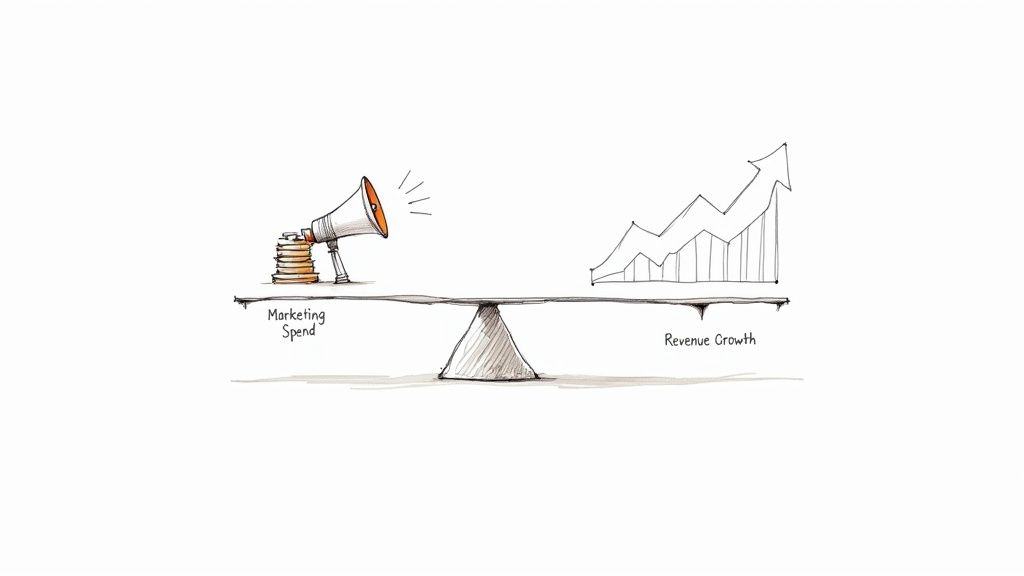
Getting a handle on your marketing return on investment is so much more than a reporting chore—it’s the backbone of any sustainable growth strategy. It gives you the hard proof you need to justify budgets, fine-tune your spending, and tie marketing activities directly to the company's revenue.
Without that clarity, marketing can quickly look like a cost center, a necessary expense with fuzzy value. But once you start measuring ROI, you transform your department into a predictable growth engine.
If you're just starting out, getting a solid grasp on how to measure ROI effectively is the perfect first step. This knowledge helps you speak the language of the C-suite, proving how your work directly impacts the bottom line.
Before we dive deeper, let's break down the essential pieces of the ROI calculation. Think of this as your cheat sheet for getting started.
Key Components for Calculating Marketing ROI
| Component | What It Is | Example |
|---|---|---|
| Sales Growth | The increase in revenue directly tied to a specific marketing campaign. | A campaign generated $50,000 in new sales. |
| Gross Profit | The revenue from sales minus the cost of goods sold (COGS). | If your profit margin is 40%, the gross profit on $50,000 is $20,000. |
| Marketing Investment | The total cost of creating and running the campaign. | Ad spend, software costs, and agency fees total $5,000. |
| Net Profit | The gross profit minus the marketing investment. | $20,000 (Gross Profit) – $5,000 (Investment) = $15,000. |
Having these four numbers is the foundation for everything that follows. They are your source of truth for campaign performance.
The Shift Toward Accountability
The pressure on marketing teams to prove their worth has never been higher. Over the last five years, demonstrating ROI has shot to the top of the priority list for marketing leaders. In fact, 83% now consider it a top concern, a significant jump from 68% back in 2018.
This isn't just a passing trend. It reflects a major shift in how businesses operate, especially when budgets are tight. A whopping 64% of companies now base their future marketing budgets heavily on past ROI performance. You can find more stats on this trend over at Firework.com.
This demand for accountability is actually a good thing. It forces us to make smarter decisions. When you know precisely which channels are delivering the best returns, you can reallocate your budget with total confidence.
Key Takeaway: Measuring marketing ROI isn't just about looking backward at campaign performance. It's a forward-looking tool that guides future strategy, informs budget allocation, and solidifies marketing's role as a critical driver of business growth.
Ultimately, mastering this skill puts you in the driver's seat. It allows you to:
- Justify Marketing Spend: You can walk into any budget meeting with concrete evidence that your team is generating a positive return, making it much easier to secure the resources you need.
- Optimize Campaign Performance: Pinpoint exactly which strategies and channels are the most profitable. This lets you double down on what works and confidently cut what doesn’t.
- Improve Strategic Decision-Making: Use historical data to forecast potential returns and make more accurate, informed choices about where to invest your time and money.
By consistently measuring ROI, you create a powerful feedback loop. Every campaign you run makes the next one smarter, more efficient, and more profitable.
Choosing the Metrics That Actually Matter
Before you can get a real handle on your marketing ROI, you have to decide what you’re actually going to measure. It’s incredibly easy to get sidetracked by what we call vanity metrics—things like likes, impressions, and shares. They look great on a report and can give you a warm, fuzzy feeling, but they rarely tell you anything about your bottom line.
To understand what’s truly working, you have to connect your marketing efforts directly to revenue and profit. That means moving past the surface-level fluff and digging into the numbers that show real financial impact.
Moving Beyond Vanity Metrics
The true story of your marketing success isn't written in social media engagement. It's found in metrics that track customer behavior and, most importantly, financial outcomes. Smart marketers learn to ignore the noise and focus on the key performance indicators (KPIs) that signal a healthy, growing business.
From my experience, it really boils down to a few core metrics:
- Customer Acquisition Cost (CAC): This is the all-in cost to land one new customer. You have to account for everything—ad spend, software subscriptions, and even the salaries of your marketing and sales teams.
- Customer Lifetime Value (CLV): This is the total profit you expect to make from a single customer over the entire course of their relationship with you. It’s a powerful forecasting metric.
- Return on Ad Spend (ROAS): This one is simple and direct: how much revenue did you generate for every dollar you spent on ads? It’s your go-to for measuring the profitability of a specific campaign.
Nail these three, and you can build a clear, compelling case for how marketing is directly fueling the company's growth.
Tying Metrics to Your Business Goals
Here’s the thing: there’s no magic, one-size-fits-all set of metrics. The right ones for you depend entirely on your business model and what you're trying to achieve.
A software-as-a-service (SaaS) company, for example, is going to be absolutely obsessed with its CLV to CAC ratio. Their entire business model is built on ensuring the long-term value of a customer is significantly higher than what it cost to get them in the door. A healthy ratio, often cited as 3:1 or higher, is the proof that their model is working and sustainable.
Now, contrast that with a local e-commerce store running a big holiday promotion. They’re going to be laser-focused on ROAS for that specific campaign. They need to know, right now, if the $2,000 they just dropped on Facebook ads brought in enough sales to make it worthwhile. It's all about the immediate return on that investment.
A common mistake I see is lumping all marketing into a single expense line. You have to think of it more like a portfolio of investments. Some, like brand awareness campaigns, are long-term plays. Others, like targeted lead gen ads, need to deliver results quickly.
This distinction is just as critical for service businesses. A company might need to look at its advertising for roofing and figure out which channels are bringing in high-value roof replacements, not just a high volume of calls for minor repairs.
A Practical Example in Home Services
Let's put this into a real-world scenario. Imagine you run a roofing company and you’ve put money into two different channels to get leads: Google Ads and local radio spots.
You look at the numbers after a month:
- Google Ads: You spent $3,000. This brought in 20 leads, and you converted 5 of them into full roof replacements, each averaging $10,000. Your total revenue from this channel is $50,000.
- Radio Ads: You also spent $3,000. The phone rang a lot more—you got 50 leads! But these were mostly for small repairs, and you closed 15 jobs that averaged only $500 each. Your total revenue here is $7,500.
If you were just counting leads, you’d think radio was the clear winner. But that's a classic case of a vanity metric tricking you.
By focusing on the bottom line, it’s obvious that Google Ads delivered a massively higher return. This is exactly why you have to connect your marketing spend to actual revenue, not just leads or clicks. It’s the only way to make smart budget decisions and figure out what truly grows your business.
Applying the Essential ROI Formulas
Once you’ve nailed down your key metrics, it's time to do the math. This is where raw data gets translated into a clear, compelling story about profitability. It’s the moment of truth where you connect every dollar spent to a tangible business result and prove which marketing efforts are really moving the needle.
The most fundamental tool in any marketer's kit is the standard marketing ROI formula. It gives you a direct, high-level view of a campaign’s financial success.
(Net Profit / Total Marketing Investment) x 100 = Marketing ROI
In plain English, this formula tells you the percentage of return for every single dollar you invested. For instance, if you spent $10,000 on a campaign that generated $25,000 in net profit, your ROI would be a very healthy 250%.
Putting The ROI Formula Into Practice
Let's walk through a real-world scenario to see how this works. Imagine a local home services company decides to run a targeted Google Ads campaign for "emergency plumbing services" in their city.
- First, they tally up the total marketing investment. They spent $4,000 on ad clicks and paid a freelance designer $1,000 to create a high-converting landing page. Their total investment is $5,000.
- Next, they track the sales. The campaign directly led to 15 new jobs, bringing in $30,000 in total revenue.
- Then, they calculate the net profit. On this type of work, their profit margin is 50%, making the gross profit $15,000. After subtracting the $5,000 campaign cost, the final net profit is $10,000.
- Finally, they plug it into the formula: ($10,000 Net Profit / $5,000 Investment) x 100 = 200% ROI.
The result is crystal clear. For every $1 they spent, the campaign brought back $2 in pure profit. That's a powerful number that not only proves the campaign's value but also makes a strong case for future investment.
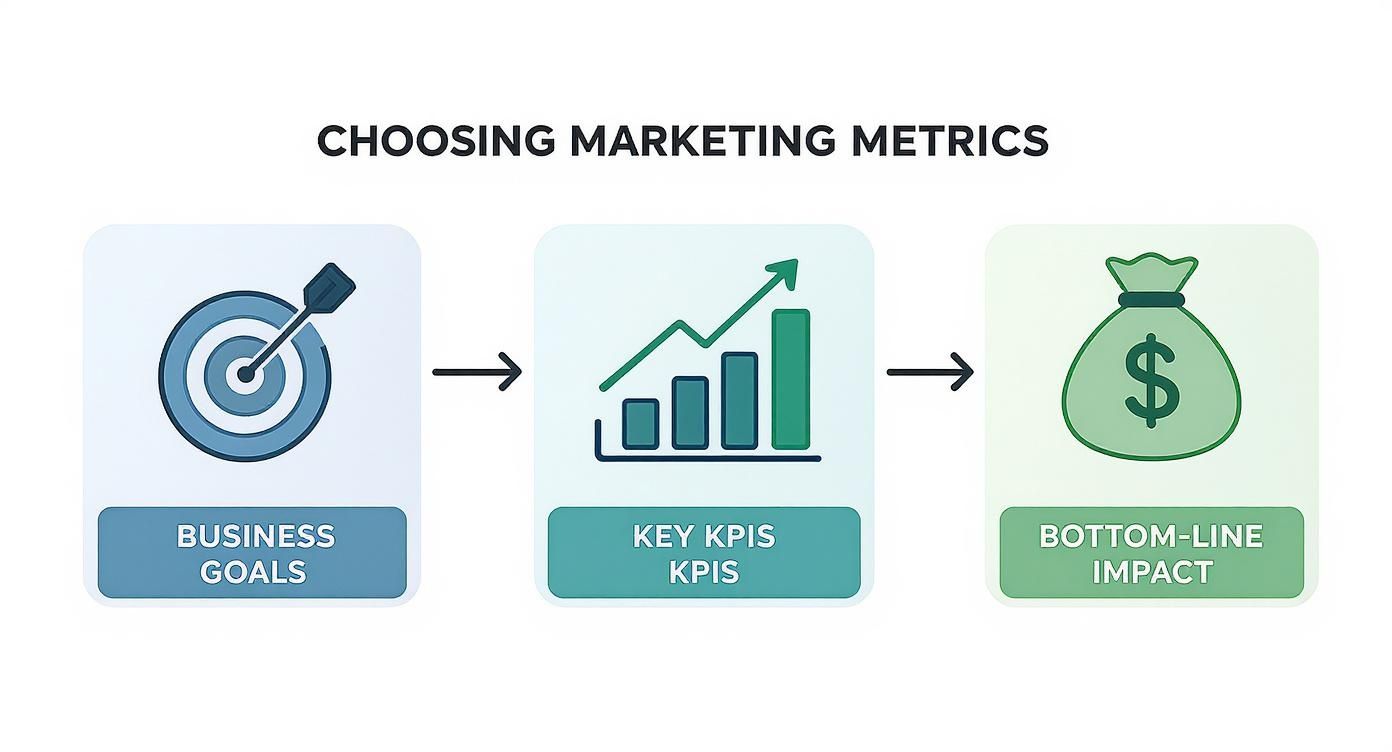
This workflow shows how successful ROI measurement is a straight line, starting with clear business goals, which then dictate the KPIs you track, and ultimately reveal the true financial impact.
Beyond The Basic Formula
While the standard ROI formula is your go-to, it doesn't always paint the full picture. For businesses with long sales cycles or a focus on repeat customers, you sometimes need more nuanced calculations to understand the health of individual channels.
One of the most valuable is Return on Ad Spend (ROAS). People often mix this up with ROI, but ROAS is different—it focuses purely on the gross revenue generated from a specific ad campaign, not the overall profit. For a great breakdown of this specific metric, check out this guide on how to calculate Return On Ad Spend (ROAS).
Another powerful metric, especially for subscription or service-based businesses, is the Customer Lifetime Value (CLV) to Customer Acquisition Cost (CAC) Ratio. This is a complete game-changer because it tells you how much a customer is worth over their entire relationship with you compared to what it cost to get them in the door.
A healthy CLV to CAC ratio (the common benchmark is 3:1 or higher) is a fantastic indicator of sustainable growth. It shows your marketing isn't just generating one-off sales; it's acquiring profitable, long-term assets for your business.
Benchmarking Your Performance
Knowing your numbers is one thing, but how do they stack up? Understanding where your ROI stands against industry averages provides crucial context and helps you spot opportunities. Your returns will naturally swing depending on the marketing channel, as each comes with different costs and typical outcomes.
To give you a clearer picture, here’s a look at some sample ROI benchmarks.
Sample ROI Across Different Marketing Channels
The table below offers a snapshot of typical ROI across popular marketing channels. This can help you set realistic expectations and see how your own efforts compare.
| Marketing Channel | Average ROI (Return per $1 Spent) | Measurement Complexity |
|---|---|---|
| Email Marketing | $36 | Low |
| SEO & Content Marketing | $5 – $15 (long-term) | High |
| Google Ads (PPC) | $2 | Medium |
| Social Media Ads | $2.80 | Medium |
| Direct Mail | $1.30 | High |
It’s easy to see why email marketing remains a powerhouse—the potential for high returns with low complexity is tough to beat. On the other hand, while SEO's impact is harder to measure day-to-day, its long-term strategic value can be enormous.
Use these benchmarks not as strict rules, but as a guide to set realistic goals and identify which channels might hold the most potential for your business.
Solving the Data and Attribution Puzzle
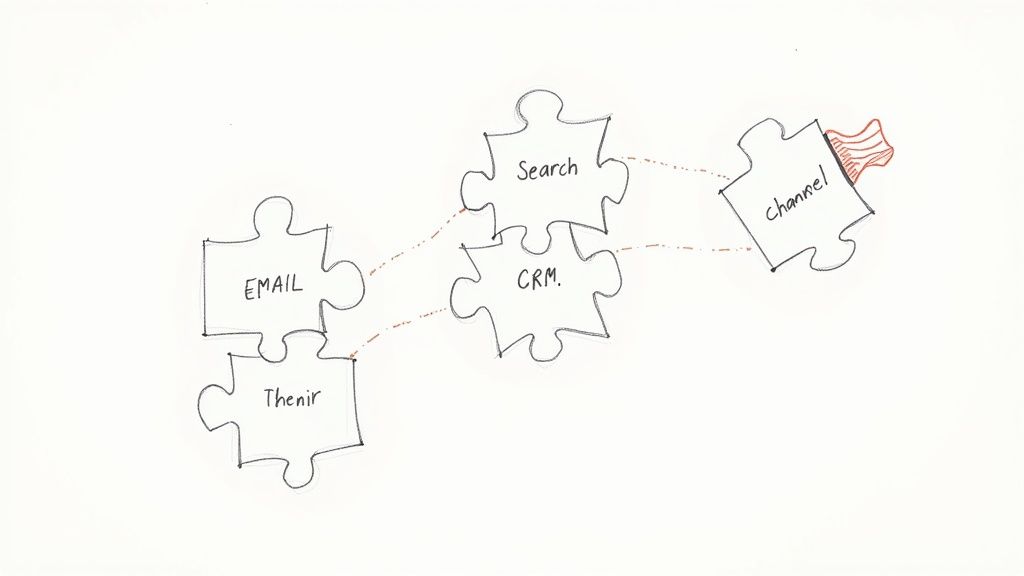
Any ROI calculation is only as good as the data you feed it. That brings us to what I believe is the single biggest hurdle for most marketers: attribution.
Attribution is just a fancy word for assigning credit. It’s the art and science of figuring out which marketing touchpoints actually led to a sale. It sounds straightforward, right? But what happens when a customer sees a Facebook ad, reads three of your blog posts, and then clicks a Google search ad before finally calling you? What really worked?
Getting this right is everything. It's the key to making smart budget decisions instead of just guessing.
Choosing Your Attribution Model
The method you use to assign credit is called an attribution model. There’s no single "best" one—the right choice really depends on your typical sales cycle and what you’re trying to achieve.
For most home service businesses, the customer journey is relatively short, which thankfully simplifies things.
Here are a few common models I see used:
-
Last-Click Attribution: This is the default for many. It gives 100% of the credit to the final touchpoint before a customer converted. If they clicked a Google Ad and immediately booked an appointment, the Google Ad gets all the glory. It’s simple to track but often undervalues the marketing that got the customer interested in the first place.
-
First-Click Attribution: As you might guess, this does the opposite. It gives all the credit to the very first interaction. This model is great for understanding which channels are best at generating initial awareness and bringing new people into your world.
-
Linear Attribution: This model takes a "share the love" approach, spreading credit evenly across every single touchpoint. While it acknowledges that multiple interactions matter, it can be misleading. It treats a quick glance at a social media post with the same weight as a high-intent click on a search ad, which rarely reflects reality.
For a home services business, a last-click model is often the perfect place to start. It clearly shows you what’s driving immediate action. As you get more sophisticated, layering in a first-click view can reveal powerful insights about your brand-building efforts.
Connecting the Dots Across Channels
The next challenge is that a customer’s journey is rarely tidy. It sprawls across different platforms. Your data often lives in separate silos—your Google Ads account, your social media insights, and your customer relationship management (CRM) software. The goal is to stitch all this information together into one cohesive story.
This is where your core marketing tools become mission-critical.
Your CRM should be your single source of truth. By integrating it with your analytics and ad platforms, you can finally connect a specific lead from a specific campaign to the final revenue number. That's how you close the loop on your ROI calculation.
Tools like Google Analytics are essential for seeing how people behave on your website. They show you which traffic sources send you visitors and which pages they look at before deciding to pick up the phone. By digging into this data, you can see which channels aren't just driving traffic, but driving traffic that actually converts. That's the signal you need to decide where your next marketing dollar should go.
Tracking the Offline World
For any home service company, a huge piece of the puzzle happens offline: the phone call. A customer might see your ad online, but their conversion is picking up the phone and scheduling a job. If you can’t connect that call back to the campaign that triggered it, you're flying blind with a massive gap in your ROI data.
This is where call tracking software is a game-changer.
By assigning unique phone numbers to different campaigns—one for Google Ads, one for your website, one for your trucks—you can see exactly which marketing efforts are making the phone ring. It’s the missing link that lets you attribute offline conversions back to their digital source with total confidence.
Looking ahead, the tools for this are only getting better. Marketing mix modeling (MMM) and predictive analytics are poised to be the leading investments for improving ROI measurement in 2025. Even though ROI is a top priority for 63% of marketers, many still struggle to prove what’s truly working. MMM is making a comeback, with about 49% of marketers already using it and 47% planning to invest in it next year. You can get ahead of the curve by learning more about these marketing statistics and future trends.
Using Advanced Analytics to Sharpen Your Insights
https://www.youtube.com/embed/iTCeVc_8aPA
Once you’ve got the basic formulas and attribution models down, it’s time to look at the next frontier of ROI measurement. The best modern analytics tools don't just tell you what happened last month; they’re starting to predict what will happen next. This gives you a serious advantage when it comes to planning and fine-tuning your campaigns.
This evolution is all thanks to artificial intelligence and machine learning. These systems can chew through massive amounts of data, spot subtle patterns in customer behavior, and draw connections a human analyst would almost certainly miss. The payoff? A much sharper, more sophisticated understanding of how your marketing is truly performing.
For a home service business, this is about getting smarter with every single dollar. It’s the difference between reacting to last quarter's numbers and proactively shaping next quarter's success.
AI and Predictive Performance
One of the biggest game-changers here is predictive analytics. AI-powered platforms can forecast campaign performance with surprising accuracy, helping you put your budget behind the channels and tactics that have the best shot at winning.
We're not just talking about a small improvement, either. Some AI-driven tools have demonstrated around 67% higher accuracy in predicting campaign success than older, more traditional methods.
Think about it this way: one company I know of used machine learning for its attribution and found that its podcast ads were driving 22% more conversions than their old last-click model ever gave them credit for. That’s a huge insight that was completely hidden before. You can dive deeper into how technology is changing the ROI game and find more insights in this comprehensive digital marketing guide.
With this kind of intelligence, you can start to:
- Optimize Ad Spend on the Fly: Let the AI shift your budget automatically, moving money from ads that are fizzling out to the ones that are crushing it, all without you having to constantly check in.
- Pinpoint Your Best Audiences: Machine learning can identify the specific customer segments that are most likely to book a job, so you can build campaigns that speak directly to them.
- Forecast Your Hottest Leads: Some advanced tools can even predict which leads are most likely to become high-value customers, helping your sales team focus their energy where it counts most.
By embracing these tools, you're not just measuring past performance; you're actively shaping future results. It’s the difference between looking in the rearview mirror and having a GPS that shows you the best route forward.
Navigating a Cookieless Future
There's another huge shift happening that's changing how we gather data: the end of third-party cookies. For years, we’ve relied on these little trackers to follow users around the web. But with new privacy rules and browser updates, that playbook is officially outdated.
This new reality makes your first-party data—the information you collect directly from your audience and customers—incredibly valuable. This is the data you already own from sources like your:
- CRM software
- Email marketing lists
- Website analytics
- Call tracking logs
Building a solid strategy around your first-party data isn't just a "nice-to-have" anymore; it's absolutely essential for measuring marketing ROI accurately.
When you own your customer data, you can create a reliable picture of the entire customer journey without needing to piggyback on third-party trackers. Not only does this give you clearer, more accurate measurements, but it also helps build trust. You’re using information your customers have willingly shared, which is a much stronger foundation for a long-term relationship. It’s a critical pivot for any business that wants to maintain clear marketing insights for years to come.
Turning Your ROI Data Into Smarter Decisions
Alright, so you’ve crunched the numbers and calculated your marketing ROI. That’s a huge step, but it’s just the beginning. The real magic isn’t in the number itself, but in what you do with it.
Think of your ROI figures as a health check-up for your marketing. They tell you what's working beautifully and what's on life support. Getting this data is how you stop just spending money and start strategically investing it.
Diagnosing Your Campaign Performance
First things first: you have to stop looking at your marketing ROI as one giant, blended number. A single average can hide serious problems and massive opportunities. You need to get granular and look at performance channel by channel, and ideally, campaign by campaign.
When you break it down, you'll likely see a couple of common scenarios pop up:
- High ROI, Low Volume: You might find a channel that delivers a fantastic return, but it only brings in a handful of jobs each month. It’s profitable, but it’s not moving the needle. The big question becomes: how can we scale this up without tanking the ROI?
- Low ROI, High Volume: On the flip side, you might have a campaign that's pulling in tons of leads, but they're just not converting into profitable work. The focus here shifts to optimization. Can you tighten up your ad targeting? Is your landing page confusing? Is there a bottleneck in your sales process?
By dissecting your marketing this way, you change the conversation from a generic "What was our ROI?" to a much more powerful "How do we make our Google Ads more profitable?"
You can't optimize what you don't measure at a granular level. The breakthrough happens when you stop seeing marketing as one big expense and start treating each channel like its own small business with its own P&L.
Creating a Continuous Feedback Loop
This kind of analysis isn't something you do once a year. The most successful home service businesses I've seen have a constant rhythm of measuring, analyzing, and acting. They build a feedback loop that makes their marketing smarter over time.
It’s a simple but incredibly powerful cycle:
- Measure: Keep a constant pulse on the ROI of all your different marketing efforts.
- Analyze: Pinpoint your winners and diagnose the underperformers.
- Act: This is where courage comes in. You have to confidently shift your budget—doubling down on what works and either cutting or radically fixing what doesn’t.
- Repeat: The results from those changes become the new data you measure in the next round.
This cycle is how you turn marketing from a guessing game into a predictable system for growth. It’s how you methodically build a data-driven strategy that consistently brings in profitable jobs and scales your business.
Your Top Marketing ROI Questions, Answered
Even with a great plan, marketing ROI can get tricky in the real world. Let's dig into some of the most common questions I hear from other marketers and business owners.
How Do You Actually Measure Content Marketing ROI?
Ah, the million-dollar question. Content marketing ROI is tough because its value builds over time, often indirectly. A blog post you publish today might not lead to a sale for another six months, making a direct line hard to draw.
The secret is to look beyond last-click attribution and start tracking assisted conversions. Dive into a tool like Google Analytics and look at the customer journey. You'll often find that a customer read a few blog posts or downloaded a guide before they ever clicked on that final ad. The ad might get the official credit, but the content did the heavy lifting to warm them up.
Think about it this way—focus on metrics that show your content is moving people closer to a sale:
- Lead Generation: Did that article get you new newsletter sign-ups? How many people downloaded the e-book you offered? These are tangible results.
- Sales Enablement: Take a look at the leads who engaged with your content. Do they close at a higher rate than leads who didn't? If the answer is yes, you've just proven your content's value to the bottom line.
What Costs Should I Really Be Including in My Calculation?
This is a classic pitfall. So many people just look at their ad spend and call it a day, but that gives you a skewed, overly optimistic ROI. To get the real number, you have to be honest about every single cost involved.
For a complete picture of your marketing investment, you need to include every dollar that went into making thecampaign happen. This includes direct costs, internal resources, and any supporting technology.
Make sure your total investment calculation includes:
- Ad Spend: This is the obvious one—the money you pay directly to platforms like Google or Facebook.
- Creative Costs: Did you hire a freelance designer, copywriter, or video editor? Their fees count.
- Software & Tools: Factor in the proportional cost of your marketing automation platform, analytics software, or CRM.
- Your Team's Time: This is the one most people forget. Calculate the value of the hours your in-house team spent planning, creating, and managing the campaign.
How Can I Track ROI with a Really Long Sales Cycle?
When it takes months—or even a year—to close a deal, tying a sale back to that first blog post or ad click feels impossible. This is where a great CRM (Customer Relationship Management) system goes from a "nice-to-have" to an absolute necessity.
By meticulously logging every email, call, and website visit from day one, your CRM gives you a clear timeline of the entire customer journey. For businesses with these longer cycles, it’s time to graduate from a simple last-click model. Adopting a multi-touch attribution model, like linear or time-decay, will give you a much more balanced view of which marketing efforts truly contributed to that final, hard-won sale.
Ready to stop guessing and start converting? The experts at Phone Staffer can hire, train, and place highly skilled remote CSRs and VAs to ensure every lead gets the attention it deserves. Learn how we can help you turn more leads into booked jobs.