

When we talk about streamlining your operations, we're really talking about a complete overhaul of how your business runs. The goal is to smooth out the rough edges, plug the leaks where you're losing money, and build a company that can grow without imploding. For home service owners, this isn't about making a few small changes; it's about shifting from putting out fires all day to having intentional, predictable control.
Why Streamlining Your Operations Is Non-Negotiable
If you own a home service business, a state of constant chaos probably feels normal. You're trying to manage a flood of phone calls, schedules are a mess, and there’s always some administrative crisis to solve. The hard truth is, running your business like this just isn't sustainable—and it's directly costing you money. Every call that goes to voicemail is a job you didn't book. Every scheduling mix-up is a wasted trip for a technician.
To actually grow, you have to get past the mindset of just surviving the day. This guide is your playbook for taking back control. It’s all about creating systems that stop problems from happening in the first place, making sure every customer gets a professional experience from the moment they call to the moment they pay.
The Real Cost of Inefficiency
Inefficiency is more than just an annoyance; it's a silent killer of your profits. Disorganized workflows create hidden costs that pile up fast. Just think about the real financial hit of things like:
- Lost Leads: When a potential customer calls and no one picks up, their next call is to your competition. A solid call-handling process turns those calls into paying jobs.
- Wasted Technician Time: A technician sitting in their van waiting for the next job or driving all over town because of bad routing is time you're paying for with zero return on investment.
- Administrative Errors: Entering the same data twice, misplacing paperwork, or sending out wrong invoices means you have to do the work all over again. It also annoys your team and your customers, eroding trust and profits.
Here's the bottom line: every single minute your team spends on repetitive, manual tasks is a minute they're not spending on activities that actually make you money. Your objective should be to build a business that runs like a well-oiled machine, even when you’re not there to personally oversee every single move.
Before we dive into the nitty-gritty, let's break down the main areas we'll be focusing on. These are the pillars of a smooth-running operation and where most businesses find the biggest opportunities for improvement.
Core Areas for Operational Improvement
| Operational Area | Common Problem | Improvement Goal |
|---|---|---|
| Call Handling | Missed calls, inconsistent greetings, lost lead details. | Capture 100% of inbound leads professionally and efficiently. |
| Scheduling & Dispatch | Inefficient routes, double-bookings, poor communication. | Maximize technician productivity and minimize drive time. |
| Admin & Billing | Lost paperwork, invoicing errors, slow payment collection. | Create a seamless, error-free process from job to payment. |
Getting these three areas right is the foundation for everything else. Once you have solid processes in place, you can finally start thinking about real growth.
Building a Foundation You Can Scale
One of the biggest wins from streamlining your operations is that you build a foundation for growth. An efficient business is a scalable one. When your call handling, dispatching, and admin tasks are standardized, bringing on new techs or expanding into a new service area becomes a straightforward process, not a chaotic nightmare.
This is where all the focus on process truly pays off. Solid systems ensure that your hard-earned leads don't fall through the cracks. If you're looking for more ways to fill your pipeline, check out our guide on lead generation strategies for home services. This playbook will walk you through auditing your current workflows, setting up rock-solid systems, and reclaiming your most valuable asset: your time.
Auditing Your Workflows to Find Hidden Bottlenecks
Before you can fix what’s broken in your business, you have to see it clearly. We often operate on assumptions about how things get done, but those assumptions can be dangerous. A real audit is about mapping the entire journey of a job, from the moment a customer calls to the second you cash their final check. This process is your treasure map to the biggest opportunities for growth.
You simply can’t improve what you don’t measure. Think of a workflow audit not as a one-time chore, but as a regular health checkup for your business. The goal is to pinpoint exactly where time and profit are leaking out. These leaks are often small, almost invisible, until they pool together and become a major drain on your resources.
This visual shows exactly what I mean—getting your team together to physically map out your processes. This is how you find and solve those hidden weak points.
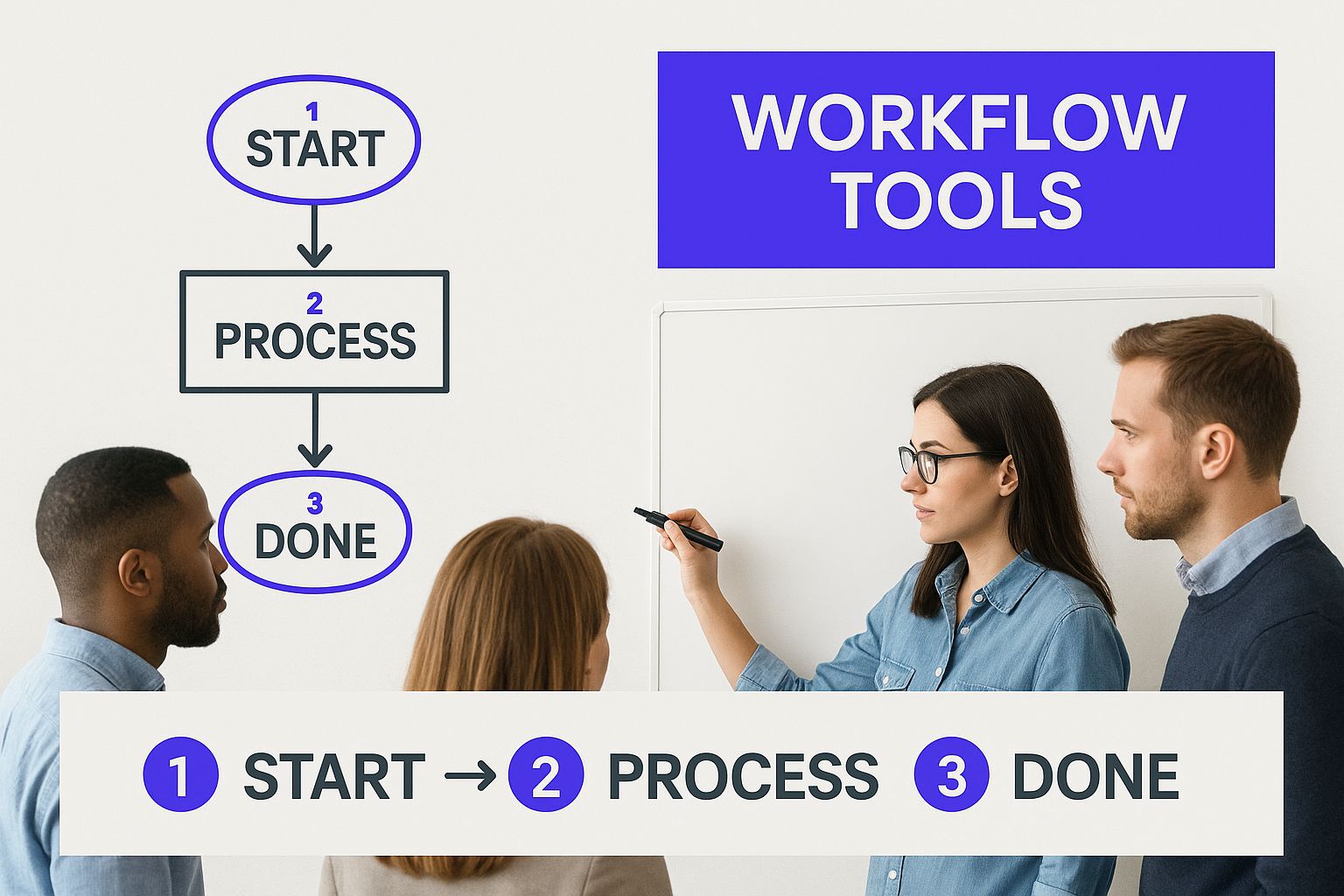
There's real value in using simple tools like a whiteboard to make those invisible processes visible. It gets your whole team involved and gives them a stake in making things better.
Mapping the Customer Journey
Start by tracing every single step a customer interaction takes. Don't rely on what you think happens; document what actually happens. I recommend grabbing a whiteboard or a big roll of butcher paper and physically drawing it out with your team.
Your map should start with the very first touchpoint—a phone call, a website form, a referral—and follow it all the way through scheduling, service, invoicing, and finally, payment. Be brutally honest here. If a lead from your website sits in an inbox for six hours before anyone calls back, write that down.
As you map this out, the friction points will start to jump out at you. These are the spots where tasks slow down, information gets lost, or work has to be redone. These bottlenecks are goldmines for improvement.
Identifying Key Bottlenecks
Once your workflow is on the wall, it's time to hunt for specific problems. In my experience with home service businesses, these bottlenecks almost always show up in a few common areas.
Look for patterns that are costing you time and money. Some classic examples include:
- Doing the Same Work Twice: Does your team jot down customer info on a notepad, only to type the exact same details into your CRM or scheduling software later? Every time you do double-entry, you're wasting time and creating a new chance for mistakes.
- Technicians Sitting Idle: Are your techs often waiting around for their next assignment? Disorganized dispatching or a communication breakdown between the office and the field is a direct hit to your bottom line.
- Endless Manual Follow-ups: How many calls or emails does it take just to confirm an appointment or chase down a payment? Without automated reminders, you're creating a ton of administrative work and slowing down your cash flow.
A critical number to watch is your lead-to-booking rate. If you're getting 100 leads but only booking 40 jobs, where did the other 60 go? A workflow audit helps you find and plug the leaks in your sales funnel.
Gathering Real-World Data
Your audit can't be based on feelings or vague stories from the team. To make smart decisions, you need cold, hard data. Start tracking a few key numbers to get a true picture of how you're performing.
You can set up simple tracking for this. Consider these metrics:
- Phone Performance:
- Missed Calls: How many calls roll to voicemail every single day?
- Call Duration: How long does a typical booking call take, from "hello" to hanging up?
- Hold Times: Are customers sitting in silence, waiting for someone to pick up?
- Scheduling and Dispatch:
- Windshield Time: What's the average drive time between jobs for each tech?
- First-Visit Completion: How many jobs are actually finished on the first trip?
- Reschedule Rate: How often do you have to move appointments around?
This data gives you a baseline. After you make changes, you can measure against these numbers to see if what you're doing is actually working.
For most home service companies, the phones are the single biggest source of friction. A service like Phone Staffer is designed to solve this exact problem by providing trained CSRs who answer every call and book jobs directly into your system. This takes the biggest bottleneck out of the equation right at the start, creating a ripple effect that helps the rest of your operations run much more smoothly.
Designing a Fail-Proof Call Handling System

In the home service business, the phone line is your lifeline. It's not just a way for people to reach you; it's how new jobs and revenue walk through your door. A missed call isn't just a missed call—it’s a customer who is immediately dialing your competitor. If you want to make one change that has a huge and immediate impact, this is it.
Building a system that grabs every single lead isn’t about just telling your team to "answer the phone faster." It’s about creating a bulletproof process that can handle the real world: busy mornings, after-hours emergencies, and those days when the phone just won't stop ringing. You need to move beyond a simple script to a smart protocol. That’s how you nail the first impression and make sure no opportunity ever slips away.
Architecting Your Call Flow
A truly "fail-proof" system knows where things can break and has a backup plan ready. The first move is to map out exactly what needs to happen from the moment the phone rings, covering every possible scenario. This isn't just a script; it’s a decision tree for your front line.
Think about the different kinds of calls you get and what each one needs to be successful. Your call flow should give clear instructions for:
- New Lead Inquiries: How do you quickly find out if they're a good fit, get the essential details, and book the job right then and there?
- Existing Customer Questions: How can you give quick answers about an upcoming appointment or a recent bill without tying up the line for new business?
- After-Hours Emergencies: What's the immediate plan for a late-night call about a burst pipe or a dead furnace? Who gets the alert, and how?
- Vendor or Spam Calls: How do you route these calls away from your main lines so they don't block actual customers?
Having documented answers to these questions takes the guesswork out of the equation. It empowers whoever is answering the phone—whether it's you, an office manager, or a virtual receptionist—to act with confidence every single time.
When a potential customer is on the phone, speed and confidence are everything. Research shows that a staggering 50% of sales go to the first vendor who responds. If your system puts them on hold or promises a callback that never happens, you've already lost.
Handling Peak Hours and Overflow
Your biggest vulnerability is when you're busiest. One person can only handle one call at a time. The moment two or three calls hit at once, you’re guaranteed to lose business unless you have an overflow plan.
This is where so many companies drop the ball. They staff for an average day, not their peak day. To really protect your business, you need a strategy for those moments when call volume spikes.
Common Overflow Solutions
| Solution | The Good | The Bad |
|---|---|---|
| Voicemail | It's cheap and easy. | It's also completely ineffective. Most new customers will just hang up and call the next company on Google. |
| Automated Attendant | Can direct calls to the right place. | Can be incredibly frustrating for a homeowner with an urgent problem. They want to talk to a human, now. |
| Overflow Answering Service | Guarantees a live person answers. They can capture lead info so you can follow up. | Can get expensive and requires you to train them on your specific business and booking process. |
The goal should always be to have a live, trained professional answer every single time. Anything less is a gamble with your bottom line.
In-House vs. Outsourced Reception
This leads to the big question: how do you provide this level of coverage? For most growing home service companies, the choice boils down to hiring a full-time, in-house receptionist or partnering with a specialized service.
An in-house receptionist offers dedicated support, but they come with a hefty price tag: salary, benefits, payroll taxes, and time spent on training. More importantly, one person can't be everywhere. They need lunch breaks, get sick, and take vacations. Who’s answering the phone then?
This is exactly why many owners are turning to services like Phone Staffer. Handing off your call handling to a team of trained virtual receptionists gives you a massive advantage. You get 24/7 coverage, meaning you never miss another emergency call or weekend lead again. These professionals are experts in the home service industry, trained not just to answer phones but to book jobs directly into your scheduling software.
With one move, you solve your biggest bottleneck and ensure every lead is captured professionally. All this comes without the high cost and headaches of managing another employee, freeing you up to focus on your techs and actually growing the business.
Automating Your Admin and Scheduling Workflows
Let's be honest. Administrative drag and scheduling chaos are the silent killers of profit in any home service business. This is the backend work—the invoicing, the dispatching, the constant data entry—that really powers your company. If that engine is sputtering along with paper-based systems and clunky manual processes, you’re just burning fuel and going nowhere fast.
The goal here is to move from that disorganized mess to a digitized, automated machine. When you create standardized, repeatable systems for your administrative and scheduling tasks, you truly begin to streamline operations. This shift frees up your team to focus on what actually brings in money, instead of getting buried in repetitive paperwork.
Building a Digital Foundation for Admin Tasks
First things first: get rid of the paper. Clipboards, carbon copy invoices, and sticky notes covered in chicken scratch are relics. They’re slow, full of potential errors, and create information bottlenecks that bring your entire business to a crawl. For any modern company looking to be efficient, moving to digital tools isn't optional.
Think about the daily tasks that eat up the most time. For most service businesses, digital invoicing is the perfect place to start. A good online invoicing system lets you:
- Generate and send invoices instantly from the field, the moment a job is finished.
- Accept online payments, which can dramatically speed up your cash flow.
- Automate payment reminders, so you can stop spending hours chasing down late payments.
Just making this one change can transform your accounts receivable from a constant headache into a smooth, automated workflow. The trick is to find a tool that actually fits your business and then commit to using it for every single job. No exceptions.
Shifting to digital isn't just about looking modern; it's a matter of survival and growth. By 2025, automation will be a cornerstone for how businesses operate globally, and it’s about much more than just cutting costs. Companies are using technology to wipe out manual data entry and repetitive tasks. This frees them up for strategic work, cuts down on human error, and improves consistency across the board. You can dive deeper into these operational efficiency trends and see the impact for yourself.
This trend brings up a critical point: your competitors are probably already doing this. Sticking with outdated methods puts you at a serious disadvantage.
Integrating Your CRM and Scheduling Platform
Now for the real power move in your quest to streamline operations: connecting your software tools. If your Customer Relationship Management (CRM) system doesn't "talk" to your scheduling platform, you're just creating endless busywork and opening the door for costly mistakes.
Imagine a world where a customer's information is entered one time. That's it. When a call comes in, the details go into the CRM. When that job gets booked, the same information automatically fills out the schedule. And when the work is done, the invoice is generated from that same, single record. This is what true integration looks like.
It completely eliminates the mind-numbing task of double-entry. That’s not just a waste of valuable time; it’s a major source of errors. A wrong address accidentally typed into the schedule can send a technician on a wild goose chase, burning fuel and wrecking the day's carefully planned route.
Creating Smart Technician Dispatch Protocols
Once all your data lives in one central place, you can get much smarter about how you dispatch your technicians. Instead of just giving the job to the next available tech, you can build protocols that are optimized for efficiency and profit. An integrated system gives you the visibility to:
- Optimize Routes: See all your jobs on a map and group them by location. This alone can slash drive time and fuel costs.
- Match Skills to Jobs: Make sure you're sending a senior technician to a tricky diagnostic job and a junior tech to a routine maintenance call.
- Manage Real-Time Changes: If a job wraps up early or a customer cancels, you can instantly see which technician is closest to the next urgent call and reroute them on the fly.
This kind of coordination is flat-out impossible with manual systems. It turns your dispatching from a reactive, often chaotic process into a real strategic advantage that directly boosts your team's productivity and your bottom line.
Using Technology and AI to Future-Proof Your Business
If you want to stay competitive, you have to look ahead. Bringing in new technology isn't just about streamlining what you do today; it's about setting your business up to handle whatever challenges and opportunities come next. This doesn't mean you need to chase every shiny new gadget that comes along. It’s about making smart, deliberate choices that build a more resilient and adaptable company.
Let's break down the real-world impact of some accessible tools and clear up the confusion around artificial intelligence in the home services world. This isn't science fiction. It’s about using affordable, powerful solutions to make smarter decisions, protect your future revenue, and get a leg up on your competition.
Adopting Cloud-Based Tools for Real-Time Control
The bedrock of a future-proof business is information. To make good decisions, you need clear, immediate data, and that’s where cloud-based software really shines. It gives you a live, bird's-eye view of your entire operation, no matter where you are.
For example, modern software can give you:
- Real-Time Fleet Tracking: See exactly where every truck is at any given moment. This lets you optimize routes on the fly, give customers accurate ETAs, and keep your team accountable.
- Digital Inventory Management: Know precisely what parts are in each van and what’s sitting in the shop. This puts a stop to unnecessary trips to the supply house and helps your technicians show up prepared to finish the job on the first visit.
These tools are constantly feeding you data, turning what used to be guesswork into informed strategy. You can start spotting trends, figuring out your most profitable job types, and seeing which technicians are your top performers.
The core idea is simple but incredibly powerful. When you move critical operational data to the cloud, you create a single source of truth for your entire team. Suddenly, everyone—from the office to the field—is working with the same up-to-date information, which dramatically cuts down on confusion and costly mistakes.
There's a reason the shift to cloud-based systems is happening everywhere. The global market for cloud pipeline management, for instance, is projected to hit $4.37 billion in 2025 and swell to $6.70 billion by 2030. This growth isn't random; it's fueled by a desperate need for operational agility and smarter data handling. One major company in the energy sector even reported a 30% cut in operational costs and a 25% boost in efficiency in the first year after switching. You can learn more about how to master cloud-based management on Superagi.com. This kind of move gives businesses a serious competitive advantage.
Demystifying AI for Home Service Businesses
The term "AI" can sound intimidating and expensive, but practical applications are now more accessible than you might think. For a home service business, using AI isn't about building robots; it's about letting software handle intelligent tasks to make your existing processes work better.
You can start bringing AI into your business in small but impactful ways that help you run a tighter ship without a massive investment.
Practical AI You Can Use Now
| AI Application | How It Helps Your Business |
|---|---|
| AI-Powered Chatbots | Handle initial website visitor questions 24/7. They can qualify leads and grab contact info even when your office is closed. |
| Predictive Analytics | Analyze past job data to forecast seasonal demand for services like AC tune-ups, helping you plan marketing and staffing. |
| Intelligent Scheduling | Suggest the most efficient routes and job assignments based on a tech's location, skills, and the job's priority, maximizing what you can get done in a day. |
These aren't some far-off concepts; they are tools available right now inside many modern CRM and field service management platforms.
Building a More Resilient Operation
At the end of the day, technology is about building a business that can weather any storm. A company that relies on paper files, memory, and manual processes is fragile. If one key employee leaves, the whole system can be thrown into chaos.
By contrast, a business built on smart, integrated technology is robust. Your processes are documented right there in the software. Your customer history is centralized and secure. Your ability to book jobs and generate revenue no longer depends on one specific person being in the office.
This is what it truly means to future-proof your business. It's about creating systems that are bigger than any single person, allowing you to scale, adapt, and thrive, no matter what comes your way. And when you want to make sure that human touch is never lost, services like Phone Staffer can plug directly into your tech stack, providing expert virtual receptionists who operate seamlessly within your digital workflows.
Common Questions About Streamlining Your Operations
Deciding to shake up your business operations can feel like a huge undertaking. It's completely normal to have questions—and maybe even a little hesitation—about changing the systems you've relied on for years. Let's walk through some of the most common questions we hear from home service business owners who are ready to tighten up their operations but aren't quite sure how to get started.
My goal here is to give you direct, practical answers that clear up the confusion and help you move forward with confidence.
Where Is the Best Place to Start If I Feel Completely Overwhelmed?
When everything feels urgent, the only way forward is to focus on the single biggest point of friction in your day. For most home service companies, that bottleneck is almost always call handling. Why? Because a missed call is the most direct and immediate form of lost revenue. Simple as that.
Try this simple but eye-opening exercise: For just one week, keep a detailed log of every single call that goes to voicemail. Then, do the math and calculate the potential revenue you lost from those unanswered calls. That final number usually provides all the motivation—and financial justification—you need to fix that system first.
Starting with small, focused wins builds incredible momentum. When you solve your biggest problem first, you prove the value of making changes and find it much easier to tackle the next bottleneck.
I can't tell you how many business owners underestimate the ripple effect of poor call handling. It doesn't just lose you a single job; it chips away at your reputation, burns through your marketing budget, and creates scheduling chaos for your team. Fixing the very top of your sales funnel is the most powerful first move you can make.
Is It Expensive to Streamline Operations with New Software and Services?
This is a fair question, but it's important to look at it from a different angle. Investing in tools to make your business run smoother isn't an expense—it's a strategic investment in your company's profitability and future growth. The real question is this: what is the cost of not acting?
Think about the hidden price of inefficiency. How much are lost leads, wasted technician time, administrative mistakes, and unhappy customers costing you every single month? You'll often find that the monthly fee for a quality CRM or a professional virtual receptionist service is just a fraction of the revenue you're already leaving on the table.
The smartest way to approach this is to start small and measure the results. Pick one tool that solves your most painful problem—like a dedicated answering service to capture every lead—and track its return on investment (ROI). Once you see the positive financial impact with your own eyes, you can confidently invest in other areas.
How Do I Get My Long-Time Employees to Adopt New Processes?
Change can be tough, especially for team members who are set in their ways. The secret to getting them on board isn't to force new processes on them, but to bring them into the conversation. Your team is on the front lines every day; they often have the best insights into what's actually broken.
Start by asking them about their biggest frustrations with the current system. Frame any new software or process as a solution to their problems, not just another task handed down from the top. Show them exactly how a new tool can eliminate tedious paperwork or prevent those frustrating double-bookings.
- Explain the "Why": Show them how the new process will make their job easier, reduce their stress, and help the whole company grow.
- Provide Real Training: Don't just send a new login and hope for the best. Carve out time for proper training and make yourself available to answer their questions.
- Celebrate Small Wins: When the new system prevents an error or saves someone a headache, make a big deal out of it. Positive reinforcement is key to showing them the changes are working.
When your employees see a new system as a tool that helps them, they'll become its biggest champions.
How Will I Know If My Efforts Are Actually Working?
You can't manage what you don't measure. The only way to know if your efforts are paying off is by tracking a few key performance indicators (KPIs) before and after you make a change. This data gives you objective proof of what’s working and what isn't.
Don’t try to track a million things at once. Just focus on a few core metrics that directly reflect the health of your operations:
- Lead Conversion Rate: What percentage of your incoming calls are you booking into actual jobs?
- Jobs Booked Per Week: Is your total job volume going up?
- Technician "Windshield Time": Is the average drive time between jobs getting shorter?
- First-Time Fix Rate: Are your techs solving the problem on the first visit more often?
- Customer Complaint Volume: Are you getting fewer calls about scheduling mix-ups or poor communication?
If these numbers are heading in the right direction, you know you're on the right track. This data-driven approach takes the emotion and guesswork out of the equation, letting you make smart, informed decisions about what to improve next.
This kind of operational upgrade isn't just a trend for small businesses; it's a global shift. A PwC survey revealed that a staggering 91% of operations leaders plan to significantly change their strategies, with 57% already using artificial intelligence. This points to a massive movement toward building more resilient, agile, and digitally-powered operations that can adapt to anything the market throws at them.
Stop letting missed calls and admin chaos dictate your company's potential. Phone Staffer provides expert, US-based virtual receptionists and cold callers who become a natural extension of your team. We answer every call professionally, book jobs directly into your calendar, and help you turn more leads into loyal, happy customers.
Discover how Phone Staffer can transform your business today!