

Effective customer service training is how you arm your team with the skills and confidence to turn every phone call into a win. For a home-service business, this isn't just about being polite; it's about booking more jobs, building loyalty, and protecting your hard-earned reputation. The real goal is to transform your call-handling from a reactive chore into a proactive, professional, and profitable engine for your business.
Laying the Foundation for Effective Training
A training program that actually gets results doesn't happen by accident. It starts with a solid foundation. Forget vague goals like "better customer service"—you need to get specific about what success looks like for your plumbing, HVAC, or electrical business. A well-thought-out plan ensures that every minute spent on training directly contributes to your bottom line.
To get it right, you need to be up on current customer support best practices. Knowing what works today helps you build a curriculum that’s relevant and genuinely prepares your team for what modern customers expect.
Defining Your Core Objectives
First things first: set clear, measurable goals. What, exactly, do you want this training to accomplish? If you can't measure it, you can't manage it.
Here are a few concrete examples of what this looks like for a home-service company:
- Boost the Appointment Booking Rate: Don't just hope for more bookings. Aim to increase your conversion rate from 65% to 75% within the next quarter.
- Improve First-Call Resolution: Set a goal to solve a higher number of issues on the first call, which cuts down on frustrating back-and-forth for everyone.
- Nail CRM Data Accuracy: Mandate a 98% accuracy rate for all customer details logged in your system. This simple step prevents scheduling nightmares and ensures your follow-ups are spot on.
A training program without clear objectives is like a service truck without a GPS. You might be moving, but you're probably not heading toward your most profitable destination.
This workflow diagram shows you exactly how to get started, moving from your high-level goals to the specific metrics that will shape your curriculum.
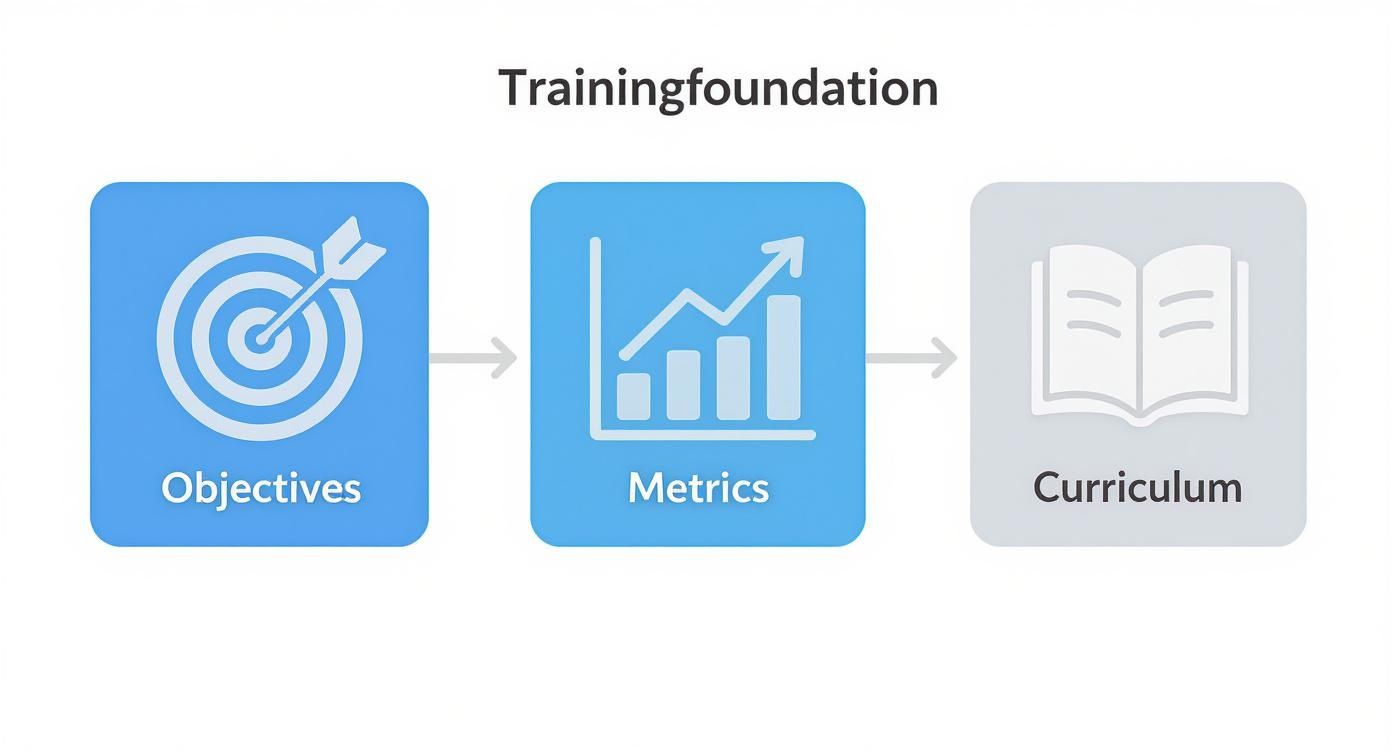
As you can see, figuring out what you’ll measure is the critical bridge between your goals and the actual content you'll teach.
Structuring Your Core Curriculum
Once you know what you want to achieve, you can build the curriculum to get you there. This goes way beyond just handing out phone scripts; it’s about developing a well-rounded skill set that empowers your CSRs to handle any situation.
The big players are already on this. By 2025, an estimated 42% of large companies will have formal customer service training programs, while only 21% of smaller businesses do. That gap is a huge opportunity. A well-trained team gives you a serious competitive edge.
To help you get started, here's a look at the essential modules that should form the backbone of any home-service CSR training program.
| Core Training Modules for Home-Service CSRs |
| :— | :— | :— |
| Module | Objective | Key Skills Developed |
| The "Perfect" Phone Call | Master a professional and empathetic phone presence from hello to goodbye. | Active listening, tone matching, call control, building rapport quickly. |
| Lead Conversion & Booking | Turn inquiries into scheduled, high-value appointments. | Overcoming price objections, creating urgency, explaining value propositions. |
| Navigating the CRM | Use the CRM as a powerful tool for efficiency and accuracy. | Fast data entry, scheduling, note-taking, accessing customer history. |
| The Booking & Dispatch Process | Understand the entire service lifecycle from call to job completion. | Quoting accurately, managing the schedule, communicating with technicians. |
Each of these modules builds on the last, creating a comprehensive skill set that prepares your team for the real-world challenges they’ll face every day.
Mastering Communication Beyond the Script
For any home-service company, that first phone call is where you win or lose the job. Scripts are a decent starting point, but they can make your team sound robotic and can completely miss the mark when it comes to making a genuine connection. Real mastery in customer service comes when you train your CSRs to think beyond the script and act as trusted advisors. This is how you turn simple inquiries into booked appointments and build the kind of loyalty that lasts for years.
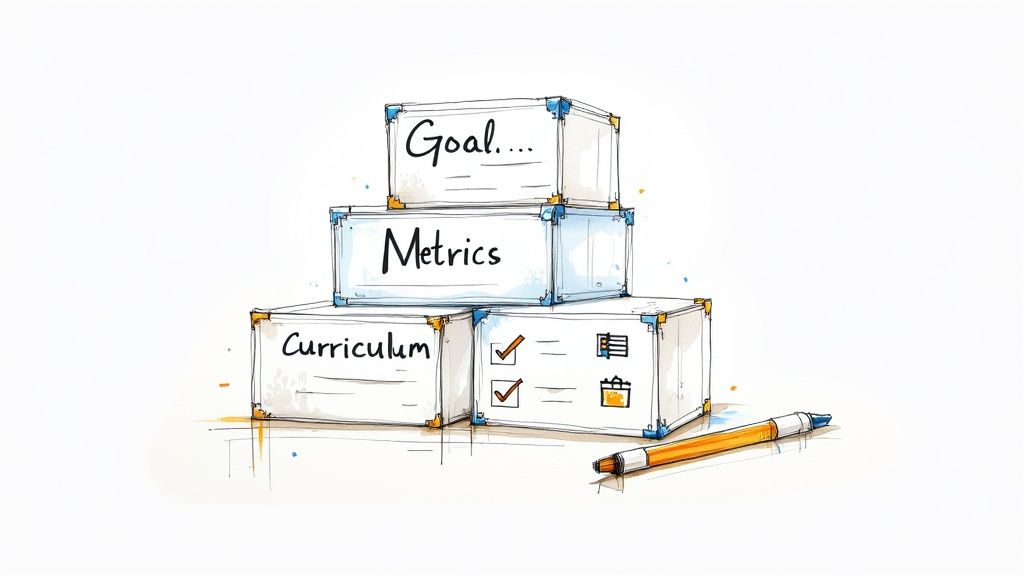
This shift from script-reader to problem-solver is the single most important part of a CSR's job. Let's break down how to get them there.
The Art of Active Listening
Active listening isn't just about being quiet while the customer talks; it’s about understanding the real need, which is often buried under their first question. It takes focus and a real desire to help, not just a desire to get off the phone.
Train your team to listen for the little things:
- The problem behind the problem: A customer asking about the cost of a new water heater might actually be terrified their current one is about to burst.
- The urgency in their voice: A "slow drain" can be a minor inconvenience or, in their mind, a full-blown plumbing emergency. Their tone will tell you which it is.
- Clues from past experiences: If they mention a bad run-in with another company, that's your opening to emphasize your reliability and professionalism.
A CSR who truly listens can say, "It sounds like you're really worried about being without hot water, especially with the weekend right around the corner. Let me see how fast we can get a technician out there for you." That’s a world away from just quoting a price.
When CSRs stop listening for their turn to talk and start listening to understand, they gain the ability to solve the real problem, not just the one the customer initially describes.
Demonstrating Genuine Empathy
Empathy is everything in this business. It's about connecting with how a customer feels and proving you get it. This is absolutely critical when you're talking to a panicked homeowner whose AC just died on a 95-degree day.
Empathy isn't just saying, "I understand." It's showing it with your words and actions.
Let's look at a real-world scenario: A customer calls, and you can hear the panic in their voice. Their basement is flooding.
- A scripted response: "I'm sorry to hear that. What is your address?"
- An empathetic response: "Oh no, that sounds incredibly stressful. Let's get this handled for you right away. The first thing we need to do is get your address so I can dispatch our on-call plumber immediately."
See the difference? The empathetic response validates their stress, shows urgency, and immediately pivots to a solution. You've just de-escalated the situation and built a mountain of trust in the first ten seconds.
Confidently Handling Objections
Objections, especially about price or scheduling, aren't rejections. They're requests for more information and reassurance. A huge part of your training needs to be teaching CSRs to see these moments as opportunities, not roadblocks.
When a customer says, "That seems a little expensive," the worst thing a CSR can do is get defensive. They need to be ready to explain the value behind that number.
Here's a great way to handle it: "I understand your concern about the cost. Our price includes a fully licensed and insured technician, a two-year warranty on all parts and labor, and our 100% satisfaction guarantee. We focus on fixing the problem correctly the first time to save you money and headaches down the road."
This kind of response doesn't just defend the price; it reinforces the quality and peace of mind you offer. When you equip your team with these skills, you give them the confidence to navigate any conversation, turning friction into a reason the customer chooses you.
Turning Calls Into Confirmed Appointments
A fantastic conversation with a potential customer doesn't mean much if it doesn't end with a job on the schedule. In fact, a clunky or confusing booking process is one of the quickest ways to lose a lead you worked hard to get in the first place. Your customer service management training has to make the entire appointment-setting experience precise, professional, and completely painless for the customer.
Think of this process as more than just finding an open time slot. It’s a vital part of the customer journey, setting the stage for the entire service visit. When it’s handled smoothly, it immediately tells the customer your company is competent and organized. But when it's done poorly, it plants a seed of doubt before your technician even picks up their tools.
Gathering Information Without an Interrogation
Your CSRs need to collect key details to book a job correctly, but how they ask for it makes all the difference. The training needs to stress a natural, conversational approach over a robotic checklist. Instead of just firing off a list of questions, teach them to weave the information-gathering into the natural flow of the chat.
For instance, after a customer explains they have a leaky faucet, a well-trained CSR might respond:
"Okay, we can definitely get someone out to take a look at that for you. So our plumber has everything they need, could I just get the best spelling of your first and last name and the full service address?"
This phrasing connects the request directly to solving the customer's problem, so it feels helpful, not intrusive. A huge part of this is also logging every single detail accurately into your CRM. A simple typo in an address or a misspelled name can throw an entire appointment off track.
Mastering the Art of Scheduling
Smart scheduling is the engine of a profitable home-service business. It’s not just about cramming appointments into the calendar; it’s about strategically optimizing your technicians' routes to slash drive time and fit more jobs into each day.
Your training program absolutely must cover the real-world logistics of your service area:
- Geographic Zones: Make sure CSRs understand how your town or region is divided into service zones for different technicians.
- Buffer Time: Explain why it's so important to add buffer time between appointments to account for traffic and unexpected job delays.
- Job-Specific Timing: They need to know that a simple faucet repair might take an hour, while a big installation could block out an entire afternoon.
A well-scheduled day is a profitable day. Training CSRs to think like a dispatcher transforms them from simple appointment-setters into key players in your operational efficiency.
This entire sequence—guiding a prospect from that first call to a confirmed job—is a core part of your revenue machine. To really grasp how these pieces fit into the bigger picture, it helps to understand the fundamentals of what sales pipeline management involves and how each stage builds on the last.
Finally, every single appointment must end with a clear confirmation. Train your CSRs to recap all the essential details before hanging up: the date, the arrival window, the specific service being performed, and the customer's contact info. This final check takes maybe 30 seconds but can prevent 99% of scheduling mix-ups, making sure your team and the customer are on the exact same page.
Tracking Performance and Driving Improvement
So, you’ve run your initial training. That’s a fantastic start, but the real work—and the real payoff—begins now. Getting your team from good to great doesn't happen in a single workshop; it comes from a consistent, ongoing cycle of tracking performance, providing feedback, and refining skills.
This isn't about micromanaging. It's about building a culture of growth where your CSRs feel supported and see a clear path to getting better at their jobs.

When you commit to this process, your training investment starts compounding. You'll see it in happier customers, smoother operations, and a healthier bottom line month after month. Let's break down how to make this a reality.
Key Performance Indicators That Actually Matter
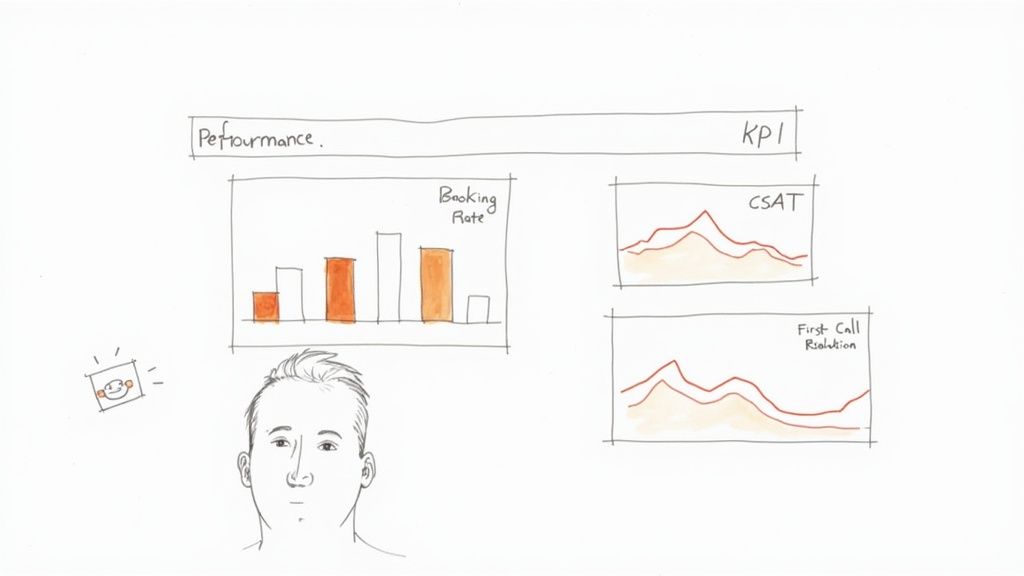
You could drown in data, but only a handful of metrics truly tell you if your customer service is on the right track. Focusing on the right Key Performance Indicators (KPIs) is everything. To make this work, your training needs to be paired with effective performance management best practices that connect data to actual coaching.
We've found that tracking a few key metrics gives us 90% of the picture we need.
To get a clear, data-driven view of how your training is paying off, it’s essential to monitor the right KPIs. These numbers help you spot exactly where your team is excelling and which areas need a bit more focus.
Key Performance Indicators for CSR Training
| KPI | How to Measure | What It Indicates |
|---|---|---|
| Appointment Booking Rate | (Booked Appointments / Qualified Leads) x 100 | The ultimate measure of a CSR's ability to convert interest into revenue. This is your most important metric. |
| Customer Satisfaction (CSAT) | Post-service surveys asking customers to rate their experience on a 1-5 scale. | Direct feedback on the customer's perception of the service they received. |
| First-Call Resolution (FCR) | (Issues Resolved on First Call / Total Issues) x 100 | How efficient and knowledgeable your CSRs are. A high FCR means happier customers and less work for your team. |
| Average Handle Time (AHT) | Total talk, hold, and wrap-up time / Total number of calls. | A measure of efficiency. You want this to be low, but not at the expense of customer satisfaction. |
These metrics aren't just for management reports; they are powerful coaching tools. They give you a starting point for conversations about what’s working and what isn’t.
Establishing Effective Feedback Loops
Numbers tell you what is happening, but they don't tell you why. That's where consistent, constructive feedback comes in. This means building simple feedback routines into your weekly operations.
A feedback loop is the conversation that happens between the performance reviews. It’s the daily and weekly coaching that prevents small issues from becoming bad habits.
One of the best ways to do this is through call shadowing or listening to recorded calls. This gives you concrete examples to discuss. Instead of saying, "You need to be more empathetic," you can say, "On that call with Mrs. Jones, when she mentioned her leaking pipe, we could have started by saying, 'That sounds stressful, but we'll get someone out there for you.'"
Combine call reviews with quick team huddles to share wins and troubleshoot common roadblocks. These frequent, informal check-ins are far more impactful than a once-a-year review.
The Power of Role-Playing Scenarios
Finally, never underestimate the power of practice. Role-playing is an incredible tool for building confidence, especially for handling those tough calls that can rattle even a seasoned CSR. It gives your team a safe space to fail, learn, and build muscle memory.
When a high-pressure call comes in for real, they won't freeze. They'll have a playbook ready to go.
Make sure you regularly run role-playing drills for common challenges:
- Price Objections: Move them beyond just quoting a price to explaining the value behind it.
- Angry Customers: Teach them how to listen, de-escalate the situation, and take ownership.
- Scheduling Conflicts: Give them practice finding creative solutions when the calendar is tight.
By weaving together KPI tracking, consistent feedback, and practical role-playing, you create a dynamic system for improvement. This turns your training program from a one-off event into the engine that drives customer service excellence and fuels your company's growth.
Supercharge Your Team: Tools, Tech, and Smart Support
Even the best in-house training program can be supercharged with the right tools and partners. A truly modern customer service operation isn't just about what your team can do on their own; it's about giving them the support they need to focus on what matters most.
By strategically blending your skilled CSRs with new technology and specialized external teams, you create a system that’s greater than the sum of its parts. This approach lets your experts handle complex customer issues and build real relationships, while routine tasks and overflow calls are managed seamlessly.
Training CSRs to Work With AI
Let's be clear: artificial intelligence in customer service isn't here to replace your people. It's here to empower them. AI is fantastic at handling the simple, repetitive stuff—like answering "What are your hours?" or "Do you service my zip code?"—which frees up your human team for the conversations that actually require a human touch.
But this doesn't just happen on its own. Your training needs to cover how to work alongside AI. Your CSRs must learn:
- The art of the handoff: They need to recognize the exact moment a customer is getting frustrated with an automated system and jump in smoothly.
- Using AI-powered insights: Smart tools can feed a CSR real-time information about a caller, like their service history or even their likely mood. A well-trained agent can use that data to make the conversation feel incredibly personal from the first second.
The shift is happening fast. Projections show that by 2025, 95% of all customer interactions will involve AI in some way. The problem? While companies are adopting the tech, only 21% of agents feel they’ve received adequate training to use it effectively. That's a huge gap you can close. You can see more stats on AI in customer service and understand just how critical this is.
Your training shouldn't be about teaching CSRs to beat the bots. It’s about training them to be the one thing a bot can never be: a genuinely empathetic, creative problem-solver.
Outsourced Support for Peak Times and After-Hours Coverage
Another game-changer for a growing home-service business is partnering with a specialized appointment-booking and remote staffing service. This gives you incredible flexibility without the cost and headache of hiring more full-time, in-house staff just to handle fluctuating call volumes.
Think about it. An external partner like Phone Staffer can bring in a fully-trained team to manage your call overflow during a heatwave or a cold snap, ensuring you never miss a lead. Better yet, they can provide 24/7 coverage. That means when a customer has a burst pipe at 2 a.m., a professional is there to answer the call, not your voicemail.
This hybrid model lets you scale your customer service capacity instantly. Your core in-house team stays focused on building long-term customer relationships, while your support partner protects your revenue and reputation by making sure every single call gets answered.
Answering Your Top Training Questions
When you're putting together a customer service training program for the first time, the same questions always seem to pop up. Let's tackle them head-on with some practical, field-tested answers. Getting these right from the start makes all the difference in building a team that actually drives your business forward.
How Long Should CSR Training Really Take?
There's no magic number here, but I've found a blended approach works best. You need an intensive upfront onboarding period—think one to two solid weeks. This is where you immerse new hires in your company's way of doing things, from your specific service offerings to getting them comfortable inside your CRM.
But training can't stop there. Real mastery doesn't come from a single boot camp; it comes from consistent, ongoing reinforcement.
- Weekly Huddles: Carve out 30 minutes every week. Use this time to listen to call recordings, celebrate big wins, and talk through any tricky situations the team ran into.
- Monthly Deep Dives: Once a month, dedicate a full hour to a specific skill. One month it might be navigating price objections; the next, it could be mastering the art of calming down a frantic customer.
- Quarterly Check-ins: These one-on-ones are for looking at the hard numbers. You’ll review their performance against your key metrics and set clear, personal goals for the next 90 days.
This rhythm of continuous coaching is what turns a good CSR into a great one.
What's the One KPI That Matters Most?
If you only track one thing, make it the Appointment Booking Rate. Hands down, this is the most critical metric for any home-service company.
Why? Because it directly ties your CSR's performance to your bottom line. It's a simple calculation: divide the number of jobs booked by the number of qualified leads that came in.
When you put the focus squarely on the booking rate, your CSR team stops being a cost center and starts becoming a revenue-generating powerhouse. It’s the clearest signal you have that your training is actually working.
Should My CSRs Be Using Scripts?
I’m a firm believer in frameworks over scripts. Handing a CSR a word-for-word script is the fastest way to make them sound like a robot. It completely stifles their ability to genuinely listen and connect with the person on the other end of the line.
A framework, on the other hand, is a game-changer. It’s more like a roadmap. It outlines the key information they need to gather and the essential points they must cover, but it gives them the freedom to be human. This flexibility allows them to match the customer's energy and build real rapport, which is what ultimately gets the job booked.
Ready to ensure every call is answered professionally and every lead is captured? Phone Staffer can hire, train, and place expert remote CSRs directly into your business, giving you a powerful, scalable team without the overhead.
Learn how our remote staffing services can transform your customer service