
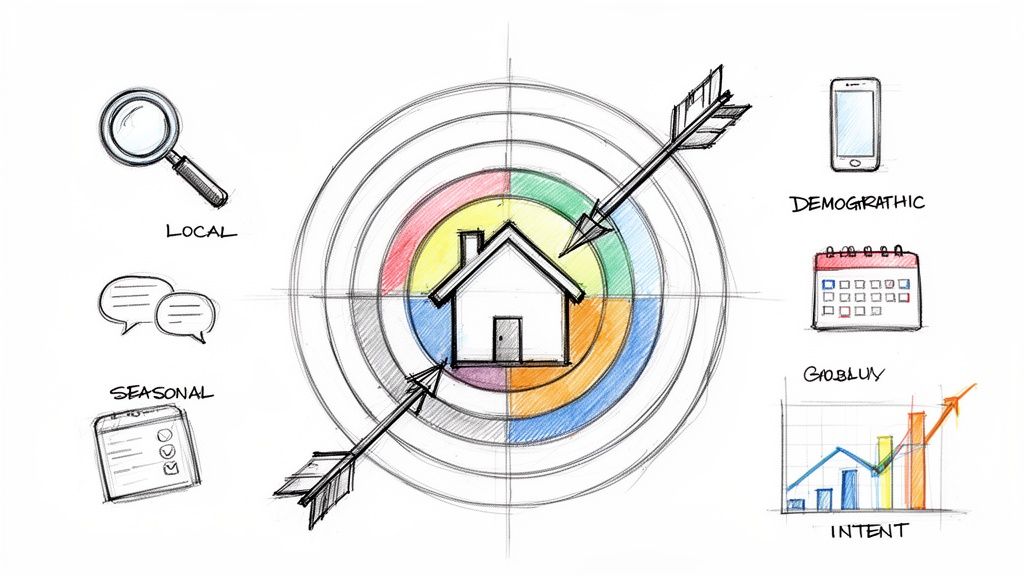
In the competitive home services industry, simply being good at your job isn't enough. Winning means reaching the right customers, in the right place, at the exact moment they need you. Generic, 'spray and pray' advertising wastes time and money, leading to unqualified leads and wasted ad spend. The key to scalable growth lies in mastering sophisticated targeting strategies in marketing designed to attract high-intent, high-value homeowners.
This guide moves beyond basic concepts to provide ten actionable, modern strategies that home service businesses can implement today. We will break down each approach, from hyper-local geographic campaigns to advanced psychographic segmentation, providing practical checklists and real-world examples. To effectively pinpoint your next high-value customers, exploring strategies for mastering lead generation online is essential for building a robust initial pipeline.
This article will equip you with the tools to not only find your next customer but also create a predictable stream of profitable jobs. You will learn how to:
- Identify and segment your most valuable customer profiles.
- Allocate your budget to platforms and tactics with the highest ROI.
- Align your messaging with specific customer needs and motivations.
- Integrate your marketing with your call-handling and booking processes for a seamless customer journey.
Prepare to transform your marketing from a cost center into a powerful, revenue-generating engine. We'll show you precisely how to stop casting a wide, expensive net and start using a laser-focused approach to attract the exact clients you want.
1. Geographic/Local Targeting
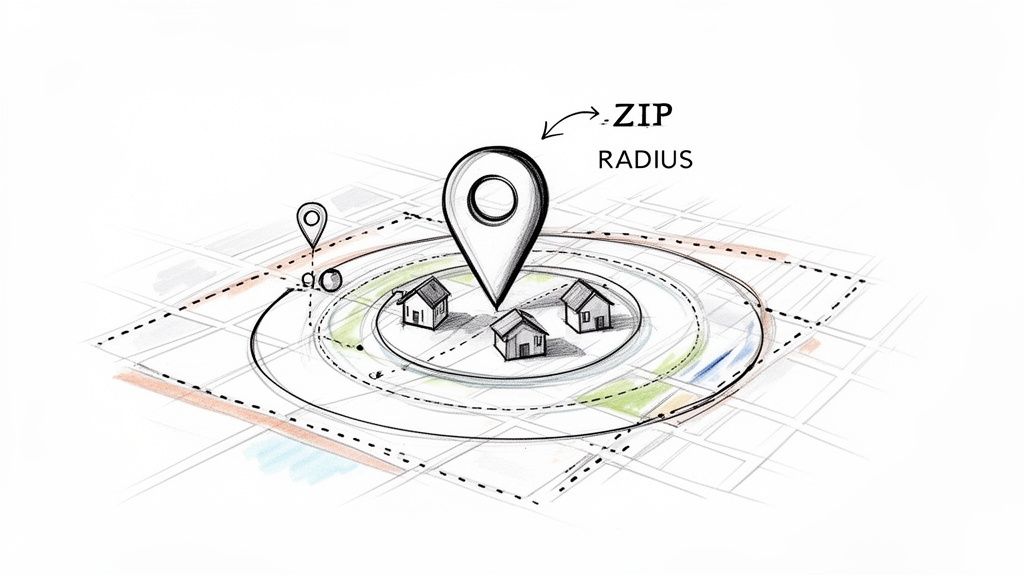
Geographic targeting is the cornerstone of any effective marketing strategy for home service businesses. This approach concentrates your advertising budget and efforts on the specific locations where you operate, ensuring every dollar is spent reaching potential customers you can actually serve. Instead of casting a wide, inefficient net, you focus on a defined service radius, specific zip codes, or even particular neighborhoods, maximizing relevance and ROI.
This strategy is non-negotiable for companies like plumbers, electricians, and HVAC technicians whose business model is inherently local. It aligns your marketing directly with your operational capacity, preventing wasted ad spend on inquiries from outside your service area and ensuring your team isn't dispatched to unprofitable, long-distance jobs.
Why It's a Foundational Strategy
For a home service business, your customer base is physically constrained. Marketing to someone 100 miles away is not just inefficient; it's a complete waste of resources. Geographic targeting is one of the most fundamental targeting strategies in marketing because it directly filters your audience to only include those who can become customers.
For businesses heavily reliant on local customers, specific local SEO tactics are paramount. Delve into the ultimate guide to Local SEO for Plumbers to master creating high-ranking service area pages that attract qualified, local leads.
Actionable Implementation Steps
- Dominate Google's Local Pack: Optimize your Google Business Profile (GBP) with accurate service areas, hours, and photos. A strong GBP is your most powerful tool for appearing in local search results and on Google Maps.
- Create Service-Area Landing Pages: Build unique pages on your website for each key city or neighborhood you serve. These pages should feature localized content, testimonials, and keywords to improve your search engine ranking in those specific areas.
- Utilize Platform-Specific Geo-Targeting: On platforms like Google Ads and Facebook, use radius targeting around your business address or target specific zip codes. For example, an HVAC company could run a "5-Star AC Repair in 75024" ad specifically to residents of that zip code.
Connecting to Your Workflow: When a geo-targeted lead calls in, your team's response is critical. Ensure your call handlers, like those at Phone Staffer, can immediately verify the caller's location against your service map. This allows them to confirm eligibility and schedule appointments efficiently, providing a seamless customer experience from the first click to the final handshake.
2. Demographic Targeting
Demographic targeting moves beyond location to segment your audience based on characteristics like age, income, homeownership status, and family size. This strategy allows home service businesses to focus their budget on the specific groups of people most likely to need, want, and afford their services. Instead of marketing a high-end kitchen remodel to a recent college graduate in a rental apartment, you can pinpoint established homeowners in a higher income bracket.
This approach is crucial for aligning your service offerings with customer profiles. For example, a company specializing in luxury pool installations or extensive home renovations will find a much higher ROI by targeting high-income households. Similarly, services like lawn care or routine pest control often resonate best with suburban homeowners in a specific age range who value convenience and property maintenance.
Why It's a Foundational Strategy
While geography tells you where your customers are, demographics tell you who they are. Understanding these attributes is one of the most effective targeting strategies in marketing because it directly addresses a customer's purchasing power and life stage. It prevents you from wasting marketing dollars on audiences who are not a good fit for your services, either due to their financial situation, housing status, or immediate needs.
By layering demographic data over your geographic targets, you sharpen your focus from a general local audience to a highly qualified local audience. This precision leads to better-quality leads, higher conversion rates, and a more efficient sales cycle.
Actionable Implementation Steps
- Refine Ad Platform Targeting: Use the detailed demographic filters available on platforms like Facebook/Meta Ads and Google Ads. Target users based on income levels, homeownership status, parental status, and age to match your ideal customer profile.
- Create Persona-Driven Messaging: Develop different ad copy and creative for distinct demographic segments. For example, messaging for a young family might emphasize safety and reliability, while content for an older, retired couple could highlight long-term value and low-maintenance solutions.
- Leverage Data for Direct Mail: For offline campaigns like direct mail, use data brokers to acquire lists that meet specific criteria, such as homeowners in a certain zip code with an estimated household income over $150,000.
Connecting to Your Workflow: Demographic targeting generates more qualified inquiries, but confirming that fit is key. Your call handlers must be trained to ask subtle qualifying questions. Phone Staffer’s CSRs can be equipped with scripts to identify high-value callers early on, such as verifying homeownership or asking project-related questions that hint at budget, ensuring your sales team only spends time on the most promising leads.
3. Behavioral Targeting
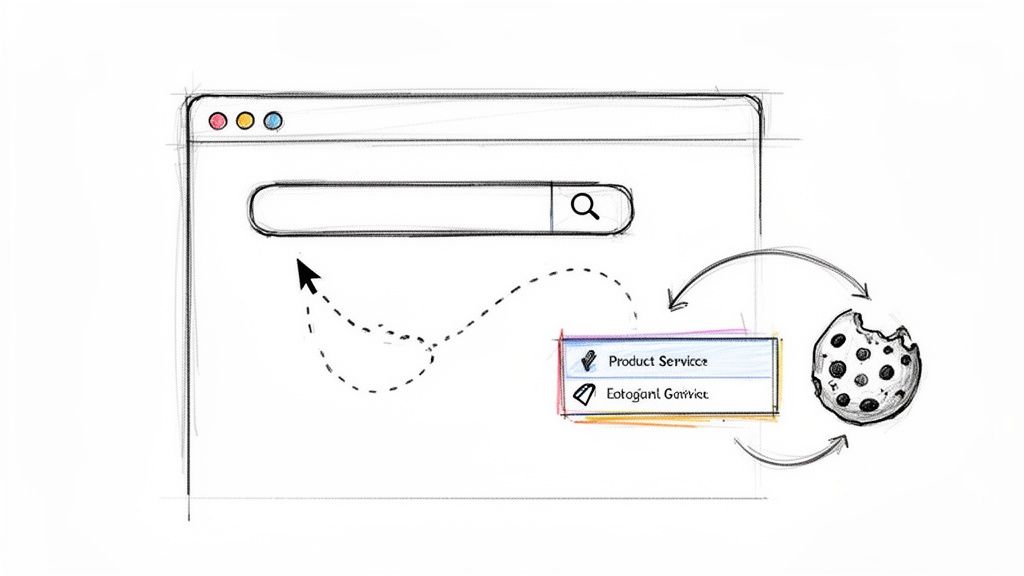
Behavioral targeting goes beyond where your customers are and focuses on what they do online. This powerful strategy uses data on user actions, such as their search history, website visits, and content engagement, to serve highly relevant ads. It allows you to connect with potential customers who are actively signaling their need for your services, moving from general awareness to capturing immediate, high-intent demand.
For a home service company, this means you can target a homeowner who just searched "emergency leak repair" or visited a competitor's pricing page. This approach is one of the most effective targeting strategies in marketing because it targets users based on demonstrated intent, not just demographic assumptions. It ensures your message reaches people at the exact moment they are looking for a solution.
Why It's a High-Intent Strategy
Unlike broader targeting methods, behavioral targeting helps you identify and engage warm leads who are already in the consideration phase of their buying journey. By tracking digital footprints, you can distinguish between someone casually browsing home improvement ideas and someone urgently needing a "24/7 electrician near me." This precision reduces wasted ad spend and significantly increases conversion rates by prioritizing prospects who are ready to book.
This focus on user intent makes your marketing more of a helpful solution and less of an interruption. It’s about being the right answer at the right time.
Actionable Implementation Steps
- Set Up Website Tracking: Install tracking pixels (like the Meta Pixel or Google Ads tag) on your website. This allows you to build remarketing audiences of users who visited specific service pages, like "AC Installation" or "Drain Cleaning," but didn't convert.
- Leverage In-Market Audiences: On platforms like Google Ads, target "in-market audiences." These are pre-built segments of users whose online behavior indicates they are actively shopping for services like "Plumbing & HVAC" or "Roofing Services."
- Monitor Search Term Reports: Regularly review the search terms that trigger your ads. This provides direct insight into customer intent and helps you refine your keyword strategy to capture the most qualified traffic. For example, you can focus more budget on "replace water heater" searches.
Connecting to Your Workflow: When a lead from a behavioral ad (like a remarketing campaign) comes in, they are already familiar with your brand. Instruct your call-handling team at Phone Staffer to acknowledge this context. A simple "I see you were looking at our AC repair services online, how can I help you book that appointment?" creates a seamless, personalized experience that accelerates the booking process and reinforces the customer's decision.
4. Psychographic Targeting
Psychographic targeting moves beyond who your customers are (demographics) to understand why they buy. This strategy segments your audience based on their lifestyle, values, attitudes, and interests, allowing you to connect with their core motivations. For a home service business, this means tailoring your message to resonate with what a customer truly values, whether that's sustainability, luxury, convenience, or budget-friendliness.
Instead of just targeting homeowners in a specific zip code, you can target those who prioritize eco-friendly solutions or those who value premium, white-glove service. This approach allows you to create marketing campaigns that speak directly to a potential customer's identity and emotional drivers, making your brand far more memorable and persuasive than a competitor focused only on basic demographics.
Why It's a Foundational Strategy
Understanding the "why" behind a purchase decision gives you a powerful competitive edge. A customer looking for the cheapest quick fix has a completely different mindset than one seeking a long-term, high-quality, sustainable solution. Psychographic targeting is one of the most effective targeting strategies in marketing because it enables you to craft messaging that aligns perfectly with a customer's worldview, building trust and justifying a premium price point.
For instance, an HVAC company could create one ad campaign for budget-conscious families emphasizing affordability and another for eco-conscious homeowners highlighting the energy-saving benefits and long-term environmental impact of a high-efficiency unit. This level of personalization makes your marketing feel less like an ad and more like a solution to their specific needs.
Actionable Implementation Steps
- Survey Your Best Customers: Ask your happiest clients what they value most about your service. Was it the speed, the quality of materials, the technician's professionalism, or your commitment to clean energy? Use this feedback to build psychographic profiles.
- Create Value-Based Buyer Personas: Develop detailed personas that include motivations and values. For example, create "Eco-Conscious Eric," who values sustainability above all, or "Prestige Paula," who wants the absolute best and is willing to pay for it.
- Tailor Ad Copy and Imagery: Use language and visuals that reflect your target persona's values. An ad for "Eco-Conscious Eric" should feature green-certified products and messaging about reducing carbon footprints, while an ad for "Prestige Paula" should highlight premium brands and exclusive warranties.
Connecting to Your Workflow: A customer's psychographic profile dictates their service expectations. Ensure your call handlers, like the team at Phone Staffer, are trained to listen for key phrases that reveal a caller's motivations. If a caller mentions "long-term investment" or "best quality," the representative can emphasize premium options and expert craftsmanship, aligning the booking process with the customer's core values from the very first interaction.
5. Intent-Based Targeting
Intent-based targeting cuts through the noise by focusing on prospects actively seeking your services right now. Instead of marketing to people who might need a plumber someday, this strategy identifies and engages homeowners with an immediate problem, like a burst pipe or a broken AC unit on a 90-degree day. It's about capturing demand at its peak, connecting your business with customers at the precise moment of need.
For home service businesses, this approach is a game-changer. Many service calls are driven by urgency and distress. By aligning your marketing with these high-intent signals, such as specific search queries or quote requests, you position your company as the immediate solution. This is one of the most efficient targeting strategies in marketing because it shortens the sales cycle dramatically.
Why It's a High-Conversion Strategy
When a homeowner searches for "emergency water leak repair NOW," they aren't casually browsing; they are in a critical buying moment. Capturing this intent means you're not convincing them they have a problem, you're simply offering the fastest, most reliable solution. This results in higher conversion rates, as the customer has already decided to make a purchase and is now just choosing a provider.
The key is speed and relevance. Your ads and landing pages must directly address their urgent need, assuring them of a quick response. This strategy turns a potential customer's crisis into your business opportunity.
Actionable Implementation Steps
- Create Urgency-Based Ad Campaigns: Target high-intent keywords in Google Ads like "24/7 HVAC repair" or "same-day roof inspection after storm." Your ad copy should mirror this urgency with phrases like "Call Now for Immediate Service" or "Fast, Reliable Fixes."
- Prioritize Call Extensions: Make it as easy as possible for a distressed homeowner to contact you. Use prominent call extensions in your search ads so they can connect with a single tap, bypassing your website entirely.
- Build Rapid Response Workflows: Once a high-intent lead is captured, every second counts. Implement automated systems that immediately notify your team or a service like Phone Staffer to initiate contact, ensuring you're the first to respond.
Connecting to Your Workflow: High-intent leads are perishable. When a call comes in from an urgency-driven ad, your response system must be flawless. A service like Phone Staffer ensures that call is answered immediately, 24/7, by a professional who can empathize with the caller's urgency, confirm service availability, and book the appointment on the spot. This locks in the job before the prospect has a chance to call a competitor.
6. Account-Based Marketing (ABM) Targeting
Account-Based Marketing (ABM) flips the traditional marketing funnel on its head. Instead of casting a wide net to capture many leads, ABM focuses your marketing and sales resources on a select group of high-value target accounts. For multi-location home service businesses or those serving commercial clients, this means treating individual key accounts, like property management firms or real estate developers, as unique markets of one.
This strategy is highly effective for securing large, recurring contracts that can form the bedrock of your revenue. Rather than one-off residential jobs, an ABM approach helps you land deals for entire apartment complexes, commercial portfolios, or franchise territories, delivering a significantly higher return on your marketing investment and fostering long-term partnerships.
Why It's a Foundational Strategy
For home service companies aiming to scale beyond individual residential jobs, ABM is one of the most powerful targeting strategies in marketing. It moves the focus from volume to value, concentrating your efforts where they will have the greatest financial impact. It’s the difference between waiting for a single leaky faucet call and proactively becoming the exclusive plumbing partner for a 300-unit apartment building.
This targeted approach ensures your most persuasive and customized proposals reach the decision-makers at your most desired accounts. It builds deeper relationships and positions your company not just as a service provider, but as an indispensable operational partner for large-scale clients.
Actionable Implementation Steps
- Identify and Tier Your Target Accounts: Create a list of your top 20-30 ideal commercial accounts based on revenue potential, location, and service needs. Tier them (e.g., Tier 1: property management firms, Tier 2: new construction developers) to prioritize your outreach efforts.
- Develop Account-Specific Offers: Don't send a generic brochure. Create customized service proposals and maintenance packages tailored to the specific needs of each target account. For example, offer a specialized preventative HVAC maintenance plan for a portfolio of commercial buildings.
- Execute Personalized Outreach: Use a multi-channel approach to engage key decision-makers within each target account. This could involve personalized emails, LinkedIn messages, direct mail with custom offers, and strategic follow-up calls to build rapport and schedule introductory meetings.
Connecting to Your Workflow: ABM relies on consistent, professional communication to nurture high-value relationships. Use your call handling team at Phone Staffer to manage outreach and follow-ups. A dedicated CSR can be tasked with scheduling regular check-in calls with key account contacts, ensuring your business stays top-of-mind and reinforcing your commitment to being a proactive partner.
7. Seasonal and Contextual Targeting
Seasonal and contextual targeting involves aligning your marketing efforts with predictable cycles of demand, weather patterns, and timely events. For home service businesses, customer needs are often driven by the time of year or immediate circumstances, making this one of the most powerful targeting strategies in marketing. Instead of maintaining a flat advertising budget year-round, you strategically increase spend when customers are most actively seeking your solutions.
This approach is essential for industries with clear peak and off-seasons. An HVAC company's demand for AC repair naturally skyrockets during the first heatwave of summer, while a roofer's phone rings off the hook after a major hailstorm. By anticipating these triggers, you can place your brand front and center at the exact moment a potential customer realizes they have an urgent need, dramatically improving conversion rates and ROI.
Why It's a Foundational Strategy
Failing to adapt to seasonal and contextual shifts means leaving money on the table during peak demand and wasting it during lulls. This strategy ensures your marketing spend is deployed with maximum impact, capturing high-intent customers when their need is greatest. It transforms your marketing from a constant, low-level hum into a precise, high-impact strike force that mobilizes in response to real-world conditions.
This proactive approach allows you to dominate the market during crucial periods. By preparing your campaigns in advance, you can outmaneuver competitors who are slow to react to changing weather or seasonal milestones, capturing the lion's share of urgent service calls.
Actionable Implementation Steps
- Map Your Demand Calendar: Analyze your past job data to identify predictable peaks and troughs in demand throughout the year. Create a marketing calendar that outlines when to ramp up ad spend for services like "furnace repair" (fall/winter) or "pool opening" (spring).
- Create Pre-Built "Trigger" Campaigns: Develop ad creatives, landing pages, and email templates for specific scenarios. Have a "Hailstorm Response" campaign ready to activate for your roofing business or a "Heatwave Emergency AC" campaign for your HVAC company.
- Leverage Weather-Targeted Ads: Use platforms like Google Ads to set up rules that automatically increase bids or activate specific ad groups when certain weather conditions are met in your service area, such as temperatures exceeding 90°F or high wind alerts.
Connecting to Your Workflow: Seasonal surges can quickly overwhelm an in-house team. Use your demand calendar to plan staffing with a service like Phone Staffer, ensuring you have trained call handlers ready to manage the influx of inquiries during your busiest times. This prevents missed calls and lost revenue when a sudden cold snap or storm creates an instant spike in customer demand.
8. Lookalike and Similar Audience Targeting
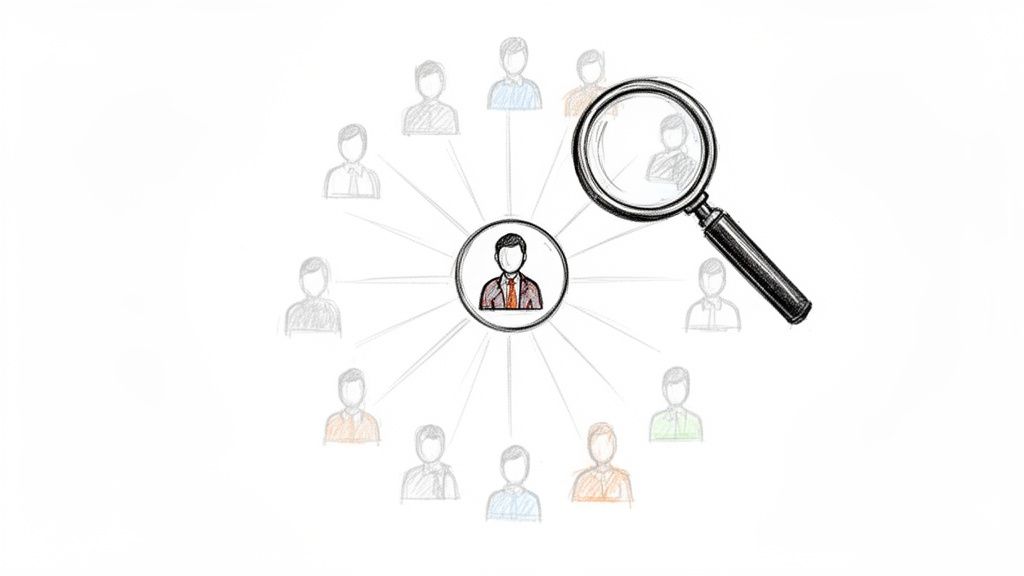
Lookalike and Similar Audience targeting is a powerful strategy that leverages your existing customer data to find new prospects. Instead of guessing who your next customer might be, this approach uses platform algorithms (like those on Facebook or Google) to analyze the traits, interests, and behaviors of your best customers and then finds other users who share those same characteristics. It’s like creating a digital clone of your ideal client profile.
This method allows home service businesses to expand their reach beyond initial targeting parameters, connecting with a highly relevant audience that is statistically more likely to convert. By using a "seed" audience of your most valuable customers, you ensure that your advertising budget is spent reaching people who mirror the exact profile of someone who has already hired and paid you.
Why It's a Foundational Strategy
This approach moves beyond basic demographics and taps into nuanced behavioral patterns, making it one of the most effective targeting strategies in marketing for scalable growth. For a plumbing company, instead of just targeting "homeowners," you can target people who behave like your highest-value customers who previously booked emergency repairs or full system replacements. This automates audience discovery and significantly improves ad relevance and efficiency.
It bridges the gap between your known audience and the vast, unknown market, providing a data-driven path to acquiring new, high-quality leads. This strategy is essential for businesses looking to grow their customer base without sacrificing lead quality.
Actionable Implementation Steps
- Create a High-Value Seed Audience: Upload a customer list to your ad platform, but don't use everyone. Start with a list of your top 20% of customers by lifetime value or job profitability to create the most potent lookalike source.
- Test Different Audience Sizes: Platforms like Facebook/Meta allow you to create lookalike audiences at different similarity percentages (e.g., 1%, 2-5%, 6-10%). A 1% audience is the most similar but smallest, while a 10% audience is broader. Test different tiers to find the right balance between reach and relevance.
- Layer with Other Targeting: Don't rely solely on the lookalike audience. Layer it with geographic targeting to ensure you’re only reaching prospects within your service area. For example, run a 1% lookalike audience targeted only to specific, high-income zip codes you serve.
Connecting to Your Workflow: A lead from a lookalike audience is highly qualified but still needs a swift, professional response to convert. When these prospects call, Phone Staffer’s agents can treat them as high-priority inquiries. By understanding the lead source, they can tailor their script to build confidence and move the prospect quickly toward a scheduled appointment, capitalizing on the high intent generated by your sophisticated targeting.
9. Niche and Vertical-Specific Targeting
Niche and vertical-specific targeting refines your marketing by focusing on highly specialized segments within the broader residential or commercial market. Instead of advertising to all property owners, this strategy concentrates on specific verticals like property management companies, HOA-managed communities, luxury estates, or historic homes. This allows you to tailor your messaging, services, and value propositions with extreme precision.
This approach is powerful for home service businesses looking to establish themselves as the go-to experts for a particular type of client. A roofer specializing in large-scale commercial buildings or a plumber renowned for working on century-old piping systems can command higher prices and face less competition by becoming the authority in that specific niche.
Why It's a Foundational Strategy
General marketing can get lost in the noise. Niche and vertical-specific targeting is one of the most effective targeting strategies in marketing because it carves out a defensible market position. You are no longer just "a plumber"; you are "the plumber for historic home preservation." This specialization builds immense trust, generates high-quality referrals, and often leads to more profitable, multi-property contracts.
This focus allows you to address the unique pain points of a specific audience. A property manager has different needs (e.g., budget predictability, tenant satisfaction) than an individual luxury homeowner (e.g., premium materials, aesthetic perfection), and your marketing must reflect that understanding.
Actionable Implementation Steps
- Develop Specialized Service Packages: Create service offerings tailored to your niche. For example, a landscaper targeting HOAs could offer a "Community Beautification & Compliance Package" that includes regular maintenance, seasonal plantings, and common area upkeep.
- Create Niche-Specific Content: Build case studies, blog posts, and landing pages that speak directly to your target vertical. A portfolio showcasing successful projects for luxury real estate agents is far more compelling to that audience than a generic gallery.
- Build Strategic Partnerships: Identify and network with the gatekeepers of your chosen niche. This could mean connecting with property managers, HOA board members, or high-end real estate agents who can provide a steady stream of qualified leads.
Connecting to Your Workflow: When a lead from a target vertical calls, your intake process must reinforce your expertise. Equip your call handlers, such as the team at Phone Staffer, with scripts and FAQs specific to each niche. They should be trained to use the right terminology, understand vertical-specific pain points, and effectively communicate how your specialized services provide the perfect solution.
10. Multi-Channel Integrated Targeting
Multi-channel integrated targeting coordinates your marketing efforts across various platforms like search ads, social media, email, and SMS to create a seamless customer journey. This approach ensures your message remains consistent while reaching prospects on their preferred channels. Instead of treating each platform as a separate silo, you weave them together to amplify your message and guide a potential customer from initial awareness to a booked appointment.
For a home service business, this means a homeowner might see your Facebook ad for a new AC unit, click to your website, and later receive a follow-up email with a special offer. This cohesive experience builds trust and keeps your brand top-of-mind, making it one of the most effective targeting strategies in marketing for nurturing leads through the decision-making process.
Why It's a Cohesive Strategy
Customers rarely make a decision after a single interaction. They research, compare, and engage with brands across multiple touchpoints. A multi-channel strategy meets them wherever they are, reinforcing your value proposition at each step. This integration prevents your message from getting lost and ensures that your investment in one channel (like Google Ads) supports and enhances the performance of another (like email marketing).
By mapping the customer journey, you can strategically deploy different channels at different stages. A search ad can capture initial intent, social media can build brand familiarity, and a timely email or SMS can push a hesitant lead to finally book the job, creating a powerful, full-funnel marketing machine.
Actionable Implementation Steps
- Map the Customer Journey: Outline the typical steps a customer takes from discovering a need (e.g., a leaky pipe) to booking your service. Identify which channels are most effective at each stage.
- Create Consistent Messaging: Ensure your branding, offers, and core value proposition are identical across all platforms. An offer mentioned in a Facebook ad should be clearly visible on the corresponding landing page.
- Integrate Your CRM: Use a Customer Relationship Management (CRM) system to track interactions across all channels. This allows you to see the complete history of a lead and trigger the next step, like an automated email follow-up after a website visit.
Connecting to Your Workflow: Multi-channel efforts often culminate in a phone call. When a lead from an integrated campaign calls in, Phone Staffer’s agents can access their interaction history via your CRM. Knowing the lead received an email about a specific "10% off water heater installation" offer allows the agent to provide a highly contextual and effective closing experience, converting a warm lead into a scheduled appointment.
10-Point Targeting Strategies Comparison
| Targeting Strategy | 🔄 Implementation Complexity | ⚡ Resource Needs | ⭐ Expected Outcomes | 📊 Ideal Use Cases | 💡 Key Advantages / Tips |
|---|---|---|---|---|---|
| Geographic / Local Targeting | Low–Medium — simple location rules and listings | Medium — local ads, GMB, mapping | ⭐⭐⭐⭐ — strong local conversions | Single-location services, franchise territories, immediate service calls | Use Google My Business, service-area pages, location call tracking |
| Demographic Targeting | Medium — data integration and segmentation | Medium–High — income, homeownership data sources | ⭐⭐⭐⭐ — targets high-value households | Remodels, roofing, services for homeowners by income/age | Cross-reference homeownership records, focus spend on top-converting segments |
| Behavioral Targeting | High — tracking, analytics, remarketing setup | High — tracking pixels, analytics, retargeting stacks | ⭐⭐⭐⭐ — high conversion from intent signals | Retargeting site visitors, searchers for urgent services | Implement conversion tracking, build remarketing audiences, prioritize warm leads |
| Psychographic Targeting | High — research, persona building, creative messaging | Medium–High — surveys, analytics, creative resources | ⭐⭐⭐ — builds loyalty and premium positioning over time | Premium services, eco-conscious or status-driven customers | Survey customers, develop value-based personas, train CSRs on emotional triggers |
| Intent-Based Targeting | Medium–High — real-time capture and rapid response | Medium — lead capture, instant follow-up systems | ⭐⭐⭐⭐⭐ — highest conversion when acted on quickly | Emergency repairs, quote requests, time-sensitive bookings | Implement rapid response workflows, use call extensions, immediately call intent leads |
| Account-Based Marketing (ABM) | Very High — bespoke campaigns per account | Very High — dedicated teams, custom assets | ⭐⭐⭐⭐ — high deal value and long-term contracts | Commercial accounts, property managers, multi-unit clients | Identify top accounts, create dedicated teams, use personalized proposals |
| Seasonal & Contextual Targeting | Medium — forecasting and trigger setup | Medium — weather APIs, scheduling, flexible budgets | ⭐⭐⭐⭐ — excellent ROI during peaks | HVAC in temperature extremes, roofing after storms, landscaping seasonally | Map historical demand, create seasonal templates, set weather-triggered campaigns |
| Lookalike / Similar Audience Targeting | Medium — data prep and platform setup | Medium — quality customer data and platform access | ⭐⭐⭐⭐ — efficient scalable acquisition | Scaling customer acquisition based on best customers | Seed with top customers, test similarity tiers, refresh seed lists regularly |
| Niche / Vertical-Specific Targeting | Medium–High — specialized messaging and expertise | Medium — vertical knowledge, partnerships | ⭐⭐⭐⭐ — strong positioning and referral growth | Commercial properties, HOAs, luxury estates, historic homes | Research niche pain points, build case studies, train CSRs on niche language |
| Multi-Channel Integrated Targeting | Very High — coordination across channels and attribution | Very High — integrated tech stack, CRM, analytics | ⭐⭐⭐⭐⭐ — highest lifetime impact when done well | Complex journeys, longer sales cycles, nurturing workflows | Map the full journey, ensure consistent messaging, use Phone Staffer as final conversion touchpoint |
Integrating Your Strategy: From Clicks to Booked Appointments
Navigating the landscape of modern marketing requires more than just a loud voice; it demands precision. Throughout this guide, we have explored ten distinct yet interconnected targeting strategies in marketing designed to help your home service business cut through the noise and connect directly with your ideal customers. From the foundational precision of geographic and demographic targeting to the sophisticated nuances of behavioral, psychographic, and intent-based approaches, the goal remains the same: deliver the right message to the right person at the right time.
We've seen how layering these strategies, such as combining seasonal promotions with lookalike audiences or integrating account-based marketing tactics for commercial clients, creates a powerful and resilient marketing engine. The key is to move beyond a one-size-fits-all mindset. Your business is unique, and your customers' needs are varied. A multi-channel, integrated approach ensures you meet them where they are, whether that’s a local Google search for "emergency plumber" or a proactive ad on Facebook for "spring HVAC tune-up."
From Theory to Tangible Results: Your Action Plan
Mastering these concepts is not an academic exercise; it's a direct path to a healthier bottom line. Effective targeting means less wasted ad spend, higher conversion rates, and a more predictable pipeline of high-quality leads. It transforms your marketing from a cost center into a reliable, revenue-generating machine.
To turn this knowledge into action, here are your immediate next steps:
- Audit Your Current Efforts: Review your existing campaigns. Which targeting strategies are you currently using? Where are the gaps? Start by identifying one or two new strategies from this list, like behavioral or intent-based targeting, to test in your next campaign.
- Refine Your Customer Personas: The success of any targeting strategy hinges on how well you know your audience. Revisit your customer personas. Are they detailed enough? Do they include psychographic and behavioral insights, or are they purely demographic?
- Map the Customer Journey: For each strategy, consider the full path from initial contact to a booked job. A lead generated from a hyper-local Google Ad has different immediate needs than one nurtured through a long-term remarketing campaign. Ensure your follow-up process is tailored to match that initial intent.
The Critical Handoff: Connecting Targeting to Conversion
Ultimately, the most brilliant targeting strategies in marketing will fail if the final, crucial step is fumbled. Generating a lead is only the beginning. When a homeowner, motivated by your perfectly targeted ad, picks up the phone, that interaction determines whether your marketing investment pays off or evaporates. A missed call, a long hold time, or an unprofessional greeting can instantly undo all your hard work.
This is the moment of truth where marketing precision must be met with operational excellence. Your ability to capture, qualify, and convert that inbound interest is what separates growing businesses from stagnant ones. By integrating your advanced targeting with a professional, responsive front line, you create an unbreakable chain from the first click to the final handshake. Don't let your marketing efforts generate demand you can't handle. Ensure the system is complete, so every qualified prospect becomes a scheduled, satisfied customer.
Ready to ensure no lead generated by your expert targeting falls through the cracks? Phone Staffer provides professional, US-based remote receptionists and cold callers who act as a seamless extension of your team, ensuring every call is answered and every opportunity is captured. Visit Phone Staffer to learn how you can convert more of your hard-won leads into booked appointments.